A military staff (often referred to as
General Staff, Army Staff, Navy Staff
or Air Staff within the individual
services) is a group of officers and
enlisted personnel that are
responsible for the administrative,
operational and logistical needs of
its unit. It provides bi-directional
flow of information between a
commanding officer and
subordinate military units. A staff
also provides an executive function
where it filters information needed
by the commander or shunts
unnecessary information.
One of the key purposes of a military staff is to
provide accurate, timely information (which
includes the results of contingency planning) on
which command decisions are based. A goal is
being able to suggest approaches or help produce
well-informed decisions that will effectively manage
and conserve unit resources.
Most NATO countries have adopted the continental
staff system (also known as the general staff system) in
structuring their militaries' staff functions. In this
system, which is based on one originally employed by
the French Army in the 19th century, each staff position
in a headquarters or unit is assigned a letter-prefix
corresponding to the formation's element and one or
more numbers specifying a role.
CONTINENTAL STAFF SYSTEM
The staff numbers are assigned according to custom not
hierarchy, traceable back to French practice; i.e., 1 is not
"higher ranking" than 2. This list reflects the SHAPE
structure:
1, for manpower or personnel
2, for intelligence and security
3, for operations
4, for logistics
5, for plans
6, for signal (i.e., communications)
7, for training (also the Joint Engineer)
8, for finance and contracts. Also known as "resource
management".
9, for Civil-Military Co-operation (CIMIC) or 'civil affairs'.
Derived from the Prussian Große Generalstab (Great
General Staff), traditionally these staff functions were
prefixed by the simple "G", which is retained in place for
modern army usage. But the increasing complexity of
modern armies, not to speak of the spread of the "Staff"
concept to naval and other elements, has demanded the
addition of new prefixes. These element prefixes are:
A, for Air Force headquarters;
C, for combined headquarters (multiple nations)
headquarters;
F, for certain forward or deployable headquarters;
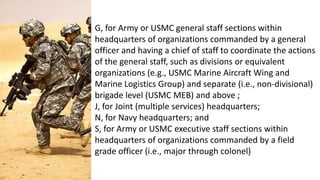
G, for Army or USMC general staff sections within
headquarters of organizations commanded by a general
officer and having a chief of staff to coordinate the actions
of the general staff, such as divisions or equivalent
organizations (e.g., USMC Marine Aircraft Wing and
Marine Logistics Group) and separate (i.e., non-divisional)
brigade level (USMC MEB) and above ;
J, for Joint (multiple services) headquarters;
N, for Navy headquarters; and
S, for Army or USMC executive staff sections within
headquarters of organizations commanded by a field
grade officer (i.e., major through colonel)
MANPOWER AND PERSONNEL
The manpower or personnel officer supervises personnel
and administration systems. This department functions as
the essential administrative liaison between the
subordinate units and the headquarters, handling
personnel actions coming from the bottom up (such as a
request for an award be given to a particular soldier) or
from the top down (such as orders being received from the
army level directing a particular soldier be reassigned to a
new unit outside the command).
INTELLIGENCE
The intelligence section is responsible for
collecting and analyzing intelligence information
about the enemy to determine what the enemy is doing,
or might do, to prevent the accomplishment of the unit's
mission. This office may also control maps and
geographical information systems and data. At the unit
level, the S2 is the unit's security officer, and the S2 section
manages all security clearance issues for the unit's
personnel.
OPERATIONS
The operations office, which may include
plans and training. The operations office
plans and coordinates operations, and all things
necessary to enable the formation to operate and
accomplish its mission. In most units, the operations
office is the largest of the staff sections and considered
the most important.
LOGISTICS
The logistics office is responsible for managing
the wide scope of materiel, transport, facilities,
services and medical/health support:
Design, development, acquisition, storage, distribution,
maintenance, evacuation, and disposition of materiel.
Transport of personnel and materiel.
Acquisition or construction, maintenance, operation, and
disposition of facilities.
Acquisition or furnishing of services.
Medical and health service support.
PLAN AND STRATEGY
The plans & strategy office is responsible for civil
military operations (CMO) strategy planning.
At the unit level, the S5 is the primary adviser to the
Commander on the civilian-to-military and military-to-
civilian impact of the mission/operation within the Host
Nation's (HN) Area of Interest (AOI), Area of Operations
(AO) or the Target area of Interest (TAOI). The G5 serves
as the Mission Support Office (MSO) at the Division
level and HHC for civil military plans and strategy.
ARMY
An army (from Latin arma "arms, weapons"
via Old French armée, "armed" [feminine])
or land force is a fighting force that fights primarily on land.
In the broadest sense, it is the land-based military branch,
service branch or armed service of a nation or state. It may also
include aviation assets by possessing an army aviation
component. In certain states, the term army refers to the entire
armed forces (e.g., People's Liberation Army). Within a national
military force, the word army may also mean a field army.
ARMY
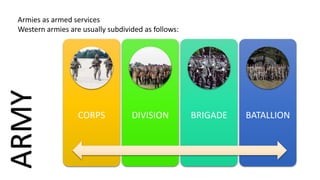
ARMYArmies as armed services
Western armies are usually subdivided as follows:
CORPS DIVISION BRIGADE BATALLION
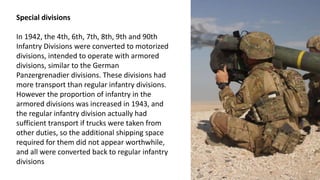
Special divisions
In 1942, the 4th, 6th, 7th, 8th, 9th and 90th
Infantry Divisions were converted to motorized
divisions, intended to operate with armored
divisions, similar to the German
Panzergrenadier divisions. These divisions had
more transport than regular infantry divisions.
However the proportion of infantry in the
armored divisions was increased in 1943, and
the regular infantry division actually had
sufficient transport if trucks were taken from
other duties, so the additional shipping space
required for them did not appear worthwhile,
and all were converted back to regular infantry
divisions
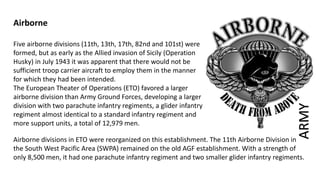
Airborne
Five airborne divisions (11th, 13th, 17th, 82nd and 101st) were
formed, but as early as the Allied invasion of Sicily (Operation
Husky) in July 1943 it was apparent that there would not be
sufficient troop carrier aircraft to employ them in the manner
for which they had been intended.
The European Theater of Operations (ETO) favored a larger
airborne division than Army Ground Forces, developing a larger
division with two parachute infantry regiments, a glider infantry
regiment almost identical to a standard infantry regiment and
more support units, a total of 12,979 men.
Airborne divisions in ETO were reorganized on this establishment. The 11th Airborne Division in
the South West Pacific Area (SWPA) remained on the old AGF establishment. With a strength of
only 8,500 men, it had one parachute infantry regiment and two smaller glider infantry regiments.
ARMY
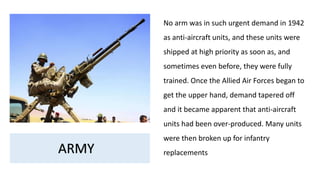
No arm was in such urgent demand in 1942
as anti-aircraft units, and these units were
shipped at high priority as soon as, and
sometimes even before, they were fully
trained. Once the Allied Air Forces began to
get the upper hand, demand tapered off
and it became apparent that anti-aircraft
units had been over-produced. Many units
were then broken up for infantry
replacementsARMY
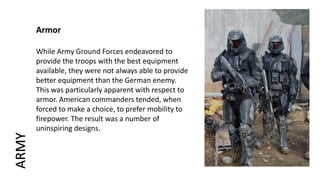
Armor
While Army Ground Forces endeavored to
provide the troops with the best equipment
available, they were not always able to provide
better equipment than the German enemy.
This was particularly apparent with respect to
armor. American commanders tended, when
forced to make a choice, to prefer mobility to
firepower. The result was a number of
uninspiring designs.
ARMY
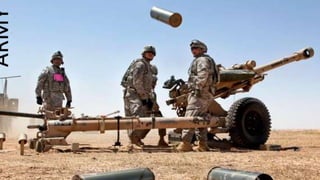
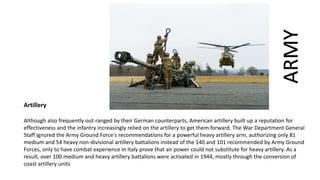
Artillery
Although also frequently out-ranged by their German counterparts, American artillery built up a reputation for
effectiveness and the infantry increasingly relied on the artillery to get them forward. The War Department General
Staff ignored the Army Ground Force's recommendations for a powerful heavy artillery arm, authorizing only 81
medium and 54 heavy non-divisional artillery battalions instead of the 140 and 101 recommended by Army Ground
Forces, only to have combat experience in Italy prove that air power could not substitute for heavy artillery. As a
result, over 100 medium and heavy artillery battalions were activated in 1944, mostly through the conversion of
coast artillery units
ARMY
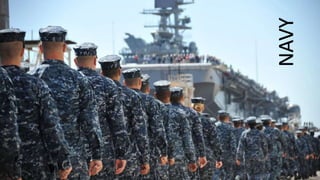
NAVY
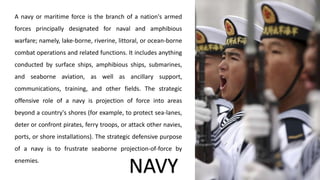
A navy or maritime force is the branch of a nation's armed
forces principally designated for naval and amphibious
warfare; namely, lake-borne, riverine, littoral, or ocean-borne
combat operations and related functions. It includes anything
conducted by surface ships, amphibious ships, submarines,
and seaborne aviation, as well as ancillary support,
communications, training, and other fields. The strategic
offensive role of a navy is projection of force into areas
beyond a country's shores (for example, to protect sea-lanes,
deter or confront pirates, ferry troops, or attack other navies,
ports, or shore installations). The strategic defensive purpose
of a navy is to frustrate seaborne projection-of-force by
enemies.
NAVY
Ships
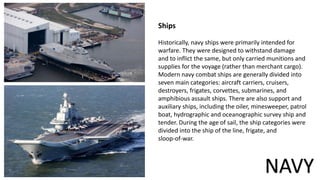
Historically, navy ships were primarily intended for
warfare. They were designed to withstand damage
and to inflict the same, but only carried munitions and
supplies for the voyage (rather than merchant cargo).
Modern navy combat ships are generally divided into
seven main categories: aircraft carriers, cruisers,
destroyers, frigates, corvettes, submarines, and
amphibious assault ships. There are also support and
auxiliary ships, including the oiler, minesweeper, patrol
boat, hydrographic and oceanographic survey ship and
tender. During the age of sail, the ship categories were
divided into the ship of the line, frigate, and
sloop-of-war.
NAVY
Boats
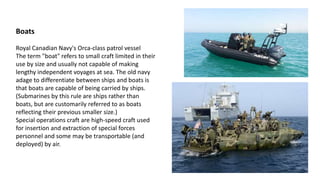
Royal Canadian Navy's Orca-class patrol vessel
The term "boat" refers to small craft limited in their
use by size and usually not capable of making
lengthy independent voyages at sea. The old navy
adage to differentiate between ships and boats is
that boats are capable of being carried by ships.
(Submarines by this rule are ships rather than
boats, but are customarily referred to as boats
reflecting their previous smaller size.)
Special operations craft are high-speed craft used
for insertion and extraction of special forces
personnel and some may be transportable (and
deployed) by air.
Units
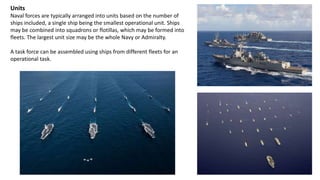
Naval forces are typically arranged into units based on the number of
ships included, a single ship being the smallest operational unit. Ships
may be combined into squadrons or flotillas, which may be formed into
fleets. The largest unit size may be the whole Navy or Admiralty.
A task force can be assembled using ships from different fleets for an
operational task.
Naval infantry
MARINES
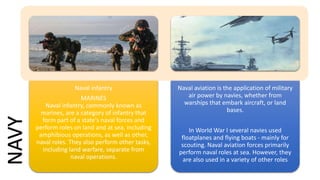
Naval infantry, commonly known as
marines, are a category of infantry that
form part of a state's naval forces and
perform roles on land and at sea, including
amphibious operations, as well as other,
naval roles. They also perform other tasks,
including land warfare, separate from
naval operations.
Naval aviation is the application of military
air power by navies, whether from
warships that embark aircraft, or land
bases.
In World War I several navies used
floatplanes and flying boats - mainly for
scouting. Naval aviation forces primarily
perform naval roles at sea. However, they
are also used in a variety of other roles
NAVY
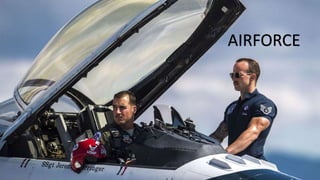
AIRFORCE
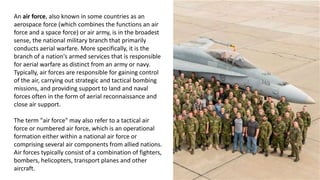
An air force, also known in some countries as an
aerospace force (which combines the functions an air
force and a space force) or air army, is in the broadest
sense, the national military branch that primarily
conducts aerial warfare. More specifically, it is the
branch of a nation's armed services that is responsible
for aerial warfare as distinct from an army or navy.
Typically, air forces are responsible for gaining control
of the air, carrying out strategic and tactical bombing
missions, and providing support to land and naval
forces often in the form of aerial reconnaissance and
close air support.
The term "air force" may also refer to a tactical air
force or numbered air force, which is an operational
formation either within a national air force or
comprising several air components from allied nations.
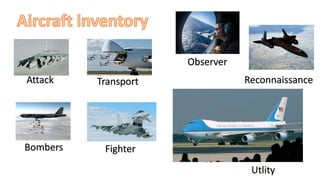
Air forces typically consist of a combination of fighters,
bombers, helicopters, transport planes and other
aircraft.
Attack
Bombers
Transport
Fighter
Observer
Reconnaissance
Utlity
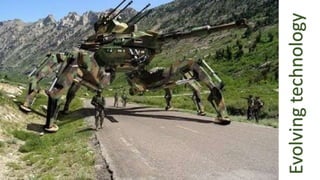
Evolvingtechnology
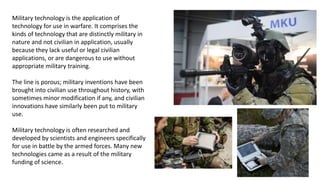
Military technology is the application of
technology for use in warfare. It comprises the
kinds of technology that are distinctly military in
nature and not civilian in application, usually
because they lack useful or legal civilian
applications, or are dangerous to use without
appropriate military training.
The line is porous; military inventions have been
brought into civilian use throughout history, with
sometimes minor modification if any, and civilian
innovations have similarly been put to military
use.
Military technology is often researched and
developed by scientists and engineers specifically
for use in battle by the armed forces. Many new
technologies came as a result of the military
funding of science.
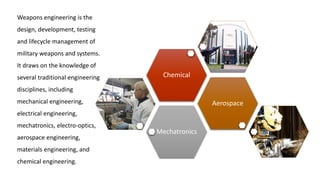
Weapons engineering is the
design, development, testing
and lifecycle management of
military weapons and systems.
It draws on the knowledge of
several traditional engineering
disciplines, including
mechanical engineering,
electrical engineering,
mechatronics, electro-optics,
aerospace engineering,
materials engineering, and
chemical engineering.
Mechatronics
Aerospace
Chemical
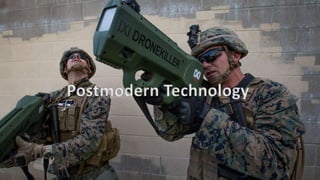
Postmodern Technology
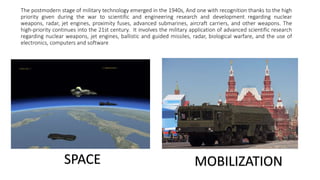
The postmodern stage of military technology emerged in the 1940s, And one with recognition thanks to the high
priority given during the war to scientific and engineering research and development regarding nuclear
weapons, radar, jet engines, proximity fuses, advanced submarines, aircraft carriers, and other weapons. The
high-priority continues into the 21st century. It involves the military application of advanced scientific research
regarding nuclear weapons, jet engines, ballistic and guided missiles, radar, biological warfare, and the use of
electronics, computers and software
SPACE MOBILIZATION

Military Forces descriptions

  • 1.
    A military staff(often referred to as General Staff, Army Staff, Navy Staff or Air Staff within the individual services) is a group of officers and enlisted personnel that are responsible for the administrative, operational and logistical needs of its unit. It provides bi-directional flow of information between a commanding officer and subordinate military units. A staff also provides an executive function where it filters information needed by the commander or shunts unnecessary information.
  • 2.
    One of thekey purposes of a military staff is to provide accurate, timely information (which includes the results of contingency planning) on which command decisions are based. A goal is being able to suggest approaches or help produce well-informed decisions that will effectively manage and conserve unit resources.
  • 3.
    Most NATO countrieshave adopted the continental staff system (also known as the general staff system) in structuring their militaries' staff functions. In this system, which is based on one originally employed by the French Army in the 19th century, each staff position in a headquarters or unit is assigned a letter-prefix corresponding to the formation's element and one or more numbers specifying a role. CONTINENTAL STAFF SYSTEM
  • 4.
    The staff numbersare assigned according to custom not hierarchy, traceable back to French practice; i.e., 1 is not "higher ranking" than 2. This list reflects the SHAPE structure: 1, for manpower or personnel 2, for intelligence and security 3, for operations 4, for logistics 5, for plans 6, for signal (i.e., communications) 7, for training (also the Joint Engineer) 8, for finance and contracts. Also known as "resource management". 9, for Civil-Military Co-operation (CIMIC) or 'civil affairs'.
  • 5.
    Derived from thePrussian Große Generalstab (Great General Staff), traditionally these staff functions were prefixed by the simple "G", which is retained in place for modern army usage. But the increasing complexity of modern armies, not to speak of the spread of the "Staff" concept to naval and other elements, has demanded the addition of new prefixes. These element prefixes are: A, for Air Force headquarters; C, for combined headquarters (multiple nations) headquarters; F, for certain forward or deployable headquarters;
  • 6.
    G, for Armyor USMC general staff sections within headquarters of organizations commanded by a general officer and having a chief of staff to coordinate the actions of the general staff, such as divisions or equivalent organizations (e.g., USMC Marine Aircraft Wing and Marine Logistics Group) and separate (i.e., non-divisional) brigade level (USMC MEB) and above ; J, for Joint (multiple services) headquarters; N, for Navy headquarters; and S, for Army or USMC executive staff sections within headquarters of organizations commanded by a field grade officer (i.e., major through colonel)
  • 7.
    MANPOWER AND PERSONNEL Themanpower or personnel officer supervises personnel and administration systems. This department functions as the essential administrative liaison between the subordinate units and the headquarters, handling personnel actions coming from the bottom up (such as a request for an award be given to a particular soldier) or from the top down (such as orders being received from the army level directing a particular soldier be reassigned to a new unit outside the command).
  • 8.
    INTELLIGENCE The intelligence sectionis responsible for collecting and analyzing intelligence information about the enemy to determine what the enemy is doing, or might do, to prevent the accomplishment of the unit's mission. This office may also control maps and geographical information systems and data. At the unit level, the S2 is the unit's security officer, and the S2 section manages all security clearance issues for the unit's personnel.
  • 9.
    OPERATIONS The operations office,which may include plans and training. The operations office plans and coordinates operations, and all things necessary to enable the formation to operate and accomplish its mission. In most units, the operations office is the largest of the staff sections and considered the most important.
  • 10.
    LOGISTICS The logistics officeis responsible for managing the wide scope of materiel, transport, facilities, services and medical/health support: Design, development, acquisition, storage, distribution, maintenance, evacuation, and disposition of materiel. Transport of personnel and materiel. Acquisition or construction, maintenance, operation, and disposition of facilities. Acquisition or furnishing of services. Medical and health service support.
  • 11.
    PLAN AND STRATEGY Theplans & strategy office is responsible for civil military operations (CMO) strategy planning. At the unit level, the S5 is the primary adviser to the Commander on the civilian-to-military and military-to- civilian impact of the mission/operation within the Host Nation's (HN) Area of Interest (AOI), Area of Operations (AO) or the Target area of Interest (TAOI). The G5 serves as the Mission Support Office (MSO) at the Division level and HHC for civil military plans and strategy.
  • 13.
  • 14.
    An army (fromLatin arma "arms, weapons" via Old French armée, "armed" [feminine]) or land force is a fighting force that fights primarily on land. In the broadest sense, it is the land-based military branch, service branch or armed service of a nation or state. It may also include aviation assets by possessing an army aviation component. In certain states, the term army refers to the entire armed forces (e.g., People's Liberation Army). Within a national military force, the word army may also mean a field army. ARMY
  • 15.
    ARMYArmies as armedservices Western armies are usually subdivided as follows: CORPS DIVISION BRIGADE BATALLION
  • 16.
    Special divisions In 1942,the 4th, 6th, 7th, 8th, 9th and 90th Infantry Divisions were converted to motorized divisions, intended to operate with armored divisions, similar to the German Panzergrenadier divisions. These divisions had more transport than regular infantry divisions. However the proportion of infantry in the armored divisions was increased in 1943, and the regular infantry division actually had sufficient transport if trucks were taken from other duties, so the additional shipping space required for them did not appear worthwhile, and all were converted back to regular infantry divisions
  • 17.
    Airborne Five airborne divisions(11th, 13th, 17th, 82nd and 101st) were formed, but as early as the Allied invasion of Sicily (Operation Husky) in July 1943 it was apparent that there would not be sufficient troop carrier aircraft to employ them in the manner for which they had been intended. The European Theater of Operations (ETO) favored a larger airborne division than Army Ground Forces, developing a larger division with two parachute infantry regiments, a glider infantry regiment almost identical to a standard infantry regiment and more support units, a total of 12,979 men. Airborne divisions in ETO were reorganized on this establishment. The 11th Airborne Division in the South West Pacific Area (SWPA) remained on the old AGF establishment. With a strength of only 8,500 men, it had one parachute infantry regiment and two smaller glider infantry regiments. ARMY
  • 18.
    No arm wasin such urgent demand in 1942 as anti-aircraft units, and these units were shipped at high priority as soon as, and sometimes even before, they were fully trained. Once the Allied Air Forces began to get the upper hand, demand tapered off and it became apparent that anti-aircraft units had been over-produced. Many units were then broken up for infantry replacementsARMY
  • 19.
    Armor While Army GroundForces endeavored to provide the troops with the best equipment available, they were not always able to provide better equipment than the German enemy. This was particularly apparent with respect to armor. American commanders tended, when forced to make a choice, to prefer mobility to firepower. The result was a number of uninspiring designs. ARMY
  • 20.
    Artillery Although also frequentlyout-ranged by their German counterparts, American artillery built up a reputation for effectiveness and the infantry increasingly relied on the artillery to get them forward. The War Department General Staff ignored the Army Ground Force's recommendations for a powerful heavy artillery arm, authorizing only 81 medium and 54 heavy non-divisional artillery battalions instead of the 140 and 101 recommended by Army Ground Forces, only to have combat experience in Italy prove that air power could not substitute for heavy artillery. As a result, over 100 medium and heavy artillery battalions were activated in 1944, mostly through the conversion of coast artillery units ARMY
  • 21.
  • 22.
    A navy ormaritime force is the branch of a nation's armed forces principally designated for naval and amphibious warfare; namely, lake-borne, riverine, littoral, or ocean-borne combat operations and related functions. It includes anything conducted by surface ships, amphibious ships, submarines, and seaborne aviation, as well as ancillary support, communications, training, and other fields. The strategic offensive role of a navy is projection of force into areas beyond a country's shores (for example, to protect sea-lanes, deter or confront pirates, ferry troops, or attack other navies, ports, or shore installations). The strategic defensive purpose of a navy is to frustrate seaborne projection-of-force by enemies. NAVY
  • 23.
    Ships Historically, navy shipswere primarily intended for warfare. They were designed to withstand damage and to inflict the same, but only carried munitions and supplies for the voyage (rather than merchant cargo). Modern navy combat ships are generally divided into seven main categories: aircraft carriers, cruisers, destroyers, frigates, corvettes, submarines, and amphibious assault ships. There are also support and auxiliary ships, including the oiler, minesweeper, patrol boat, hydrographic and oceanographic survey ship and tender. During the age of sail, the ship categories were divided into the ship of the line, frigate, and sloop-of-war. NAVY
  • 24.
    Boats Royal Canadian Navy'sOrca-class patrol vessel The term "boat" refers to small craft limited in their use by size and usually not capable of making lengthy independent voyages at sea. The old navy adage to differentiate between ships and boats is that boats are capable of being carried by ships. (Submarines by this rule are ships rather than boats, but are customarily referred to as boats reflecting their previous smaller size.) Special operations craft are high-speed craft used for insertion and extraction of special forces personnel and some may be transportable (and deployed) by air.
  • 25.
    Units Naval forces aretypically arranged into units based on the number of ships included, a single ship being the smallest operational unit. Ships may be combined into squadrons or flotillas, which may be formed into fleets. The largest unit size may be the whole Navy or Admiralty. A task force can be assembled using ships from different fleets for an operational task.
  • 26.
    Naval infantry MARINES Naval infantry,commonly known as marines, are a category of infantry that form part of a state's naval forces and perform roles on land and at sea, including amphibious operations, as well as other, naval roles. They also perform other tasks, including land warfare, separate from naval operations. Naval aviation is the application of military air power by navies, whether from warships that embark aircraft, or land bases. In World War I several navies used floatplanes and flying boats - mainly for scouting. Naval aviation forces primarily perform naval roles at sea. However, they are also used in a variety of other roles NAVY
  • 27.
  • 28.
    An air force,also known in some countries as an aerospace force (which combines the functions an air force and a space force) or air army, is in the broadest sense, the national military branch that primarily conducts aerial warfare. More specifically, it is the branch of a nation's armed services that is responsible for aerial warfare as distinct from an army or navy. Typically, air forces are responsible for gaining control of the air, carrying out strategic and tactical bombing missions, and providing support to land and naval forces often in the form of aerial reconnaissance and close air support. The term "air force" may also refer to a tactical air force or numbered air force, which is an operational formation either within a national air force or comprising several air components from allied nations. Air forces typically consist of a combination of fighters, bombers, helicopters, transport planes and other aircraft.
  • 29.
  • 30.
  • 31.
    Military technology isthe application of technology for use in warfare. It comprises the kinds of technology that are distinctly military in nature and not civilian in application, usually because they lack useful or legal civilian applications, or are dangerous to use without appropriate military training. The line is porous; military inventions have been brought into civilian use throughout history, with sometimes minor modification if any, and civilian innovations have similarly been put to military use. Military technology is often researched and developed by scientists and engineers specifically for use in battle by the armed forces. Many new technologies came as a result of the military funding of science.
  • 32.
    Weapons engineering isthe design, development, testing and lifecycle management of military weapons and systems. It draws on the knowledge of several traditional engineering disciplines, including mechanical engineering, electrical engineering, mechatronics, electro-optics, aerospace engineering, materials engineering, and chemical engineering. Mechatronics Aerospace Chemical
  • 33.
  • 34.
    The postmodern stageof military technology emerged in the 1940s, And one with recognition thanks to the high priority given during the war to scientific and engineering research and development regarding nuclear weapons, radar, jet engines, proximity fuses, advanced submarines, aircraft carriers, and other weapons. The high-priority continues into the 21st century. It involves the military application of advanced scientific research regarding nuclear weapons, jet engines, ballistic and guided missiles, radar, biological warfare, and the use of electronics, computers and software SPACE MOBILIZATION