MILITARY DECISION MAKING PROCESS
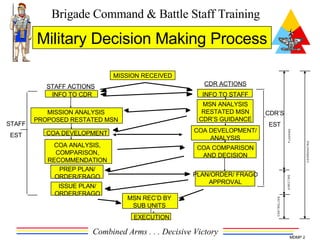
Military Decision Making Process MISSION RECEIVED STAFF ACTIONS INFO TO CDR STAFF EST MISSION ANALYSIS PROPOSED RESTATED MSN COA DEVELOPMENT COA ANALYSIS, COMPARISON, RECOMMENDATION PREP PLAN/ ORDER/FRAGO ISSUE PLAN/ ORDER/FRAGO MSN REC’D BY SUB UNITS EXECUTION CDR ACTIONS INFO TO STAFF MSN ANALYSIS RESTATED MSN CDR’S GUIDANCE COA DEVELOPMENT/ ANALYSIS COA COMPARISON AND DECISION PLAN/ORDER/ FRAGO APPROVAL CDR’S EST
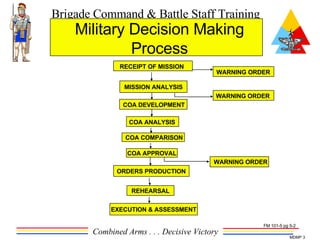
Military Decision Making Process WARNING ORDER WARNING ORDER WARNING ORDER EXECUTION & ASSESSMENT COA DEVELOPMENT COA ANALYSIS RECEIPT OF MISSION  MISSION ANALYSIS ORDERS PRODUCTION REHEARSAL COA APPROVAL COA COMPARISON FM 101-5 pg 5-2
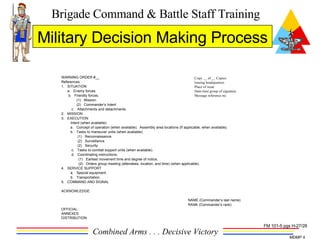
Military Decision Making Process  Copy __ of __ Copies Issuing headquarters Place of issue Date-time group of signature Message reference no. WARNING ORDER #__ References: 1.  SITUATION a.  Enemy forces. b.  Friendly forces. (1)  Mission (2)  Commander’s Intent c.  Attachments and detachments. 2.  MISSION 3.  EXECUTION Intent (when available). a.  Concept of operation (when available).  Assembly area locations (If applicable, when available). b.  Tasks to maneuver units (when available). (1)  Reconnaissance. (2)  Surveillance (2)  Security c.  Tasks to combat support units (when available). d.  Coordinating instructions. (1)  Earliest movement time and degree of notice. (2)  Orders group meeting (attendees, location, and time) (when applicable). 4.  SERVICE SUPPORT a.  Special equipment. b.  Transportation. 5.  COMMAND AND SIGNAL ACKNOWLEDGE: NAME (Commander’s last name)  RANK (Commander’s rank) OFFICIAL: ANNEXES: DISTRIBUTION:  FM 101-5 pgs H-27/28
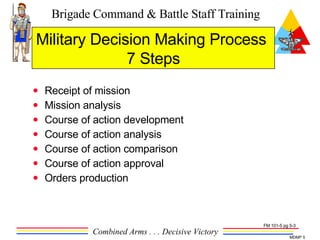
Receipt of mission Mission analysis Course of action development Course of action analysis Course of action comparison Course of action approval Orders production Military Decision Making Process  7 Steps FM 101-5 pg 5-3
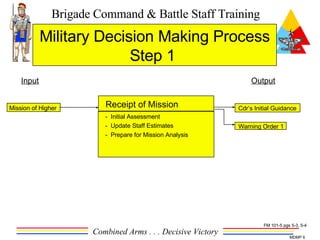
Military Decision Making Process Step 1  Output Input Mission of Higher Cdr’s Initial Guidance Warning Order 1 Receipt of Mission -  Initial Assessment -  Update Staff Estimates -  Prepare for Mission Analysis FM 101-5 pgs 5-3, 5-4
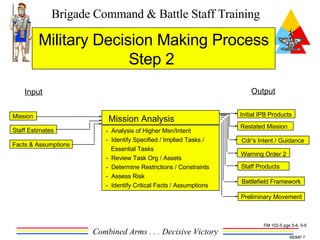
Military Decision Making Process Step 2  Cdr’s Intent / Guidance Output Input Mission Staff Estimates Mission Analysis -  Analysis of Higher Msn/Intent -  Identify Specified / Implied Tasks /  Essential Tasks  -  Review Task Org / Assets -  Determine Restrictions / Constraints -  Assess Risk -  Identify Critical Facts / Assumptions Initial IPB Products Restated Mission Staff Products Warning Order 2 Battlefield Framework Preliminary Movement FM 102-5 pgs 5-4, 5-5 Facts & Assumptions
The commander’s intent is a clear, concise statement of what the force must do to succeed with respect to the enemy and the terrain, and the desired end state.  It provides the link between the mission and the concept of operations by stating the key tasks that, along with the mission, are the basis for subordinates to exercise initiative when unanticipated opportunities arise or when the original concept of operations no longer applies.  Intent is normally expressed in four or five sentences and is mandatory for all orders.  The mission and the commander’s intent must be understood two echelons down.  Definition of  Commander’s Intent FM 101-5 pg 5-9
Commander’s intent statement should state the following: Key tasks End state Intent Statement FM 101-5 pg 5-9
Tasks that must be performed, or conditions that must be met, to achieve stated purpose of the operation Not tied to specific course of action, but fundamental to the force’s success Subordinates use these tasks to keep their efforts supporting the commander’s intent Examples Tempo Duration Terrain that must be controlled Effect on the enemy Key Tasks For  Commander’s Intent FM 101-5 pg 5-9
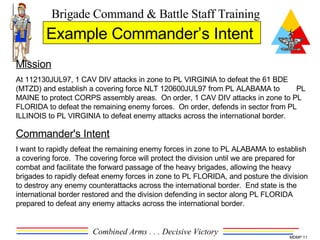
Mission At 112130JUL97, 1 CAV DIV attacks in zone to PL VIRGINIA to defeat the 61 BDE (MTZD) and establish a covering force NLT 120600JUL97 from PL ALABAMA to  PL MAINE to protect CORPS assembly areas.  On order, 1 CAV DIV attacks in zone to PL FLORIDA to defeat the remaining enemy forces.  On order, defends in sector from PL ILLINOIS to PL VIRGINIA to defeat enemy attacks across the international border. Commander's Intent I want to rapidly defeat the remaining enemy forces in zone to PL ALABAMA to establish a covering force.  The covering force will protect the division until we are prepared for combat and facilitate the forward passage of the heavy brigades, allowing the heavy brigades to rapidly defeat enemy forces in zone to PL FLORIDA, and posture the division to destroy any enemy counterattacks across the international border.  End state is the international border restored and the division defending in sector along PL FLORIDA prepared to defeat any enemy attacks across the international border. Example Commander’s Intent
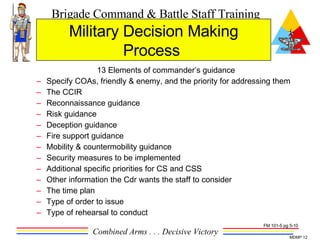
13 Elements of commander’s guidance Specify COAs, friendly & enemy, and the priority for addressing them The CCIR Reconnaissance guidance Risk guidance Deception guidance Fire support guidance Mobility & countermobility guidance Security measures to be implemented Additional specific priorities for CS and CSS Other information the Cdr wants the staff to consider The time plan Type of order to issue Type of rehearsal to conduct Military Decision Making Process  FM 101-5 pg 5-10
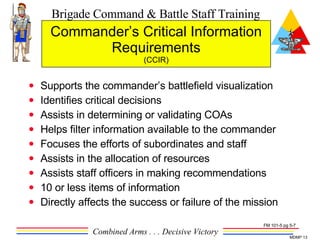
Commander’s Critical Information Requirements (CCIR) Supports the commander’s battlefield visualization Identifies critical decisions Assists in determining or validating COAs Helps filter information available to the commander Focuses the efforts of subordinates and staff Assists in the allocation of resources Assists staff officers in making recommendations 10 or less items of information Directly affects the success or failure of the mission FM 101-5 pg 5-7
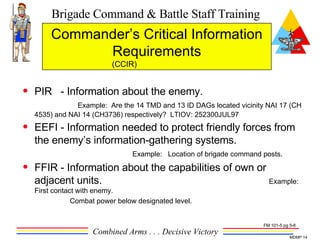
Commander’s Critical Information Requirements (CCIR)  PIR  - Information about the enemy.  Example:  Are the 14 TMD and 13 ID DAGs located vicinity NAI 17 (CH 4535) and NAI 14 (CH3736) respectively?  LTIOV: 252300JUL97  EEFI - Information needed to protect friendly forces from the enemy’s information-gathering systems.  Example:  Location of brigade command posts. FFIR - Information about the capabilities of own or adjacent units.  Example:  First contact with enemy. Combat power below designated level.  FM 101-5 pg 5-8
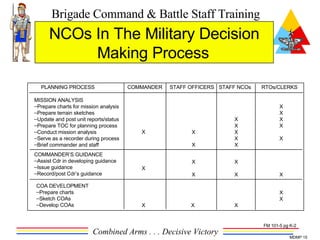
NCOs In The Military Decision Making Process   MISSION ANALYSIS Prepare charts for mission analysis Prepare terrain sketches Update and post unit reports/status Prepare TOC for planning process Conduct mission analysis Serve as a recorder during process Brief commander and staff COMMANDER’S GUIDANCE Assist Cdr in developing guidance Issue guidance Record/post Cdr’s guidance COA DEVELOPMENT Prepare charts Sketch COAs Develop COAs PLANNING PROCESS COMMANDER STAFF OFFICERS STAFF NCOs RTOs/CLERKS X X X X X X X X X X X X X X X X X X X X X X X X FM 101-5 pg K-2
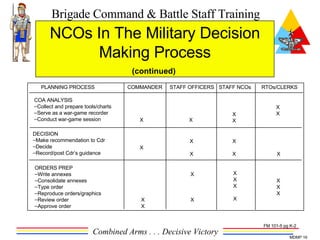
NCOs In The Military Decision Making Process (continued)  COA ANALYSIS Collect and prepare tools/charts Serve as a war-game recorder Conduct war-game session DECISION Make recommendation to Cdr Decide Record/post Cdr’s guidance ORDERS PREP Write annexes Consolidate annexes Type order Reproduce orders/graphics Review order Approve order PLANNING PROCESS COMMANDER STAFF OFFICERS STAFF NCOs RTOs/CLERKS X X X X X X X X X X X X X X X X X X X X X X  X FM 101-5 pg K-2
MILITARY DECISION MAKING PROCESS Workshop #2
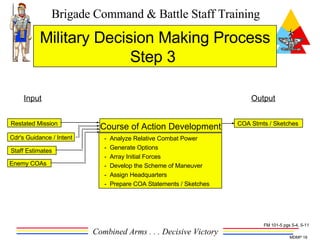
Military Decision Making Process Step 3  Restated Mission Cdr's Guidance / Intent Output Input Course of Action Development -  Analyze Relative Combat Power -  Generate Options -  Array Initial Forces -  Develop the Scheme of Maneuver -  Assign Headquarters -  Prepare COA Statements / Sketches COA Stmts / Sketches Enemy COAs  Staff Estimates FM 101-5 pgs 5-4, 5-11
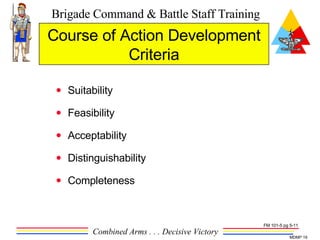
Suitability Feasibility Acceptability Distinguishability Completeness Course of Action Development Criteria FM 101-5 pg 5-11
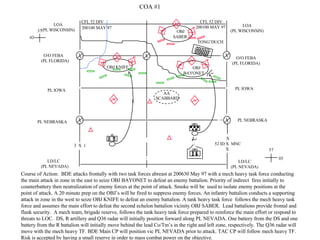
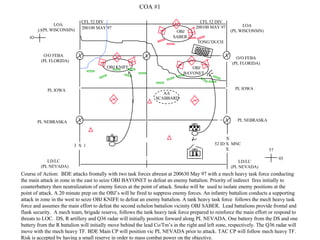
PL NEBRASKA 42 Course of Action:  BDE attacks frontally with two task forces abreast at 200630 May 97 with a mech heavy task force conducting the main attack in zone in the east to seize OBJ BAYONET to defeat an enemy battalion. Priority of indirect  fires initially to counterbattery then neutralization of enemy forces at the point of attack. Smoke will be  used to isolate enemy positions at the point of attack. A 20 minute prep on the OBJ’s will be fired to suppress enemy forces. An infantry battalion conducts a supporting attack in zone in the west to seize OBJ KNIFE to defeat an enemy battalion. A tank heavy task force  follows the mech heavy task force and assumes the main effort to defeat the second echelon battalion vicinity OBJ SABER.  Lead battalions provide frontal and flank security.  A mech team, brigade reserve, follows the tank heavy task force prepared to reinforce the main effort or respond to  threats to LOC.  DS, R artillery and Q36 radar will initially position forward along PL NEVADA. One battery from the DS and one  battery from the R battalion will initially move behind the lead Co/Tm’s in the right and left zone, respectively. The Q36 radar will  move with the mech heavy TF. BDE Main CP will position vic PL NEVADA prior to attack. TAC CP will follow mech heavy TF.  Risk is accepted by having a small reserve in order to mass combat power on the objective.  PL IOWA O/O FEBA (PL FLORIDA) OBJ KNIFE 3  X  1 LOA (PL WISCONSIN) 37 LOA (PL WISCONSIN) O/O FEBA (PL FLORIDA) PL IOWA PL NEBRASKA LD/LC (PL NEVADA) LD/LC (PL NEVADA) X 52 ID X  MNC X  AA SCABBARD OBJ BAYONET TONG’DUCH OBJ SABER COA #1 CFL 52 DIV CFL 52 DIV 200100 MAY 97 200100 MAY 97 03 57
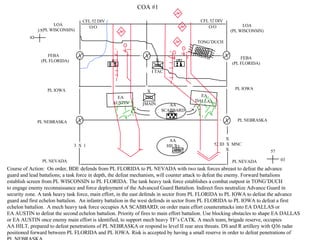
PL NEBRASKA Course of Action:  On order, BDE defends from PL FLORIDA to PL NEVADA with two task forces abreast to defeat the advance guard and lead battalions; a task force in depth, the defeat mechanism, will counter attack to defeat the enemy. Forward battalions establish screen from PL WISCONSIN to PL FLORIDA. The tank heavy task force establishes a combat outpost in TONG’DUCH  to engage enemy reconnaissance and force deployment of the Advanced Guard Battalion. Indirect fires neutralize Advance Guard in security zone. A tank heavy task force, main effort, in the east defends in sector from PL FLORIDA to PL IOWA to defeat the advance guard and first echelon battalion.  An infantry battalion in the west defends in sector from PL FLORIDA to PL IOWA to defeat a first echelon battalion.  A mech heavy task force occupies AA SCABBARD; on order main effort counterattacks into EA DALLAS or  EA AUSTIN to defeat the second echelon battalion. Priority of fires to main effort battalion. Use blocking obstacles to shape EA DALLAS or EA AUSTIN once enemy main effort is identified, to support mech heavy TF’s CATK. A mech team, brigade reserve, occupies  AA HILT, prepared to defeat penetrations of PL NEBRASKA or respond to level II rear area threats. DS and R artillery with Q36 radar positioned forward between PL FLORIDA and PL IOWA. Risk is accepted by having a small reserve in order to defeat penetrations of  PL NEBRASKA.  PL IOWA FEBA (PL FLORIDA) 37 42 PL NEVADA COA #1 3  X  1 LOA (PL WISCONSIN) LOA (PL WISCONSIN) FEBA (PL FLORIDA) PL IOWA PL NEBRASKA PL NEVADA TONG’DUCH AA HILT AA SCABBARD EA DALLAS EA AUSTIN X 52 ID  X  MNC X CFL 52 DIV O/O CFL 52 DIV O/O MAIN TAC 57 03 X X
PL NEBRASKA 42 Course of Action:  BDE attacks frontally with two task forces abreast at 200630 May 97 with a mech heavy task force conducting the main attack in zone in the east to seize OBJ BAYONET to defeat an enemy battalion. Priority of indirect  fires initially to counterbattery then neutralization of enemy forces at the point of attack. Smoke will be  used to isolate enemy positions at the point of attack. A 20 minute prep on the OBJ’s will be fired to suppress enemy forces. An infantry battalion conducts a supporting attack in zone in the west to seize OBJ KNIFE to defeat an enemy battalion. A tank heavy task force  follows the mech heavy task force and assumes the main effort to defeat the second echelon battalion vicinity OBJ SABER.  Lead battalions provide frontal and flank security.  A mech team, brigade reserve, follows the tank heavy task force prepared to reinforce the main effort or respond to  threats to LOC.  DS, R artillery and Q36 radar will initially position forward along PL NEVADA. One battery from the DS and one  battery from the R battalion will initially move behind the lead Co/Tm’s in the right and left zone, respectively. The Q36 radar will  move with the mech heavy TF. BDE Main CP will position vic PL NEVADA prior to attack. TAC CP will follow mech heavy TF.  Risk is accepted by having a small reserve in order to mass combat power on the objective.  PL IOWA O/O FEBA (PL FLORIDA) OBJ KNIFE 3  X  1 LOA (PL WISCONSIN) 37 LOA (PL WISCONSIN) O/O FEBA (PL FLORIDA) PL IOWA PL NEBRASKA LD/LC (PL NEVADA) LD/LC (PL NEVADA) X 52 ID X  MNC X  AA SCABBARD OBJ BAYONET TONG’DUCH OBJ SABER COA #1 CFL 52 DIV CFL 52 DIV 200100 MAY 97 200100 MAY 97 03 57
MILITARY DECISION MAKING PROCESS Workshop #3
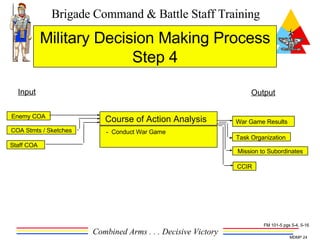
Military Decision Making Process Step 4 COA Stmts / Sketches Staff COA War Game Results Mission to Subordinates CCIR Output Input Enemy COA -  Conduct War Game Course of Action Analysis Task Organization FM 101-5 pgs 5-4, 5-16
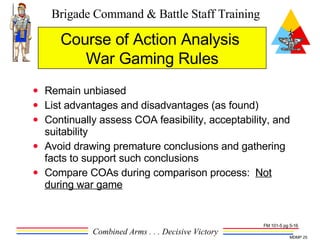
Remain unbiased List advantages and disadvantages (as found) Continually assess COA feasibility, acceptability, and suitability Avoid drawing premature conclusions and gathering facts to support such conclusions Compare COAs during comparison process:  Not during war game Course of Action Analysis  War Gaming Rules FM 101-5 pg 5-16
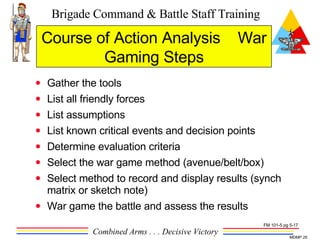
Gather the tools List all friendly forces List assumptions List known critical events and decision points Determine evaluation criteria Select the war game method (avenue/belt/box) Select method to record and display results (synch matrix or sketch note) War game the battle and assess the results Course of Action Analysis  War Gaming Steps FM 101-5 pg 5-17
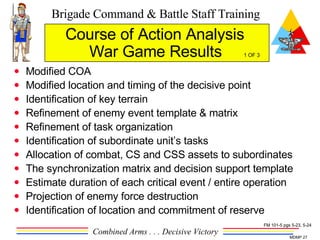
Modified COA Modified location and timing of the decisive point Identification of key terrain Refinement of enemy event template & matrix Refinement of task organization Identification of subordinate unit’s tasks Allocation of combat, CS and CSS assets to subordinates The synchronization matrix and decision support template Estimate duration of each critical event / entire operation Projection of enemy force destruction Identification of location and commitment of reserve Course of Action Analysis  War Game Results  1 OF 3 FM 101-5 pgs 5-23, 5-24
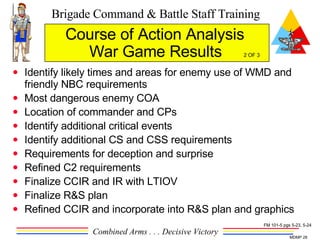
Identify likely times and areas for enemy use of WMD and friendly NBC requirements Most dangerous enemy COA Location of commander and CPs Identify additional critical events Identify additional CS and CSS requirements Requirements for deception and surprise Refined C2 requirements Finalize CCIR and IR with LTIOV Finalize R&S plan Refined CCIR and incorporate into R&S plan and graphics Course of Action Analysis  War Game Results  2 OF 3 FM 101-5 pgs 5-23, 5-24
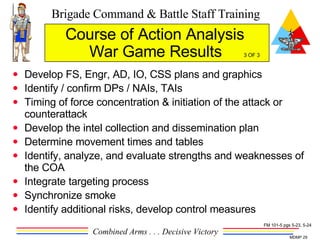
Develop FS, Engr, AD, IO, CSS plans and graphics Identify / confirm DPs / NAIs, TAIs Timing of force concentration & initiation of the attack or counterattack Develop the intel collection and dissemination plan Determine movement times and tables Identify, analyze, and evaluate strengths and weaknesses of the COA Integrate targeting process Synchronize smoke Identify additional risks, develop control measures Course of Action Analysis  War Game Results  3 OF 3 FM 101-5 pgs 5-23, 5-24
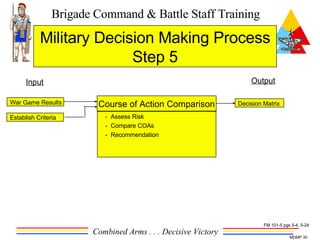
Military Decision Making Process Step 5 Output Input War Game Results Decision Matrix Course of Action Comparison -  Assess Risk -  Compare COAs -  Recommendation Establish Criteria FM 101-5 pgs 5-4, 5-24
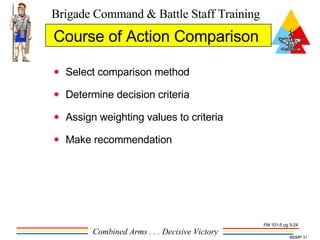
Select comparison method Determine decision criteria Assign weighting values to criteria Make recommendation Course of Action Comparison  FM 101-5 pg 5-24
MILITARY DECISION MAKING PROCESS Workshop #4
“ If the band played a piece first with the piccolo then with the brass horn, then with the clarinet, and then with the trumpet, there  would be a hell of a lot of noise but no music.  To get harmony in the music, each instrument  must support the others, to get harmony in  battle, each weapon must support the others.  Team play wins.” General George S. Patton
“ There is a type of staff officer who seems to think that it is more important to draft immaculate orders than to get out a reasonably well-worded order in time for action to be taken before the situation changes or the opportunity passes.”   Orders BH Liddell Hart Thoughts on War 1933
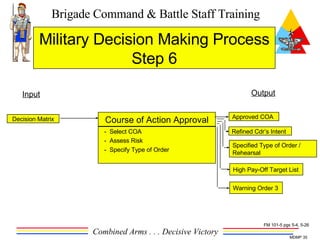
Military Decision Making Process Step 6 Course of Action Approval Decision Matrix Specified Type of Order /  Rehearsal High Pay-Off Target List -  Select COA -  Assess Risk -  Specify Type of Order Approved COA Refined Cdr’s Intent Output Input FM 101-5 pgs 5-4, 5-26 Warning Order 3
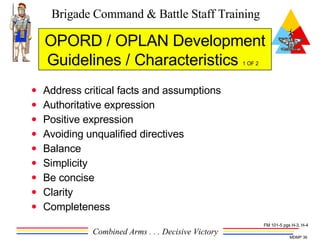
Address critical facts and assumptions Authoritative expression Positive expression Avoiding unqualified directives Balance Simplicity Be concise Clarity Completeness OPORD / OPLAN Development Guidelines / Characteristics  1 OF 2   FM 101-5 pgs H-3, H-4
Coordination Flexibility Clear, concise mission and intent statements Centralized planning Decentralized execution Use of existing resources Timeliness OPORD / OPLAN Development Guidelines / Characteristics  2 OF 2   FM 101-5 pgs H-3, H-4
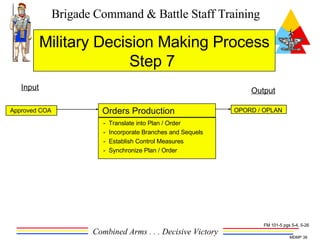
Military Decision Making Process Step 7  Approved COA Orders Production -  Translate into Plan / Order -  Incorporate Branches and Sequels -  Establish Control Measures -  Synchronize Plan / Order OPORD / OPLAN  Output Input FM 101-5 pgs 5-4, 5-26
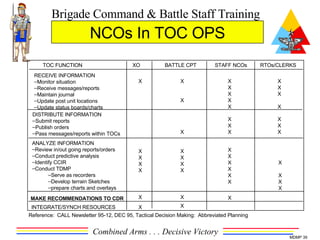
NCOs In TOC OPS RECEIVE INFORMATION Monitor situation Receive messages/reports Maintain journal Update post unit locations Update status boards/charts DISTRIBUTE INFORMATION Submit reports Publish orders Pass messages/reports within TOCs ANALYZE INFORMATION Review in/out going reports/orders Conduct predictive analysis Identify CCIR Conduct TDMP Serve as recorders Develop terrain Sketches prepare charts and overlays TOC FUNCTION XO BATTLE CPT STAFF NCOs RTOs/CLERKS X X X X X X X X X X X X X X X  X X X X X X X X X X X X X X X X X X  Reference:  CALL Newsletter 95-12, DEC 95, Tactical Decision Making:  Abbreviated Planning MAKE RECOMMENDATIONS TO CDR INTEGRATE/SYNCH RESOURCES X X X X X X X X X
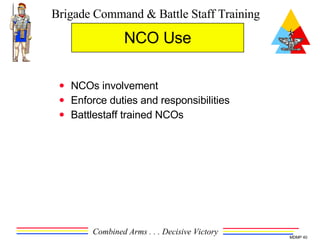
NCO Use NCOs involvement Enforce duties and responsibilities Battlestaff trained NCOs
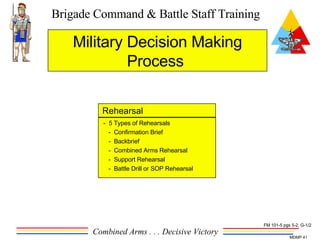
Military Decision Making Process  Rehearsal -  5 Types of Rehearsals -  Confirmation Brief -  Backbrief -  Combined Arms Rehearsal -  Support Rehearsal -  Battle Drill or SOP Rehearsal  FM 101-5 pgs 5-2, G-1/2
Military Decision Making Process  Execution & Assessment FM 101-5 pg 5-2
Common Problems In Applying The MDMP Using intelligence tools/products properly Forgetting the enemy has a vote Providing adequate commander’s guidance Intent Developing/analyzing courses of action War-gaming Presenting information for decision Format/content Meeting timeline guidance
MILITARY  DECISION MAKING  PROCESS

Mdmp Bctp.2

  • 1.
  • 2.
    Military Decision MakingProcess MISSION RECEIVED STAFF ACTIONS INFO TO CDR STAFF EST MISSION ANALYSIS PROPOSED RESTATED MSN COA DEVELOPMENT COA ANALYSIS, COMPARISON, RECOMMENDATION PREP PLAN/ ORDER/FRAGO ISSUE PLAN/ ORDER/FRAGO MSN REC’D BY SUB UNITS EXECUTION CDR ACTIONS INFO TO STAFF MSN ANALYSIS RESTATED MSN CDR’S GUIDANCE COA DEVELOPMENT/ ANALYSIS COA COMPARISON AND DECISION PLAN/ORDER/ FRAGO APPROVAL CDR’S EST
  • 3.
    Military Decision MakingProcess WARNING ORDER WARNING ORDER WARNING ORDER EXECUTION & ASSESSMENT COA DEVELOPMENT COA ANALYSIS RECEIPT OF MISSION MISSION ANALYSIS ORDERS PRODUCTION REHEARSAL COA APPROVAL COA COMPARISON FM 101-5 pg 5-2
  • 4.
    Military Decision MakingProcess Copy __ of __ Copies Issuing headquarters Place of issue Date-time group of signature Message reference no. WARNING ORDER #__ References: 1. SITUATION a. Enemy forces. b. Friendly forces. (1) Mission (2) Commander’s Intent c. Attachments and detachments. 2. MISSION 3. EXECUTION Intent (when available). a. Concept of operation (when available). Assembly area locations (If applicable, when available). b. Tasks to maneuver units (when available). (1) Reconnaissance. (2) Surveillance (2) Security c. Tasks to combat support units (when available). d. Coordinating instructions. (1) Earliest movement time and degree of notice. (2) Orders group meeting (attendees, location, and time) (when applicable). 4. SERVICE SUPPORT a. Special equipment. b. Transportation. 5. COMMAND AND SIGNAL ACKNOWLEDGE: NAME (Commander’s last name) RANK (Commander’s rank) OFFICIAL: ANNEXES: DISTRIBUTION: FM 101-5 pgs H-27/28
  • 5.
    Receipt of missionMission analysis Course of action development Course of action analysis Course of action comparison Course of action approval Orders production Military Decision Making Process 7 Steps FM 101-5 pg 5-3
  • 6.
    Military Decision MakingProcess Step 1 Output Input Mission of Higher Cdr’s Initial Guidance Warning Order 1 Receipt of Mission - Initial Assessment - Update Staff Estimates - Prepare for Mission Analysis FM 101-5 pgs 5-3, 5-4
  • 7.
    Military Decision MakingProcess Step 2 Cdr’s Intent / Guidance Output Input Mission Staff Estimates Mission Analysis - Analysis of Higher Msn/Intent - Identify Specified / Implied Tasks / Essential Tasks - Review Task Org / Assets - Determine Restrictions / Constraints - Assess Risk - Identify Critical Facts / Assumptions Initial IPB Products Restated Mission Staff Products Warning Order 2 Battlefield Framework Preliminary Movement FM 102-5 pgs 5-4, 5-5 Facts & Assumptions
  • 8.
    The commander’s intentis a clear, concise statement of what the force must do to succeed with respect to the enemy and the terrain, and the desired end state. It provides the link between the mission and the concept of operations by stating the key tasks that, along with the mission, are the basis for subordinates to exercise initiative when unanticipated opportunities arise or when the original concept of operations no longer applies. Intent is normally expressed in four or five sentences and is mandatory for all orders. The mission and the commander’s intent must be understood two echelons down. Definition of Commander’s Intent FM 101-5 pg 5-9
  • 9.
    Commander’s intent statementshould state the following: Key tasks End state Intent Statement FM 101-5 pg 5-9
  • 10.
    Tasks that mustbe performed, or conditions that must be met, to achieve stated purpose of the operation Not tied to specific course of action, but fundamental to the force’s success Subordinates use these tasks to keep their efforts supporting the commander’s intent Examples Tempo Duration Terrain that must be controlled Effect on the enemy Key Tasks For Commander’s Intent FM 101-5 pg 5-9
  • 11.
    Mission At 112130JUL97,1 CAV DIV attacks in zone to PL VIRGINIA to defeat the 61 BDE (MTZD) and establish a covering force NLT 120600JUL97 from PL ALABAMA to PL MAINE to protect CORPS assembly areas. On order, 1 CAV DIV attacks in zone to PL FLORIDA to defeat the remaining enemy forces. On order, defends in sector from PL ILLINOIS to PL VIRGINIA to defeat enemy attacks across the international border. Commander's Intent I want to rapidly defeat the remaining enemy forces in zone to PL ALABAMA to establish a covering force. The covering force will protect the division until we are prepared for combat and facilitate the forward passage of the heavy brigades, allowing the heavy brigades to rapidly defeat enemy forces in zone to PL FLORIDA, and posture the division to destroy any enemy counterattacks across the international border. End state is the international border restored and the division defending in sector along PL FLORIDA prepared to defeat any enemy attacks across the international border. Example Commander’s Intent
  • 12.
    13 Elements ofcommander’s guidance Specify COAs, friendly & enemy, and the priority for addressing them The CCIR Reconnaissance guidance Risk guidance Deception guidance Fire support guidance Mobility & countermobility guidance Security measures to be implemented Additional specific priorities for CS and CSS Other information the Cdr wants the staff to consider The time plan Type of order to issue Type of rehearsal to conduct Military Decision Making Process FM 101-5 pg 5-10
  • 13.
    Commander’s Critical InformationRequirements (CCIR) Supports the commander’s battlefield visualization Identifies critical decisions Assists in determining or validating COAs Helps filter information available to the commander Focuses the efforts of subordinates and staff Assists in the allocation of resources Assists staff officers in making recommendations 10 or less items of information Directly affects the success or failure of the mission FM 101-5 pg 5-7
  • 14.
    Commander’s Critical InformationRequirements (CCIR) PIR - Information about the enemy. Example: Are the 14 TMD and 13 ID DAGs located vicinity NAI 17 (CH 4535) and NAI 14 (CH3736) respectively? LTIOV: 252300JUL97 EEFI - Information needed to protect friendly forces from the enemy’s information-gathering systems. Example: Location of brigade command posts. FFIR - Information about the capabilities of own or adjacent units. Example: First contact with enemy. Combat power below designated level. FM 101-5 pg 5-8
  • 15.
    NCOs In TheMilitary Decision Making Process MISSION ANALYSIS Prepare charts for mission analysis Prepare terrain sketches Update and post unit reports/status Prepare TOC for planning process Conduct mission analysis Serve as a recorder during process Brief commander and staff COMMANDER’S GUIDANCE Assist Cdr in developing guidance Issue guidance Record/post Cdr’s guidance COA DEVELOPMENT Prepare charts Sketch COAs Develop COAs PLANNING PROCESS COMMANDER STAFF OFFICERS STAFF NCOs RTOs/CLERKS X X X X X X X X X X X X X X X X X X X X X X X X FM 101-5 pg K-2
  • 16.
    NCOs In TheMilitary Decision Making Process (continued) COA ANALYSIS Collect and prepare tools/charts Serve as a war-game recorder Conduct war-game session DECISION Make recommendation to Cdr Decide Record/post Cdr’s guidance ORDERS PREP Write annexes Consolidate annexes Type order Reproduce orders/graphics Review order Approve order PLANNING PROCESS COMMANDER STAFF OFFICERS STAFF NCOs RTOs/CLERKS X X X X X X X X X X X X X X X X X X X X X X X FM 101-5 pg K-2
  • 17.
    MILITARY DECISION MAKINGPROCESS Workshop #2
  • 18.
    Military Decision MakingProcess Step 3 Restated Mission Cdr's Guidance / Intent Output Input Course of Action Development - Analyze Relative Combat Power - Generate Options - Array Initial Forces - Develop the Scheme of Maneuver - Assign Headquarters - Prepare COA Statements / Sketches COA Stmts / Sketches Enemy COAs Staff Estimates FM 101-5 pgs 5-4, 5-11
  • 19.
    Suitability Feasibility AcceptabilityDistinguishability Completeness Course of Action Development Criteria FM 101-5 pg 5-11
  • 20.
    PL NEBRASKA 42Course of Action: BDE attacks frontally with two task forces abreast at 200630 May 97 with a mech heavy task force conducting the main attack in zone in the east to seize OBJ BAYONET to defeat an enemy battalion. Priority of indirect fires initially to counterbattery then neutralization of enemy forces at the point of attack. Smoke will be used to isolate enemy positions at the point of attack. A 20 minute prep on the OBJ’s will be fired to suppress enemy forces. An infantry battalion conducts a supporting attack in zone in the west to seize OBJ KNIFE to defeat an enemy battalion. A tank heavy task force follows the mech heavy task force and assumes the main effort to defeat the second echelon battalion vicinity OBJ SABER. Lead battalions provide frontal and flank security. A mech team, brigade reserve, follows the tank heavy task force prepared to reinforce the main effort or respond to threats to LOC. DS, R artillery and Q36 radar will initially position forward along PL NEVADA. One battery from the DS and one battery from the R battalion will initially move behind the lead Co/Tm’s in the right and left zone, respectively. The Q36 radar will move with the mech heavy TF. BDE Main CP will position vic PL NEVADA prior to attack. TAC CP will follow mech heavy TF. Risk is accepted by having a small reserve in order to mass combat power on the objective. PL IOWA O/O FEBA (PL FLORIDA) OBJ KNIFE 3 X 1 LOA (PL WISCONSIN) 37 LOA (PL WISCONSIN) O/O FEBA (PL FLORIDA) PL IOWA PL NEBRASKA LD/LC (PL NEVADA) LD/LC (PL NEVADA) X 52 ID X MNC X AA SCABBARD OBJ BAYONET TONG’DUCH OBJ SABER COA #1 CFL 52 DIV CFL 52 DIV 200100 MAY 97 200100 MAY 97 03 57
  • 21.
    PL NEBRASKA Courseof Action: On order, BDE defends from PL FLORIDA to PL NEVADA with two task forces abreast to defeat the advance guard and lead battalions; a task force in depth, the defeat mechanism, will counter attack to defeat the enemy. Forward battalions establish screen from PL WISCONSIN to PL FLORIDA. The tank heavy task force establishes a combat outpost in TONG’DUCH to engage enemy reconnaissance and force deployment of the Advanced Guard Battalion. Indirect fires neutralize Advance Guard in security zone. A tank heavy task force, main effort, in the east defends in sector from PL FLORIDA to PL IOWA to defeat the advance guard and first echelon battalion. An infantry battalion in the west defends in sector from PL FLORIDA to PL IOWA to defeat a first echelon battalion. A mech heavy task force occupies AA SCABBARD; on order main effort counterattacks into EA DALLAS or EA AUSTIN to defeat the second echelon battalion. Priority of fires to main effort battalion. Use blocking obstacles to shape EA DALLAS or EA AUSTIN once enemy main effort is identified, to support mech heavy TF’s CATK. A mech team, brigade reserve, occupies AA HILT, prepared to defeat penetrations of PL NEBRASKA or respond to level II rear area threats. DS and R artillery with Q36 radar positioned forward between PL FLORIDA and PL IOWA. Risk is accepted by having a small reserve in order to defeat penetrations of PL NEBRASKA. PL IOWA FEBA (PL FLORIDA) 37 42 PL NEVADA COA #1 3 X 1 LOA (PL WISCONSIN) LOA (PL WISCONSIN) FEBA (PL FLORIDA) PL IOWA PL NEBRASKA PL NEVADA TONG’DUCH AA HILT AA SCABBARD EA DALLAS EA AUSTIN X 52 ID X MNC X CFL 52 DIV O/O CFL 52 DIV O/O MAIN TAC 57 03 X X
  • 22.
    PL NEBRASKA 42Course of Action: BDE attacks frontally with two task forces abreast at 200630 May 97 with a mech heavy task force conducting the main attack in zone in the east to seize OBJ BAYONET to defeat an enemy battalion. Priority of indirect fires initially to counterbattery then neutralization of enemy forces at the point of attack. Smoke will be used to isolate enemy positions at the point of attack. A 20 minute prep on the OBJ’s will be fired to suppress enemy forces. An infantry battalion conducts a supporting attack in zone in the west to seize OBJ KNIFE to defeat an enemy battalion. A tank heavy task force follows the mech heavy task force and assumes the main effort to defeat the second echelon battalion vicinity OBJ SABER. Lead battalions provide frontal and flank security. A mech team, brigade reserve, follows the tank heavy task force prepared to reinforce the main effort or respond to threats to LOC. DS, R artillery and Q36 radar will initially position forward along PL NEVADA. One battery from the DS and one battery from the R battalion will initially move behind the lead Co/Tm’s in the right and left zone, respectively. The Q36 radar will move with the mech heavy TF. BDE Main CP will position vic PL NEVADA prior to attack. TAC CP will follow mech heavy TF. Risk is accepted by having a small reserve in order to mass combat power on the objective. PL IOWA O/O FEBA (PL FLORIDA) OBJ KNIFE 3 X 1 LOA (PL WISCONSIN) 37 LOA (PL WISCONSIN) O/O FEBA (PL FLORIDA) PL IOWA PL NEBRASKA LD/LC (PL NEVADA) LD/LC (PL NEVADA) X 52 ID X MNC X AA SCABBARD OBJ BAYONET TONG’DUCH OBJ SABER COA #1 CFL 52 DIV CFL 52 DIV 200100 MAY 97 200100 MAY 97 03 57
  • 23.
    MILITARY DECISION MAKINGPROCESS Workshop #3
  • 24.
    Military Decision MakingProcess Step 4 COA Stmts / Sketches Staff COA War Game Results Mission to Subordinates CCIR Output Input Enemy COA - Conduct War Game Course of Action Analysis Task Organization FM 101-5 pgs 5-4, 5-16
  • 25.
    Remain unbiased Listadvantages and disadvantages (as found) Continually assess COA feasibility, acceptability, and suitability Avoid drawing premature conclusions and gathering facts to support such conclusions Compare COAs during comparison process: Not during war game Course of Action Analysis War Gaming Rules FM 101-5 pg 5-16
  • 26.
    Gather the toolsList all friendly forces List assumptions List known critical events and decision points Determine evaluation criteria Select the war game method (avenue/belt/box) Select method to record and display results (synch matrix or sketch note) War game the battle and assess the results Course of Action Analysis War Gaming Steps FM 101-5 pg 5-17
  • 27.
    Modified COA Modifiedlocation and timing of the decisive point Identification of key terrain Refinement of enemy event template & matrix Refinement of task organization Identification of subordinate unit’s tasks Allocation of combat, CS and CSS assets to subordinates The synchronization matrix and decision support template Estimate duration of each critical event / entire operation Projection of enemy force destruction Identification of location and commitment of reserve Course of Action Analysis War Game Results 1 OF 3 FM 101-5 pgs 5-23, 5-24
  • 28.
    Identify likely timesand areas for enemy use of WMD and friendly NBC requirements Most dangerous enemy COA Location of commander and CPs Identify additional critical events Identify additional CS and CSS requirements Requirements for deception and surprise Refined C2 requirements Finalize CCIR and IR with LTIOV Finalize R&S plan Refined CCIR and incorporate into R&S plan and graphics Course of Action Analysis War Game Results 2 OF 3 FM 101-5 pgs 5-23, 5-24
  • 29.
    Develop FS, Engr,AD, IO, CSS plans and graphics Identify / confirm DPs / NAIs, TAIs Timing of force concentration & initiation of the attack or counterattack Develop the intel collection and dissemination plan Determine movement times and tables Identify, analyze, and evaluate strengths and weaknesses of the COA Integrate targeting process Synchronize smoke Identify additional risks, develop control measures Course of Action Analysis War Game Results 3 OF 3 FM 101-5 pgs 5-23, 5-24
  • 30.
    Military Decision MakingProcess Step 5 Output Input War Game Results Decision Matrix Course of Action Comparison - Assess Risk - Compare COAs - Recommendation Establish Criteria FM 101-5 pgs 5-4, 5-24
  • 31.
    Select comparison methodDetermine decision criteria Assign weighting values to criteria Make recommendation Course of Action Comparison FM 101-5 pg 5-24
  • 32.
    MILITARY DECISION MAKINGPROCESS Workshop #4
  • 33.
    “ If theband played a piece first with the piccolo then with the brass horn, then with the clarinet, and then with the trumpet, there would be a hell of a lot of noise but no music. To get harmony in the music, each instrument must support the others, to get harmony in battle, each weapon must support the others. Team play wins.” General George S. Patton
  • 34.
    “ There isa type of staff officer who seems to think that it is more important to draft immaculate orders than to get out a reasonably well-worded order in time for action to be taken before the situation changes or the opportunity passes.” Orders BH Liddell Hart Thoughts on War 1933
  • 35.
    Military Decision MakingProcess Step 6 Course of Action Approval Decision Matrix Specified Type of Order / Rehearsal High Pay-Off Target List - Select COA - Assess Risk - Specify Type of Order Approved COA Refined Cdr’s Intent Output Input FM 101-5 pgs 5-4, 5-26 Warning Order 3
  • 36.
    Address critical factsand assumptions Authoritative expression Positive expression Avoiding unqualified directives Balance Simplicity Be concise Clarity Completeness OPORD / OPLAN Development Guidelines / Characteristics 1 OF 2 FM 101-5 pgs H-3, H-4
  • 37.
    Coordination Flexibility Clear,concise mission and intent statements Centralized planning Decentralized execution Use of existing resources Timeliness OPORD / OPLAN Development Guidelines / Characteristics 2 OF 2 FM 101-5 pgs H-3, H-4
  • 38.
    Military Decision MakingProcess Step 7 Approved COA Orders Production - Translate into Plan / Order - Incorporate Branches and Sequels - Establish Control Measures - Synchronize Plan / Order OPORD / OPLAN Output Input FM 101-5 pgs 5-4, 5-26
  • 39.
    NCOs In TOCOPS RECEIVE INFORMATION Monitor situation Receive messages/reports Maintain journal Update post unit locations Update status boards/charts DISTRIBUTE INFORMATION Submit reports Publish orders Pass messages/reports within TOCs ANALYZE INFORMATION Review in/out going reports/orders Conduct predictive analysis Identify CCIR Conduct TDMP Serve as recorders Develop terrain Sketches prepare charts and overlays TOC FUNCTION XO BATTLE CPT STAFF NCOs RTOs/CLERKS X X X X X X X X X X X X X X X X X X X X X X X X X X X X X X X X X Reference: CALL Newsletter 95-12, DEC 95, Tactical Decision Making: Abbreviated Planning MAKE RECOMMENDATIONS TO CDR INTEGRATE/SYNCH RESOURCES X X X X X X X X X
  • 40.
    NCO Use NCOsinvolvement Enforce duties and responsibilities Battlestaff trained NCOs
  • 41.
    Military Decision MakingProcess Rehearsal - 5 Types of Rehearsals - Confirmation Brief - Backbrief - Combined Arms Rehearsal - Support Rehearsal - Battle Drill or SOP Rehearsal FM 101-5 pgs 5-2, G-1/2
  • 42.
    Military Decision MakingProcess Execution & Assessment FM 101-5 pg 5-2
  • 43.
    Common Problems InApplying The MDMP Using intelligence tools/products properly Forgetting the enemy has a vote Providing adequate commander’s guidance Intent Developing/analyzing courses of action War-gaming Presenting information for decision Format/content Meeting timeline guidance
  • 44.
    MILITARY DECISIONMAKING PROCESS