Battle Command Seminar MILITARY DECISION  MAKING PROCESS ( MDMP )   Major Frank J. Snyder 18 SEP 07
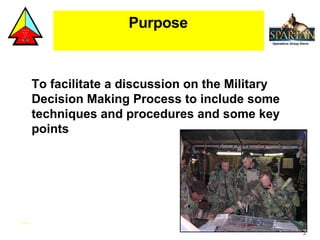
Purpose To facilitate a discussion on the Military Decision Making Process to include some techniques and procedures and some key points
Agenda Decision Making  Military Decision Making Process (MDMP) Key Points (Summary)
Decision Making “ Success often depends on superior information that enables superior decisions.  Effective decision making combines judgment with information as an element of combat power:  it requires knowing if to decide, when to decide, and what to decide.  It requires….identifying important information and focusing subordinates and the staff on it.”  - FM 3-0
Types of Decision Making FMI 5-0.1 talks about two types of decision making. What are they? Intuitive (pattern recognition is key) Analytical (process/methodology is key) Military  decision making uses  which  technique? Why?
MDMP “ The military decision making process is a process that integrates the activities of the commander, staff, and subordinate commanders in developing an operation plan or order.  It establishes procedures for analyzing a mission; developing, analyzing, and comparing courses of action; selecting the best course of action; and producing an operation plan or order.” - FM 5-0.1 How do you organize for MDMP?
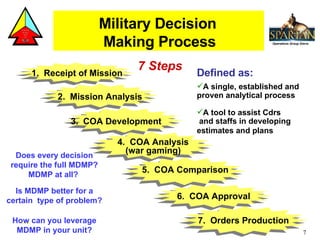
5.  COA Comparison 6.  COA Approval 3.  COA Development 4.  COA Analysis (war gaming) 2.  Mission Analysis 7.  Orders Production Military Decision  Making Process 1.  Receipt of Mission 7 Steps Defined as: A single, established and proven analytical process A tool to assist Cdrs and staffs in developing  estimates and plans   Does every decision require the full MDMP? MDMP at all?  Is MDMP better for a certain  type of problem? How can you leverage MDMP in your unit?
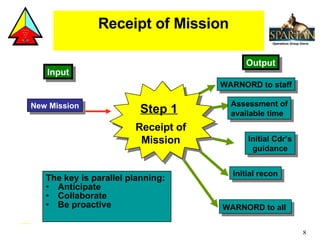
The key is parallel planning: Anticipate  Collaborate Be proactive   WARNORD to staff Initial recon WARNORD to all   Receipt of Mission Step 1 Receipt of  Mission Input New Mission Output Initial Cdr’s guidance Assessment of available time
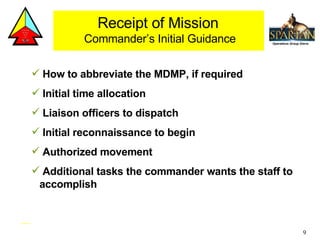
Receipt of Mission   Commander’s Initial Guidance How to abbreviate the MDMP, if required Initial time allocation Liaison officers to dispatch Initial reconnaissance to begin Authorized movement Additional tasks the commander wants the staff to accomplish
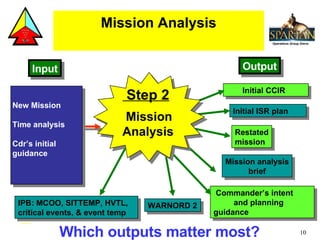
Mission Analysis Output IPB: MCOO, SITTEMP, HVTL, critical events, & event temp Input New Mission  Time analysis Cdr’s initial guidance Step 2 Mission Analysis Which outputs matter most? Commander’s intent  and planning guidance Initial ISR plan WARNORD 2 Restated mission Initial CCIR Mission analysis brief
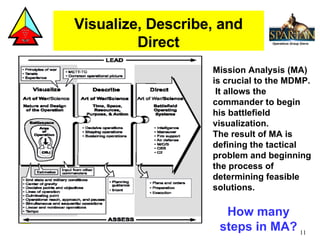
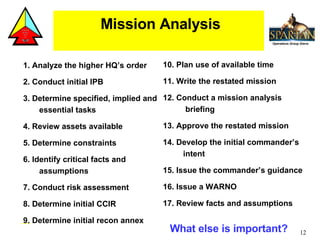
Visualize, Describe, and Direct Mission Analysis (MA) is crucial to the MDMP.  It allows the commander to begin his battlefield visualization. The result of MA is defining the tactical problem and beginning the process of determining feasible solutions.   How many steps in MA?
10. Plan use of available time 11. Write the restated mission 12. Conduct a mission analysis    briefing 13. Approve the restated mission 14. Develop the initial commander’s   intent 15. Issue the commander’s guidance 16. Issue a WARNO 17. Review facts and assumptions  1. Analyze the higher HQ’s order 2. Conduct initial IPB 3. Determine specified, implied and essential tasks 4. Review assets available 5. Determine constraints 6. Identify critical facts and assumptions 7. Conduct risk assessment  8. Determine initial CCIR 9. Determine initial recon annex Mission Analysis What else is important?
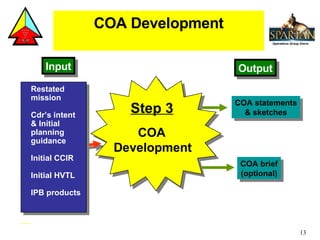
COA Development Step 3 COA Development Restated mission Cdr’s intent & Initial planning guidance Initial CCIR Initial HVTL IPB products Output Input COA statements & sketches COA brief (optional)
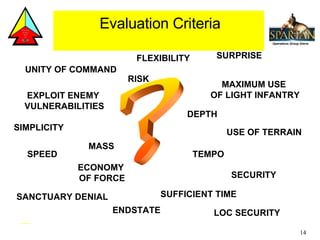
? RISK SIMPLICITY FLEXIBILITY EXPLOIT ENEMY  VULNERABILITIES SURPRISE SPEED USE OF TERRAIN MAXIMUM USE  OF LIGHT INFANTRY SUFFICIENT TIME ENDSTATE TEMPO MASS ECONOMY  OF FORCE SECURITY UNITY OF COMMAND DEPTH SANCTUARY DENIAL LOC SECURITY Evaluation Criteria
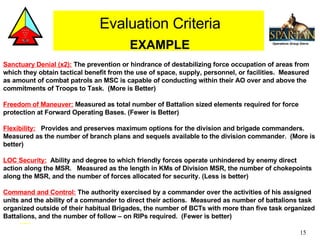
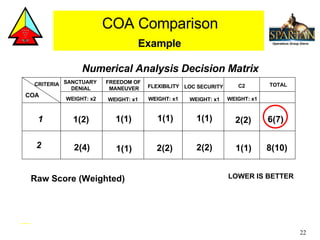
Sanctuary Denial (x2):  The prevention or hindrance of destabilizing force occupation of areas from which they obtain tactical benefit from the use of space, supply, personnel, or facilities.  Measured as amount of combat patrols an MSC is capable of conducting within their AO over and above the commitments of Troops to Task.  (More is Better)  Freedom of Maneuver:  Measured as total number of Battalion sized elements required for force protection at Forward Operating Bases. (Fewer is Better)  Flexibility:   Provides and preserves maximum options for the division and brigade commanders.  Measured as the number of branch plans and sequels available to the division commander.  (More is better) LOC Security:   Ability and degree to which friendly forces operate unhindered by enemy direct action along the MSR.  Measured as the length in KMs of Division MSR, the number of chokepoints along the MSR, and the number of forces allocated for security. (Less is better) Command and Control:  The authority exercised by a commander over the activities of his assigned units and the ability of a commander to direct their actions.  Measured as number of battalions task organized outside of their habitual Brigades, the number of BCTs with more than five task organized Battalions, and the number of follow – on RIPs required.  (Fewer is better) EXAMPLE Evaluation Criteria
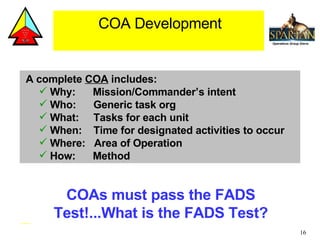
A complete  COA  includes: Why:  Mission/Commander’s intent Who:  Generic task org What:  Tasks for each unit When:  Time for designated activities to occur Where:  Area of Operation How:  Method COA Development COAs must pass the FADS Test!...What is the FADS Test?
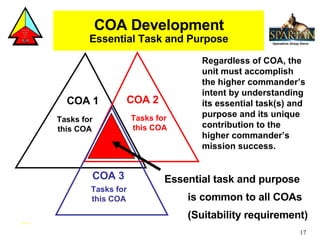
COA Development   Essential Task and Purpose   Regardless of COA, the unit must accomplish the higher commander’s intent by understanding its essential task(s) and purpose and its unique contribution to the higher commander’s mission success. Tasks for  this COA Tasks for this COA Tasks for this COA COA 1 COA 2 COA 3 Essential task and purpose is common to all COAs  (Suitability requirement)
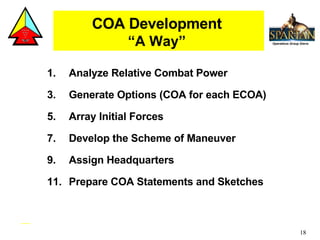
Analyze Relative Combat Power Generate Options (COA for each ECOA) Array Initial Forces Develop the Scheme of Maneuver Assign Headquarters Prepare COA Statements and Sketches COA Development “ A Way”
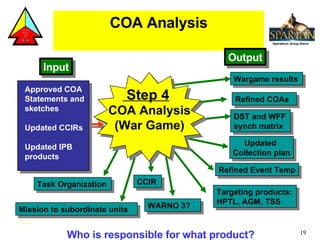
COA Analysis Mission to subordinate units CCIR Refined COAs Targeting products: HPTL, AGM, TSS Output Input Approved COA  Statements and sketches  Updated CCIRs Updated IPB products Step 4 COA Analysis (War Game) Who is responsible for what product? Task Organization Wargame results DST and WFF synch matrix WARNO 3? Updated  Collection plan Refined Event Temp
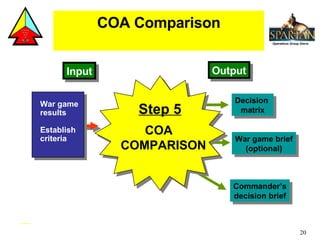
COA Comparison Commander’s decision brief Step 5 COA COMPARISON War game  results Establish  criteria  Output Input Decision  matrix War game brief (optional)
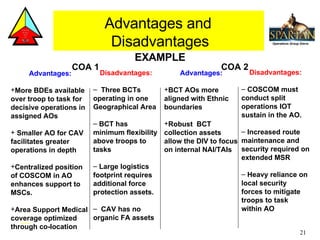
COA 1 COA 2 Advantages: More BDEs available over troop to task for decisive operations in assigned AOs Smaller AO for CAV facilitates greater operations in depth Centralized position of COSCOM in AO enhances support to MSCs. Area Support Medical coverage optimized through co-location  Disadvantages: Three BCTs operating in one Geographical Area BCT has minimum flexibility above troops to tasks Large logistics footprint requires additional force protection assets.  CAV has no organic FA assets Advantages: BCT AOs more aligned with Ethnic boundaries  Robust  BCT collection assets allow the DIV to focus on internal NAI/TAIs Disadvantages: COSCOM must conduct split operations IOT sustain in the AO. Increased route maintenance and security required on extended MSR Heavy reliance on local security forces to mitigate troops to task within AO EXAMPLE Advantages and  Disadvantages
LOWER IS BETTER COA Numerical Analysis Decision Matrix CRITERIA 1 2 WEIGHT: x2 WEIGHT: x1 WEIGHT: x1 WEIGHT: x1 WEIGHT: x1 SANCTUARY  DENIAL FREEDOM OF  MANEUVER FLEXIBILITY LOC SECURITY C2 TOTAL 6(7) 8(10) 1(2) 2(4) 1(1) 1(1) 1(1) 2(2) 1(1) 2(2) 2(2) 1(1) Raw Score (Weighted) Example COA Comparison
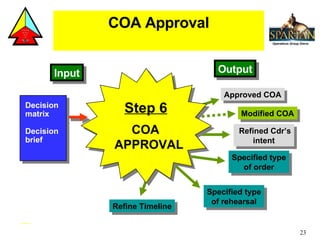
COA Approval Specified type of order Approved COA Step 6 COA APPROVAL Decision  matrix Decision  brief  Output Input Specified type of rehearsal Refine Timeline Modified COA Refined Cdr’s intent
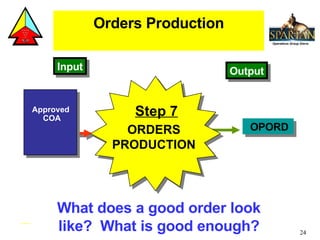
Orders Production OPORD Step 7 ORDERS PRODUCTION Approved  COA Output Input What does a good order look like?  What is good enough?
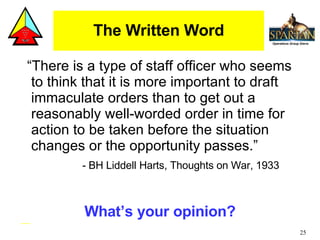
The Written Word “There is a type of staff officer who seems to think that it is more important to draft immaculate orders than to get out a reasonably well-worded order in time for action to be taken before the situation changes or the opportunity passes.” - BH Liddell Harts, Thoughts on War, 1933 What’s your opinion?
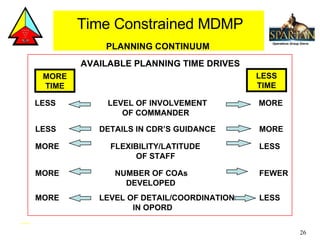
PLANNING CONTINUUM AVAILABLE PLANNING TIME DRIVES MORE TIME LESS TIME Time Constrained MDMP LESS DETAILS IN CDR’S GUIDANCE MORE MORE   FLEXIBILITY/LATITUDE  LESS OF STAFF MORE    NUMBER OF COAs  FEWER   DEVELOPED MORE LEVEL OF DETAIL/COORDINATION LESS   IN OPORD LESS   LEVEL OF INVOLVEMENT MORE OF COMMANDER
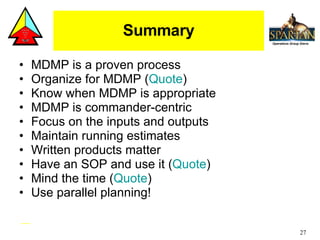
Summary MDMP is a proven process Organize for MDMP ( Quote ) Know when MDMP is appropriate MDMP is commander-centric Focus on the inputs and outputs Maintain running estimates Written products matter Have an SOP and use it ( Quote ) Mind the time ( Quote ) Use parallel planning!
Questions
On…  “Organization” “We can never forget that organization, no less than a bayonet or an aircraft carrier, is a weapon of war.” - Congressman Bill Nichols, 1986 back
On…  “Consistency of Process” “More important than doing things the best way is doing them the same way.” -  Dr. and COL(R) Kenneth Allard, 1990 back
On…  “Speed in decision making” “In general, whoever can make and implement his decisions consistently faster gains a tremendous, often decisive advantage.” - MCDP 1, The Conduct of War, 1997 back
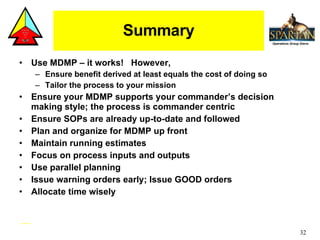
Summary Use MDMP – it works!  However, Ensure benefit derived at least equals the cost of doing so Tailor the process to your mission Ensure your MDMP supports your commander’s decision making style; the process is commander centric Ensure SOPs are already up-to-date and followed Plan and organize for MDMP up front  Maintain running estimates  Focus on process inputs and outputs Use parallel planning Issue warning orders early; Issue GOOD orders Allocate time wisely
Types of Decisions Commanders make two types of decisions: Execution Decisions The selection, during preparation and execution, of a course of action anticipated by the order (FM 6-0). Commanders often delegate to subordinates. Adjustment Decisions During preparation and execution, the selection of a course of action that modifies the order to respond to unanticipated opportunities or threats (FM 6-0). Commanders rarely delegate to subordinates.
Receipt of Mission Initial Steps Receive mission from higher HQ or  derive  from an ongoing mission  Staff immediately prepares for mission analysis (SOP preparation) Commander and staff do a quick initial assessment with emphasis on an initial allocation of available time (SOP, 1/3 :2/3 guide?) Conduct individual staff element estimates: IPB, LOG Est., etc.  Collaborate with higher HQ, adjacent and subordinate units  Look for intelligence gaps (higher ISM) Focus on time management (staff and subordinate unit timelines) Commander issues initial guidance; G-3/S-3 issues WARNORD to subordinate units
Mission Analysis (MA) is crucial to the MDMP.  It allows the commander to begin his battlefield visualization. The result of MA is defining the tactical problem and beginning the process of determining feasible solutions. Mission Analysis
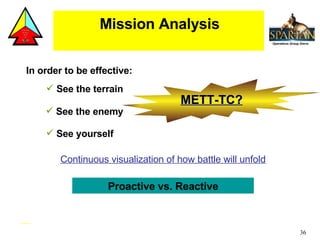
Mission Analysis In order to be effective: See the terrain See the enemy See yourself Continuous visualization of how battle will unfold Proactive vs. Reactive METT-TC?
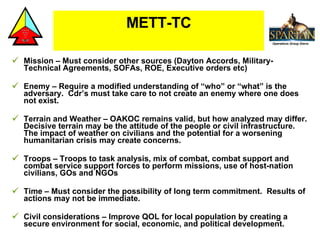
Mission – Must consider other sources (Dayton Accords, Military-Technical Agreements, SOFAs, ROE, Executive orders etc) Enemy – Require a modified understanding of “who” or “what” is the adversary.  Cdr’s must take care to not create an enemy where one does not exist. Terrain and Weather – OAKOC remains valid, but how analyzed may differ.  Decisive terrain may be the attitude of the people or civil infrastructure.  The impact of weather on civilians and the potential for a worsening humanitarian crisis may create concerns. Troops – Troops to task analysis, mix of combat, combat support and combat service support forces to perform missions, use of host-nation civilians, GOs and NGOs Time – Must consider the possibility of long term commitment.  Results of actions may not be immediate. Civil considerations – Improve QOL for local population by creating a secure environment for social, economic, and political development. METT-TC
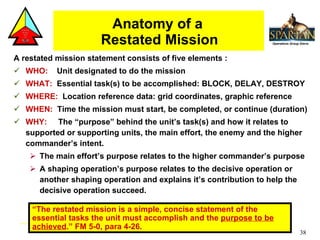
A restated mission statement consists of five elements : WHO:   Unit designated to do the mission WHAT:   Essential task(s) to be accomplished: BLOCK, DELAY, DESTROY WHERE:   Location reference data: grid coordinates, graphic reference WHEN:   Time the mission must start, be completed, or continue (duration) WHY:   The “purpose” behind the unit’s task(s) and how it relates to supported or supporting units, the main effort, the enemy and the higher commander’s intent. The main effort’s purpose relates to the higher commander’s purpose A shaping operation’s purpose relates to the decisive operation or another shaping operation and explains it’s contribution to help the decisive operation succeed. Anatomy of a  Restated Mission “ The restated mission is a simple, concise statement of the essential tasks the unit must accomplish and the  purpose to be achieved .” FM 5-0, para 4-26.
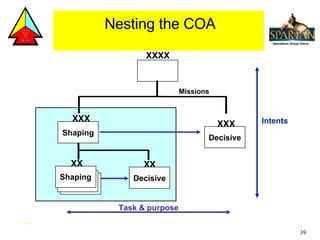
Nesting the COA Intents XXXX Task & purpose Missions XXX Shaping XXX Decisive XX Decisive XX Shaping
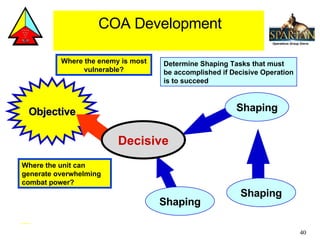
Shaping Determine Shaping  Tasks that must  be accomplished if Decisive Operation is to succeed Shaping Objective Where the enemy is most vulnerable? Where the unit can generate overwhelming combat power? Shaping Decisive COA Development
Identify Endstate Identify Decisive Operation(s) necessary to achieve endstate Identify Shaping Operation(s) necessary to ensure success of the Decisive Operation Identify Decisive point(s) Identify necessary Form(s) of Maneuver Sequence Supporting Operation(s) Array Forces necessary to achieve the decisive, shaping and supporting operations Assign a higher headquarters  COA Development “ A Way”
COA development must address unique role of unit in accomplishing higher’s decisive operation Shaping missions of subordinate units should contribute directly or indirectly to success of the decisive operation Effects of adjacent unit’s concept of operations must be factored into planning process COA Development
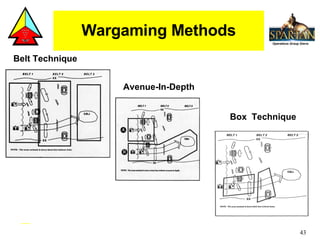
Wargaming Methods Belt Technique Avenue-In-Depth Box  Technique
CCIR helps the commander: Reduce the information reported to him to what is important and what is urgent to mission accomplishment Identify information needed to support his battlefield visualization and to make critical decisions Directly affect the success or failure of the mission; are time sensitive  and linked to decision points Focus efforts of subordinates and staff Allocate resources FM 5-0  Initial CCIR
Priority intelligence requirements (PIR ) -- information about the enemy. Essential elements of friendly information (EEFI ) -- information needed to protect friendly forces from  the enemy’s information -gathering systems. (No longer a CCIR, but become a commander’s priority when he states them.” Friendly forces information requirements (FFIR ) -- information about the capabilities of his or adjacent units. CCIR are expressed as : FM 5-0  “ What does the commander need to know in a specific situation to make a particular decision in a timely manner?” FM 3-0  Initial CCIR
FM 5-0  The CCIR are: Applicable only to the commander who specifies them Situation dependent events or activities that are predictable Specified by the commander for each operation Time- sensitive information that must be immediately reported to the commander, staff, and subordinate commanders Always included in an OPORD or OPLAN Continuously reviewed during planning and adjusted as needed Initial CCIR
BCTP PERCEPTIONS ... Commanders are prepared to issue their initial intent and focused guidance following the mission analysis brief  Commanders are identifying a decisive point, or decisive operation in their guidance Staffs need to ask commanders questions that assist in refining plans and clarify commander’s guidance Intent and Guidance
The commander’s intent is: A clear, concise statement of what a force must do to succeed Provides link between mission and concept States key tasks, including tempo, duration and effect on enemy or terrain Understood two levels down Prepared by commander 4-5 sentences Not COA specific--allows for initiative Does not--- Include the method to get to end state Contain risk Restate the “why” of the mission  Commander’s Intent Format Before concept of operations Next two higher intents in para 1b
The commander’s guidance must focus on:  Essential tasks supporting mission accomplishment When, where, and how he intends to mass effects to accomplish the mission according to his higher commander’s intent Priorities for all combat, CS, and CSS elements  How he envisions their support of his concept Commander’s Guidance
1.  Specific courses of action to consider or not to consider, both friendly and enemy, and the priority for addressing them 2.  CCIR 3.  Reconnaissance guidance 4.  Risk guidance 5.  Deception guidance 6.  Fire support guidance  Commander’s Guidance  Key Points (1 of 2)
7.  Mobility and countermobility guidance 8.  Security measures to be implemented 9.  Additional specific priorities for CS and CSS 10.  Any other information the commander wants the staff to consider 11.  Time allocation plan 12.  Type of order to issue 13.  Type of rehearsal to conduct Commander’s Guidance  Key Points (2 of 2)
Receipt of Guidance “ Things to Consider” The staff must understand the best medium in which their commander receives information, what is important to him, and how he sees things.  Take a 15 min break before receiving guidance to allow Cdr time to analyze information received Who is in the CG’s “guidance group”? Provide the Cdr a “read ahead” / “smart card” / worksheet either before or during MA brief for note taking  Do we use a scribe to record his guidance? Do we conduct a “brief back” to the Commander to ensure understanding of his guidance?
Wargaming of each course of action The application of overwhelming combat power at the decisive point or for the decisive operation must be considered during planning  Doctrinally precise terms to clearly define missions (task and purpose) must be used  The Chief of Staff (or his designated rep) needs to keep the staff focused during the preparation and execution of proper and thorough wargaming Excessive complexity and phasing results in a loss of momentum and tempo COA Analysis BCTP PERCEPTIONS...

Mdmp Bctp

  • 1.
    Battle Command SeminarMILITARY DECISION MAKING PROCESS ( MDMP ) Major Frank J. Snyder 18 SEP 07
  • 2.
    Purpose To facilitatea discussion on the Military Decision Making Process to include some techniques and procedures and some key points
  • 3.
    Agenda Decision Making Military Decision Making Process (MDMP) Key Points (Summary)
  • 4.
    Decision Making “Success often depends on superior information that enables superior decisions. Effective decision making combines judgment with information as an element of combat power: it requires knowing if to decide, when to decide, and what to decide. It requires….identifying important information and focusing subordinates and the staff on it.” - FM 3-0
  • 5.
    Types of DecisionMaking FMI 5-0.1 talks about two types of decision making. What are they? Intuitive (pattern recognition is key) Analytical (process/methodology is key) Military decision making uses which technique? Why?
  • 6.
    MDMP “ Themilitary decision making process is a process that integrates the activities of the commander, staff, and subordinate commanders in developing an operation plan or order. It establishes procedures for analyzing a mission; developing, analyzing, and comparing courses of action; selecting the best course of action; and producing an operation plan or order.” - FM 5-0.1 How do you organize for MDMP?
  • 7.
    5. COAComparison 6. COA Approval 3. COA Development 4. COA Analysis (war gaming) 2. Mission Analysis 7. Orders Production Military Decision Making Process 1. Receipt of Mission 7 Steps Defined as: A single, established and proven analytical process A tool to assist Cdrs and staffs in developing estimates and plans Does every decision require the full MDMP? MDMP at all? Is MDMP better for a certain type of problem? How can you leverage MDMP in your unit?
  • 8.
    The key isparallel planning: Anticipate Collaborate Be proactive WARNORD to staff Initial recon WARNORD to all Receipt of Mission Step 1 Receipt of Mission Input New Mission Output Initial Cdr’s guidance Assessment of available time
  • 9.
    Receipt of Mission Commander’s Initial Guidance How to abbreviate the MDMP, if required Initial time allocation Liaison officers to dispatch Initial reconnaissance to begin Authorized movement Additional tasks the commander wants the staff to accomplish
  • 10.
    Mission Analysis OutputIPB: MCOO, SITTEMP, HVTL, critical events, & event temp Input New Mission Time analysis Cdr’s initial guidance Step 2 Mission Analysis Which outputs matter most? Commander’s intent and planning guidance Initial ISR plan WARNORD 2 Restated mission Initial CCIR Mission analysis brief
  • 11.
    Visualize, Describe, andDirect Mission Analysis (MA) is crucial to the MDMP. It allows the commander to begin his battlefield visualization. The result of MA is defining the tactical problem and beginning the process of determining feasible solutions. How many steps in MA?
  • 12.
    10. Plan useof available time 11. Write the restated mission 12. Conduct a mission analysis briefing 13. Approve the restated mission 14. Develop the initial commander’s intent 15. Issue the commander’s guidance 16. Issue a WARNO 17. Review facts and assumptions 1. Analyze the higher HQ’s order 2. Conduct initial IPB 3. Determine specified, implied and essential tasks 4. Review assets available 5. Determine constraints 6. Identify critical facts and assumptions 7. Conduct risk assessment 8. Determine initial CCIR 9. Determine initial recon annex Mission Analysis What else is important?
  • 13.
    COA Development Step3 COA Development Restated mission Cdr’s intent & Initial planning guidance Initial CCIR Initial HVTL IPB products Output Input COA statements & sketches COA brief (optional)
  • 14.
    ? RISK SIMPLICITYFLEXIBILITY EXPLOIT ENEMY VULNERABILITIES SURPRISE SPEED USE OF TERRAIN MAXIMUM USE OF LIGHT INFANTRY SUFFICIENT TIME ENDSTATE TEMPO MASS ECONOMY OF FORCE SECURITY UNITY OF COMMAND DEPTH SANCTUARY DENIAL LOC SECURITY Evaluation Criteria
  • 15.
    Sanctuary Denial (x2): The prevention or hindrance of destabilizing force occupation of areas from which they obtain tactical benefit from the use of space, supply, personnel, or facilities. Measured as amount of combat patrols an MSC is capable of conducting within their AO over and above the commitments of Troops to Task. (More is Better) Freedom of Maneuver: Measured as total number of Battalion sized elements required for force protection at Forward Operating Bases. (Fewer is Better) Flexibility: Provides and preserves maximum options for the division and brigade commanders. Measured as the number of branch plans and sequels available to the division commander. (More is better) LOC Security: Ability and degree to which friendly forces operate unhindered by enemy direct action along the MSR. Measured as the length in KMs of Division MSR, the number of chokepoints along the MSR, and the number of forces allocated for security. (Less is better) Command and Control: The authority exercised by a commander over the activities of his assigned units and the ability of a commander to direct their actions. Measured as number of battalions task organized outside of their habitual Brigades, the number of BCTs with more than five task organized Battalions, and the number of follow – on RIPs required. (Fewer is better) EXAMPLE Evaluation Criteria
  • 16.
    A complete COA includes: Why: Mission/Commander’s intent Who: Generic task org What: Tasks for each unit When: Time for designated activities to occur Where: Area of Operation How: Method COA Development COAs must pass the FADS Test!...What is the FADS Test?
  • 17.
    COA Development Essential Task and Purpose Regardless of COA, the unit must accomplish the higher commander’s intent by understanding its essential task(s) and purpose and its unique contribution to the higher commander’s mission success. Tasks for this COA Tasks for this COA Tasks for this COA COA 1 COA 2 COA 3 Essential task and purpose is common to all COAs (Suitability requirement)
  • 18.
    Analyze Relative CombatPower Generate Options (COA for each ECOA) Array Initial Forces Develop the Scheme of Maneuver Assign Headquarters Prepare COA Statements and Sketches COA Development “ A Way”
  • 19.
    COA Analysis Missionto subordinate units CCIR Refined COAs Targeting products: HPTL, AGM, TSS Output Input Approved COA Statements and sketches Updated CCIRs Updated IPB products Step 4 COA Analysis (War Game) Who is responsible for what product? Task Organization Wargame results DST and WFF synch matrix WARNO 3? Updated Collection plan Refined Event Temp
  • 20.
    COA Comparison Commander’sdecision brief Step 5 COA COMPARISON War game results Establish criteria Output Input Decision matrix War game brief (optional)
  • 21.
    COA 1 COA2 Advantages: More BDEs available over troop to task for decisive operations in assigned AOs Smaller AO for CAV facilitates greater operations in depth Centralized position of COSCOM in AO enhances support to MSCs. Area Support Medical coverage optimized through co-location Disadvantages: Three BCTs operating in one Geographical Area BCT has minimum flexibility above troops to tasks Large logistics footprint requires additional force protection assets. CAV has no organic FA assets Advantages: BCT AOs more aligned with Ethnic boundaries Robust BCT collection assets allow the DIV to focus on internal NAI/TAIs Disadvantages: COSCOM must conduct split operations IOT sustain in the AO. Increased route maintenance and security required on extended MSR Heavy reliance on local security forces to mitigate troops to task within AO EXAMPLE Advantages and Disadvantages
  • 22.
    LOWER IS BETTERCOA Numerical Analysis Decision Matrix CRITERIA 1 2 WEIGHT: x2 WEIGHT: x1 WEIGHT: x1 WEIGHT: x1 WEIGHT: x1 SANCTUARY DENIAL FREEDOM OF MANEUVER FLEXIBILITY LOC SECURITY C2 TOTAL 6(7) 8(10) 1(2) 2(4) 1(1) 1(1) 1(1) 2(2) 1(1) 2(2) 2(2) 1(1) Raw Score (Weighted) Example COA Comparison
  • 23.
    COA Approval Specifiedtype of order Approved COA Step 6 COA APPROVAL Decision matrix Decision brief Output Input Specified type of rehearsal Refine Timeline Modified COA Refined Cdr’s intent
  • 24.
    Orders Production OPORDStep 7 ORDERS PRODUCTION Approved COA Output Input What does a good order look like? What is good enough?
  • 25.
    The Written Word“There is a type of staff officer who seems to think that it is more important to draft immaculate orders than to get out a reasonably well-worded order in time for action to be taken before the situation changes or the opportunity passes.” - BH Liddell Harts, Thoughts on War, 1933 What’s your opinion?
  • 26.
    PLANNING CONTINUUM AVAILABLEPLANNING TIME DRIVES MORE TIME LESS TIME Time Constrained MDMP LESS DETAILS IN CDR’S GUIDANCE MORE MORE FLEXIBILITY/LATITUDE LESS OF STAFF MORE NUMBER OF COAs FEWER DEVELOPED MORE LEVEL OF DETAIL/COORDINATION LESS IN OPORD LESS LEVEL OF INVOLVEMENT MORE OF COMMANDER
  • 27.
    Summary MDMP isa proven process Organize for MDMP ( Quote ) Know when MDMP is appropriate MDMP is commander-centric Focus on the inputs and outputs Maintain running estimates Written products matter Have an SOP and use it ( Quote ) Mind the time ( Quote ) Use parallel planning!
  • 28.
  • 29.
    On… “Organization”“We can never forget that organization, no less than a bayonet or an aircraft carrier, is a weapon of war.” - Congressman Bill Nichols, 1986 back
  • 30.
    On… “Consistencyof Process” “More important than doing things the best way is doing them the same way.” - Dr. and COL(R) Kenneth Allard, 1990 back
  • 31.
    On… “Speedin decision making” “In general, whoever can make and implement his decisions consistently faster gains a tremendous, often decisive advantage.” - MCDP 1, The Conduct of War, 1997 back
  • 32.
    Summary Use MDMP– it works! However, Ensure benefit derived at least equals the cost of doing so Tailor the process to your mission Ensure your MDMP supports your commander’s decision making style; the process is commander centric Ensure SOPs are already up-to-date and followed Plan and organize for MDMP up front Maintain running estimates Focus on process inputs and outputs Use parallel planning Issue warning orders early; Issue GOOD orders Allocate time wisely
  • 33.
    Types of DecisionsCommanders make two types of decisions: Execution Decisions The selection, during preparation and execution, of a course of action anticipated by the order (FM 6-0). Commanders often delegate to subordinates. Adjustment Decisions During preparation and execution, the selection of a course of action that modifies the order to respond to unanticipated opportunities or threats (FM 6-0). Commanders rarely delegate to subordinates.
  • 34.
    Receipt of MissionInitial Steps Receive mission from higher HQ or derive from an ongoing mission Staff immediately prepares for mission analysis (SOP preparation) Commander and staff do a quick initial assessment with emphasis on an initial allocation of available time (SOP, 1/3 :2/3 guide?) Conduct individual staff element estimates: IPB, LOG Est., etc. Collaborate with higher HQ, adjacent and subordinate units Look for intelligence gaps (higher ISM) Focus on time management (staff and subordinate unit timelines) Commander issues initial guidance; G-3/S-3 issues WARNORD to subordinate units
  • 35.
    Mission Analysis (MA)is crucial to the MDMP. It allows the commander to begin his battlefield visualization. The result of MA is defining the tactical problem and beginning the process of determining feasible solutions. Mission Analysis
  • 36.
    Mission Analysis Inorder to be effective: See the terrain See the enemy See yourself Continuous visualization of how battle will unfold Proactive vs. Reactive METT-TC?
  • 37.
    Mission – Mustconsider other sources (Dayton Accords, Military-Technical Agreements, SOFAs, ROE, Executive orders etc) Enemy – Require a modified understanding of “who” or “what” is the adversary. Cdr’s must take care to not create an enemy where one does not exist. Terrain and Weather – OAKOC remains valid, but how analyzed may differ. Decisive terrain may be the attitude of the people or civil infrastructure. The impact of weather on civilians and the potential for a worsening humanitarian crisis may create concerns. Troops – Troops to task analysis, mix of combat, combat support and combat service support forces to perform missions, use of host-nation civilians, GOs and NGOs Time – Must consider the possibility of long term commitment. Results of actions may not be immediate. Civil considerations – Improve QOL for local population by creating a secure environment for social, economic, and political development. METT-TC
  • 38.
    A restated missionstatement consists of five elements : WHO: Unit designated to do the mission WHAT: Essential task(s) to be accomplished: BLOCK, DELAY, DESTROY WHERE: Location reference data: grid coordinates, graphic reference WHEN: Time the mission must start, be completed, or continue (duration) WHY: The “purpose” behind the unit’s task(s) and how it relates to supported or supporting units, the main effort, the enemy and the higher commander’s intent. The main effort’s purpose relates to the higher commander’s purpose A shaping operation’s purpose relates to the decisive operation or another shaping operation and explains it’s contribution to help the decisive operation succeed. Anatomy of a Restated Mission “ The restated mission is a simple, concise statement of the essential tasks the unit must accomplish and the purpose to be achieved .” FM 5-0, para 4-26.
  • 39.
    Nesting the COAIntents XXXX Task & purpose Missions XXX Shaping XXX Decisive XX Decisive XX Shaping
  • 40.
    Shaping Determine Shaping Tasks that must be accomplished if Decisive Operation is to succeed Shaping Objective Where the enemy is most vulnerable? Where the unit can generate overwhelming combat power? Shaping Decisive COA Development
  • 41.
    Identify Endstate IdentifyDecisive Operation(s) necessary to achieve endstate Identify Shaping Operation(s) necessary to ensure success of the Decisive Operation Identify Decisive point(s) Identify necessary Form(s) of Maneuver Sequence Supporting Operation(s) Array Forces necessary to achieve the decisive, shaping and supporting operations Assign a higher headquarters COA Development “ A Way”
  • 42.
    COA development mustaddress unique role of unit in accomplishing higher’s decisive operation Shaping missions of subordinate units should contribute directly or indirectly to success of the decisive operation Effects of adjacent unit’s concept of operations must be factored into planning process COA Development
  • 43.
    Wargaming Methods BeltTechnique Avenue-In-Depth Box Technique
  • 44.
    CCIR helps thecommander: Reduce the information reported to him to what is important and what is urgent to mission accomplishment Identify information needed to support his battlefield visualization and to make critical decisions Directly affect the success or failure of the mission; are time sensitive and linked to decision points Focus efforts of subordinates and staff Allocate resources FM 5-0 Initial CCIR
  • 45.
    Priority intelligence requirements(PIR ) -- information about the enemy. Essential elements of friendly information (EEFI ) -- information needed to protect friendly forces from the enemy’s information -gathering systems. (No longer a CCIR, but become a commander’s priority when he states them.” Friendly forces information requirements (FFIR ) -- information about the capabilities of his or adjacent units. CCIR are expressed as : FM 5-0 “ What does the commander need to know in a specific situation to make a particular decision in a timely manner?” FM 3-0 Initial CCIR
  • 46.
    FM 5-0 The CCIR are: Applicable only to the commander who specifies them Situation dependent events or activities that are predictable Specified by the commander for each operation Time- sensitive information that must be immediately reported to the commander, staff, and subordinate commanders Always included in an OPORD or OPLAN Continuously reviewed during planning and adjusted as needed Initial CCIR
  • 47.
    BCTP PERCEPTIONS ...Commanders are prepared to issue their initial intent and focused guidance following the mission analysis brief Commanders are identifying a decisive point, or decisive operation in their guidance Staffs need to ask commanders questions that assist in refining plans and clarify commander’s guidance Intent and Guidance
  • 48.
    The commander’s intentis: A clear, concise statement of what a force must do to succeed Provides link between mission and concept States key tasks, including tempo, duration and effect on enemy or terrain Understood two levels down Prepared by commander 4-5 sentences Not COA specific--allows for initiative Does not--- Include the method to get to end state Contain risk Restate the “why” of the mission Commander’s Intent Format Before concept of operations Next two higher intents in para 1b
  • 49.
    The commander’s guidancemust focus on: Essential tasks supporting mission accomplishment When, where, and how he intends to mass effects to accomplish the mission according to his higher commander’s intent Priorities for all combat, CS, and CSS elements How he envisions their support of his concept Commander’s Guidance
  • 50.
    1. Specificcourses of action to consider or not to consider, both friendly and enemy, and the priority for addressing them 2. CCIR 3. Reconnaissance guidance 4. Risk guidance 5. Deception guidance 6. Fire support guidance Commander’s Guidance Key Points (1 of 2)
  • 51.
    7. Mobilityand countermobility guidance 8. Security measures to be implemented 9. Additional specific priorities for CS and CSS 10. Any other information the commander wants the staff to consider 11. Time allocation plan 12. Type of order to issue 13. Type of rehearsal to conduct Commander’s Guidance Key Points (2 of 2)
  • 52.
    Receipt of Guidance“ Things to Consider” The staff must understand the best medium in which their commander receives information, what is important to him, and how he sees things. Take a 15 min break before receiving guidance to allow Cdr time to analyze information received Who is in the CG’s “guidance group”? Provide the Cdr a “read ahead” / “smart card” / worksheet either before or during MA brief for note taking Do we use a scribe to record his guidance? Do we conduct a “brief back” to the Commander to ensure understanding of his guidance?
  • 53.
    Wargaming of eachcourse of action The application of overwhelming combat power at the decisive point or for the decisive operation must be considered during planning Doctrinally precise terms to clearly define missions (task and purpose) must be used The Chief of Staff (or his designated rep) needs to keep the staff focused during the preparation and execution of proper and thorough wargaming Excessive complexity and phasing results in a loss of momentum and tempo COA Analysis BCTP PERCEPTIONS...