Topic 1
Foundations of Environmental
Systems and Societies
1.5 Humans and Pollution
Pollution
• The addition of a substance or an agent at a rate
greater than that at which it can be rendered
harmless by the environment, and having an
appreciable effect on organisms within it
(IB ESS guide)
• It may be:
– Natural (e.g. volcanoes)
– Anthropogenic (e.g. release of sewage)
– Deliberate or accidental
– May harm the quality of air, water or soil
Pollution
• Pollutants may be:
– Primary Pollutants (active upon emission)
– Secondary (primary pollutants which have
undergone some change in order to become
active)
Point Source Pollution
• Discrete sources of pollution which can be
pinpointed on a map
• May be more easily treated and managed, but
may be have a huge impact on the local
environment
– Chernobyl disaster, 1986
– Bhopal disaster
– A single sewage outfall
Non-point Source Pollution
• Dispersed sources of pollution
• Not possible to pinpoint a single origin
• Not easily managed
– Car pollution in a city
– Numerous industries in a single area
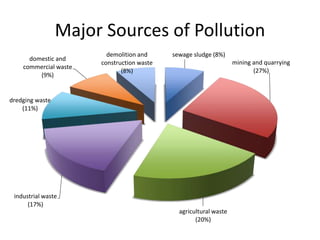
Major Sources of Pollution
sewage sludge (8%)
mining and quarrying
(27%)
agricultural waste
(20%)
industrial waste
(17%)
dredging waste
(11%)
domestic and
commercial waste
(9%)
demolition and
construction waste
(8%)
Effects of Pollution
• Death in serious cases
• Decreased level of public health
• Reduced water quality and availability
• Reduced soil quality
It is important that sources of pollution are tackled rather than the symptoms
http://www.youtube.com/watch?v=iyckJOd9A
es&list=PL51D60810437D8150
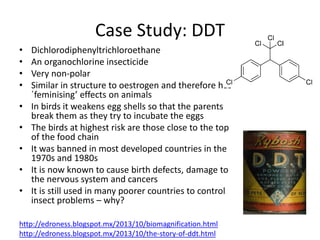
Case Study: DDT
• Dichlorodiphenyltrichloroethane
• An organochlorine insecticide
• Very non-polar
• Similar in structure to oestrogen and therefore has
´feminising’ effects on animals
• In birds it weakens egg shells so that the parents
break them as they try to incubate the eggs
• The birds at highest risk are those close to the top
of the food chain
• It was banned in most developed countries in the
1970s and 1980s
• It is now known to cause birth defects, damage to
the nervous system and cancers
• It is still used in many poorer countries to control
insect problems – why?
http://edroness.blogspot.mx/2013/10/biomagnification.html
http://edroness.blogspot.mx/2013/10/the-story-of-ddt.html
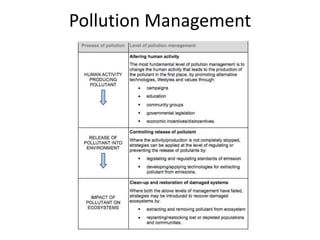
Pollution Management

Summary of topic 1.5

  • 1.
    Topic 1 Foundations ofEnvironmental Systems and Societies 1.5 Humans and Pollution
  • 2.
    Pollution • The additionof a substance or an agent at a rate greater than that at which it can be rendered harmless by the environment, and having an appreciable effect on organisms within it (IB ESS guide) • It may be: – Natural (e.g. volcanoes) – Anthropogenic (e.g. release of sewage) – Deliberate or accidental – May harm the quality of air, water or soil
  • 3.
    Pollution • Pollutants maybe: – Primary Pollutants (active upon emission) – Secondary (primary pollutants which have undergone some change in order to become active)
  • 4.
    Point Source Pollution •Discrete sources of pollution which can be pinpointed on a map • May be more easily treated and managed, but may be have a huge impact on the local environment – Chernobyl disaster, 1986 – Bhopal disaster – A single sewage outfall
  • 5.
    Non-point Source Pollution •Dispersed sources of pollution • Not possible to pinpoint a single origin • Not easily managed – Car pollution in a city – Numerous industries in a single area
  • 6.
    Major Sources ofPollution sewage sludge (8%) mining and quarrying (27%) agricultural waste (20%) industrial waste (17%) dredging waste (11%) domestic and commercial waste (9%) demolition and construction waste (8%)
  • 7.
    Effects of Pollution •Death in serious cases • Decreased level of public health • Reduced water quality and availability • Reduced soil quality It is important that sources of pollution are tackled rather than the symptoms http://www.youtube.com/watch?v=iyckJOd9A es&list=PL51D60810437D8150
  • 8.
    Case Study: DDT •Dichlorodiphenyltrichloroethane • An organochlorine insecticide • Very non-polar • Similar in structure to oestrogen and therefore has ´feminising’ effects on animals • In birds it weakens egg shells so that the parents break them as they try to incubate the eggs • The birds at highest risk are those close to the top of the food chain • It was banned in most developed countries in the 1970s and 1980s • It is now known to cause birth defects, damage to the nervous system and cancers • It is still used in many poorer countries to control insect problems – why? http://edroness.blogspot.mx/2013/10/biomagnification.html http://edroness.blogspot.mx/2013/10/the-story-of-ddt.html
  • 9.