DENSITY
 The density of a substance is its mass
per unit volume
 Density = Mass / Volume (kg/m3) or
(g/cm3)
 Mass = Density x Volume (kg) or (g)
 Volume = Mass / Density (m3) or (cm3)
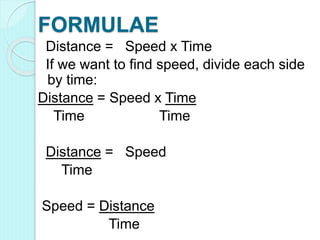
FORMULAE
Distance = Speed x Time
If we want to find speed, divide each side
by time:
Distance = Speed x Time
Time Time
Distance = Speed
Time
Speed = Distance
Time
FORMULAE
Force = Mass x Acceleration
Find Mass.
FORMULAE
Force = Mass x Acceleration
If we want to find acceleration. Divide
each side by mass:
Force = Mass x Acceleration
Mass Mass
Force = Acceleration
Mass
Acceleration = Force
Mass
FORMULAE
Speed = Distance
Time
 If we want to find time. We cross multiply.
Speed = Distance
1 Time
 Distance = Speed x Time
Now we divide by speed.
Distance = Speed x Time
Speed Speed
FORMULAE
Distance = Speed x Time
Speed Speed
Distance = Time
Speed
Time = Distance
Speed
FORMULAE
Acceleration = Force
Mass
Find mass.
FORMULAE
Acceleration = Force
Mass
Find mass. We cross multiply.
Acceleration = Force
1 Mass
Force = Acceleration x Mass
Now we divide by acceleration.
Force = Acceleration x Mass
Acceleration Acceleration
FORMULAE
Now we divide by acceleration.
Force = Acceleration x Mass
Acceleration Acceleration
Force = Mass
Acceleration
Mass = Force
Acceleration
DENSITY
 The density of a substance is its mass
per unit volume
 Density = Mass / Volume (kg/m3) or
(g/cm3)
 Mass = Density x Volume (kg) or (g)
 Volume = Mass / Density (m3) or (cm3)
DENSITY
 The density of water is 1000 kg/m3 or
1g/cm3
 1 litre of water has a mass of 1 kilogram
(kg).
 1 cm3 of water has a mass of 1 g
 1 m3 of water has a mass of 1000 kg
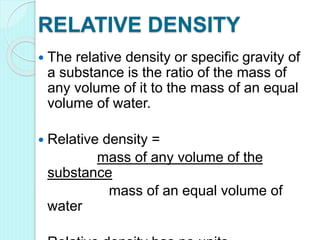
RELATIVE DENSITY
 The relative density or specific gravity of
a substance is the ratio of the mass of
any volume of it to the mass of an equal
volume of water.
 Relative density =
mass of any volume of the
substance
mass of an equal volume of
water
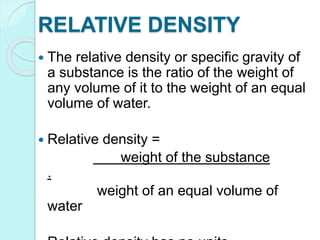
RELATIVE DENSITY
 The relative density or specific gravity of
a substance is the ratio of the weight of
any volume of it to the weight of an equal
volume of water.
 Relative density =
weight of the substance
.
weight of an equal volume of
water
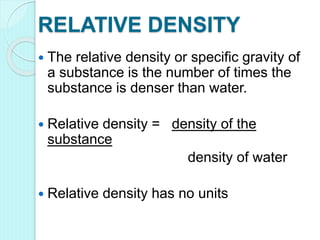
RELATIVE DENSITY
 The relative density or specific gravity of
a substance is the number of times the
substance is denser than water.
 Relative density = density of the
substance
density of water
 Relative density has no units
RELATIVE DENSITY
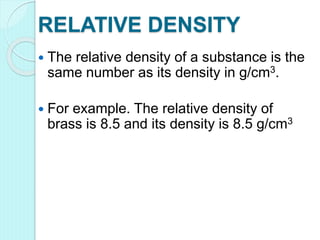
 The relative density of a substance is the
same number as its density in g/cm3.
 For example. The relative density of
brass is 8.5 and its density is 8.5 g/cm3
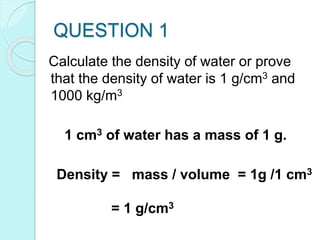
QUESTION 1
Calculate the density of water or prove
that the density of water is 1 g/cm3 and
1000 kg/m3
1 cm3 of water has a mass of 1 g.
Density = mass / volume = 1g /1 cm3
= 1 g/cm3
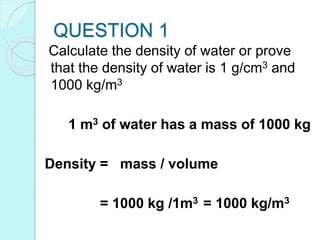
QUESTION 1
Calculate the density of water or prove
that the density of water is 1 g/cm3 and
1000 kg/m3
1 m3 of water has a mass of 1000 kg
Density = mass / volume
= 1000 kg /1m3 = 1000 kg/m3
QUESTION 2
What is the SI unit for density?
QUESTION 2
What is the SI unit for density?
kg/m3
QUESTION 3
What is the mass of 50 cm3 of water?
1 cm3 of water has a mass of 1 g.
50 cm3 of water has a mass of:
50 x 1 g = 50 g
QUESTION 4
What is the mass of 100 ml (millilitres) of
water?
1 litre of water has a mass of 1 kg.
1 litre of water = 1000 ml
1000 ml of water = 1 kg
1 ml of water is 1/1000 kg.
100 ml = 100 x 1/1000 = 0.1 kg or 100 g
QUESTION 4
What is the mass of 100 ml (millilitres) of
water?
1 m3 of water is = 1000 litres = 1000000 ml
1 m3 of water is = 1000000 cm3 = 1000000 ml
1 cm3 of water = 1000000 /1000000 = 1 ml
1 cm3 of water = 1 ml = 1 g
1 ml of water = 1 g
100 ml of water 100 x 1 = 100 g
QUESTION 4
What is the mass of 100 ml (millilitres) of
water?
1 cm3 of water = 1 ml = 1g
100 ml of water = 100 x 1 g = 100 g
QUESTION 5
Calculate the density of 5 cm3 of copper if
it has a mass of 44.5 g.
Density = mass / volume
= 44.5 g /5 cm3 = 8.9 g/cm3
QUESTION 6
Calculate the density of 1.5 m3 of lead if it
has a mass of 16,950 kg.
Density = mass / volume
= 16,950 kg /1.5 m3
= 11,300 kg/m3
QUESTION 7
A sheet of tinfoil measures 20 cm x 10 cm
x 0.1 mm. The density of the foil is 4
g/cm3. What is the mass of the tinfoil?
Volume of tinfoil = 20 x 10 x 0.01 = 2 cm3
Density = Mass / Volume
Mass of tinfoil = density x volume
= 4 g/cm3 x 2 cm3 = 8 g
QUESTION 8
The density of mercury is 13.5 g/cm3.
Find the volume of 1 kg of mercury.
Density = Mass / Volume
Volume = mass / density = 1 kg /13,500
kg/m3
= 0.00007407 m3
QUESTION 8
The density of mercury is 13.5 g/cm3.
Find the volume of 1 kg of mercury.
Density = Mass / Volume
Volume = mass / density
= 1000 g /13.5 g/cm3
= 74.07 cm3
QUESTION 9
The volume of the solution was measured
in a graduated cylinder was 45 cm3, if the
mass of solution measured to be 60.75
grams. What is the relative density of the
solution?
Relative density
= mass of any volume of the substance
mass of an equal volume of water
= 60.75 g = 1.35
QUESTION 10
An empty 60 litre petrol tank has a mass of 10 kg. What
will be its mass when full of fuel of relative density 0.72.
Relative density = mass of any volume of the
substance
mass of an equal volume of water
Mass of fuel = relative density x mass of an equal
volume of water
= 0.72 x 60 kg = 43.2 kg
Mass of tank when fill with fuel = mass of fuel + mass
of tank = 43.2 + 10 = 53.2 kg
QUESTION 12
A pump discharges 2000 litres of water
per minute at 6 bar pressure.
i) Calculate the water power of the pump.
Water power = 100 × L × P
60
= 100 × 2000 × 6
60
= 1,200,000
60
= 20,000 watts
QUESTION 12
If the pump is 70% efficient, calculate the
brake power of the engine driving the
pump.
Brake power = Water power (WP)
Efficiency
= 20,000 × 100
70
= 2,000,000
70
= 28571.43 watts
QUESTION 12
 If the design of the pump were to be improved
so that the discharge increased to 2400 litres of
water per minute at 6 bar, calculate the new
efficiency of the pump.
Water power = 100 × L × P
60
= 100 × 2400 × 6
60
= 1,440,000 = 24,000 watts
60
QUESTION 12
 If the design of the pump were to be improved
so that the discharge increased to 2400 litres of
water per minute at 6 bar, calculate the new
efficiency of the pump.
Water power = 24,000 watts
Efficiency = WP x 100
BP
= 24,000 × 100
28571.43
= 84 %

HYDRAULICS Density & Relative Density + Que.ppt

  • 1.
    DENSITY  The densityof a substance is its mass per unit volume  Density = Mass / Volume (kg/m3) or (g/cm3)  Mass = Density x Volume (kg) or (g)  Volume = Mass / Density (m3) or (cm3)
  • 2.
    FORMULAE Distance = Speedx Time If we want to find speed, divide each side by time: Distance = Speed x Time Time Time Distance = Speed Time Speed = Distance Time
  • 3.
    FORMULAE Force = Massx Acceleration Find Mass.
  • 4.
    FORMULAE Force = Massx Acceleration If we want to find acceleration. Divide each side by mass: Force = Mass x Acceleration Mass Mass Force = Acceleration Mass Acceleration = Force Mass
  • 6.
    FORMULAE Speed = Distance Time If we want to find time. We cross multiply. Speed = Distance 1 Time  Distance = Speed x Time Now we divide by speed. Distance = Speed x Time Speed Speed
  • 7.
    FORMULAE Distance = Speedx Time Speed Speed Distance = Time Speed Time = Distance Speed
  • 8.
  • 9.
    FORMULAE Acceleration = Force Mass Findmass. We cross multiply. Acceleration = Force 1 Mass Force = Acceleration x Mass Now we divide by acceleration. Force = Acceleration x Mass Acceleration Acceleration
  • 10.
    FORMULAE Now we divideby acceleration. Force = Acceleration x Mass Acceleration Acceleration Force = Mass Acceleration Mass = Force Acceleration
  • 12.
    DENSITY  The densityof a substance is its mass per unit volume  Density = Mass / Volume (kg/m3) or (g/cm3)  Mass = Density x Volume (kg) or (g)  Volume = Mass / Density (m3) or (cm3)
  • 13.
    DENSITY  The densityof water is 1000 kg/m3 or 1g/cm3  1 litre of water has a mass of 1 kilogram (kg).  1 cm3 of water has a mass of 1 g  1 m3 of water has a mass of 1000 kg
  • 14.
    RELATIVE DENSITY  Therelative density or specific gravity of a substance is the ratio of the mass of any volume of it to the mass of an equal volume of water.  Relative density = mass of any volume of the substance mass of an equal volume of water
  • 15.
    RELATIVE DENSITY  Therelative density or specific gravity of a substance is the ratio of the weight of any volume of it to the weight of an equal volume of water.  Relative density = weight of the substance . weight of an equal volume of water
  • 16.
    RELATIVE DENSITY  Therelative density or specific gravity of a substance is the number of times the substance is denser than water.  Relative density = density of the substance density of water  Relative density has no units
  • 17.
    RELATIVE DENSITY  Therelative density of a substance is the same number as its density in g/cm3.  For example. The relative density of brass is 8.5 and its density is 8.5 g/cm3
  • 18.
    QUESTION 1 Calculate thedensity of water or prove that the density of water is 1 g/cm3 and 1000 kg/m3 1 cm3 of water has a mass of 1 g. Density = mass / volume = 1g /1 cm3 = 1 g/cm3
  • 19.
    QUESTION 1 Calculate thedensity of water or prove that the density of water is 1 g/cm3 and 1000 kg/m3 1 m3 of water has a mass of 1000 kg Density = mass / volume = 1000 kg /1m3 = 1000 kg/m3
  • 20.
    QUESTION 2 What isthe SI unit for density?
  • 21.
    QUESTION 2 What isthe SI unit for density? kg/m3
  • 22.
    QUESTION 3 What isthe mass of 50 cm3 of water? 1 cm3 of water has a mass of 1 g. 50 cm3 of water has a mass of: 50 x 1 g = 50 g
  • 23.
    QUESTION 4 What isthe mass of 100 ml (millilitres) of water? 1 litre of water has a mass of 1 kg. 1 litre of water = 1000 ml 1000 ml of water = 1 kg 1 ml of water is 1/1000 kg. 100 ml = 100 x 1/1000 = 0.1 kg or 100 g
  • 24.
    QUESTION 4 What isthe mass of 100 ml (millilitres) of water? 1 m3 of water is = 1000 litres = 1000000 ml 1 m3 of water is = 1000000 cm3 = 1000000 ml 1 cm3 of water = 1000000 /1000000 = 1 ml 1 cm3 of water = 1 ml = 1 g 1 ml of water = 1 g 100 ml of water 100 x 1 = 100 g
  • 25.
    QUESTION 4 What isthe mass of 100 ml (millilitres) of water? 1 cm3 of water = 1 ml = 1g 100 ml of water = 100 x 1 g = 100 g
  • 26.
    QUESTION 5 Calculate thedensity of 5 cm3 of copper if it has a mass of 44.5 g. Density = mass / volume = 44.5 g /5 cm3 = 8.9 g/cm3
  • 27.
    QUESTION 6 Calculate thedensity of 1.5 m3 of lead if it has a mass of 16,950 kg. Density = mass / volume = 16,950 kg /1.5 m3 = 11,300 kg/m3
  • 28.
    QUESTION 7 A sheetof tinfoil measures 20 cm x 10 cm x 0.1 mm. The density of the foil is 4 g/cm3. What is the mass of the tinfoil? Volume of tinfoil = 20 x 10 x 0.01 = 2 cm3 Density = Mass / Volume Mass of tinfoil = density x volume = 4 g/cm3 x 2 cm3 = 8 g
  • 29.
    QUESTION 8 The densityof mercury is 13.5 g/cm3. Find the volume of 1 kg of mercury. Density = Mass / Volume Volume = mass / density = 1 kg /13,500 kg/m3 = 0.00007407 m3
  • 30.
    QUESTION 8 The densityof mercury is 13.5 g/cm3. Find the volume of 1 kg of mercury. Density = Mass / Volume Volume = mass / density = 1000 g /13.5 g/cm3 = 74.07 cm3
  • 31.
    QUESTION 9 The volumeof the solution was measured in a graduated cylinder was 45 cm3, if the mass of solution measured to be 60.75 grams. What is the relative density of the solution? Relative density = mass of any volume of the substance mass of an equal volume of water = 60.75 g = 1.35
  • 32.
    QUESTION 10 An empty60 litre petrol tank has a mass of 10 kg. What will be its mass when full of fuel of relative density 0.72. Relative density = mass of any volume of the substance mass of an equal volume of water Mass of fuel = relative density x mass of an equal volume of water = 0.72 x 60 kg = 43.2 kg Mass of tank when fill with fuel = mass of fuel + mass of tank = 43.2 + 10 = 53.2 kg
  • 34.
    QUESTION 12 A pumpdischarges 2000 litres of water per minute at 6 bar pressure. i) Calculate the water power of the pump. Water power = 100 × L × P 60 = 100 × 2000 × 6 60 = 1,200,000 60 = 20,000 watts
  • 35.
    QUESTION 12 If thepump is 70% efficient, calculate the brake power of the engine driving the pump. Brake power = Water power (WP) Efficiency = 20,000 × 100 70 = 2,000,000 70 = 28571.43 watts
  • 36.
    QUESTION 12  Ifthe design of the pump were to be improved so that the discharge increased to 2400 litres of water per minute at 6 bar, calculate the new efficiency of the pump. Water power = 100 × L × P 60 = 100 × 2400 × 6 60 = 1,440,000 = 24,000 watts 60
  • 37.
    QUESTION 12  Ifthe design of the pump were to be improved so that the discharge increased to 2400 litres of water per minute at 6 bar, calculate the new efficiency of the pump. Water power = 24,000 watts Efficiency = WP x 100 BP = 24,000 × 100 28571.43 = 84 %