OCULOMOTOR NERVE
D R A . G . M A L A VI KA
INTRODUCTION
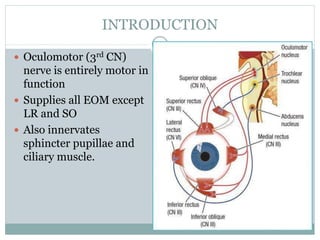
 Oculomotor (3rd CN)
nerve is entirely motor in
function
 Supplies all EOM except
LR and SO
 Also innervates
sphincter pupillae and
ciliary muscle.
 SOMATIC EFFERENT - movements of the eyeball
 GENERAL VISCERAL EFFERENT-accomodation
and contraction of the pupil
 GENERAL SOMATIC AFFERENT-proprioception
from EOM
FUNCTIONAL COMPONENTS
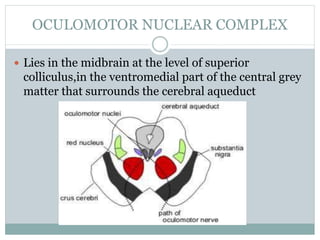
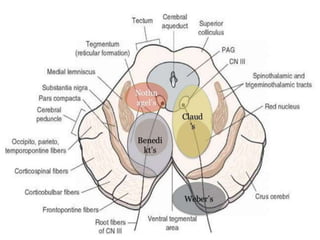
OCULOMOTOR NUCLEAR COMPLEX
 Lies in the midbrain at the level of superior
colliculus,in the ventromedial part of the central grey
matter that surrounds the cerebral aqueduct
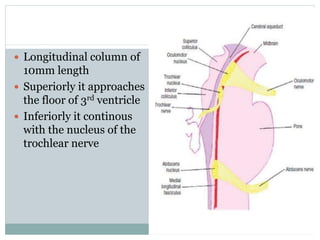
 Longitudinal column of
10mm length
 Superiorly it approaches
the floor of 3rd ventricle
 Inferiorly it continous
with the nucleus of the
trochlear nerve
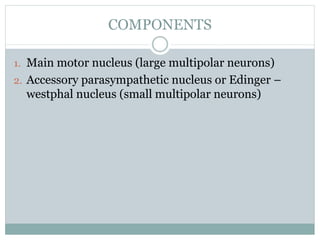
COMPONENTS
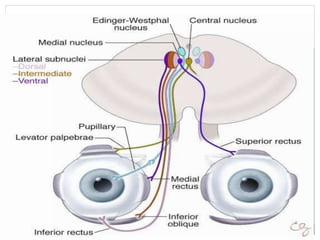
1. Main motor nucleus (large multipolar neurons)
2. Accessory parasympathetic nucleus or Edinger –
westphal nucleus (small multipolar neurons)
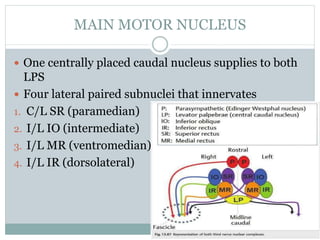
MAIN MOTOR NUCLEUS
 One centrally placed caudal nucleus supplies to both
LPS
 Four lateral paired subnuclei that innervates
1. C/L SR (paramedian)
2. I/L IO (intermediate)
3. I/L MR (ventromedian)
4. I/L IR (dorsolateral)
• SITE- posterior to the main oculomotor nucleus mass
• Sends preganglionic parasympathetic fibres along
other oculomotor fibres
• Consists of a median and two lateral components
• Cranial half of the nucleus is concerned with light
reflexes
• Caudal half with accomodation
ACCESSORY MOTOR NUCLEUS
(Edinger Westphal Nucleus)
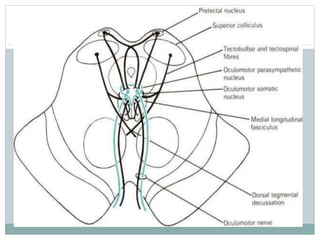
CONNECTIONS OF THE NUCLEUS
1. CEREBRAL CORTEX
• Motor cortex (precentral gyrus) of both sides through the
corticonuclear tracts
• Visual cortex through the superior colliculus and the
tactobulbar tract
• Frontal eye field (FEF)
2. Nuclei of 4th,6th,8th CN through medial longitudinal
bundle
3. Pretectal nucleus of both sides(for light reflex)
4.Vertical and torsional gaze centres through medial
longitudinal bundle
5.Cerebellum through vestibular nuclei
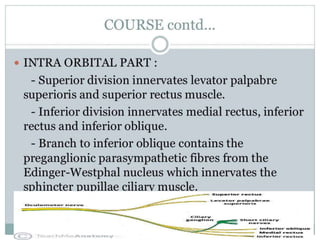
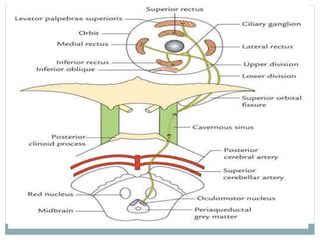
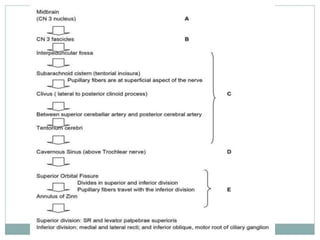
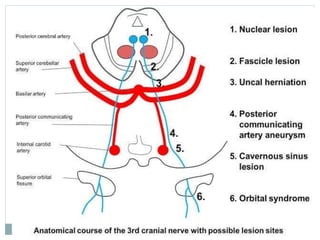
COURSE AND DISTRIBUTION
1. Fasicular part
2. Basilar part
3. Intracavernous part
4. Intraorbital part
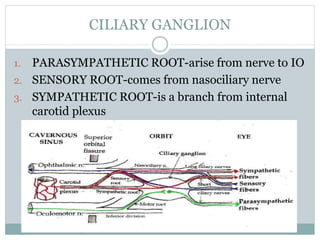
CILIARY GANGLION
1. PARASYMPATHETIC ROOT-arise from nerve to IO
2. SENSORY ROOT-comes from nasociliary nerve
3. SYMPATHETIC ROOT-is a branch from internal
carotid plexus
BRANCHES OF CILIARY GANGLION
 Gives 15-20 short ciliary nerve
 Contains fibres of all three roots of ciliary ganglion
FUNCTIONS OF 3RD CN
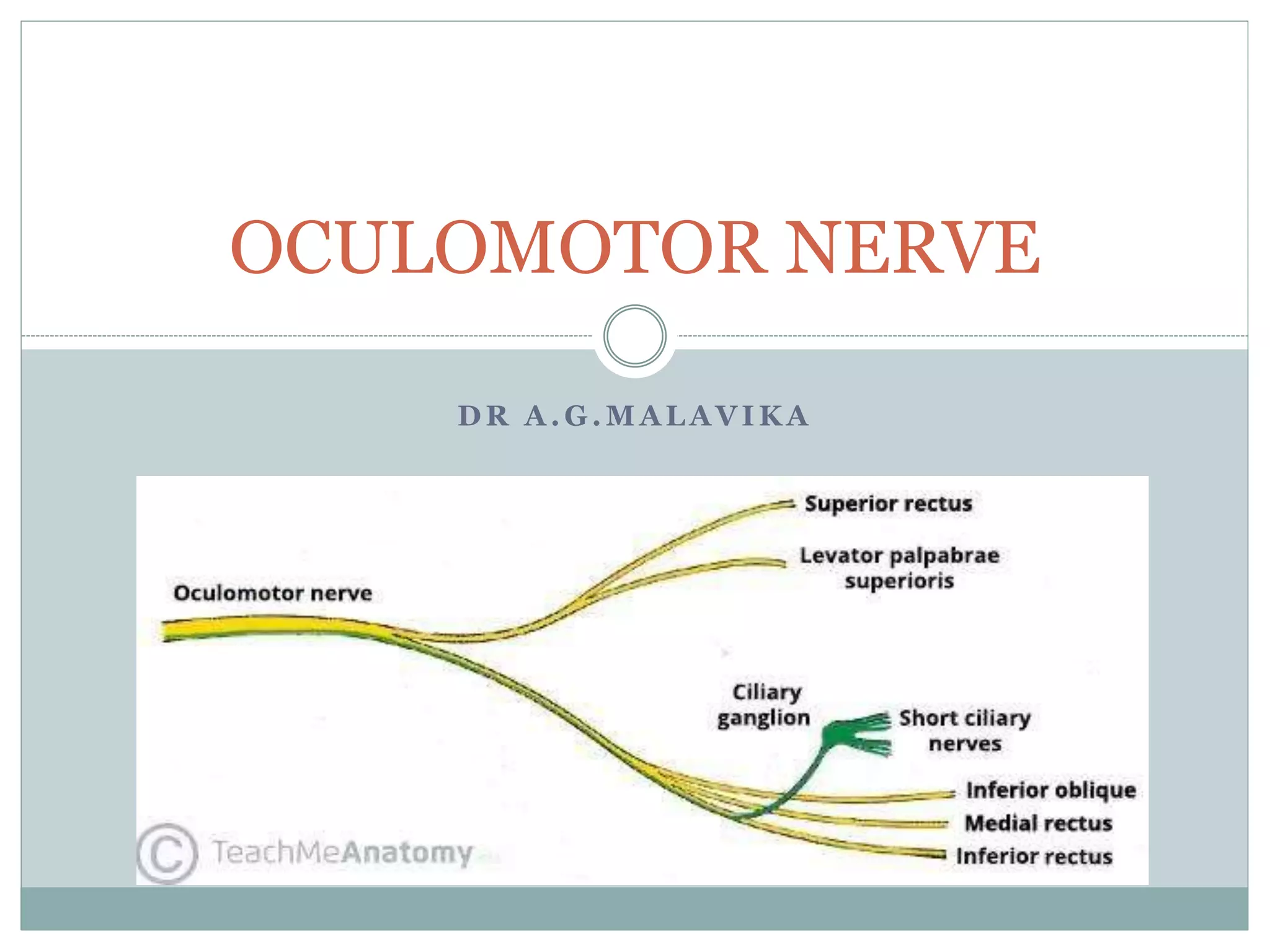
 Elevation of lid(levator palpabrae superioris)
 All movements of eye except lateral,down and out
movements
 Miosis ,Accomodation and light reflex
(parasympathetic innervation)
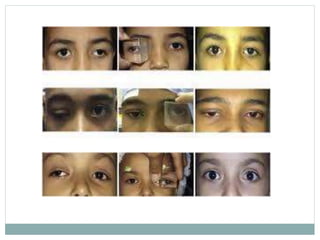
3RD NERVE PALSY
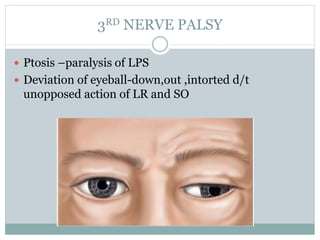
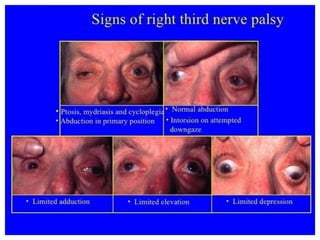
 Ptosis –paralysis of LPS
 Deviation of eyeball-down,out ,intorted d/t
unopposed action of LR and SO
 Ocular movements restricted-d/t paralysis of
1. Adduction-MR
2. Elevation-SR & IO
3. Depression-IR
4. Extorsion –IR & IO
 Pupil is fixed and dilated –paralysis of sphincter
pupillae muscle
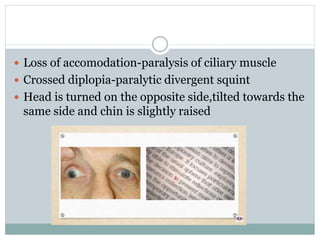
 Loss of accomodation-paralysis of ciliary muscle
 Crossed diplopia-paralytic divergent squint
 Head is turned on the opposite side,tilted towards the
same side and chin is slightly raised
Supranuclear Lesions
 Lesions of cerebral cortex and supranuclear pathway
produce conjugate paresis which affect both eyes
equally
 Although ,position and movements of the eyes are
abnormal,they maintain their coordination and
produce no diplopia.
ABERRANT REGENERATION
 It occurs following traumatic and compressive lesions
where endoneural sheaths are breached but not seen
in vascular lesion where they remain intact.
 Clinical presentaions include lid and pupil gaze
dyskinesis.
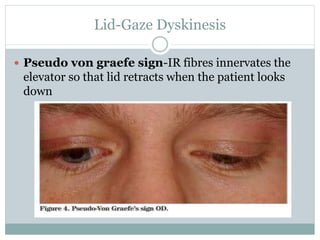
Lid-Gaze Dyskinesis
 Pseudo von graefe sign-IR fibres innervates the
elevator so that lid retracts when the patient looks
down
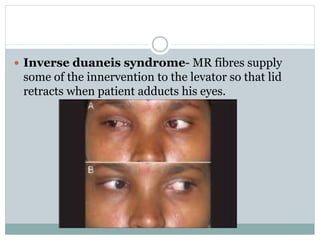
 Inverse duaneis syndrome- MR fibres supply
some of the innervention to the levator so that lid
retracts when patient adducts his eyes.
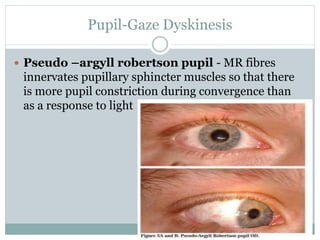
Pupil-Gaze Dyskinesis
 Pseudo –argyll robertson pupil - MR fibres
innervates pupillary sphincter muscles so that there
is more pupil constriction during convergence than
as a response to light
oculomotor nerve.pptx

oculomotor nerve.pptx

  • 1.
    OCULOMOTOR NERVE D RA . G . M A L A VI KA
  • 2.
    INTRODUCTION  Oculomotor (3rdCN) nerve is entirely motor in function  Supplies all EOM except LR and SO  Also innervates sphincter pupillae and ciliary muscle.
  • 3.
     SOMATIC EFFERENT- movements of the eyeball  GENERAL VISCERAL EFFERENT-accomodation and contraction of the pupil  GENERAL SOMATIC AFFERENT-proprioception from EOM FUNCTIONAL COMPONENTS
  • 4.
    OCULOMOTOR NUCLEAR COMPLEX Lies in the midbrain at the level of superior colliculus,in the ventromedial part of the central grey matter that surrounds the cerebral aqueduct
  • 5.
     Longitudinal columnof 10mm length  Superiorly it approaches the floor of 3rd ventricle  Inferiorly it continous with the nucleus of the trochlear nerve
  • 6.
    COMPONENTS 1. Main motornucleus (large multipolar neurons) 2. Accessory parasympathetic nucleus or Edinger – westphal nucleus (small multipolar neurons)
  • 7.
    MAIN MOTOR NUCLEUS One centrally placed caudal nucleus supplies to both LPS  Four lateral paired subnuclei that innervates 1. C/L SR (paramedian) 2. I/L IO (intermediate) 3. I/L MR (ventromedian) 4. I/L IR (dorsolateral)
  • 8.
    • SITE- posteriorto the main oculomotor nucleus mass • Sends preganglionic parasympathetic fibres along other oculomotor fibres • Consists of a median and two lateral components • Cranial half of the nucleus is concerned with light reflexes • Caudal half with accomodation ACCESSORY MOTOR NUCLEUS (Edinger Westphal Nucleus)
  • 10.
    CONNECTIONS OF THENUCLEUS 1. CEREBRAL CORTEX • Motor cortex (precentral gyrus) of both sides through the corticonuclear tracts • Visual cortex through the superior colliculus and the tactobulbar tract • Frontal eye field (FEF) 2. Nuclei of 4th,6th,8th CN through medial longitudinal bundle 3. Pretectal nucleus of both sides(for light reflex) 4.Vertical and torsional gaze centres through medial longitudinal bundle 5.Cerebellum through vestibular nuclei
  • 12.
    COURSE AND DISTRIBUTION 1.Fasicular part 2. Basilar part 3. Intracavernous part 4. Intraorbital part
  • 19.
    CILIARY GANGLION 1. PARASYMPATHETICROOT-arise from nerve to IO 2. SENSORY ROOT-comes from nasociliary nerve 3. SYMPATHETIC ROOT-is a branch from internal carotid plexus
  • 20.
    BRANCHES OF CILIARYGANGLION  Gives 15-20 short ciliary nerve  Contains fibres of all three roots of ciliary ganglion
  • 21.
    FUNCTIONS OF 3RDCN  Elevation of lid(levator palpabrae superioris)  All movements of eye except lateral,down and out movements  Miosis ,Accomodation and light reflex (parasympathetic innervation)
  • 22.
    3RD NERVE PALSY Ptosis –paralysis of LPS  Deviation of eyeball-down,out ,intorted d/t unopposed action of LR and SO
  • 23.
     Ocular movementsrestricted-d/t paralysis of 1. Adduction-MR 2. Elevation-SR & IO 3. Depression-IR 4. Extorsion –IR & IO  Pupil is fixed and dilated –paralysis of sphincter pupillae muscle
  • 24.
     Loss ofaccomodation-paralysis of ciliary muscle  Crossed diplopia-paralytic divergent squint  Head is turned on the opposite side,tilted towards the same side and chin is slightly raised
  • 28.
    Supranuclear Lesions  Lesionsof cerebral cortex and supranuclear pathway produce conjugate paresis which affect both eyes equally  Although ,position and movements of the eyes are abnormal,they maintain their coordination and produce no diplopia.
  • 41.
    ABERRANT REGENERATION  Itoccurs following traumatic and compressive lesions where endoneural sheaths are breached but not seen in vascular lesion where they remain intact.  Clinical presentaions include lid and pupil gaze dyskinesis.
  • 42.
    Lid-Gaze Dyskinesis  Pseudovon graefe sign-IR fibres innervates the elevator so that lid retracts when the patient looks down
  • 43.
     Inverse duaneissyndrome- MR fibres supply some of the innervention to the levator so that lid retracts when patient adducts his eyes.
  • 44.
    Pupil-Gaze Dyskinesis  Pseudo–argyll robertson pupil - MR fibres innervates pupillary sphincter muscles so that there is more pupil constriction during convergence than as a response to light