•Family communication refers to the way verbal and non-verbal information is exchanged between
family members. It enables members to express their needs, wants, and concerns to each other.
•It is through communication that family members are able to resolve the unavoidable problems that
arise in all families.
 Communication can be divided into two different areas: instrumental and affective.
 Instrumental communication is the exchange of factual information that enables individuals
to fulfil common family functions
 Affective communication is the way individual family members share their emotions with
one another
 Some families function extremely well with instrumental communication, yet
have great difficulty with affective communication. Healthy families are able
to communicate well in both areas.
 Two communication dimensions: Conversation orientation and Conformity orientation.
 Conversation orientation::: the extent to which families foster open interaction among family
members about their thoughts and feelings.
o In families at the high end of this dimension, members interact frequently and for large
amounts of time.
o In families at the low end of conversation orientation, family members interact less
frequently and discuss fewer topics openly with one another.
 Conformity orientation::: Conformity orientationis the extent to which families encourage all
members to have similar attitudes, beliefs, and values.
o Interactions in families at the high end of this dimension typically emphasize obedience to
parents and the interdependence of family members.
o Conversely, families at the low end of conformity orientation encourage individuality in
family members’ thoughts and feelings and tend to be less cohesive.
Four
patterns of
family
communicat
ion:
laissez-
faire
protective
consensual
pluralistic
 Laissez-faire families are low in both conversation and conformity orientation.Children in
these families are relatively likely to be influenced by social ties outside of the family.
 Pluralistic families are high in conversation orientation and low in conformity orientation
Children in pluralistic families learn to think independently and to value rational
argumentation.
 Protective families are low in conversation orientation and high in conformity orientation.
Children in protective families learn to avoid conflict and not to question authority figures
outside the family system.
 Consensual families are high in both conversation and conformity orientation. Children in
consensual families tend to evaluate messages according to how consistent they are with their
parents’ attitudes, beliefs, and values.
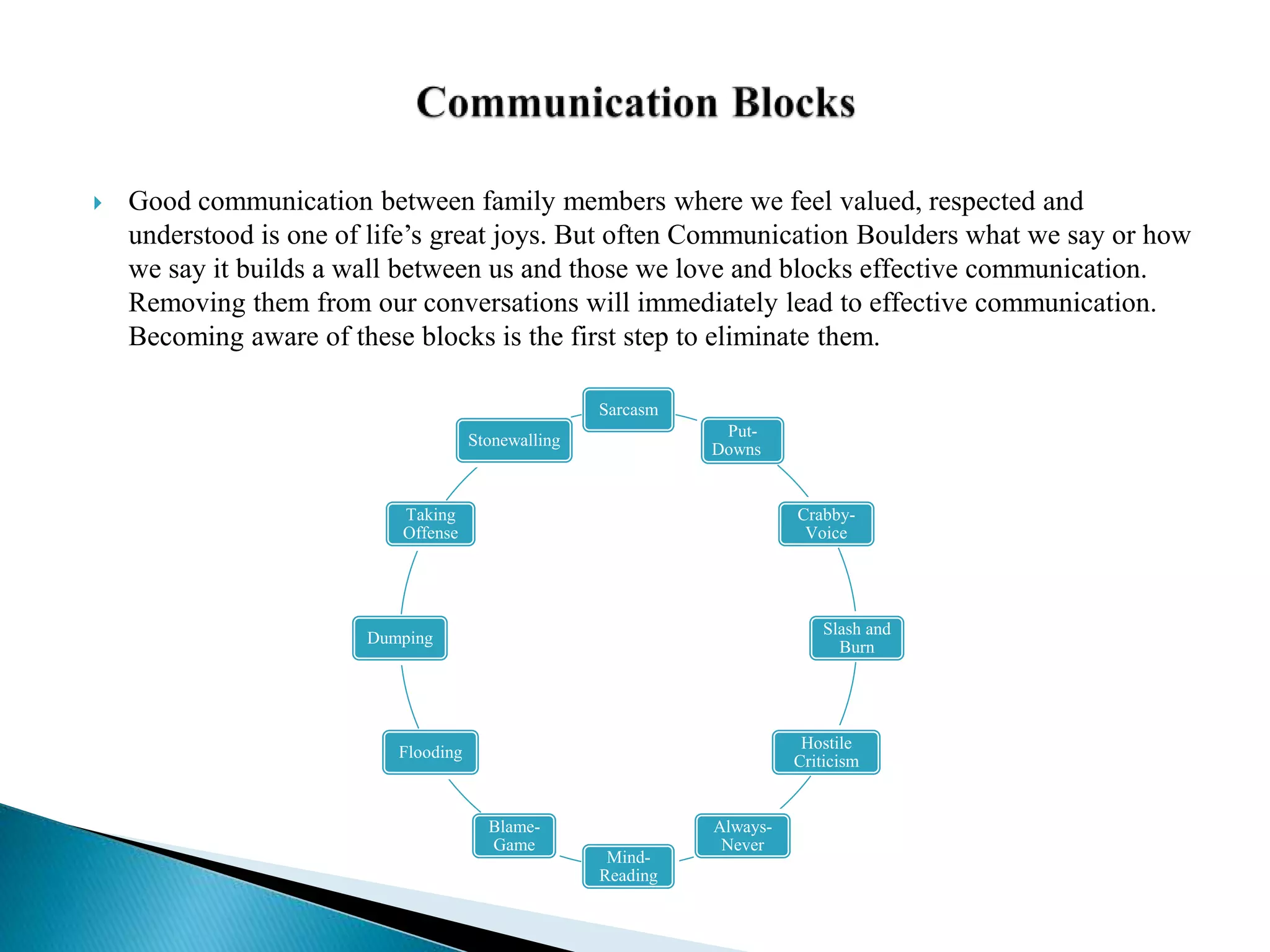
 Good communication between family members where we feel valued, respected and
understood is one of life’s great joys. But often Communication Boulders what we say or how
we say it builds a wall between us and those we love and blocks effective communication.
Removing them from our conversations will immediately lead to effective communication.
Becoming aware of these blocks is the first step to eliminate them.
Sarcasm
Put-
Downs
Crabby-
Voice
Slash and
Burn
Hostile
Criticism
Always-
Never
Mind-
Reading
Blame-
Game
Flooding
Dumping
Taking
Offense
Stonewalling

Family Communication.pptx

  • 1.
    •Family communication refersto the way verbal and non-verbal information is exchanged between family members. It enables members to express their needs, wants, and concerns to each other. •It is through communication that family members are able to resolve the unavoidable problems that arise in all families.
  • 2.
     Communication canbe divided into two different areas: instrumental and affective.  Instrumental communication is the exchange of factual information that enables individuals to fulfil common family functions  Affective communication is the way individual family members share their emotions with one another  Some families function extremely well with instrumental communication, yet have great difficulty with affective communication. Healthy families are able to communicate well in both areas.
  • 3.
     Two communicationdimensions: Conversation orientation and Conformity orientation.  Conversation orientation::: the extent to which families foster open interaction among family members about their thoughts and feelings. o In families at the high end of this dimension, members interact frequently and for large amounts of time. o In families at the low end of conversation orientation, family members interact less frequently and discuss fewer topics openly with one another.  Conformity orientation::: Conformity orientationis the extent to which families encourage all members to have similar attitudes, beliefs, and values. o Interactions in families at the high end of this dimension typically emphasize obedience to parents and the interdependence of family members. o Conversely, families at the low end of conformity orientation encourage individuality in family members’ thoughts and feelings and tend to be less cohesive.
  • 4.
  • 5.
     Laissez-faire familiesare low in both conversation and conformity orientation.Children in these families are relatively likely to be influenced by social ties outside of the family.  Pluralistic families are high in conversation orientation and low in conformity orientation Children in pluralistic families learn to think independently and to value rational argumentation.  Protective families are low in conversation orientation and high in conformity orientation. Children in protective families learn to avoid conflict and not to question authority figures outside the family system.  Consensual families are high in both conversation and conformity orientation. Children in consensual families tend to evaluate messages according to how consistent they are with their parents’ attitudes, beliefs, and values.
  • 6.
     Good communicationbetween family members where we feel valued, respected and understood is one of life’s great joys. But often Communication Boulders what we say or how we say it builds a wall between us and those we love and blocks effective communication. Removing them from our conversations will immediately lead to effective communication. Becoming aware of these blocks is the first step to eliminate them. Sarcasm Put- Downs Crabby- Voice Slash and Burn Hostile Criticism Always- Never Mind- Reading Blame- Game Flooding Dumping Taking Offense Stonewalling