EXAMINING
SIMPLIFIED SHELF
LIFE TESTING
METHODS
DR. BRADY CARTER
HOUSEKEEPING
ITEMS
45 minutes of presentation
15 minutes for questions
Use chat pane for Q&A
Recording/slides will be sent out following
presentation
SPEAKER
INTRODUCTION
Examining Simplified Shelf Life Testing Methods
Dr. Brady Carter, Director of Food Science
METER Group, Inc. USA
WHAT IS SHELF LIFE?
The practical time a product remains desirable to the consumer
Used to translate to a best by date
Not regulated for most products
Dependent upon the intrinsic properties of the product such as
• Water activity
• Matrix type
• Ingredients
Dependent on extrinsic factors such as
• Storage humidity
• Storage temperature
• Packaging
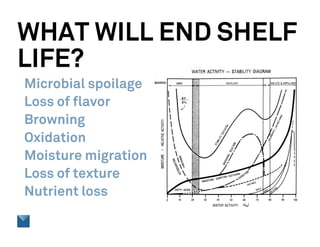
WHAT WILL END SHELF
LIFE?
Microbial spoilage
Loss of flavor
Browning
Oxidation
Moisture migration
Loss of texture
Nutrient loss
HOW DO YOU
DETERMINE SHELF
LIFE?
Guess
Estimate based on similar products on the market
Store product and observe until it becomes unacceptable
• What do you track?
• How do you test it?
Accelerated shelf life testing
• How do you use data to determine real shelf life?
WHAT IS SHELF LIFE
SIMPLIFIED?
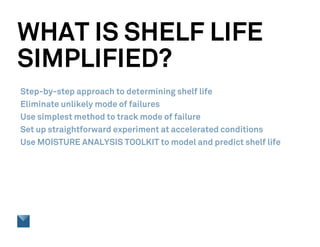
Step-by-step approach to determining shelf life
Eliminate unlikely mode of failures
Use simplest method to track mode of failure
Set up straightforward experiment at accelerated conditions
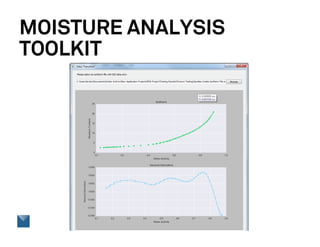
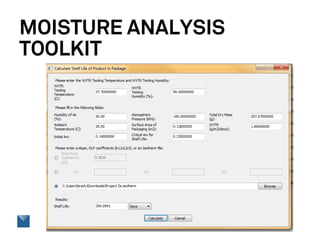
Use MOISTURE ANALYSIS TOOLKIT to model and predict shelf life
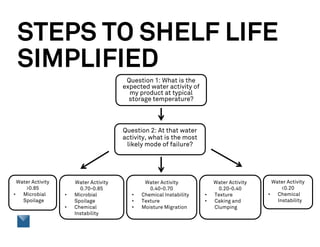
STEPS TO SHELF LIFE
SIMPLIFIED
Question 1: What is the
expected water activity of
my product at typical
storage temperature?
Question 2: At that water
activity, what is the most
likely mode of failure?
Water Activity
>0.85
• Microbial
Spoilage
Water Activity
0.70-0.85
• Microbial
Spoilage
• Chemical
Instability
Water Activity
0.40-0.70
• Chemical Instability
• Texture
• Moisture Migration
Water Activity
0.20-0.40
• Texture
• Caking and
Clumping
Water Activity
<0.20
• Chemical
Instability
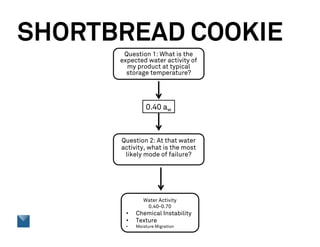
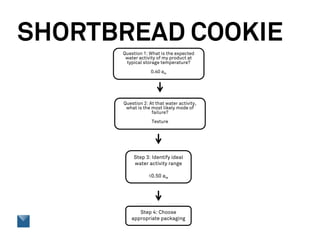
SHORTBREAD COOKIE
Question 1: What is the
expected water activity of
my product at typical
storage temperature?
Question 2: At that water
activity, what is the most
likely mode of failure?
Water Activity
0.40-0.70
• Chemical Instability
• Texture
• Moisture Migration
0.40 aw
GENERAL
EXPERIMENTAL
DESIGN
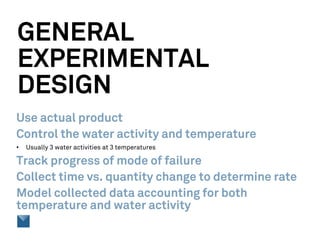
Use actual product
Control the water activity and temperature
• Usually 3 water activities at 3 temperatures
Track progress of mode of failure
Collect time vs. quantity change to determine rate
Model collected data accounting for both
temperature and water activity
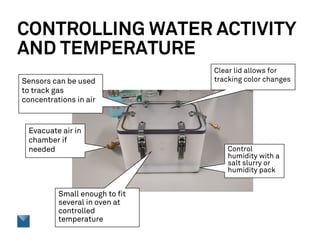
CONTROLLING WATER ACTIVITY
AND TEMPERATURE
Control
humidity with a
salt slurry or
humidity pack
Evacuate air in
chamber if
needed
Small enough to fit
several in oven at
controlled
temperature
Clear lid allows for
tracking color changesSensors can be used
to track gas
concentrations in air
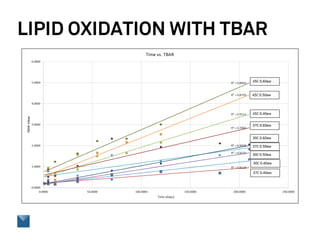
LIPID OXIDATION WITH TBAR
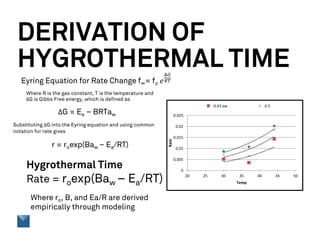
DERIVATION OF
HYGROTHERMAL TIME
Eyring Equation for Rate Change f∞= fo 𝑒
"#
$%
ΔG = Ea – BRTaw
r = roexp(Baw – Ea/RT)
Hygrothermal Time
Rate = roexp(Baw – Ea/RT)
Where ro, B, and Ea/R are derived
empirically through modeling
0
0.005
0.01
0.015
0.02
0.025
20 25 30 35 40 45 50
Rate
Temp
0.43	aw 0.5
Substituting ΔG into the Eyring equation and using common
notation for rate gives
Where R is the gas constant, T is the temperature and
ΔG is Gibbs Free energy, which is defined as
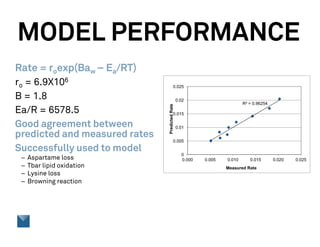
MODEL PERFORMANCE
Rate = roexp(Baw – Ea/RT)
ro = 6.9X10⁶
B = 1.8
Ea/R = 6578.5
Good agreement between
predicted and measured rates
Successfully used to model
– Aspartame loss
– Tbar lipid oxidation
– Lysine loss
– Browning reaction
R² = 0.96254
0
0.005
0.01
0.015
0.02
0.025
0.000 0.005 0.010 0.015 0.020 0.025
PredictedRate
Measured Rate
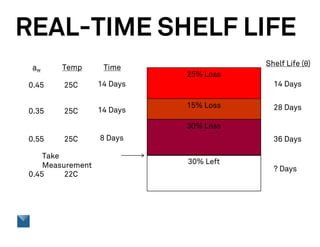
REAL-TIME SHELF LIFE
25% Loss
aw Temp Time
15% Loss
30% Loss
30% Left
0.45 25C 14 Days
0.35 25C 14 Days
Shelf Life (θ)
14 Days
28 Days
0.55 25C 8 Days 36 Days
0.45 22C
Take
Measurement ? Days
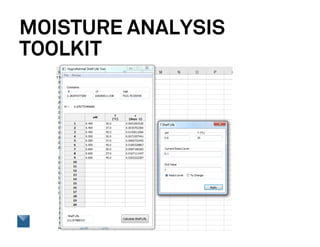
MOISTURE ANALYSIS
TOOLKIT
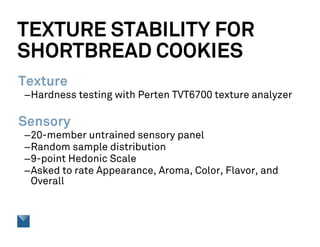
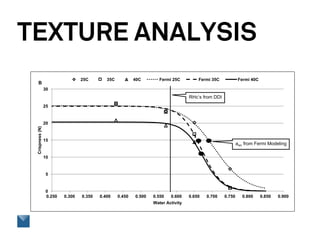
TEXTURE STABILITY FOR
SHORTBREAD COOKIES
Texture
–Hardness testing with Perten TVT6700 texture analyzer
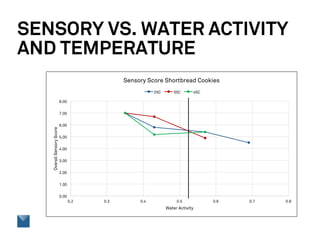
Sensory
–20-member untrained sensory panel
–Random sample distribution
–9-point Hedonic Scale
–Asked to rate Appearance, Aroma, Color, Flavor, and
Overall
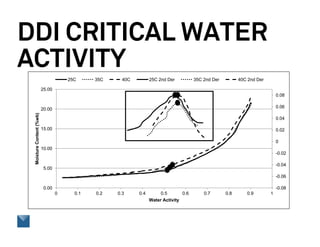
DDI CRITICAL WATER
ACTIVITY
-0.08
-0.06
-0.04
-0.02
0
0.02
0.04
0.06
0.08
0.00
5.00
10.00
15.00
20.00
25.00
0 0.1 0.2 0.3 0.4 0.5 0.6 0.7 0.8 0.9 1
MoistureContent(%wb)
Water Activity
25C 35C 40C 25C 2nd Der 35C 2nd Der 40C 2nd Der
TEXTURE ANALYSIS
0
5
10
15
20
25
30
0.250 0.300 0.350 0.400 0.450 0.500 0.550 0.600 0.650 0.700 0.750 0.800 0.850 0.900
Crispness(N)
Water Activity
25C 35C 40C Fermi 25C Fermi 35C Fermi 40C
B
RHc’s from DDI
awc from Fermi Modeling
SENSORY VS. WATER ACTIVITY
AND TEMPERATURE
0.00
1.00
2.00
3.00
4.00
5.00
6.00
7.00
8.00
0.2 0.3 0.4 0.5 0.6 0.7 0.8
OverallSensoryScore
Water Activity
Sensory Score Shortbread Cookies
25C 35C 45C
MOISTURE ANALYSIS
TOOLKIT
SHORTBREAD COOKIE
Question 1: What is the expected
water activity of my product at
typical storage temperature?
0.40 aw
Question 2: At that water activity,
what is the most likely mode of
failure?
Texture
Step 3: Identify ideal
water activity range
<0.50 aw
Step 4: Choose
appropriate packaging
STEP 4: ROLE OF
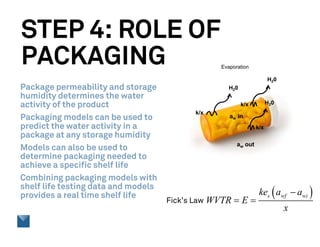
PACKAGING
Package permeability and storage
humidity determines the water
activity of the product
Packaging models can be used to
predict the water activity in a
package at any storage humidity
Models can also be used to
determine packaging needed to
achieve a specific shelf life
Combining packaging models with
shelf life testing data and models
provides a real time shelf life
Fick’s Law
( )s wf wike a a
WVTR E
x
-
= =
Evaporation
H20
H20
H20
aw in
aw out
k/x
k/x
k/x
MOISTURE ANALYSIS
TOOLKIT
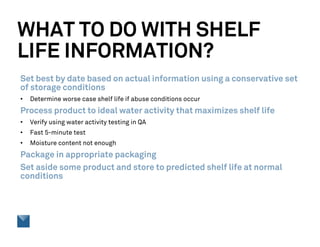
WHAT TO DO WITH SHELF
LIFE INFORMATION?
Set best by date based on actual information using a conservative set
of storage conditions
• Determine worse case shelf life if abuse conditions occur
Process product to ideal water activity that maximizes shelf life
• Verify using water activity testing in QA
• Fast 5-minute test
• Moisture content not enough
Package in appropriate packaging
Set aside some product and store to predicted shelf life at normal
conditions
CONTACT US FOR
MORE INFORMATION
Brady Carter, PhD
Phone: (509) 332-2756 / (800) 755-2751
Web: www.metergroup.com
Email: brady.carter@metergroup.com

Examining Simplified Shelf Life Testing Methods

  • 2.
  • 3.
    HOUSEKEEPING ITEMS 45 minutes ofpresentation 15 minutes for questions Use chat pane for Q&A Recording/slides will be sent out following presentation
  • 4.
    SPEAKER INTRODUCTION Examining Simplified ShelfLife Testing Methods Dr. Brady Carter, Director of Food Science METER Group, Inc. USA
  • 5.
    WHAT IS SHELFLIFE? The practical time a product remains desirable to the consumer Used to translate to a best by date Not regulated for most products Dependent upon the intrinsic properties of the product such as • Water activity • Matrix type • Ingredients Dependent on extrinsic factors such as • Storage humidity • Storage temperature • Packaging
  • 6.
    WHAT WILL ENDSHELF LIFE? Microbial spoilage Loss of flavor Browning Oxidation Moisture migration Loss of texture Nutrient loss
  • 7.
    HOW DO YOU DETERMINESHELF LIFE? Guess Estimate based on similar products on the market Store product and observe until it becomes unacceptable • What do you track? • How do you test it? Accelerated shelf life testing • How do you use data to determine real shelf life?
  • 8.
    WHAT IS SHELFLIFE SIMPLIFIED? Step-by-step approach to determining shelf life Eliminate unlikely mode of failures Use simplest method to track mode of failure Set up straightforward experiment at accelerated conditions Use MOISTURE ANALYSIS TOOLKIT to model and predict shelf life
  • 9.
    STEPS TO SHELFLIFE SIMPLIFIED Question 1: What is the expected water activity of my product at typical storage temperature? Question 2: At that water activity, what is the most likely mode of failure? Water Activity >0.85 • Microbial Spoilage Water Activity 0.70-0.85 • Microbial Spoilage • Chemical Instability Water Activity 0.40-0.70 • Chemical Instability • Texture • Moisture Migration Water Activity 0.20-0.40 • Texture • Caking and Clumping Water Activity <0.20 • Chemical Instability
  • 10.
    SHORTBREAD COOKIE Question 1:What is the expected water activity of my product at typical storage temperature? Question 2: At that water activity, what is the most likely mode of failure? Water Activity 0.40-0.70 • Chemical Instability • Texture • Moisture Migration 0.40 aw
  • 11.
    GENERAL EXPERIMENTAL DESIGN Use actual product Controlthe water activity and temperature • Usually 3 water activities at 3 temperatures Track progress of mode of failure Collect time vs. quantity change to determine rate Model collected data accounting for both temperature and water activity
  • 12.
    CONTROLLING WATER ACTIVITY ANDTEMPERATURE Control humidity with a salt slurry or humidity pack Evacuate air in chamber if needed Small enough to fit several in oven at controlled temperature Clear lid allows for tracking color changesSensors can be used to track gas concentrations in air
  • 13.
  • 14.
    DERIVATION OF HYGROTHERMAL TIME EyringEquation for Rate Change f∞= fo 𝑒 "# $% ΔG = Ea – BRTaw r = roexp(Baw – Ea/RT) Hygrothermal Time Rate = roexp(Baw – Ea/RT) Where ro, B, and Ea/R are derived empirically through modeling 0 0.005 0.01 0.015 0.02 0.025 20 25 30 35 40 45 50 Rate Temp 0.43 aw 0.5 Substituting ΔG into the Eyring equation and using common notation for rate gives Where R is the gas constant, T is the temperature and ΔG is Gibbs Free energy, which is defined as
  • 15.
    MODEL PERFORMANCE Rate =roexp(Baw – Ea/RT) ro = 6.9X10⁶ B = 1.8 Ea/R = 6578.5 Good agreement between predicted and measured rates Successfully used to model – Aspartame loss – Tbar lipid oxidation – Lysine loss – Browning reaction R² = 0.96254 0 0.005 0.01 0.015 0.02 0.025 0.000 0.005 0.010 0.015 0.020 0.025 PredictedRate Measured Rate
  • 16.
    REAL-TIME SHELF LIFE 25%Loss aw Temp Time 15% Loss 30% Loss 30% Left 0.45 25C 14 Days 0.35 25C 14 Days Shelf Life (θ) 14 Days 28 Days 0.55 25C 8 Days 36 Days 0.45 22C Take Measurement ? Days
  • 17.
  • 18.
    TEXTURE STABILITY FOR SHORTBREADCOOKIES Texture –Hardness testing with Perten TVT6700 texture analyzer Sensory –20-member untrained sensory panel –Random sample distribution –9-point Hedonic Scale –Asked to rate Appearance, Aroma, Color, Flavor, and Overall
  • 19.
    DDI CRITICAL WATER ACTIVITY -0.08 -0.06 -0.04 -0.02 0 0.02 0.04 0.06 0.08 0.00 5.00 10.00 15.00 20.00 25.00 00.1 0.2 0.3 0.4 0.5 0.6 0.7 0.8 0.9 1 MoistureContent(%wb) Water Activity 25C 35C 40C 25C 2nd Der 35C 2nd Der 40C 2nd Der
  • 20.
    TEXTURE ANALYSIS 0 5 10 15 20 25 30 0.250 0.3000.350 0.400 0.450 0.500 0.550 0.600 0.650 0.700 0.750 0.800 0.850 0.900 Crispness(N) Water Activity 25C 35C 40C Fermi 25C Fermi 35C Fermi 40C B RHc’s from DDI awc from Fermi Modeling
  • 21.
    SENSORY VS. WATERACTIVITY AND TEMPERATURE 0.00 1.00 2.00 3.00 4.00 5.00 6.00 7.00 8.00 0.2 0.3 0.4 0.5 0.6 0.7 0.8 OverallSensoryScore Water Activity Sensory Score Shortbread Cookies 25C 35C 45C
  • 22.
  • 23.
    SHORTBREAD COOKIE Question 1:What is the expected water activity of my product at typical storage temperature? 0.40 aw Question 2: At that water activity, what is the most likely mode of failure? Texture Step 3: Identify ideal water activity range <0.50 aw Step 4: Choose appropriate packaging
  • 24.
    STEP 4: ROLEOF PACKAGING Package permeability and storage humidity determines the water activity of the product Packaging models can be used to predict the water activity in a package at any storage humidity Models can also be used to determine packaging needed to achieve a specific shelf life Combining packaging models with shelf life testing data and models provides a real time shelf life Fick’s Law ( )s wf wike a a WVTR E x - = = Evaporation H20 H20 H20 aw in aw out k/x k/x k/x
  • 25.
  • 26.
    WHAT TO DOWITH SHELF LIFE INFORMATION? Set best by date based on actual information using a conservative set of storage conditions • Determine worse case shelf life if abuse conditions occur Process product to ideal water activity that maximizes shelf life • Verify using water activity testing in QA • Fast 5-minute test • Moisture content not enough Package in appropriate packaging Set aside some product and store to predicted shelf life at normal conditions
  • 27.
    CONTACT US FOR MOREINFORMATION Brady Carter, PhD Phone: (509) 332-2756 / (800) 755-2751 Web: www.metergroup.com Email: brady.carter@metergroup.com