Packaging of food beverage
industry
definitions
• Food-Food is any substance consumed to provide nutritional support for
an organism. It is usually of plant or animal origin, and contains
essential nutrients, such as carbohydrates, fats, proteins, vitamins,
or minerals. The substance is ingested by an organism and assimilated by
the organism's cells to provide energy, maintain life, or stimulate growth.
• Beverage-A beverage is a liquid intended for human consumption.In
addition to their basic function of satisfying thirst, drinks play important
roles in human culture. Common types of drinks include
plain water, milk, juices, coffee, tea, and soft drinks.
• Packaging-it is the technology of enclosing or protecting products for
distribution, storage, sale, and use. Packaging also refers to the process of
designing, evaluating, and producing packages. Packaging can be
described as a coordinated system of preparing goods for transport,
warehousing, logistics, sale, and end use. Packaging contains, protects,
preserves, transports, informs, and sells.
introduction
• Beverage are an important part of the diet of all
humans and have been since the earliest time.
• Much of beverage growth can be attributed to
the developments in packaging, which have made
it possible for a large national and international
trade in beverages to flourish.
• Today, wide variety of quite different beverages
are consumed along with full range of packaging
media is used(either alone or in varying
combinations) to bring these beverages to
consumers.
Key parameters for a packaging system
• Process
• Distribution, shelf-life requirements, legislation
• Product composition and quality as produced and at full
shelf-life
• Product protection required during storage, distribution
and retail sale
• Pack size, printing options, display etc.
• Packing system concept, automation options, ability to
integrate with existing and/or future systems
• Consumer appeal, image of product and packing
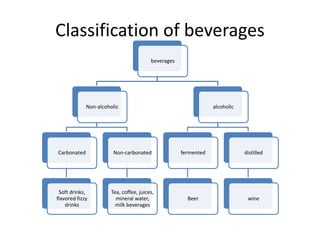
Classification of beverages
beverages
Non-alcoholic
Carbonated
Soft drinks,
flavored fizzy
drinks
Non-carbonated
Tea, coffee, juices,
mineral water,
milk beverages
alcoholic
fermented
Beer
distilled
wine
Non- alcoholic
beverages
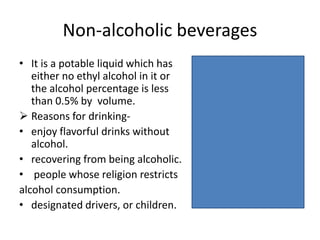
Non-alcoholic beverages
• It is a potable liquid which has
either no ethyl alcohol in it or
the alcohol percentage is less
than 0.5% by volume.
 Reasons for drinking-
• enjoy flavorful drinks without
alcohol.
• recovering from being alcoholic.
• people whose religion restricts
alcohol consumption.
• designated drivers, or children.
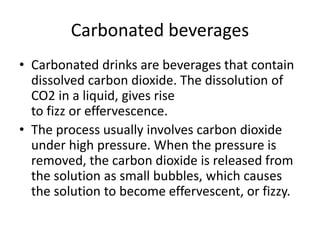
Carbonated beverages
• Carbonated drinks are beverages that contain
dissolved carbon dioxide. The dissolution of
CO2 in a liquid, gives rise
to fizz or effervescence.
• The process usually involves carbon dioxide
under high pressure. When the pressure is
removed, the carbon dioxide is released from
the solution as small bubbles, which causes
the solution to become effervescent, or fizzy.
Deteriorative changes
• Two major deteriorative changes that occur in carbonated drinks
are the loss of carbonation
• and rancidification of essential flavouring oils. The first is largely a
function of the effectiveness
• of the package in providing a barrier to gas permeation, while the
latter can be prevented by
• the use of high quality flavourings and antioxidants, and de-aerating
the mix prior to
• carbonation. Oxidative rancidity is reduced by the effectiveness of
the package in providing a
• barrier to gas permeation.
• Hence, the carbonated drink package requires a container that will
hold pressure and not
• contribute off flavours.
packaging
• Carbonated beverages are packaged in a wide
variety of formats and pack sizes, depending on
target markets, product characteristics and
geographical or cultural preferences.
• From disposable or returnable plastic or glass
bottles of various shapes and sizes to aluminium
cans, each requires a different filling technology,
using mechanical, volumetric or electronic filling
systems to ensure accurate and consistent filling
quality.
history
Among the metal containers, the
3-piece tinplate containers have
been used since long for the
packaging of carbonated
beverages.
For many years virtually all
carbonated soft drinks were
packaged in glass bottles sealed
with crown cork.
Recent trends
 Glass bottles
• In recent years, non-returnable glass bottles are giving way to refillable
bottles. These have a foam plastic protective label of paper/poly or an all
plastic shrink sleeve, as a safety measure to prevent flying of glass
fragments in case of breakage of these containers. The crown closure has
been replaced with a roll-on aluminium screw cap with tamper proof
facility.
 Metal cans
• 3-piece tinplate containers are being replaced now by 2-piece aluminium
cans. Vinyl, epoxy and vinyl organosol coatings are used as lacquers for
aluminium cans. Epoxy amine provides good adhesion, colour and
flexibility to the can.
 Plastic packaging
• Among the plastic containers, PET(Polyethylene terephthalate) bottles are
the most preferred packaging material for packaging of soft drinks.
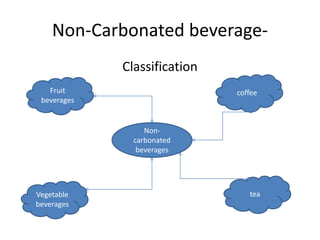
Non-Carbonated beverage-
Classification
Non-
carbonated
beverages
teaVegetable
beverages
coffeeFruit
beverages
Fruit beverages
• These include fruit juices, fruit drinks, and fruit nectars. They contain fruit
juice, water, sugar, dextrose, invert sugar etc. The major deterioration that
occurs in fruit beverages is loss of nutrition, physico-chemical changes and
microbial growth. The product characteristics to be considered in relation
to packaging are:
 Acidity
 Enzymes
 Vitamin c
 Color and flavour
• Spoilage of fruit juices is mainly due to yeast. Its growth depends upon the
temperature. Spoilage of raw fruit juice at room temperature results in
alcoholic fermentation, followed by the oxidation of alcohol and fruit acids
by yeasts or moulds growing on the surface.
• Hence every living yeast cell must be removed or suppressed by
pasteurization, filtration and/or preservatives.
Packaging of fruit and vegetable
beverages
 Glasss containers-
• The use of glass bottles for the packaging of fruit beverages was widespread although the hot-
fill/hold/cool process had to be applied with care to avoid breakage of the containers. Glass is still
the preferred packaging medium for high quality fruit beverages.
 Metal containers-
• Tinplate cans made of low carbon mild steel of 99.75% purity, coated with tin with easy open ends
are used. These tinplate containers are either 3 piece or 2 piece containers. They are lacquered
internally to prevent corrosion.
 Plastic Containers-
• Fruit juices contain organic substances, which are sensitive to bacterial contamination. Packaging of
such products is done through hot filling, to achieve extended shelf-life, PET bottles are usually
used for hot filling applications.
• Normally hot-filled PET bottles are designed about 1.5 times heavier than cold-filled bottles.
• Flexible plastic packages offer economic savings over conventional glass and metal containers but
they are permeable to oxygen. Flexible laminated pouches like metallised polyester/polyester/
polyethylene are used for hot fill packaging method without retorting for acidic fruit juices. These
are used either as flat pouches or stand-up pouches. However, the shelf-life of the product in these
pouches is limited.
 Aseptic Packages-
• Ready to serve fruit beverages and fruit pulps/concentrates, packed in aseptic
packages provide excellent protection for fruit juices/pulps.
• These aseptic packages are made by combining thermoplastic with paperboard
and aluminium foil. Their multi-layered construction enables the carton to protect
the contents from various factors responsible for spoilage. The aluminium foil layer
is a strong barrier for O2 and light.
• The inner plastic layer made of polyethylene makes it possible to seal through the
liquid. The outer paper layer provides stiffness making it possible for the cartons in
a brick shape, thus, enabling maximum utilisation of available storage and
transportation space.
 Bag-in-Box System-
It consists of a collapsible bag within a rigid container, a filling machine to introduce
the liquid product into the bag and a dispenser to draw the
product out. Plastic films manufactured from high performance polyethylene, with
excellent sealing and puncture properties are usually used as inner layer materials.
The spout and cap assembly are made of injection moulded plastics.
Coffee
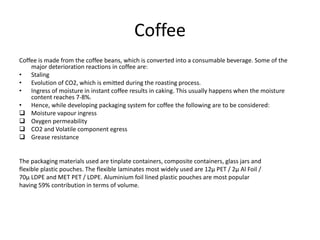
Coffee is made from the coffee beans, which is converted into a consumable beverage. Some of the
major deterioration reactions in coffee are:
• Staling
• Evolution of CO2, which is emitted during the roasting process.
• Ingress of moisture in instant coffee results in caking. This usually happens when the moisture
content reaches 7-8%.
• Hence, while developing packaging system for coffee the following are to be considered:
 Moisture vapour ingress
 Oxygen permeability
 CO2 and Volatile component egress
 Grease resistance
The packaging materials used are tinplate containers, composite containers, glass jars and
flexible plastic pouches. The flexible laminates most widely used are 12μ PET / 2μ Al Foil /
70μ LDPE and MET PET / LDPE. Aluminium foil lined plastic pouches are most popular
having 59% contribution in terms of volume.
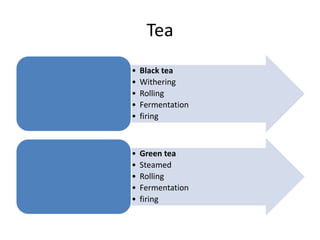
Tea
• Black tea
• Withering
• Rolling
• Fermentation
• firing
• Green tea
• Steamed
• Rolling
• Fermentation
• firing
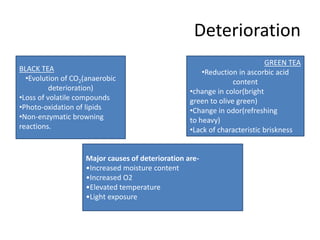
Deterioration
BLACK TEA
•Evolution of CO2(anaerobic
deterioration)
•Loss of volatile compounds
•Photo-oxidation of lipids
•Non-enzymatic browning
reactions.
GREEN TEA
•Reduction in ascorbic acid
content
•change in color(bright
green to olive green)
•Change in odor(refreshing
to heavy)
•Lack of characteristic briskness
Major causes of deterioration are-
•Increased moisture content
•Increased O2
•Elevated temperature
•Light exposure
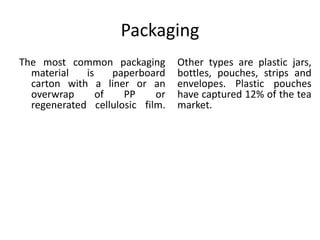
Packaging
The most common packaging
material is paperboard
carton with a liner or an
overwrap of PP or
regenerated cellulosic film.
Other types are plastic jars,
bottles, pouches, strips and
envelopes. Plastic pouches
have captured 12% of the tea
market.
Alcoholic beverages
Introduction-
• Alcoholic drinks originated through the action of yeast
cells on sugar containing liquids. Alcoholic drinks are
aromatic liquids with a specified alcohol content.
• Some kinds contain carbon dioxide, others a quantity
of sugar.
• They are either fruit/sap based or grain based.
• They can either be non-distilled or distilled depending
on the volume percentage of alcohol per litre. The
border between the two kinds of drink is about 20%.
• The different types of alcoholic beverages are beer,
wine, whiskey, brandy etc.
Non-distilled alcoholic beverages
• Beer (Grain Based):
Beer is made from grains and has low alcoholic content
around 5% by volume. The grains are brewed and
fermented and then carbonated with CO2 and
flavoured with hops to give a bitter flavour.
• Wine (Fruit/Sap based):
Wine is a beverage resulting from the fermentation by
yeasts of the juice of grapes with appropriate
processing and additions. The major deteriorative
reaction in wines is caused by oxidation, the oxygen
gradually changing the wine character, leading to
development of browning and undesirable flavours.
Distilled alcoholic beverages
 Brandy and Whisky:
• These drinks are obtained by distillation of alcohol
containing drinks. During distillation the aqueous part is
separated from the alcohol.
• The distillates obtained are sold under several names like
brandy, gin, whisky cognac, vodka, etc. and have different
alcohol percentage.
• Because of their high alcohol percentages, these liquors are
mostly packed in glass bottles so that they can be kept for
an infinite time after opening.
• The bottles are sealed to prevent alcohol from evaporating
and to protect the contents of the bottles from dirt and
dust.
Deterioration
• Flavor loss accelerated in presence of light and
certain metal ions.
• Presence of oxygen reduces shelf life.
• ‘Heavy beer’ containing higher protein and
carbohydrate content.
Conclusion
•Tea, coffee, fruit juices, alcoholic drinks and carbonated soft drinks
are the most popular beverages in the Indian society today.
•Sophisticated packaging media and techniques have enabled
retention of the unique taste, colour and aroma of these beverages
while in transportation and storage.
•The traditional returnable glass bottles have given way to newer
plastic containers as packing solutions.
•In rigid applications, glass, metal and plastics are the major packaging
material used. Flexible plastic packages offer economical savings over
conventional glass and metal containers.
•Use of PET bottles for packing alcoholic beverages and carbonated
soft drinks have revolutionized the packaging industry in India. The use
of plastic packaging in the beverage market will witness high growth.

packaging

  • 1.
    Packaging of foodbeverage industry
  • 2.
    definitions • Food-Food isany substance consumed to provide nutritional support for an organism. It is usually of plant or animal origin, and contains essential nutrients, such as carbohydrates, fats, proteins, vitamins, or minerals. The substance is ingested by an organism and assimilated by the organism's cells to provide energy, maintain life, or stimulate growth. • Beverage-A beverage is a liquid intended for human consumption.In addition to their basic function of satisfying thirst, drinks play important roles in human culture. Common types of drinks include plain water, milk, juices, coffee, tea, and soft drinks. • Packaging-it is the technology of enclosing or protecting products for distribution, storage, sale, and use. Packaging also refers to the process of designing, evaluating, and producing packages. Packaging can be described as a coordinated system of preparing goods for transport, warehousing, logistics, sale, and end use. Packaging contains, protects, preserves, transports, informs, and sells.
  • 3.
    introduction • Beverage arean important part of the diet of all humans and have been since the earliest time. • Much of beverage growth can be attributed to the developments in packaging, which have made it possible for a large national and international trade in beverages to flourish. • Today, wide variety of quite different beverages are consumed along with full range of packaging media is used(either alone or in varying combinations) to bring these beverages to consumers.
  • 4.
    Key parameters fora packaging system • Process • Distribution, shelf-life requirements, legislation • Product composition and quality as produced and at full shelf-life • Product protection required during storage, distribution and retail sale • Pack size, printing options, display etc. • Packing system concept, automation options, ability to integrate with existing and/or future systems • Consumer appeal, image of product and packing
  • 5.
    Classification of beverages beverages Non-alcoholic Carbonated Softdrinks, flavored fizzy drinks Non-carbonated Tea, coffee, juices, mineral water, milk beverages alcoholic fermented Beer distilled wine
  • 6.
  • 7.
    Non-alcoholic beverages • Itis a potable liquid which has either no ethyl alcohol in it or the alcohol percentage is less than 0.5% by volume.  Reasons for drinking- • enjoy flavorful drinks without alcohol. • recovering from being alcoholic. • people whose religion restricts alcohol consumption. • designated drivers, or children.
  • 8.
    Carbonated beverages • Carbonateddrinks are beverages that contain dissolved carbon dioxide. The dissolution of CO2 in a liquid, gives rise to fizz or effervescence. • The process usually involves carbon dioxide under high pressure. When the pressure is removed, the carbon dioxide is released from the solution as small bubbles, which causes the solution to become effervescent, or fizzy.
  • 9.
    Deteriorative changes • Twomajor deteriorative changes that occur in carbonated drinks are the loss of carbonation • and rancidification of essential flavouring oils. The first is largely a function of the effectiveness • of the package in providing a barrier to gas permeation, while the latter can be prevented by • the use of high quality flavourings and antioxidants, and de-aerating the mix prior to • carbonation. Oxidative rancidity is reduced by the effectiveness of the package in providing a • barrier to gas permeation. • Hence, the carbonated drink package requires a container that will hold pressure and not • contribute off flavours.
  • 10.
    packaging • Carbonated beveragesare packaged in a wide variety of formats and pack sizes, depending on target markets, product characteristics and geographical or cultural preferences. • From disposable or returnable plastic or glass bottles of various shapes and sizes to aluminium cans, each requires a different filling technology, using mechanical, volumetric or electronic filling systems to ensure accurate and consistent filling quality.
  • 11.
    history Among the metalcontainers, the 3-piece tinplate containers have been used since long for the packaging of carbonated beverages. For many years virtually all carbonated soft drinks were packaged in glass bottles sealed with crown cork.
  • 12.
    Recent trends  Glassbottles • In recent years, non-returnable glass bottles are giving way to refillable bottles. These have a foam plastic protective label of paper/poly or an all plastic shrink sleeve, as a safety measure to prevent flying of glass fragments in case of breakage of these containers. The crown closure has been replaced with a roll-on aluminium screw cap with tamper proof facility.  Metal cans • 3-piece tinplate containers are being replaced now by 2-piece aluminium cans. Vinyl, epoxy and vinyl organosol coatings are used as lacquers for aluminium cans. Epoxy amine provides good adhesion, colour and flexibility to the can.  Plastic packaging • Among the plastic containers, PET(Polyethylene terephthalate) bottles are the most preferred packaging material for packaging of soft drinks.
  • 13.
  • 14.
    Fruit beverages • Theseinclude fruit juices, fruit drinks, and fruit nectars. They contain fruit juice, water, sugar, dextrose, invert sugar etc. The major deterioration that occurs in fruit beverages is loss of nutrition, physico-chemical changes and microbial growth. The product characteristics to be considered in relation to packaging are:  Acidity  Enzymes  Vitamin c  Color and flavour • Spoilage of fruit juices is mainly due to yeast. Its growth depends upon the temperature. Spoilage of raw fruit juice at room temperature results in alcoholic fermentation, followed by the oxidation of alcohol and fruit acids by yeasts or moulds growing on the surface. • Hence every living yeast cell must be removed or suppressed by pasteurization, filtration and/or preservatives.
  • 15.
    Packaging of fruitand vegetable beverages  Glasss containers- • The use of glass bottles for the packaging of fruit beverages was widespread although the hot- fill/hold/cool process had to be applied with care to avoid breakage of the containers. Glass is still the preferred packaging medium for high quality fruit beverages.  Metal containers- • Tinplate cans made of low carbon mild steel of 99.75% purity, coated with tin with easy open ends are used. These tinplate containers are either 3 piece or 2 piece containers. They are lacquered internally to prevent corrosion.  Plastic Containers- • Fruit juices contain organic substances, which are sensitive to bacterial contamination. Packaging of such products is done through hot filling, to achieve extended shelf-life, PET bottles are usually used for hot filling applications. • Normally hot-filled PET bottles are designed about 1.5 times heavier than cold-filled bottles. • Flexible plastic packages offer economic savings over conventional glass and metal containers but they are permeable to oxygen. Flexible laminated pouches like metallised polyester/polyester/ polyethylene are used for hot fill packaging method without retorting for acidic fruit juices. These are used either as flat pouches or stand-up pouches. However, the shelf-life of the product in these pouches is limited.
  • 16.
     Aseptic Packages- •Ready to serve fruit beverages and fruit pulps/concentrates, packed in aseptic packages provide excellent protection for fruit juices/pulps. • These aseptic packages are made by combining thermoplastic with paperboard and aluminium foil. Their multi-layered construction enables the carton to protect the contents from various factors responsible for spoilage. The aluminium foil layer is a strong barrier for O2 and light. • The inner plastic layer made of polyethylene makes it possible to seal through the liquid. The outer paper layer provides stiffness making it possible for the cartons in a brick shape, thus, enabling maximum utilisation of available storage and transportation space.  Bag-in-Box System- It consists of a collapsible bag within a rigid container, a filling machine to introduce the liquid product into the bag and a dispenser to draw the product out. Plastic films manufactured from high performance polyethylene, with excellent sealing and puncture properties are usually used as inner layer materials. The spout and cap assembly are made of injection moulded plastics.
  • 17.
    Coffee Coffee is madefrom the coffee beans, which is converted into a consumable beverage. Some of the major deterioration reactions in coffee are: • Staling • Evolution of CO2, which is emitted during the roasting process. • Ingress of moisture in instant coffee results in caking. This usually happens when the moisture content reaches 7-8%. • Hence, while developing packaging system for coffee the following are to be considered:  Moisture vapour ingress  Oxygen permeability  CO2 and Volatile component egress  Grease resistance The packaging materials used are tinplate containers, composite containers, glass jars and flexible plastic pouches. The flexible laminates most widely used are 12μ PET / 2μ Al Foil / 70μ LDPE and MET PET / LDPE. Aluminium foil lined plastic pouches are most popular having 59% contribution in terms of volume.
  • 18.
    Tea • Black tea •Withering • Rolling • Fermentation • firing • Green tea • Steamed • Rolling • Fermentation • firing
  • 19.
    Deterioration BLACK TEA •Evolution ofCO2(anaerobic deterioration) •Loss of volatile compounds •Photo-oxidation of lipids •Non-enzymatic browning reactions. GREEN TEA •Reduction in ascorbic acid content •change in color(bright green to olive green) •Change in odor(refreshing to heavy) •Lack of characteristic briskness Major causes of deterioration are- •Increased moisture content •Increased O2 •Elevated temperature •Light exposure
  • 20.
    Packaging The most commonpackaging material is paperboard carton with a liner or an overwrap of PP or regenerated cellulosic film. Other types are plastic jars, bottles, pouches, strips and envelopes. Plastic pouches have captured 12% of the tea market.
  • 21.
  • 22.
    Introduction- • Alcoholic drinksoriginated through the action of yeast cells on sugar containing liquids. Alcoholic drinks are aromatic liquids with a specified alcohol content. • Some kinds contain carbon dioxide, others a quantity of sugar. • They are either fruit/sap based or grain based. • They can either be non-distilled or distilled depending on the volume percentage of alcohol per litre. The border between the two kinds of drink is about 20%. • The different types of alcoholic beverages are beer, wine, whiskey, brandy etc.
  • 23.
    Non-distilled alcoholic beverages •Beer (Grain Based): Beer is made from grains and has low alcoholic content around 5% by volume. The grains are brewed and fermented and then carbonated with CO2 and flavoured with hops to give a bitter flavour. • Wine (Fruit/Sap based): Wine is a beverage resulting from the fermentation by yeasts of the juice of grapes with appropriate processing and additions. The major deteriorative reaction in wines is caused by oxidation, the oxygen gradually changing the wine character, leading to development of browning and undesirable flavours.
  • 24.
    Distilled alcoholic beverages Brandy and Whisky: • These drinks are obtained by distillation of alcohol containing drinks. During distillation the aqueous part is separated from the alcohol. • The distillates obtained are sold under several names like brandy, gin, whisky cognac, vodka, etc. and have different alcohol percentage. • Because of their high alcohol percentages, these liquors are mostly packed in glass bottles so that they can be kept for an infinite time after opening. • The bottles are sealed to prevent alcohol from evaporating and to protect the contents of the bottles from dirt and dust.
  • 25.
    Deterioration • Flavor lossaccelerated in presence of light and certain metal ions. • Presence of oxygen reduces shelf life. • ‘Heavy beer’ containing higher protein and carbohydrate content.
  • 26.
    Conclusion •Tea, coffee, fruitjuices, alcoholic drinks and carbonated soft drinks are the most popular beverages in the Indian society today. •Sophisticated packaging media and techniques have enabled retention of the unique taste, colour and aroma of these beverages while in transportation and storage. •The traditional returnable glass bottles have given way to newer plastic containers as packing solutions. •In rigid applications, glass, metal and plastics are the major packaging material used. Flexible plastic packages offer economical savings over conventional glass and metal containers. •Use of PET bottles for packing alcoholic beverages and carbonated soft drinks have revolutionized the packaging industry in India. The use of plastic packaging in the beverage market will witness high growth.