© 2008 Pearson Prentice Hall, Electronic Commerce 2008, Efraim Turban, et al.
Dynamic Trading: E-Auctions,
Bartering, and Negotiations
10-2
Learning Objectives
1. Define the various types of e-auctions and
list their characteristics.
2. Describe forward and reverse auctions.
3. Describe the benefits and limitations of e-
auctions.
4. Describe some unique e-auction models.
5. Describe the various services that support e-
auctions.
10-3
Learning Objectives
6. Describe bartering and negotiating.
7. Describe the hazards of e-auction
fraud and discuss possible
countermeasures.
8. Describe e-auction deployment and
implementation issues.
9. Analyze mobile and future directions of
e-auctions.
10-4
Fundamentals of
Dynamic Pricing and E-Auctions
auction
Market mechanism by which buyers
make bids and sellers place offers;
characterized by the competitive and
dynamic nature by which the final price
is reached
electronic auctions (e-auctions)
Auctions conducted online
10-5
Fundamentals of
Dynamic Pricing and E-Auctions
dynamic pricing
Fluctuating prices that are determined
based on supply and demand
relationships at any given time
10-6
Fundamentals of
Dynamic Pricing and E-Auctions
10-7
Fundamentals of
Dynamic Pricing and E-Auctions
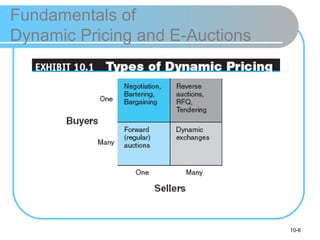
One Buyer, One Seller
One Seller, Many Potential Buyers
forward auction
An auction in which a seller offers a product to
many potential buyers
sealed-bid auction
Auction in which each bidder bids only once; a
silent auction, in which bidders do not know who is
placing bids or what the bid prices are
Vickrey auction
Auction in which the highest bidder wins but pays
only the second highest bid
10-8
Fundamentals of
Dynamic Pricing and E-Auctions
One Buyer, Many Potential Sellers
reverse auction
Auction in which the buyer places an item
for bid (tender) on a request for quote
(RFQ) system; potential suppliers bid on the
job, with bid price reducing sequentially, and
the lowest bid wins; used mainly in B2B and
G2B e-commerce
10-9
Fundamentals of
Dynamic Pricing and E-Auctions
B2B reverse auctions
C2C reverse auctions
“name-your-own-price” model
Auction model in which would-be buyers
specify the price (and other terms) they are
willing to pay to any willing seller; a C2B
model pioneered by Priceline.com
10-10
Fundamentals of
Dynamic Pricing and E-Auctions
Many Sellers, Many Buyers
vertical auction
Auction that takes place between sellers
and buyers in one industry or for one
commodity
auction vortals
Another name for a vertical auction vertical
portal
10-11
Benefits, Limitations,
and Strategic Uses of E-Auctions
Benefits of E-Auctions
Benefits to sellers
Larger reach and increased revenues
Optimal price setting
Removal of expensive intermediaries
Liquidation
Lower transaction costs
Lower administrative costs
Better customer relationships
10-12
Benefits, Limitations,
and Strategic Uses of E-Auctions
Benefits to buyers
Opportunities to Find Unique Items and Collectibles
Lower prices
Anonymity
Convenience
Entertainment
Benefits to E-Auctioneers
Higher repeat purchases
A stickier Web site
Expansion of the auction business
10-13
Benefits, Limitations,
and Strategic Uses of E-Auctions
Limitations of E-Auctions
Possibility of fraud
Limited participation
Security
Auction software
Long cycle time
Monitoring time
Equipment for buyers
Order fulfillment costs
10-14
Benefits, Limitations,
and Strategic Uses of E-Auctions
Strategic Uses of Auctions and
Pricing Mechanisms
Through dynamic pricing, buyers and
sellers are able to adjust pricing strategies
and optimize product inventory levels very
quickly
Auctions for Publicity
Auctions can be used to attract attention
10-15
The “Name-Your-Own-Price” C2B
Model
One of the most interesting e-commerce
models is the “name-your-own-price” model
This model enables consumers to achieve
significant savings by naming their own price
for goods and services
The concept is that of a C2B reverse auction,
in which vendors bid on a job by submitting
offers and the lowest-priced vendor or the one
that meets the buyer’s requirements gets the
job
10-16
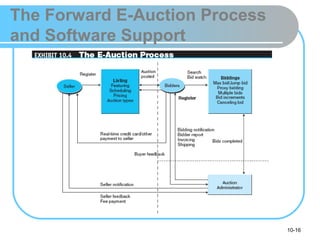
The Forward E-Auction Process
and Software Support
10-17
The Forward E-Auction Process
and Software Support
Phase 1: Searching and Comparing
Auction aggregators and notification
auction aggregators
Companies that use software agents to visit
Web auction sites, find information, summarize
it, and deliver it to users
Browsing site categories
Basic and advanced searching
10-18
The Forward E-Auction Process
and Software Support
Phase 2: Getting Started at an
Auction
Registration and participants’ profiles
Listing and promoting
Pricing
10-19
The Forward E-Auction Process
and Software Support
Phase 3: Bidding
Bid Watching and Multiple Bids
sniping
Entering a bid during the very last seconds of an
auction and outbidding the highest bidder
proxy bidding
Use of a software system to place bids on behalf
of buyers; when another bidder places a bid, the
software (the proxy) will automatically raise the
bid to the next level until it reaches the buyer’s
predetermined maximum price
10-20
The Forward E-Auction Process
and Software Support
Phase 4: Post auction Follow-Up
Post auction activities
Bidding notifications
End-of-auction notices
Seller notices
Postcards and thank-you notes
User communication
Chat groups
Mailing lists
Message boards
10-21
The Forward E-Auction Process
and Software Support
Feedback and ratings
Invoicing and billing
Payment methods
P2P transfer service
Escrow service
Credit card payment
Shipping and postage
10-22
The Forward E-Auction Process
and Software Support
Additional Terms and Rules
Bid retraction
Featured auctions
Other services
10-23
Double Auctions,
Bundle Trading, and Pricing Issues
Double Auctions
single auction
Auction in which at least one side of the market
consists of a single entity (a single buyer or a single
seller)
double auction
Auction in which multiple buyers and sellers may be
making bids and offers simultaneously; buyers and
their bidding prices and sellers and their asking
prices are matched, considering the quantities on
both sides
10-24
Double Auctions,
Bundle Trading, and Pricing Issues
bundle trading
The selling of several related products
and/or services together
Prices in Auctions: Higher or Lower?
Pricing strategies in online auctions
10-25
Bartering and Negotiating Online
bartering
The exchange of goods and services
electronic bartering (e-bartering)
Bartering conducted online, usually by a
bartering exchange
Consumer-to-consumer barter exchanges
10-26
Bartering and Negotiating Online
Negotiation and Bargaining
online negotiation
A back-and-forth electronic process of
bargaining until the buyer and seller reach a
mutually agreeable price; sometimes
supported by software (intelligent) agents
P2P online negotiations
10-27
Bartering and Negotiating Online
Technologies for electronic bargaining
Search
Selection
Negotiation
Continuing selection and negotiation
Transaction completion
10-28
E-Auction Fraud and Its Prevention
Types of E-Auction Fraud
bid shielding
Having phantom bidders bid at a very high
price when an auction begins; they pull out
at the last minute, and the real bidder who
bid a much lower price wins
shilling
Placing fake bids on auction items to
artificially jack up the bidding price
10-29
E-Auction Fraud and Its
Prevention
Fake photos and misleading descriptions
Improper grading techniques
Bid siphoning
Selling reproductions as originals
Failure to pay
Failure to pay the auction house
10-30
E-Auction Fraud and Its
Prevention
High shipping costs and handling fees
Failure to ship merchandise
Loss and damage claims
Fake escrow services
Switch and return
Other frauds
10-31
E-Auction Fraud and Its Prevention
User identity verification
Authentication service
Grading services
Feedback forum
Insurance policy
Escrow services
Nonpayment
punishment
Appraisal services
Physical inspection
Item verification
Buyer protections
Spoof (fraudulent) Web
site protection
eBay security center
Protecting against E-Auction Fraud
10-32
Issues in E-Auction Implementation
Using Intermediaries
Some of the popular third-party auction
sites include:
General sites
Specialized sites
B2B-oriented sites
Trading Assistants
Auction Rules
10-33
Issues in E-Auction Implementation
Strategic Issues
Which items (services) to auction
What type of auction to use
Whether to do the auction in-house or to use an
auctioneer (and which one)
How long to run each auction
How to set the initial prices
How to accept a bid
What increments to allow in the bidding
What information to disclose to the participants
10-34
Issues in E-Auction Implementation
Auctions in Exchanges
Infrastructure for E-Auctions
Building auction sites
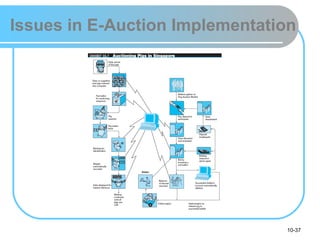
Auctions on Private Networks
Pigs in Singapore and Taiwan
Livestock auctions in Australia
10-35
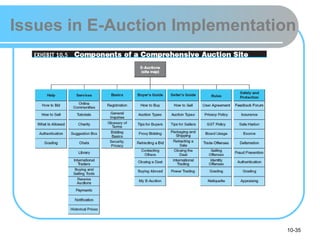
Issues in E-Auction Implementation
10-36
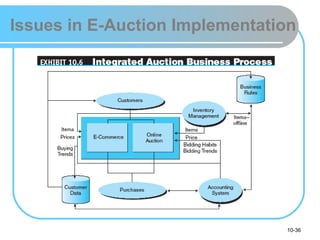
Issues in E-Auction Implementation
10-37
Issues in E-Auction Implementation
10-38
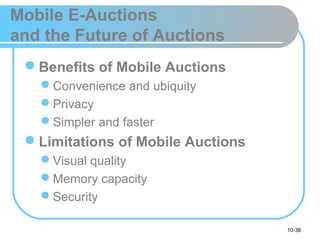
Mobile E-Auctions
and the Future of Auctions
Benefits of Mobile Auctions
Convenience and ubiquity
Privacy
Simpler and faster
Limitations of Mobile Auctions
Visual quality
Memory capacity
Security
10-39
Mobile E-Auctions
and the Future of Auctions
The Future of E-Auctions
Global auctions
Wireless auctions
Selling art online in real-time auctions
Strategic alliances
10-40
Managerial Issues
1. Should we have our own auction site or
use a third party site?
2. What are the costs and benefits of
auctions?
3. What auction strategies would we use?
4. What about support services?
10-41
Managerial Issues
5. What would we auction?
6. What is the best bartering strategy?
7. How can we promote our auction?
8. Should we combine auctions with other
models?

E auctions

  • 1.
    © 2008 PearsonPrentice Hall, Electronic Commerce 2008, Efraim Turban, et al. Dynamic Trading: E-Auctions, Bartering, and Negotiations
  • 2.
    10-2 Learning Objectives 1. Definethe various types of e-auctions and list their characteristics. 2. Describe forward and reverse auctions. 3. Describe the benefits and limitations of e- auctions. 4. Describe some unique e-auction models. 5. Describe the various services that support e- auctions.
  • 3.
    10-3 Learning Objectives 6. Describebartering and negotiating. 7. Describe the hazards of e-auction fraud and discuss possible countermeasures. 8. Describe e-auction deployment and implementation issues. 9. Analyze mobile and future directions of e-auctions.
  • 4.
    10-4 Fundamentals of Dynamic Pricingand E-Auctions auction Market mechanism by which buyers make bids and sellers place offers; characterized by the competitive and dynamic nature by which the final price is reached electronic auctions (e-auctions) Auctions conducted online
  • 5.
    10-5 Fundamentals of Dynamic Pricingand E-Auctions dynamic pricing Fluctuating prices that are determined based on supply and demand relationships at any given time
  • 6.
  • 7.
    10-7 Fundamentals of Dynamic Pricingand E-Auctions One Buyer, One Seller One Seller, Many Potential Buyers forward auction An auction in which a seller offers a product to many potential buyers sealed-bid auction Auction in which each bidder bids only once; a silent auction, in which bidders do not know who is placing bids or what the bid prices are Vickrey auction Auction in which the highest bidder wins but pays only the second highest bid
  • 8.
    10-8 Fundamentals of Dynamic Pricingand E-Auctions One Buyer, Many Potential Sellers reverse auction Auction in which the buyer places an item for bid (tender) on a request for quote (RFQ) system; potential suppliers bid on the job, with bid price reducing sequentially, and the lowest bid wins; used mainly in B2B and G2B e-commerce
  • 9.
    10-9 Fundamentals of Dynamic Pricingand E-Auctions B2B reverse auctions C2C reverse auctions “name-your-own-price” model Auction model in which would-be buyers specify the price (and other terms) they are willing to pay to any willing seller; a C2B model pioneered by Priceline.com
  • 10.
    10-10 Fundamentals of Dynamic Pricingand E-Auctions Many Sellers, Many Buyers vertical auction Auction that takes place between sellers and buyers in one industry or for one commodity auction vortals Another name for a vertical auction vertical portal
  • 11.
    10-11 Benefits, Limitations, and StrategicUses of E-Auctions Benefits of E-Auctions Benefits to sellers Larger reach and increased revenues Optimal price setting Removal of expensive intermediaries Liquidation Lower transaction costs Lower administrative costs Better customer relationships
  • 12.
    10-12 Benefits, Limitations, and StrategicUses of E-Auctions Benefits to buyers Opportunities to Find Unique Items and Collectibles Lower prices Anonymity Convenience Entertainment Benefits to E-Auctioneers Higher repeat purchases A stickier Web site Expansion of the auction business
  • 13.
    10-13 Benefits, Limitations, and StrategicUses of E-Auctions Limitations of E-Auctions Possibility of fraud Limited participation Security Auction software Long cycle time Monitoring time Equipment for buyers Order fulfillment costs
  • 14.
    10-14 Benefits, Limitations, and StrategicUses of E-Auctions Strategic Uses of Auctions and Pricing Mechanisms Through dynamic pricing, buyers and sellers are able to adjust pricing strategies and optimize product inventory levels very quickly Auctions for Publicity Auctions can be used to attract attention
  • 15.
    10-15 The “Name-Your-Own-Price” C2B Model Oneof the most interesting e-commerce models is the “name-your-own-price” model This model enables consumers to achieve significant savings by naming their own price for goods and services The concept is that of a C2B reverse auction, in which vendors bid on a job by submitting offers and the lowest-priced vendor or the one that meets the buyer’s requirements gets the job
  • 16.
    10-16 The Forward E-AuctionProcess and Software Support
  • 17.
    10-17 The Forward E-AuctionProcess and Software Support Phase 1: Searching and Comparing Auction aggregators and notification auction aggregators Companies that use software agents to visit Web auction sites, find information, summarize it, and deliver it to users Browsing site categories Basic and advanced searching
  • 18.
    10-18 The Forward E-AuctionProcess and Software Support Phase 2: Getting Started at an Auction Registration and participants’ profiles Listing and promoting Pricing
  • 19.
    10-19 The Forward E-AuctionProcess and Software Support Phase 3: Bidding Bid Watching and Multiple Bids sniping Entering a bid during the very last seconds of an auction and outbidding the highest bidder proxy bidding Use of a software system to place bids on behalf of buyers; when another bidder places a bid, the software (the proxy) will automatically raise the bid to the next level until it reaches the buyer’s predetermined maximum price
  • 20.
    10-20 The Forward E-AuctionProcess and Software Support Phase 4: Post auction Follow-Up Post auction activities Bidding notifications End-of-auction notices Seller notices Postcards and thank-you notes User communication Chat groups Mailing lists Message boards
  • 21.
    10-21 The Forward E-AuctionProcess and Software Support Feedback and ratings Invoicing and billing Payment methods P2P transfer service Escrow service Credit card payment Shipping and postage
  • 22.
    10-22 The Forward E-AuctionProcess and Software Support Additional Terms and Rules Bid retraction Featured auctions Other services
  • 23.
    10-23 Double Auctions, Bundle Trading,and Pricing Issues Double Auctions single auction Auction in which at least one side of the market consists of a single entity (a single buyer or a single seller) double auction Auction in which multiple buyers and sellers may be making bids and offers simultaneously; buyers and their bidding prices and sellers and their asking prices are matched, considering the quantities on both sides
  • 24.
    10-24 Double Auctions, Bundle Trading,and Pricing Issues bundle trading The selling of several related products and/or services together Prices in Auctions: Higher or Lower? Pricing strategies in online auctions
  • 25.
    10-25 Bartering and NegotiatingOnline bartering The exchange of goods and services electronic bartering (e-bartering) Bartering conducted online, usually by a bartering exchange Consumer-to-consumer barter exchanges
  • 26.
    10-26 Bartering and NegotiatingOnline Negotiation and Bargaining online negotiation A back-and-forth electronic process of bargaining until the buyer and seller reach a mutually agreeable price; sometimes supported by software (intelligent) agents P2P online negotiations
  • 27.
    10-27 Bartering and NegotiatingOnline Technologies for electronic bargaining Search Selection Negotiation Continuing selection and negotiation Transaction completion
  • 28.
    10-28 E-Auction Fraud andIts Prevention Types of E-Auction Fraud bid shielding Having phantom bidders bid at a very high price when an auction begins; they pull out at the last minute, and the real bidder who bid a much lower price wins shilling Placing fake bids on auction items to artificially jack up the bidding price
  • 29.
    10-29 E-Auction Fraud andIts Prevention Fake photos and misleading descriptions Improper grading techniques Bid siphoning Selling reproductions as originals Failure to pay Failure to pay the auction house
  • 30.
    10-30 E-Auction Fraud andIts Prevention High shipping costs and handling fees Failure to ship merchandise Loss and damage claims Fake escrow services Switch and return Other frauds
  • 31.
    10-31 E-Auction Fraud andIts Prevention User identity verification Authentication service Grading services Feedback forum Insurance policy Escrow services Nonpayment punishment Appraisal services Physical inspection Item verification Buyer protections Spoof (fraudulent) Web site protection eBay security center Protecting against E-Auction Fraud
  • 32.
    10-32 Issues in E-AuctionImplementation Using Intermediaries Some of the popular third-party auction sites include: General sites Specialized sites B2B-oriented sites Trading Assistants Auction Rules
  • 33.
    10-33 Issues in E-AuctionImplementation Strategic Issues Which items (services) to auction What type of auction to use Whether to do the auction in-house or to use an auctioneer (and which one) How long to run each auction How to set the initial prices How to accept a bid What increments to allow in the bidding What information to disclose to the participants
  • 34.
    10-34 Issues in E-AuctionImplementation Auctions in Exchanges Infrastructure for E-Auctions Building auction sites Auctions on Private Networks Pigs in Singapore and Taiwan Livestock auctions in Australia
  • 35.
  • 36.
  • 37.
  • 38.
    10-38 Mobile E-Auctions and theFuture of Auctions Benefits of Mobile Auctions Convenience and ubiquity Privacy Simpler and faster Limitations of Mobile Auctions Visual quality Memory capacity Security
  • 39.
    10-39 Mobile E-Auctions and theFuture of Auctions The Future of E-Auctions Global auctions Wireless auctions Selling art online in real-time auctions Strategic alliances
  • 40.
    10-40 Managerial Issues 1. Shouldwe have our own auction site or use a third party site? 2. What are the costs and benefits of auctions? 3. What auction strategies would we use? 4. What about support services?
  • 41.
    10-41 Managerial Issues 5. Whatwould we auction? 6. What is the best bartering strategy? 7. How can we promote our auction? 8. Should we combine auctions with other models?