Electronic Auctions
(e-auctions)
E-Commerce
Agenda
1. Definition
2. Example
3. Type of Auction
4. The E-Auctions Process and Software Support
5. E-Auction Fraud
6. Mobile E-Auctions and the Future of
Auctions
1. Definition: Online auction
•An online auction is a service in which auction
users or participants sell or bid for products or
services via the Internet. Virtual auctions facilitate
online activities between buyers and sellers in
different locations or geographical areas. Various
auction sites provide users with platforms
powered by different types of auction software.
An online auction is also known as a virtual
E-Auctions – A Major Trend in Supply
Chain
• CAPS Research (2003) defined an e-auction as an online, real-
time dynamic auction between a buyer (including an
organization) and a group of pre-qualified suppliers who
compete against each other so as to win the business of
supplying products or services that have pre-defined
specifications for design, quality, quantity, delivery, and related
terms and conditions. Within this e-auction, these suppliers
compete against each other by bidding online using specialized
software by submitting successively lower-priced bids during a
scheduled time period.
• Additionally, Sehwail and Ingalls (2004) defined e-auction as the
real-time electronic bidding event, which a company uses to
outsource products/ services with reducing bid prices.
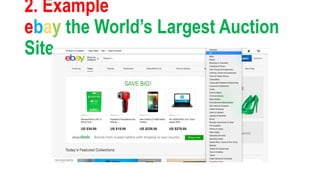
2. Example
ebay the World’s Largest Auction
Site
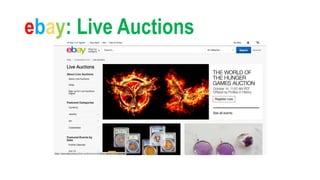
ebay: Live Auctions
http://pics.ebay.com/aw/pics/pdf/us/education/sellingbasics/selli
ngBasics.pdf
ebay the World’s Largest
Auction Site
•On eBay, people can buy and sell just about anything
The auction process:
•Seller fills in the appropriate registration information
•Posts a description of the item for sale specifying a minimum
opening bid
•If a successful bid is made, the seller and the buyer negotiate
(the payment method, shipping details, warranty, and other
particulars)
•eBay is the interface through which sellers and buyers can
3. Type of Auctions
Fundamentals of
Dynamic Pricing and E-Auctions
•auction
Market mechanism by which buyers make bids
and sellers place offers; characterized by the
competitive and dynamic nature by which the
final price is reached
•electronic auctions (e-auctions)
Auctions conducted online
Fundamentals of
Dynamic Pricing and E-Auctions
•dynamic pricing
Fluctuating prices that are determined based on
supply and demand relationships at any given
time
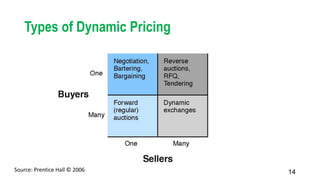
14
Types of Dynamic Pricing
Source: Prentice Hall © 2006
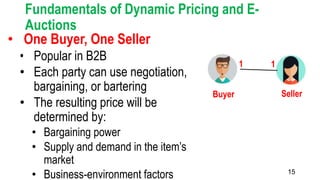
15
Fundamentals of Dynamic Pricing and E-
Auctions
• One Buyer, One Seller
• Popular in B2B
• Each party can use negotiation,
bargaining, or bartering
• The resulting price will be
determined by:
• Bargaining power
• Supply and demand in the item’s
market
• Business-environment factors
Buyer Seller
1 1
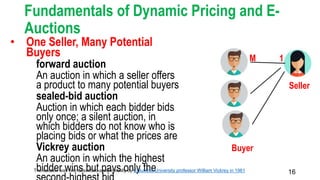
16
Fundamentals of Dynamic Pricing and E-
Auctions
• One Seller, Many Potential
Buyers
forward auction
An auction in which a seller offers
a product to many potential buyers
sealed-bid auction
Auction in which each bidder bids
only once; a silent auction, in
which bidders do not know who is
placing bids or what the prices are
Vickrey auction
An auction in which the highest
bidder wins but pays only the
Buyer
Seller
M 1
The auction was first described academically by Columbia University professor William Vickrey in 1961
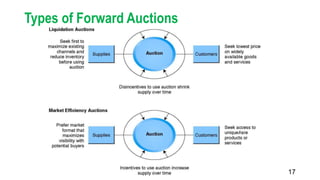
17
Types of Forward Auctions
18
Fundamentals of Dynamic Pricing and E-
Auctions
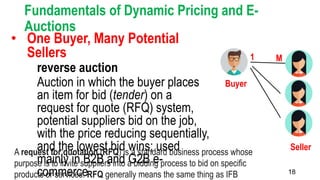
• One Buyer, Many Potential
Sellers
reverse auction
Auction in which the buyer places
an item for bid (tender) on a
request for quote (RFQ) system,
potential suppliers bid on the job,
with the price reducing sequentially,
and the lowest bid wins; used
mainly in B2B and G2B e-
commerce
Buyer
Seller
M
1
A request for quotation (RFQ) is a standard business process whose
purpose is to invite suppliers into a bidding process to bid on specific
products or services. RFQ generally means the same thing as IFB
19
Fundamentals of Dynamic Pricing and E-
Auctions
• One Buyer, Many Potential Sellers
• B2B Reverse Auctions
• C2C Reverse Auctions
• “Name-Your-Own-Price” Model
“name-your-own-price” model
Auction model in which would-be buyers specify the
price (and other terms) they are willing to pay to any
willing seller; a C2B model, pioneered by
Priceline.com
Priceline.com
21
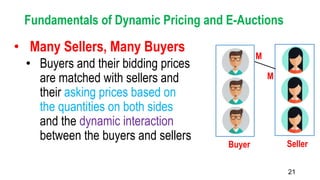
Fundamentals of Dynamic Pricing and E-Auctions
• Many Sellers, Many Buyers
• Buyers and their bidding prices
are matched with sellers and
their asking prices based on
the quantities on both sides
and the dynamic interaction
between the buyers and sellers
Buyer Seller
M
M
22
The “Name-Your-Own-Price” C2B
Model
• Enables consumers to achieve significant
savings by naming their own price for goods
and services
• Same concept as C2B reverse auction, in
which vendors bid on a job by submitting offers
and the lowest priced vendor or the one that
meets the buyer’s requirements gets the job
Types of Auctions
•English auctions:
•Single item up for sale to single buyer
•Highest bidder wins
•Traditional Dutch auction:
Uses a clock visible to all that displays starting price,
ticks down until buyer stops it
•Dutch Internet auction:
Public ascending price, multiple units
Final price is lowest successful bid, which sets price for
all higher bidders
24
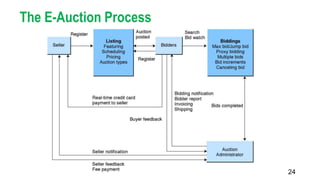
The E-Auction Process
25
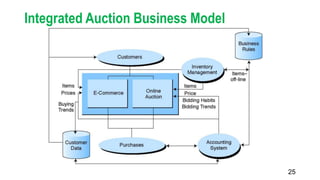
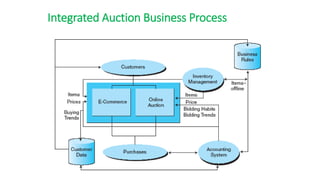
Integrated Auction Business Model
26
4. The E-Auctions Process and Software
Support
• Phase 1: Searching and Comparing
• Phase 2: Getting Started at an Auction
• Phase 3: Bidding
• Phase 4: Post-auction Follow-Up
•Phase 1: Searching and Comparing
•Auction aggregators and notification
•auction aggregators
Companies that use software agents to visit Web
auction sites, find information, summarize it, and
deliver it to users
•Browsing site categories
•Basic and advanced searching
The E-Auctions Process and Software Support
•Phase 2: Getting Started at an Auction
•Registration and participants’ profiles
•Listing and promoting
•Pricing
The E-Auctions Process and Software Support
•Phase 3: Bidding
•Bid Watching and Multiple Bids
• sniping
Entering a bid during the very last seconds of an auction
and outbidding the highest bidder
• proxy bidding
Use of a software system to place bids on behalf of buyers;
when another bidder places a bid, the software (the proxy)
will automatically raise the bid to the next level until it
reaches the buyer’s predetermined maximum price
The E-Auctions Process and Software Support
•Phase 4: Post auction Follow-Up
• Post auction activities
• Bidding notifications
• End-of-auction notices
• Seller notices
• Postcards and thank-you notes
• User communication
• Chat groups
• Mailing lists
• Message boards
The E-Auctions Process and Software Support
•Feedback and ratings
•Invoicing and billing
•Payment methods
•P2P transfer service
•Escrow service
•Credit card payment
•Shipping and postage
The E-Auctions Process and Software Support
•Additional Terms and Rules
•Bid retraction
•Featured auctions
•Other services
The E-Auctions Process and Software Support
Double Auctions, Bundle Trading, and Pricing Issues
•Double Auctions
•single auction
Auction in which at least one side of the market consists
of a single entity (a single buyer or a single seller)
•double auction
Auction in which multiple buyers and sellers may be
making bids and offers simultaneously; buyers and their
bidding prices and sellers and their asking prices are
matched, considering the quantities on both sides
34
5. E-Auction Fraud
• Fake photos and misleading descriptions
• Improper grading techniques
• Bid siphoning
• Selling reproductions as originals
• Failure to pay
• Failure to pay the auction house
35
5. E-Auction Fraud
• High shipping costs and handling fees
• Failure to ship merchandise
• Loss and damage claims
• Fake escrow services
• Switch and return
• Other frauds
10-36
5. E-Auction Fraud
•Types of E-Auction Fraud
•bid shielding
Having phantom bidders bid at a very high price
when an auction begins; they pull out at the last
minute, and the real bidder who bid a much lower
price wins
•shilling
Placing fake bids on auction items to artificially jack
up the bidding price
10-37
E-Auction Fraud and Its
Prevention
•User identity verification
•Authentication service
•Grading services
•Feedback forum
•Insurance policy
•Escrow services
•Nonpayment punishment
• Appraisal services
• Physical inspection
•Item verification
• Buyer protections
• Spoof (fraudulent) Web site
protection
• eBay security center
Protecting against E-Auction Fraud
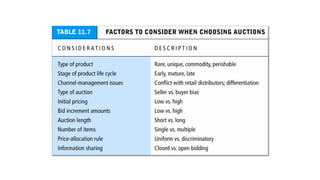
Issues in E-Auction Implementation
•Using Intermediaries e-auction
•Some of the popular third-party auction sites
include:
•General sites
•Specialized sites
•B2B-oriented sites
•Trading Assistants
•Auction Rules
Issues in E-Auction
Implementation
•Strategic Issues
•Which items (services) to auction
•What type of auction to use
•Whether to do the auction in-house or to use an
auctioneer (and which one)
•How long to run each auction
•How to set the initial prices
•How to accept a bid
•What increments to allow in the bidding
•What information to disclose to the participants
Issues in E-Auction Implementation
•Auctions in Exchanges
•Infrastructure for E-Auctions
•Building auction sites
•Auctions on Private Networks
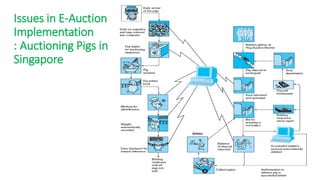
•Pigs in Singapore and Taiwan
•Livestock auctions in Australia
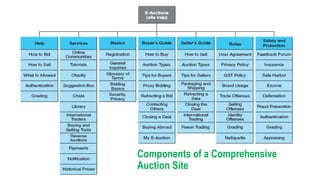
Components of a Comprehensive
Auction Site
Integrated Auction Business Process
Issues in E-Auction
Implementation
: Auctioning Pigs in
Singapore
6. Mobile E-Auctions and the Future of
Auctions
•Benefits of Mobile Auctions
•Convenience and ubiquity
•Privacy
•Simpler and faster
•Limitations of Mobile Auctions
•Visual quality
•Memory capacity
•Security
6. Mobile E-Auctions and the Future of
Auctions
•The Future of E-Auctions
•Global auctions
•Wireless auctions
•Selling art online in real-time auctions
•Strategic alliances
7. Managerial Issues
1. Should we have our own auction site or use a
third party site?
2. What are the costs and benefits of auctions?
3. What auction strategies would we use?
4. What about support services?
10-47
7. Managerial Issues
5. What would we auction?
6. What is the best bartering strategy?
7. How can we promote our auction?
8. Should we combine auctions with other
models?
Questions?
References
•© 2008 Pearson Prentice Hall, Electronic Commerce
2008, Efraim Turban, et al.
•http://www.sci.brooklyn.cuny.edu/~sklar/teaching/f05/
cis3.2/notes/lec6.pdf
•https://www.cips.org/Documents/Knowledge/Procure
ment-Topics-and-Skills/12-E-commerce-Systems/E-
Sourcing-E-Procurement-
Systems/BuyIT_Online_Auctions.pdf

E-auction.pptx

  • 1.
  • 2.
    Agenda 1. Definition 2. Example 3.Type of Auction 4. The E-Auctions Process and Software Support 5. E-Auction Fraud 6. Mobile E-Auctions and the Future of Auctions
  • 3.
    1. Definition: Onlineauction •An online auction is a service in which auction users or participants sell or bid for products or services via the Internet. Virtual auctions facilitate online activities between buyers and sellers in different locations or geographical areas. Various auction sites provide users with platforms powered by different types of auction software. An online auction is also known as a virtual
  • 4.
    E-Auctions – AMajor Trend in Supply Chain • CAPS Research (2003) defined an e-auction as an online, real- time dynamic auction between a buyer (including an organization) and a group of pre-qualified suppliers who compete against each other so as to win the business of supplying products or services that have pre-defined specifications for design, quality, quantity, delivery, and related terms and conditions. Within this e-auction, these suppliers compete against each other by bidding online using specialized software by submitting successively lower-priced bids during a scheduled time period. • Additionally, Sehwail and Ingalls (2004) defined e-auction as the real-time electronic bidding event, which a company uses to outsource products/ services with reducing bid prices.
  • 5.
    2. Example ebay theWorld’s Largest Auction Site
  • 6.
  • 7.
  • 9.
    ebay the World’sLargest Auction Site •On eBay, people can buy and sell just about anything The auction process: •Seller fills in the appropriate registration information •Posts a description of the item for sale specifying a minimum opening bid •If a successful bid is made, the seller and the buyer negotiate (the payment method, shipping details, warranty, and other particulars) •eBay is the interface through which sellers and buyers can
  • 10.
    3. Type ofAuctions
  • 11.
    Fundamentals of Dynamic Pricingand E-Auctions •auction Market mechanism by which buyers make bids and sellers place offers; characterized by the competitive and dynamic nature by which the final price is reached •electronic auctions (e-auctions) Auctions conducted online
  • 12.
    Fundamentals of Dynamic Pricingand E-Auctions •dynamic pricing Fluctuating prices that are determined based on supply and demand relationships at any given time
  • 14.
    14 Types of DynamicPricing Source: Prentice Hall © 2006
  • 15.
    15 Fundamentals of DynamicPricing and E- Auctions • One Buyer, One Seller • Popular in B2B • Each party can use negotiation, bargaining, or bartering • The resulting price will be determined by: • Bargaining power • Supply and demand in the item’s market • Business-environment factors Buyer Seller 1 1
  • 16.
    16 Fundamentals of DynamicPricing and E- Auctions • One Seller, Many Potential Buyers forward auction An auction in which a seller offers a product to many potential buyers sealed-bid auction Auction in which each bidder bids only once; a silent auction, in which bidders do not know who is placing bids or what the prices are Vickrey auction An auction in which the highest bidder wins but pays only the Buyer Seller M 1 The auction was first described academically by Columbia University professor William Vickrey in 1961
  • 17.
  • 18.
    18 Fundamentals of DynamicPricing and E- Auctions • One Buyer, Many Potential Sellers reverse auction Auction in which the buyer places an item for bid (tender) on a request for quote (RFQ) system, potential suppliers bid on the job, with the price reducing sequentially, and the lowest bid wins; used mainly in B2B and G2B e- commerce Buyer Seller M 1 A request for quotation (RFQ) is a standard business process whose purpose is to invite suppliers into a bidding process to bid on specific products or services. RFQ generally means the same thing as IFB
  • 19.
    19 Fundamentals of DynamicPricing and E- Auctions • One Buyer, Many Potential Sellers • B2B Reverse Auctions • C2C Reverse Auctions • “Name-Your-Own-Price” Model “name-your-own-price” model Auction model in which would-be buyers specify the price (and other terms) they are willing to pay to any willing seller; a C2B model, pioneered by Priceline.com
  • 20.
  • 21.
    21 Fundamentals of DynamicPricing and E-Auctions • Many Sellers, Many Buyers • Buyers and their bidding prices are matched with sellers and their asking prices based on the quantities on both sides and the dynamic interaction between the buyers and sellers Buyer Seller M M
  • 22.
    22 The “Name-Your-Own-Price” C2B Model •Enables consumers to achieve significant savings by naming their own price for goods and services • Same concept as C2B reverse auction, in which vendors bid on a job by submitting offers and the lowest priced vendor or the one that meets the buyer’s requirements gets the job
  • 23.
    Types of Auctions •Englishauctions: •Single item up for sale to single buyer •Highest bidder wins •Traditional Dutch auction: Uses a clock visible to all that displays starting price, ticks down until buyer stops it •Dutch Internet auction: Public ascending price, multiple units Final price is lowest successful bid, which sets price for all higher bidders
  • 24.
  • 25.
  • 26.
    26 4. The E-AuctionsProcess and Software Support • Phase 1: Searching and Comparing • Phase 2: Getting Started at an Auction • Phase 3: Bidding • Phase 4: Post-auction Follow-Up
  • 27.
    •Phase 1: Searchingand Comparing •Auction aggregators and notification •auction aggregators Companies that use software agents to visit Web auction sites, find information, summarize it, and deliver it to users •Browsing site categories •Basic and advanced searching The E-Auctions Process and Software Support
  • 28.
    •Phase 2: GettingStarted at an Auction •Registration and participants’ profiles •Listing and promoting •Pricing The E-Auctions Process and Software Support
  • 29.
    •Phase 3: Bidding •BidWatching and Multiple Bids • sniping Entering a bid during the very last seconds of an auction and outbidding the highest bidder • proxy bidding Use of a software system to place bids on behalf of buyers; when another bidder places a bid, the software (the proxy) will automatically raise the bid to the next level until it reaches the buyer’s predetermined maximum price The E-Auctions Process and Software Support
  • 30.
    •Phase 4: Postauction Follow-Up • Post auction activities • Bidding notifications • End-of-auction notices • Seller notices • Postcards and thank-you notes • User communication • Chat groups • Mailing lists • Message boards The E-Auctions Process and Software Support
  • 31.
    •Feedback and ratings •Invoicingand billing •Payment methods •P2P transfer service •Escrow service •Credit card payment •Shipping and postage The E-Auctions Process and Software Support
  • 32.
    •Additional Terms andRules •Bid retraction •Featured auctions •Other services The E-Auctions Process and Software Support
  • 33.
    Double Auctions, BundleTrading, and Pricing Issues •Double Auctions •single auction Auction in which at least one side of the market consists of a single entity (a single buyer or a single seller) •double auction Auction in which multiple buyers and sellers may be making bids and offers simultaneously; buyers and their bidding prices and sellers and their asking prices are matched, considering the quantities on both sides
  • 34.
    34 5. E-Auction Fraud •Fake photos and misleading descriptions • Improper grading techniques • Bid siphoning • Selling reproductions as originals • Failure to pay • Failure to pay the auction house
  • 35.
    35 5. E-Auction Fraud •High shipping costs and handling fees • Failure to ship merchandise • Loss and damage claims • Fake escrow services • Switch and return • Other frauds
  • 36.
    10-36 5. E-Auction Fraud •Typesof E-Auction Fraud •bid shielding Having phantom bidders bid at a very high price when an auction begins; they pull out at the last minute, and the real bidder who bid a much lower price wins •shilling Placing fake bids on auction items to artificially jack up the bidding price
  • 37.
    10-37 E-Auction Fraud andIts Prevention •User identity verification •Authentication service •Grading services •Feedback forum •Insurance policy •Escrow services •Nonpayment punishment • Appraisal services • Physical inspection •Item verification • Buyer protections • Spoof (fraudulent) Web site protection • eBay security center Protecting against E-Auction Fraud
  • 38.
    Issues in E-AuctionImplementation •Using Intermediaries e-auction •Some of the popular third-party auction sites include: •General sites •Specialized sites •B2B-oriented sites •Trading Assistants •Auction Rules
  • 39.
    Issues in E-Auction Implementation •StrategicIssues •Which items (services) to auction •What type of auction to use •Whether to do the auction in-house or to use an auctioneer (and which one) •How long to run each auction •How to set the initial prices •How to accept a bid •What increments to allow in the bidding •What information to disclose to the participants
  • 40.
    Issues in E-AuctionImplementation •Auctions in Exchanges •Infrastructure for E-Auctions •Building auction sites •Auctions on Private Networks •Pigs in Singapore and Taiwan •Livestock auctions in Australia
  • 41.
    Components of aComprehensive Auction Site
  • 42.
  • 43.
    Issues in E-Auction Implementation :Auctioning Pigs in Singapore
  • 44.
    6. Mobile E-Auctionsand the Future of Auctions •Benefits of Mobile Auctions •Convenience and ubiquity •Privacy •Simpler and faster •Limitations of Mobile Auctions •Visual quality •Memory capacity •Security
  • 45.
    6. Mobile E-Auctionsand the Future of Auctions •The Future of E-Auctions •Global auctions •Wireless auctions •Selling art online in real-time auctions •Strategic alliances
  • 46.
    7. Managerial Issues 1.Should we have our own auction site or use a third party site? 2. What are the costs and benefits of auctions? 3. What auction strategies would we use? 4. What about support services?
  • 47.
    10-47 7. Managerial Issues 5.What would we auction? 6. What is the best bartering strategy? 7. How can we promote our auction? 8. Should we combine auctions with other models?
  • 48.
  • 49.
    References •© 2008 PearsonPrentice Hall, Electronic Commerce 2008, Efraim Turban, et al. •http://www.sci.brooklyn.cuny.edu/~sklar/teaching/f05/ cis3.2/notes/lec6.pdf •https://www.cips.org/Documents/Knowledge/Procure ment-Topics-and-Skills/12-E-commerce-Systems/E- Sourcing-E-Procurement- Systems/BuyIT_Online_Auctions.pdf