chapter 4

paradigms
why study paradigms

Concerns
  – how can an interactive system be developed
    to ensure its usability?
  – how can the usability of an interactive
    system be demonstrated or measured?


History of interactive system design
  provides paradigms for usable designs
What are Paradigms

• Predominant theoretical frameworks or
  scientific world views
  – e.g., Aristotelian, Newtonian, Einsteinian (relativistic)
    paradigms in physics
• Understanding HCI history is largely about
  understanding a series of paradigm shifts
  – Not all listed here are necessarily “paradigm” shifts,
    but are at least candidates
  – History will judge which are true shifts
Paradigms of interaction

New computing technologies arrive,
creating a new perception of the
human—computer relationship.
We can trace some of these shifts in
the history of interactive technologies.
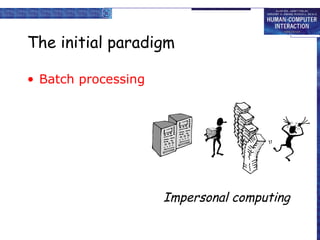
The initial paradigm

• Batch processing


                     Impersonal computing
Example Paradigm Shifts

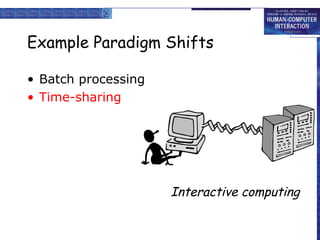
• Batch processing
• Time-sharing


                     Interactive computing
Example Paradigm Shifts

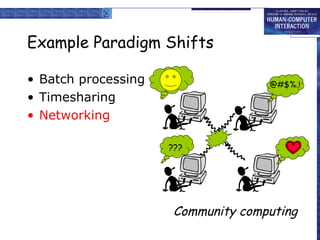
• Batch processing                  @#$% !
• Timesharing
• Networking

                     ???


                      Community computing
Example Paradigm Shifts

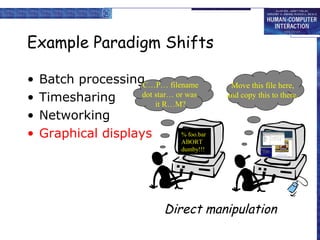
•   Batch processingC…P… filename               Move this file here,
•   Timesharing      dot star… or was
                         it R…M?
                                               and copy this to there.

•   Networking
•   Graphical displays           % foo.bar
                                    ABORT
                                    dumby!!!


                                Direct manipulation
Example Paradigm Shifts

•   Batch processing
•   Timesharing
•   Networking
•   Graphical display
•   Microprocessor


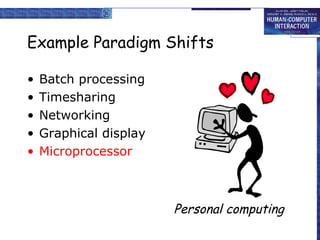
                        Personal computing
Example Paradigm Shifts

•   Batch processing
•   Timesharing
•   Networking
•   Graphical display
•   Microprocessor
•   WWW

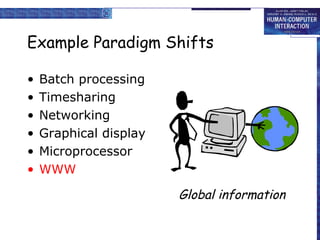
                        Global information
Example Paradigm Shifts

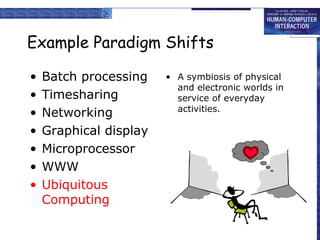
•   Batch processing    • A symbiosis of physical
                          and electronic worlds in
•   Timesharing           service of everyday
                          activities.
•   Networking
•   Graphical display
•   Microprocessor
•   WWW
•   Ubiquitous
    Computing
Time-sharing

• 1940s and 1950s – explosive technological
  growth

• 1960s – need to channel the power

• J.C.R. Licklider at ARPA

• single computer supporting multiple users
Video Display Units

• more suitable medium than paper

• 1962 – Sutherland's Sketchpad

• computers for visualizing and manipulating
  data

• one person's contribution could drastically
  change the history of computing
Programming toolkits

• Engelbart at Stanford Research Institute

• 1963 – augmenting man's intellect

• 1968 NLS/Augment system demonstration

• the right programming toolkit provides
  building blocks to producing complex
  interactive systems
Personal computing

• 1970s – Papert's LOGO language for simple
  graphics programming by children

• A system is more powerful as it becomes
  easier to user

• Future of computing in small, powerful
  machines dedicated to the individual

• Kay at Xerox PARC – the Dynabook as the
  ultimate personal computer
Window systems and the
WIMP interface
• humans can pursue more than one task at a
  time

• windows used for dialogue partitioning, to
  “change the topic”

• 1981 – Xerox Star first commercial windowing
  system

• windows, icons, menus and pointers now
  familiar interaction mechanisms
Metaphor

• relating computing to other real-world activity
  is effective teaching technique
   –   LOGO's turtle dragging its tail
   –   file management on an office desktop
   –   word processing as typing
   –   financial analysis on spreadsheets
   –   virtual reality – user inside the metaphor


• Problems
   – some tasks do not fit into a given metaphor
   – cultural bias
Direct manipulation

• 1982 – Shneiderman describes appeal of
  graphically-based interaction
  –   visibility of objects
  –   incremental action and rapid feedback
  –   reversibility encourages exploration
  –   syntactic correctness of all actions
  –   replace language with action


• 1984 – Apple Macintosh
• the model-world metaphor
• What You See Is What You Get (WYSIWYG)
Language versus Action

• actions do not always speak louder than
  words!
• DM – interface replaces underlying
  system
• language paradigm
• interface as mediator
• interface acts as intelligent agent
• programming by example is both action
  and language
Hypertext

• 1945 – Vannevar Bush and the memex

• key to success in managing explosion of
  information

• mid 1960s – Nelson describes hypertext as
  non-linear browsing structure

• hypermedia and multimedia

• Nelson's Xanadu project still a dream today
Multimodality


• a mode is a human communication
  channel

• emphasis on simultaneous use of
  multiple channels for input and output
Computer Supported
Cooperative Work (CSCW)

• CSCW removes bias of single user /
  single computer system

• Can no longer neglect the social aspects

• Electronic mail is most prominent
  success
The World Wide Web

• Hypertext, as originally realized, was a
  closed system
• Simple, universal protocols (e.g. HTTP)
  and mark-up languages (e.g. HTML)
  made publishing and accessing easy
• Critical mass of users lead to a
  complete transformation of our
  information economy.
Agent-based Interfaces

• Original interfaces
   – Commands given to computer
   – Language-based
• Direct Manipulation/WIMP
   – Commands performed on “world” representation
   – Action based
• Agents - return to language by instilling
  proactivity and “intelligence” in command
  processor
   – Avatars, natural language processing
Ubiquitous Computing

“The most profound technologies are those that
  disappear.”
                             Mark Weiser, 1991

Late 1980’s: computer was very apparent

How to make it disappear?
  – Shrink and embed/distribute it in the physical world
  – Design interactions that don’t demand our intention
Sensor-based and Context-
aware Interaction
• Humans are good at recognizing the
  “context” of a situation and reacting
  appropriately
• Automatically sensing physical
  phenomena (e.g., light, temp, location,
  identity) becoming easier
• How can we go from sensed physical
  measures to interactions that behave as
  if made “aware” of the surroundings?

E3 chap-04

  • 1.
  • 2.
    why study paradigms Concerns – how can an interactive system be developed to ensure its usability? – how can the usability of an interactive system be demonstrated or measured? History of interactive system design provides paradigms for usable designs
  • 3.
    What are Paradigms •Predominant theoretical frameworks or scientific world views – e.g., Aristotelian, Newtonian, Einsteinian (relativistic) paradigms in physics • Understanding HCI history is largely about understanding a series of paradigm shifts – Not all listed here are necessarily “paradigm” shifts, but are at least candidates – History will judge which are true shifts
  • 4.
    Paradigms of interaction Newcomputing technologies arrive, creating a new perception of the human—computer relationship. We can trace some of these shifts in the history of interactive technologies.
  • 5.
    The initial paradigm •Batch processing Impersonal computing
  • 6.
    Example Paradigm Shifts •Batch processing • Time-sharing Interactive computing
  • 7.
    Example Paradigm Shifts •Batch processing @#$% ! • Timesharing • Networking ??? Community computing
  • 8.
    Example Paradigm Shifts • Batch processingC…P… filename Move this file here, • Timesharing dot star… or was it R…M? and copy this to there. • Networking • Graphical displays % foo.bar ABORT dumby!!! Direct manipulation
  • 9.
    Example Paradigm Shifts • Batch processing • Timesharing • Networking • Graphical display • Microprocessor Personal computing
  • 10.
    Example Paradigm Shifts • Batch processing • Timesharing • Networking • Graphical display • Microprocessor • WWW Global information
  • 11.
    Example Paradigm Shifts • Batch processing • A symbiosis of physical and electronic worlds in • Timesharing service of everyday activities. • Networking • Graphical display • Microprocessor • WWW • Ubiquitous Computing
  • 12.
    Time-sharing • 1940s and1950s – explosive technological growth • 1960s – need to channel the power • J.C.R. Licklider at ARPA • single computer supporting multiple users
  • 13.
    Video Display Units •more suitable medium than paper • 1962 – Sutherland's Sketchpad • computers for visualizing and manipulating data • one person's contribution could drastically change the history of computing
  • 14.
    Programming toolkits • Engelbartat Stanford Research Institute • 1963 – augmenting man's intellect • 1968 NLS/Augment system demonstration • the right programming toolkit provides building blocks to producing complex interactive systems
  • 15.
    Personal computing • 1970s– Papert's LOGO language for simple graphics programming by children • A system is more powerful as it becomes easier to user • Future of computing in small, powerful machines dedicated to the individual • Kay at Xerox PARC – the Dynabook as the ultimate personal computer
  • 16.
    Window systems andthe WIMP interface • humans can pursue more than one task at a time • windows used for dialogue partitioning, to “change the topic” • 1981 – Xerox Star first commercial windowing system • windows, icons, menus and pointers now familiar interaction mechanisms
  • 17.
    Metaphor • relating computingto other real-world activity is effective teaching technique – LOGO's turtle dragging its tail – file management on an office desktop – word processing as typing – financial analysis on spreadsheets – virtual reality – user inside the metaphor • Problems – some tasks do not fit into a given metaphor – cultural bias
  • 18.
    Direct manipulation • 1982– Shneiderman describes appeal of graphically-based interaction – visibility of objects – incremental action and rapid feedback – reversibility encourages exploration – syntactic correctness of all actions – replace language with action • 1984 – Apple Macintosh • the model-world metaphor • What You See Is What You Get (WYSIWYG)
  • 19.
    Language versus Action •actions do not always speak louder than words! • DM – interface replaces underlying system • language paradigm • interface as mediator • interface acts as intelligent agent • programming by example is both action and language
  • 20.
    Hypertext • 1945 –Vannevar Bush and the memex • key to success in managing explosion of information • mid 1960s – Nelson describes hypertext as non-linear browsing structure • hypermedia and multimedia • Nelson's Xanadu project still a dream today
  • 21.
    Multimodality • a modeis a human communication channel • emphasis on simultaneous use of multiple channels for input and output
  • 22.
    Computer Supported Cooperative Work(CSCW) • CSCW removes bias of single user / single computer system • Can no longer neglect the social aspects • Electronic mail is most prominent success
  • 23.
    The World WideWeb • Hypertext, as originally realized, was a closed system • Simple, universal protocols (e.g. HTTP) and mark-up languages (e.g. HTML) made publishing and accessing easy • Critical mass of users lead to a complete transformation of our information economy.
  • 24.
    Agent-based Interfaces • Originalinterfaces – Commands given to computer – Language-based • Direct Manipulation/WIMP – Commands performed on “world” representation – Action based • Agents - return to language by instilling proactivity and “intelligence” in command processor – Avatars, natural language processing
  • 25.
    Ubiquitous Computing “The mostprofound technologies are those that disappear.” Mark Weiser, 1991 Late 1980’s: computer was very apparent How to make it disappear? – Shrink and embed/distribute it in the physical world – Design interactions that don’t demand our intention
  • 26.
    Sensor-based and Context- awareInteraction • Humans are good at recognizing the “context” of a situation and reacting appropriately • Automatically sensing physical phenomena (e.g., light, temp, location, identity) becoming easier • How can we go from sensed physical measures to interactions that behave as if made “aware” of the surroundings?