Perspective (Space)
[Any graphic system used in creating the illusion of three-dimensional
images and/or spatial relationships in which the objects or their parts
appear to diminish as they recede into the distance. ]
Linear Perspective
[A system used to depict
3D images on a 2D surface;
it develops the optical
phenomenon of
diminishing size by treating
edges as converging
parallel lines that extend
to a vanishing point or
points on the horizon (eye
level) and recede from the
viewer]
Linear Perspective
To create a drawing with linear perspective, an artist must use three
basic components:
Horizon Line
[determined by viewer’s eye
level]
Vanishing Point (s) Converging Lines
[also called Orthogonals]
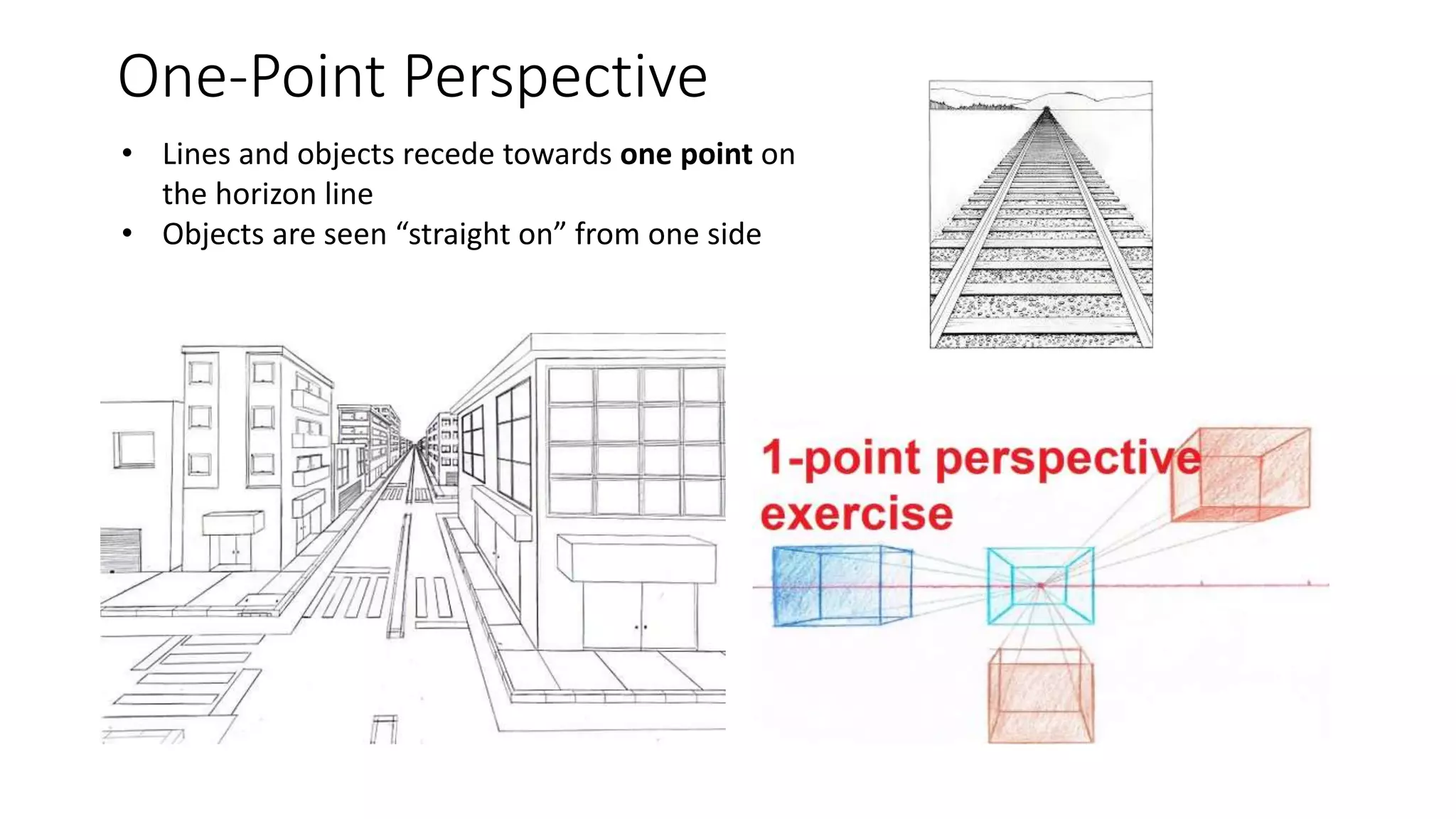
One-Point Perspective
• Lines and objects recede towards one point on
the horizon line
• Objects are seen “straight on” from one side
Two-Point Perspective
• Lines and objects recede towards two points
on the horizon line
• For squares and rectangles, the side-edge is
closer than any one side, so both side-planes
recede.
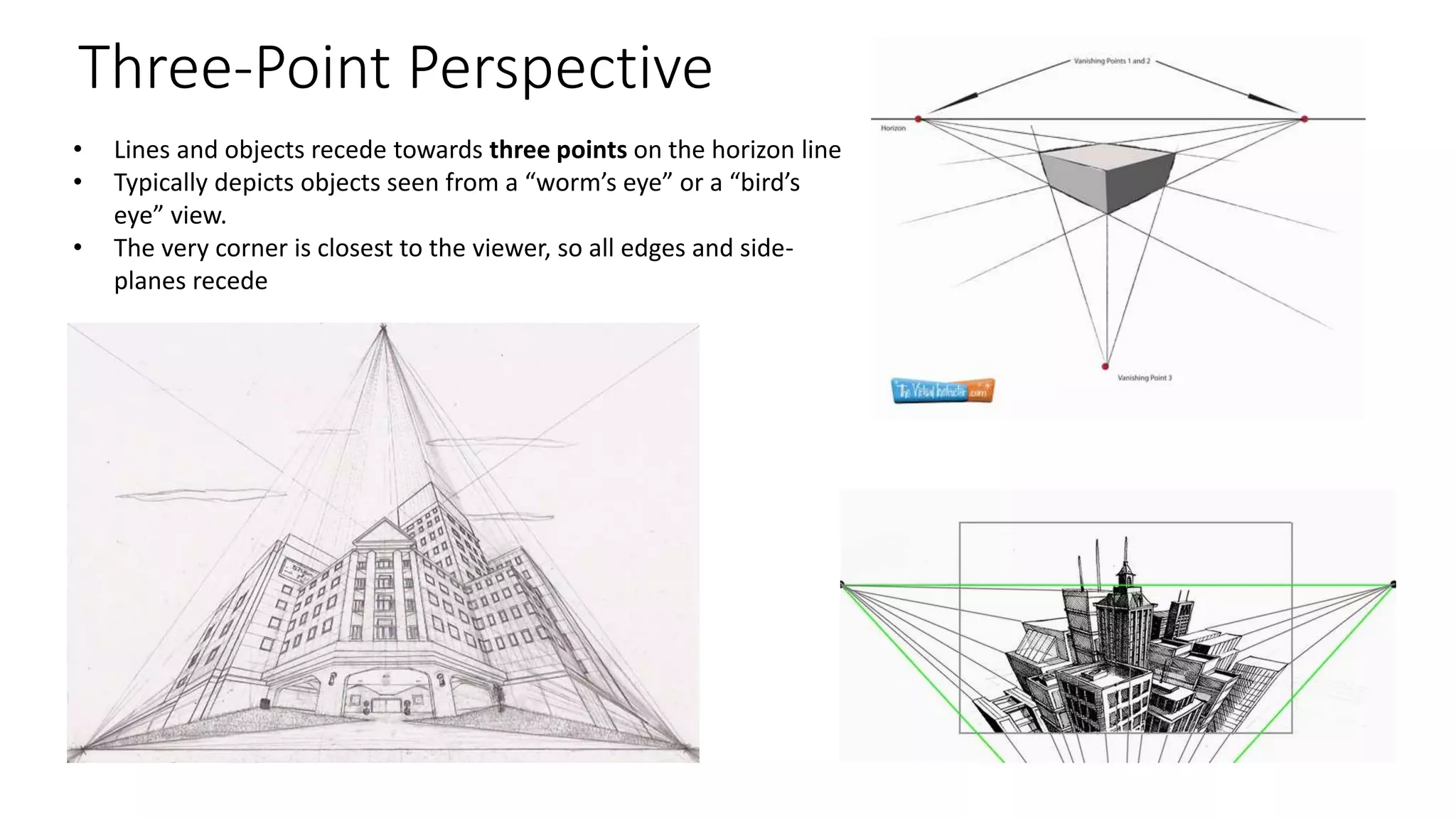
Three-Point Perspective
• Lines and objects recede towards three points on the horizon line
• Typically depicts objects seen from a “worm’s eye” or a “bird’s
eye” view.
• The very corner is closest to the viewer, so all edges and side-
planes recede
Atmospheric Perspective
[The illusion of deep space produced in graphic works by lightening
values, softening details and textures, reducing value contrasts, and
neutralizing colors in objects as they recede]
FIVE TOOLS
Through atmospheric perspective, artists can create the illusion of
depth and distance using these tools:
1. Hazy lines
2. Indistinct shapes
3. Grayed values
4. Simple textures
5. Neutralized colors
Project: Perspective
Objectives:
• To create a composition demonstrating the proper use of linear
perspective
• To use graphite pencil to achieve a variety of values
• The use knowledge of value, depth and composition to create an
interesting design
Preliminary (Sketchbook) Work:
• 1st Page: Draw 3 cubes/rectangles using only 1-point perspective
• 2nd Page: Draw 3 cubes/rectangles using only 2-point perspective
• 3rd Page: Draw 3 cubes/rectangles using only 3-point perspective
Materials:
• One image that shows clear linear perspective
• 1 sheet of 9x12” watercolor paper (provided)
• Assorted graphite pencils
• Staedtler Mars eraser
Process:
Using your chosen image, create a drawing in only graphite pencil. Start
by finding and drawing your horizon line and vanishing point, and use
these to create a corresponding drawing which adheres to the laws of
linear perspective.
Due: April 30, 2018 at BEGINNING OF CLASS

Element of Art - Space

  • 1.
    Perspective (Space) [Any graphicsystem used in creating the illusion of three-dimensional images and/or spatial relationships in which the objects or their parts appear to diminish as they recede into the distance. ]
  • 2.
    Linear Perspective [A systemused to depict 3D images on a 2D surface; it develops the optical phenomenon of diminishing size by treating edges as converging parallel lines that extend to a vanishing point or points on the horizon (eye level) and recede from the viewer]
  • 3.
    Linear Perspective To createa drawing with linear perspective, an artist must use three basic components: Horizon Line [determined by viewer’s eye level] Vanishing Point (s) Converging Lines [also called Orthogonals]
  • 4.
    One-Point Perspective • Linesand objects recede towards one point on the horizon line • Objects are seen “straight on” from one side
  • 5.
    Two-Point Perspective • Linesand objects recede towards two points on the horizon line • For squares and rectangles, the side-edge is closer than any one side, so both side-planes recede.
  • 6.
    Three-Point Perspective • Linesand objects recede towards three points on the horizon line • Typically depicts objects seen from a “worm’s eye” or a “bird’s eye” view. • The very corner is closest to the viewer, so all edges and side- planes recede
  • 7.
    Atmospheric Perspective [The illusionof deep space produced in graphic works by lightening values, softening details and textures, reducing value contrasts, and neutralizing colors in objects as they recede]
  • 8.
    FIVE TOOLS Through atmosphericperspective, artists can create the illusion of depth and distance using these tools: 1. Hazy lines 2. Indistinct shapes 3. Grayed values 4. Simple textures 5. Neutralized colors
  • 9.
    Project: Perspective Objectives: • Tocreate a composition demonstrating the proper use of linear perspective • To use graphite pencil to achieve a variety of values • The use knowledge of value, depth and composition to create an interesting design
  • 10.
    Preliminary (Sketchbook) Work: •1st Page: Draw 3 cubes/rectangles using only 1-point perspective • 2nd Page: Draw 3 cubes/rectangles using only 2-point perspective • 3rd Page: Draw 3 cubes/rectangles using only 3-point perspective Materials: • One image that shows clear linear perspective • 1 sheet of 9x12” watercolor paper (provided) • Assorted graphite pencils • Staedtler Mars eraser
  • 11.
    Process: Using your chosenimage, create a drawing in only graphite pencil. Start by finding and drawing your horizon line and vanishing point, and use these to create a corresponding drawing which adheres to the laws of linear perspective. Due: April 30, 2018 at BEGINNING OF CLASS