Perspective
Drawing
Arts Activity
Perspective drawing
is a technique that
gives three-
dimensionality to
flat images.
 What Is Perspective Drawing?
Perspective drawing is a technique that
gives the illusion of spatial depth, or
perspective, to drawings and paintings.
Perspective drawing, like
foreshortening, gives the illusion of
depth and makes work pop off of the
page by using angled lines to suggest
vertical lines and horizontal lines.
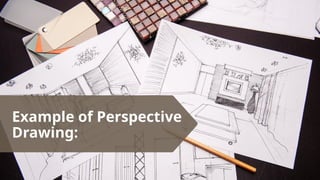
Example of Perspective
Drawing:
 2 Types of Perspective
Drawing
There are two main types of
perspective drawing—linear
perspective and atmospheric
perspective:
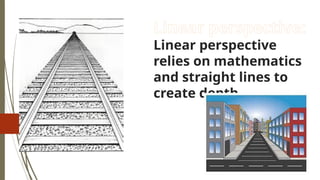
 Linear perspective:
Linear perspective
relies on mathematics
and straight lines to
create depth.
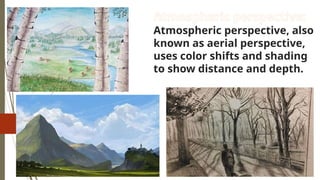
 Atmospheric perspective:
Atmospheric perspective, also
known as aerial perspective,
uses color shifts and shading
to show distance and depth.
4 Elements of
Perspective
Drawing
4 Elements of
Perspective
Drawing
 To use linear and
atmospheric
perspective, you
must understand
the following
terms:
10
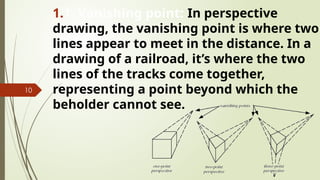
1.1. Vanishing point: In perspective
drawing, the vanishing point is where two
lines appear to meet in the distance. In a
drawing of a railroad, it’s where the two
lines of the tracks come together,
representing a point beyond which the
beholder cannot see.
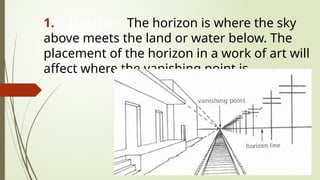
1.2. Horizon: The horizon is where the sky
above meets the land or water below. The
placement of the horizon in a work of art will
affect where the vanishing point is.
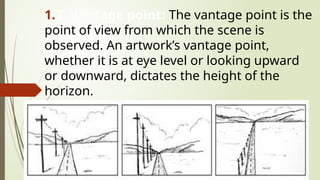
1.3. Vantage point: The vantage point is the
point of view from which the scene is
observed. An artwork’s vantage point,
whether it is at eye level or looking upward
or downward, dictates the height of the
horizon.
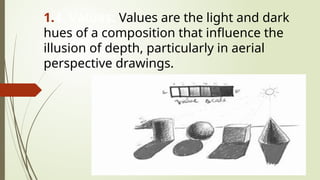
1.4. Values: Values are the light and dark
hues of a composition that influence the
illusion of depth, particularly in aerial
perspective drawings.
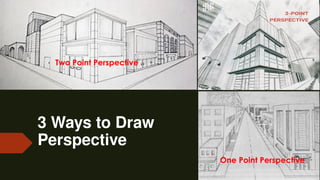
3 Ways to Draw
Perspective
Two Point Perspective
One Point Perspective
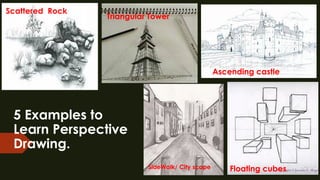
5 Examples to
Learn Perspective
Drawing.
Floating cubes
SideWalk/ City scape
Triangular Tower
Scattered Rock
Ascending castle

Arts Activity - Perspective Drawing.pptx

  • 1.
  • 2.
    Perspective drawing is atechnique that gives three- dimensionality to flat images.
  • 3.
     What IsPerspective Drawing? Perspective drawing is a technique that gives the illusion of spatial depth, or perspective, to drawings and paintings. Perspective drawing, like foreshortening, gives the illusion of depth and makes work pop off of the page by using angled lines to suggest vertical lines and horizontal lines.
  • 4.
  • 5.
     2 Typesof Perspective Drawing There are two main types of perspective drawing—linear perspective and atmospheric perspective:
  • 6.
     Linear perspective: Linearperspective relies on mathematics and straight lines to create depth.
  • 7.
     Atmospheric perspective: Atmosphericperspective, also known as aerial perspective, uses color shifts and shading to show distance and depth.
  • 8.
  • 9.
    4 Elements of Perspective Drawing To use linear and atmospheric perspective, you must understand the following terms:
  • 10.
    10 1.1. Vanishing point:In perspective drawing, the vanishing point is where two lines appear to meet in the distance. In a drawing of a railroad, it’s where the two lines of the tracks come together, representing a point beyond which the beholder cannot see.
  • 11.
    1.2. Horizon: Thehorizon is where the sky above meets the land or water below. The placement of the horizon in a work of art will affect where the vanishing point is.
  • 12.
    1.3. Vantage point:The vantage point is the point of view from which the scene is observed. An artwork’s vantage point, whether it is at eye level or looking upward or downward, dictates the height of the horizon.
  • 13.
    1.4. Values: Valuesare the light and dark hues of a composition that influence the illusion of depth, particularly in aerial perspective drawings.
  • 14.
    3 Ways toDraw Perspective Two Point Perspective One Point Perspective
  • 15.
    5 Examples to LearnPerspective Drawing. Floating cubes SideWalk/ City scape Triangular Tower Scattered Rock Ascending castle