Revised Bloom’s taxonomyHow to Use Higher Order Thinking Skills in the ClassroomBy:  Laura Davis     June 5, 2011
Table of ContentsHigher Order ThinkingWhat is Bloom’s Taxonomy?Old vs. NewWho uses Bloom’s?Remembering UnderstandingApplyingAnalyzingEvaluatingCreatingOther Visualizations of Bloom’sDigital Revised Bloom’s Taxonomy
Thinking is the hardest work there is, which is probably the reason why so few engage in it. -Henry FordHigher Order Thinking
Quick Facts about Higher Order ThinkingH: Higher O: OrderT: ThinkingNo one thinks perfectly or poorly all the time.Memorizing something is not the same as thinking about it.You can memorize something without understanding it.Thinking is done in both words and pictures.There are three main types of intelligence and thinking: analytical, creative and practical.All three intelligences and ways of thinking are useful in our everyday lives.You can improve your thinking skills by understanding the processes involved in thinking.Metacognition-thinking about thinking-is part of higher order thinking.http://www.cdl.org/resource-library/articles/highorderthinking.php
Higher Order Thinking (HOT)HOT does not include memorization. HOT requires that we do something with the facts. We must understand them, connect them to each other, categorize them, manipulate them, put them together in new or novel ways, and apply them as we seek new solutions to new problems.Higher Order Thinking involves metacognition.Metacognition is thinking about your thinking. When a learner uses metacognition they are contemplating and revising their thoughts continuously to make sure they truly understand the information.
What is it and where did it come from?Bloom’s Taxonomy
Bloom’s Timeline1948: Benjamin Bloom and a group of psychologists studied classroom activities and goals teachers has while planning these activities. Through this study three domains were concluded:Cognitive DomainAffective DomainPsychomotor DomainCognitive Domain was split into a hierarchy of 6 thinking skills: knowledge, comprehension, application, analysis, synthesis, and evaluation.1956: Original Bloom’s Taxonomy is publishedhttp://learngen.org/Resources/lgend101_norm1/3000/3100_4/3130/3131alias2.html
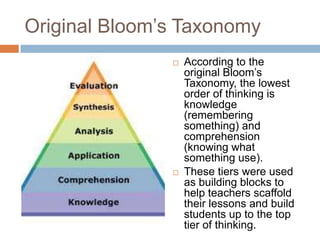
Original Bloom’s TaxonomyAccording to the original Bloom’s Taxonomy, the lowest order of thinking is knowledge (remembering something) and comprehension (knowing what something use). These tiers were used as building blocks to help teachers scaffold their lessons and build students up to the top tier of thinking.
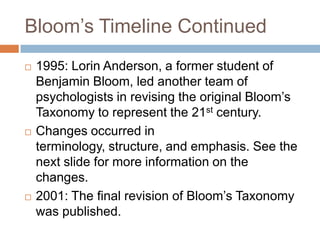
Bloom’s Timeline Continued1995: Lorin Anderson, a former student of Benjamin Bloom, led another team of psychologists in revising the original Bloom’s Taxonomy to represent the 21st century. Changes occurred in terminology, structure, and emphasis. See the next slide for more information on the changes. 2001: The final revision of Bloom’s Taxonomy was published.
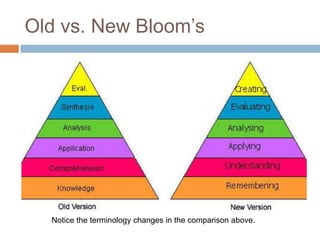
Old vs. New Bloom’s Notice the terminology changes in the comparison above.
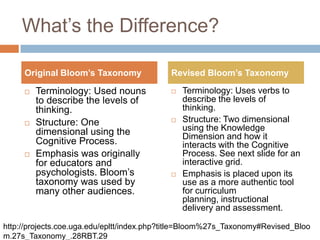
What’s the Difference?Terminology: Used nouns to describe the levels of thinking. Structure: One dimensional using the Cognitive Process.Emphasis was originally for educators and psychologists. Bloom’s taxonomy was used by many other audiences.Terminology: Uses verbs to describe the levels of thinking.Structure: Two dimensional using the Knowledge Dimension and how it interacts with the Cognitive Process. See next slide for an interactive grid.Emphasis is placed upon its use as a more authentic tool for curriculum planning, instructional delivery and assessment.Original Bloom’s TaxonomyRevised Bloom’s Taxonomyhttp://projects.coe.uga.edu/epltt/index.php?title=Bloom%27s_Taxonomy#Revised_Bloom.27s_Taxonomy_.28RBT.29
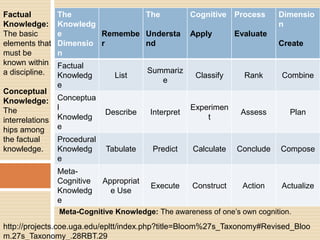
Factual Knowledge:  The basic elements that must be known within a discipline.Conceptual Knowledge: The interrelationships among the factual knowledge.Two Dimensional Blooms TaxonomyProcedural Knowledge: How to do something, methods of inquiry, and criteria for using a skill, algorithm, technique or method.Meta-Cognitive Knowledge: The awareness of one’s own cognition.http://projects.coe.uga.edu/epltt/index.php?title=Bloom%27s_Taxonomy#Revised_Bloom.27s_Taxonomy_.28RBT.29
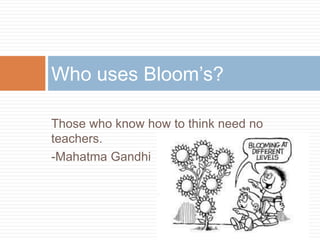
Those who know how to think need no teachers. -Mahatma GandhiWho uses Bloom’s?
We all think…but are we using HOT skills?
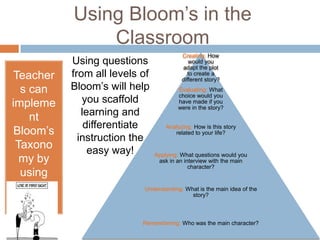
Using Bloom’s in the ClassroomUsing questions from all levels of Bloom’s will help you scaffold learning and differentiate instruction the easy way! Teachers can implement Bloom’s Taxonomy by using HOT Questions!
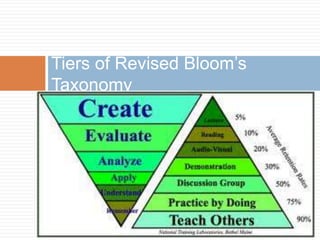
Tiers of Revised Bloom’s Taxonomy
Lower Order Thinking Skill:  Remembering
Remembering QuestionsWhat is …?Where is …?How did ___ happen?Why did …?When did …?How would you show …?Who were the main …?Which one …?How is …?When did ___  happen?How would you explain …?How would you describe ..?Can you recall …?Can you select …?Can you list the three …?Who was …?
Using Remembering in a LessonMake a list of the main events.Make a timeline of events.Make a facts chart.Write a list of any pieces of information you can remember.List all the …in the story.Make a chart showing…Make an acrostic.Recite a poem.Websites to help scaffold with this tier:www.Spellingcity.comwww.Thatquiz.orgwww.Aplusclick.comwww.Dictionary.comwww.socialstudiesforkids.com/subjects/timelines.htm
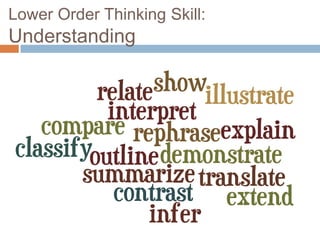
Lower Order Thinking Skill:  Understanding
Understanding QuestionsHow would you classify the type of …?How would you compare …? contrast …?Will you state or interpret in your own words …?How would you rephrase the meaning …?What facts or ideas show …?How would you summarize …? What is the main idea of …?Which statements support …?Can you explain what is happening …? what is meant …?What can you say about …?Which is the best answer …?
Using Understanding in a LessonCut out or draw pictures to show a particular event.Illustrate what you think the main idea was.Make a cartoon strip showing the sequence of events.Retell the story in your own words.Paint a picture of some aspect you like.Write a summary report of an event.Prepare a flow chart to illustrate the sequence of events.Make a colouring book.Websites to help you scaffold with this tier:www.Tagxedo.comwww.Wordle.netwww.makebeliefscomix.comwww.prezi.comwww.bitstrips.com/create/comic/www.toondoo.com/www.netrover.com/~kingskid/anchors/anchors_main.htm
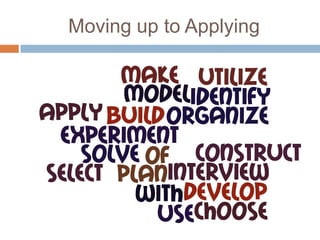
Moving up to Applying
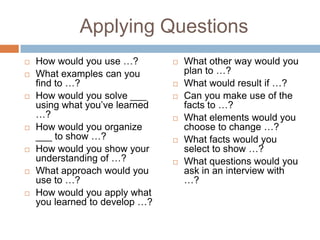
Applying Questions How would you use …?What examples can you find to …?How would you solve ___ using what you’ve learned …?How would you organize ___ to show …?How would you show your understanding of …?What approach would you use to …?How would you apply what you learned to develop …?What other way would you plan to …?What would result if …?Can you make use of the facts to …?What elements would you choose to change …?What facts would you select to show …?What questions would you ask in an interview with …?
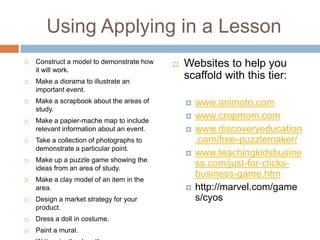
Using Applying in a LessonConstruct a model to demonstrate how it will work.Make a diorama to illustrate an important event.Make a scrapbook about the areas of study.Make a papier-mache map to include relevant information about an event.Take a collection of photographs to demonstrate a particular point.Make up a puzzle game showing the ideas from an area of study.Make a clay model of an item in the area.Design a market strategy for your product.Dress a doll in costume.Paint a mural.Write a textbook outline.Websites to help you scaffold with this tier:www.animoto.comwww.cropmom.comwww.discoveryeducation.com/free-puzzlemaker/www.teachingkidsbusiness.com/just-for-clicks-business-game.htmhttp://marvel.com/games/cyos
Higher Order Thinking Skill: Analyzing
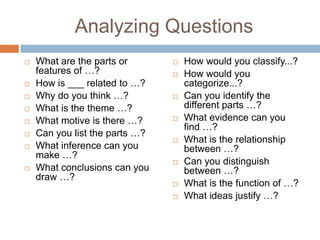
Analyzing QuestionsWhat are the parts or features of …?How is ___ related to …?Why do you think …?What is the theme …?What motive is there …?Can you list the parts …?What inference can you make …?What conclusions can you draw …?How would you classify...?How would you categorize...?Can you identify the different parts …?What evidence can you find …?What is the relationship between …?Can you distinguish between …?What is the function of …?What ideas justify …?
Using Analyzing in a LessonDesign a questionnaire to gather information.Write a commercial to sell a new product.Conduct an investigation to produce information to support a point of view.Construct a graph to illustrate selected information.Make a jigsaw puzzle.Make a family tree showing relationships.Put on a play about the study area.Write a biography of the study person.Prepare a report.Arrange a party and record as a procedure.Review a piece of art including form, colour and textureWebsites to help you scaffold with this tier:http://dissect.froguts.com/www.zunal.comwww.polleverywhere.comhttp://nces.ed.gov/nceskids/createagraph/http://kids.familytreemagazine.com/kids/www.kidsturncentral.com/topics/hobbies/genforms.htmwww.timeforkids.com/TFK/kids/hh/writeideas/articles/0,28372,634428,00.html
Higher Order Thinking Skill: Evaluating
Evaluating QuestionsDo you agree with the actions…? with the outcome…?What is your opinion of …?How would you prove …? Disprove…?Can you assess the value or importance of …?Would it be better if …?Why did they (the character) choose …?What would you recommend…?How would you rate the …?What would you cite to defend the actions …?How could you determine…?What choice would you have made …?How would you prioritize …?What judgment would you make about …?Based on what you know, how would you explain …?What information would you use to support the view…?How would you justify …?What data was used to make the conclusion…?What was it better that …?How would you compare the ideas …?  people …?
Using Evaluating in a LessonPrepare a list of criteria to judge a ……..show? Remember to indicate priorities and ratings.Conduct a debate about a special issue.Make a booklet about 5 rules you see as important to convince others.Form a panel to discuss views.Write a letter to .... advising on changes needed at …Write a half yearly report.Present your point of view.Websites to help you scaffold with this tier:www.rubistar.comwww.funenglishgames.com/writinggames/debate.htmlwww.idebate.org/debatabase/search.php?junior=yeswww.bubblesnaps.com/www.fodey.com
Higher Order Thinking Skill: Creating
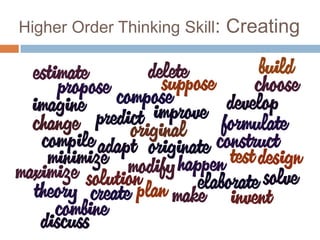
Creating QuestionsWhat changes would you make to solve …?How would you improve …?What would happen if …?Can you elaborate on the reason …?Can you propose an alternative…?Can you invent …?How would you adapt ___ to create a different …?How could you change (modify) the plot (plan) …?What could be done to minimize (maximize) …?What way would you design …?What could be combined to improve (change) …?Suppose you could ___ what would you do …?How would you test …?Can you formulate a theory for …?Can you predict the outcome if …?How would you estimate the results for …?What facts can you compile …?Can you construct a model that would change …?Can you think of an original way for the …?
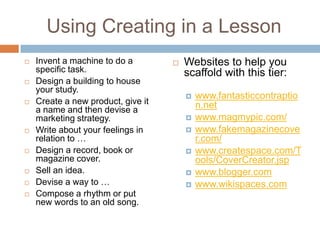
Using Creating in a LessonInvent a machine to do a specific task.Design a building to house your study.Create a new product, give it a name and then devise a marketing strategy.Write about your feelings in relation to …Design a record, book or magazine cover.Sell an idea.Devise a way to …Compose a rhythm or put new words to an old song.Websites to help you scaffold with this tier:www.fantasticcontraption.netwww.magmypic.com/www.fakemagazinecover.com/www.createspace.com/Tools/CoverCreator.jspwww.blogger.comwww.wikispaces.com
Thought is the blossom; language the bud; action the fruit behind it.-Ralph Waldo EmersonOther Visualizations of Bloom’s
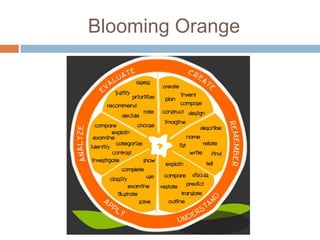
Blooming Orange
This is based on the original Bloom’s but I thought it was a great illustration.http://fisheggs.typepad.com/forty-fisheggs/2010/06/fishegg-129-blooms-taxonomy-levels-of-thinking.html
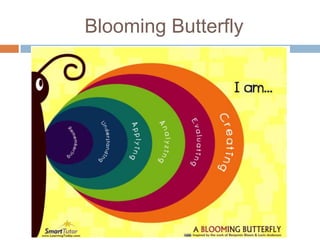
Blooming Butterfly
Technology is integrated in almost every part of lesson preparation and presentation. Scholars have now come up with a digital Bloom’s Taxonomy. Check it out!!DIGITAL Revised Bloom’s Taxonomy
What do you use everyday? Are you using your HOT skills?There is a whole website dedicated to digital Bloom’s! Check it out here: http://visualblooms.wikispaces.com/
BibliographyEduPress. (n.d.). Questions for the Revised Bloom's Taxonomy. Retrieved June 5, 2011, from EduPress Inc.: http://www.highsmith.com/edupress/Quick-Flip-Questions-for-the-Revised-Blooms-Taxonomy-c_23506705/EP729/Lee, V. S. (1999). Creating a Blueprint for the Constructivist Classroom. National Teaching & Learning Forum, 8 (4).Thomas, A., & Thorne, G. (n.d.). Higher Order Thinking. Retrieved June 5, 2011, from Center for Development and Learning: http://www.cdl.org/resource-library/articles/highorderthinking.phpUniversity of Kansas. (2002). Reporting. Retrieved June 5, 2011, from University of Kansas: http://learngen.org/Resources/lgend101_norm1/3000/3100_4/3130/3131alias2.htmlWestern Carolina University. (n.d.). Revised Bloom's Taxonomy Matrix. Retrieved June 5, 2011, from Western Carolina University: www.wcu.edu/WebFiles/WordDocs/wcucfc_bloomsverbsmatrix_082409.doc 

Blooms Taxonomy Made Easy

  • 1.
    Revised Bloom’s taxonomyHowto Use Higher Order Thinking Skills in the ClassroomBy: Laura Davis June 5, 2011
  • 2.
    Table of ContentsHigherOrder ThinkingWhat is Bloom’s Taxonomy?Old vs. NewWho uses Bloom’s?Remembering UnderstandingApplyingAnalyzingEvaluatingCreatingOther Visualizations of Bloom’sDigital Revised Bloom’s Taxonomy
  • 3.
    Thinking is thehardest work there is, which is probably the reason why so few engage in it. -Henry FordHigher Order Thinking
  • 4.
    Quick Facts aboutHigher Order ThinkingH: Higher O: OrderT: ThinkingNo one thinks perfectly or poorly all the time.Memorizing something is not the same as thinking about it.You can memorize something without understanding it.Thinking is done in both words and pictures.There are three main types of intelligence and thinking: analytical, creative and practical.All three intelligences and ways of thinking are useful in our everyday lives.You can improve your thinking skills by understanding the processes involved in thinking.Metacognition-thinking about thinking-is part of higher order thinking.http://www.cdl.org/resource-library/articles/highorderthinking.php
  • 5.
    Higher Order Thinking(HOT)HOT does not include memorization. HOT requires that we do something with the facts. We must understand them, connect them to each other, categorize them, manipulate them, put them together in new or novel ways, and apply them as we seek new solutions to new problems.Higher Order Thinking involves metacognition.Metacognition is thinking about your thinking. When a learner uses metacognition they are contemplating and revising their thoughts continuously to make sure they truly understand the information.
  • 6.
    What is itand where did it come from?Bloom’s Taxonomy
  • 7.
    Bloom’s Timeline1948: BenjaminBloom and a group of psychologists studied classroom activities and goals teachers has while planning these activities. Through this study three domains were concluded:Cognitive DomainAffective DomainPsychomotor DomainCognitive Domain was split into a hierarchy of 6 thinking skills: knowledge, comprehension, application, analysis, synthesis, and evaluation.1956: Original Bloom’s Taxonomy is publishedhttp://learngen.org/Resources/lgend101_norm1/3000/3100_4/3130/3131alias2.html
  • 8.
    Original Bloom’s TaxonomyAccordingto the original Bloom’s Taxonomy, the lowest order of thinking is knowledge (remembering something) and comprehension (knowing what something use). These tiers were used as building blocks to help teachers scaffold their lessons and build students up to the top tier of thinking.
  • 9.
    Bloom’s Timeline Continued1995:Lorin Anderson, a former student of Benjamin Bloom, led another team of psychologists in revising the original Bloom’s Taxonomy to represent the 21st century. Changes occurred in terminology, structure, and emphasis. See the next slide for more information on the changes. 2001: The final revision of Bloom’s Taxonomy was published.
  • 10.
    Old vs. NewBloom’s Notice the terminology changes in the comparison above.
  • 11.
    What’s the Difference?Terminology:Used nouns to describe the levels of thinking. Structure: One dimensional using the Cognitive Process.Emphasis was originally for educators and psychologists. Bloom’s taxonomy was used by many other audiences.Terminology: Uses verbs to describe the levels of thinking.Structure: Two dimensional using the Knowledge Dimension and how it interacts with the Cognitive Process. See next slide for an interactive grid.Emphasis is placed upon its use as a more authentic tool for curriculum planning, instructional delivery and assessment.Original Bloom’s TaxonomyRevised Bloom’s Taxonomyhttp://projects.coe.uga.edu/epltt/index.php?title=Bloom%27s_Taxonomy#Revised_Bloom.27s_Taxonomy_.28RBT.29
  • 12.
    Factual Knowledge: The basic elements that must be known within a discipline.Conceptual Knowledge: The interrelationships among the factual knowledge.Two Dimensional Blooms TaxonomyProcedural Knowledge: How to do something, methods of inquiry, and criteria for using a skill, algorithm, technique or method.Meta-Cognitive Knowledge: The awareness of one’s own cognition.http://projects.coe.uga.edu/epltt/index.php?title=Bloom%27s_Taxonomy#Revised_Bloom.27s_Taxonomy_.28RBT.29
  • 13.
    Those who knowhow to think need no teachers. -Mahatma GandhiWho uses Bloom’s?
  • 14.
    We all think…butare we using HOT skills?
  • 15.
    Using Bloom’s inthe ClassroomUsing questions from all levels of Bloom’s will help you scaffold learning and differentiate instruction the easy way! Teachers can implement Bloom’s Taxonomy by using HOT Questions!
  • 16.
    Tiers of RevisedBloom’s Taxonomy
  • 17.
    Lower Order ThinkingSkill: Remembering
  • 18.
    Remembering QuestionsWhat is…?Where is …?How did ___ happen?Why did …?When did …?How would you show …?Who were the main …?Which one …?How is …?When did ___ happen?How would you explain …?How would you describe ..?Can you recall …?Can you select …?Can you list the three …?Who was …?
  • 19.
    Using Remembering ina LessonMake a list of the main events.Make a timeline of events.Make a facts chart.Write a list of any pieces of information you can remember.List all the …in the story.Make a chart showing…Make an acrostic.Recite a poem.Websites to help scaffold with this tier:www.Spellingcity.comwww.Thatquiz.orgwww.Aplusclick.comwww.Dictionary.comwww.socialstudiesforkids.com/subjects/timelines.htm
  • 20.
    Lower Order ThinkingSkill: Understanding
  • 21.
    Understanding QuestionsHow wouldyou classify the type of …?How would you compare …? contrast …?Will you state or interpret in your own words …?How would you rephrase the meaning …?What facts or ideas show …?How would you summarize …? What is the main idea of …?Which statements support …?Can you explain what is happening …? what is meant …?What can you say about …?Which is the best answer …?
  • 22.
    Using Understanding ina LessonCut out or draw pictures to show a particular event.Illustrate what you think the main idea was.Make a cartoon strip showing the sequence of events.Retell the story in your own words.Paint a picture of some aspect you like.Write a summary report of an event.Prepare a flow chart to illustrate the sequence of events.Make a colouring book.Websites to help you scaffold with this tier:www.Tagxedo.comwww.Wordle.netwww.makebeliefscomix.comwww.prezi.comwww.bitstrips.com/create/comic/www.toondoo.com/www.netrover.com/~kingskid/anchors/anchors_main.htm
  • 23.
    Moving up toApplying
  • 24.
    Applying Questions Howwould you use …?What examples can you find to …?How would you solve ___ using what you’ve learned …?How would you organize ___ to show …?How would you show your understanding of …?What approach would you use to …?How would you apply what you learned to develop …?What other way would you plan to …?What would result if …?Can you make use of the facts to …?What elements would you choose to change …?What facts would you select to show …?What questions would you ask in an interview with …?
  • 25.
    Using Applying ina LessonConstruct a model to demonstrate how it will work.Make a diorama to illustrate an important event.Make a scrapbook about the areas of study.Make a papier-mache map to include relevant information about an event.Take a collection of photographs to demonstrate a particular point.Make up a puzzle game showing the ideas from an area of study.Make a clay model of an item in the area.Design a market strategy for your product.Dress a doll in costume.Paint a mural.Write a textbook outline.Websites to help you scaffold with this tier:www.animoto.comwww.cropmom.comwww.discoveryeducation.com/free-puzzlemaker/www.teachingkidsbusiness.com/just-for-clicks-business-game.htmhttp://marvel.com/games/cyos
  • 26.
    Higher Order ThinkingSkill: Analyzing
  • 27.
    Analyzing QuestionsWhat arethe parts or features of …?How is ___ related to …?Why do you think …?What is the theme …?What motive is there …?Can you list the parts …?What inference can you make …?What conclusions can you draw …?How would you classify...?How would you categorize...?Can you identify the different parts …?What evidence can you find …?What is the relationship between …?Can you distinguish between …?What is the function of …?What ideas justify …?
  • 28.
    Using Analyzing ina LessonDesign a questionnaire to gather information.Write a commercial to sell a new product.Conduct an investigation to produce information to support a point of view.Construct a graph to illustrate selected information.Make a jigsaw puzzle.Make a family tree showing relationships.Put on a play about the study area.Write a biography of the study person.Prepare a report.Arrange a party and record as a procedure.Review a piece of art including form, colour and textureWebsites to help you scaffold with this tier:http://dissect.froguts.com/www.zunal.comwww.polleverywhere.comhttp://nces.ed.gov/nceskids/createagraph/http://kids.familytreemagazine.com/kids/www.kidsturncentral.com/topics/hobbies/genforms.htmwww.timeforkids.com/TFK/kids/hh/writeideas/articles/0,28372,634428,00.html
  • 29.
    Higher Order ThinkingSkill: Evaluating
  • 30.
    Evaluating QuestionsDo youagree with the actions…? with the outcome…?What is your opinion of …?How would you prove …? Disprove…?Can you assess the value or importance of …?Would it be better if …?Why did they (the character) choose …?What would you recommend…?How would you rate the …?What would you cite to defend the actions …?How could you determine…?What choice would you have made …?How would you prioritize …?What judgment would you make about …?Based on what you know, how would you explain …?What information would you use to support the view…?How would you justify …?What data was used to make the conclusion…?What was it better that …?How would you compare the ideas …? people …?
  • 31.
    Using Evaluating ina LessonPrepare a list of criteria to judge a ……..show? Remember to indicate priorities and ratings.Conduct a debate about a special issue.Make a booklet about 5 rules you see as important to convince others.Form a panel to discuss views.Write a letter to .... advising on changes needed at …Write a half yearly report.Present your point of view.Websites to help you scaffold with this tier:www.rubistar.comwww.funenglishgames.com/writinggames/debate.htmlwww.idebate.org/debatabase/search.php?junior=yeswww.bubblesnaps.com/www.fodey.com
  • 32.
    Higher Order ThinkingSkill: Creating
  • 33.
    Creating QuestionsWhat changeswould you make to solve …?How would you improve …?What would happen if …?Can you elaborate on the reason …?Can you propose an alternative…?Can you invent …?How would you adapt ___ to create a different …?How could you change (modify) the plot (plan) …?What could be done to minimize (maximize) …?What way would you design …?What could be combined to improve (change) …?Suppose you could ___ what would you do …?How would you test …?Can you formulate a theory for …?Can you predict the outcome if …?How would you estimate the results for …?What facts can you compile …?Can you construct a model that would change …?Can you think of an original way for the …?
  • 34.
    Using Creating ina LessonInvent a machine to do a specific task.Design a building to house your study.Create a new product, give it a name and then devise a marketing strategy.Write about your feelings in relation to …Design a record, book or magazine cover.Sell an idea.Devise a way to …Compose a rhythm or put new words to an old song.Websites to help you scaffold with this tier:www.fantasticcontraption.netwww.magmypic.com/www.fakemagazinecover.com/www.createspace.com/Tools/CoverCreator.jspwww.blogger.comwww.wikispaces.com
  • 35.
    Thought is theblossom; language the bud; action the fruit behind it.-Ralph Waldo EmersonOther Visualizations of Bloom’s
  • 36.
  • 37.
    This is basedon the original Bloom’s but I thought it was a great illustration.http://fisheggs.typepad.com/forty-fisheggs/2010/06/fishegg-129-blooms-taxonomy-levels-of-thinking.html
  • 38.
  • 39.
    Technology is integratedin almost every part of lesson preparation and presentation. Scholars have now come up with a digital Bloom’s Taxonomy. Check it out!!DIGITAL Revised Bloom’s Taxonomy
  • 40.
    What do youuse everyday? Are you using your HOT skills?There is a whole website dedicated to digital Bloom’s! Check it out here: http://visualblooms.wikispaces.com/
  • 41.
    BibliographyEduPress. (n.d.). Questionsfor the Revised Bloom's Taxonomy. Retrieved June 5, 2011, from EduPress Inc.: http://www.highsmith.com/edupress/Quick-Flip-Questions-for-the-Revised-Blooms-Taxonomy-c_23506705/EP729/Lee, V. S. (1999). Creating a Blueprint for the Constructivist Classroom. National Teaching & Learning Forum, 8 (4).Thomas, A., & Thorne, G. (n.d.). Higher Order Thinking. Retrieved June 5, 2011, from Center for Development and Learning: http://www.cdl.org/resource-library/articles/highorderthinking.phpUniversity of Kansas. (2002). Reporting. Retrieved June 5, 2011, from University of Kansas: http://learngen.org/Resources/lgend101_norm1/3000/3100_4/3130/3131alias2.htmlWestern Carolina University. (n.d.). Revised Bloom's Taxonomy Matrix. Retrieved June 5, 2011, from Western Carolina University: www.wcu.edu/WebFiles/WordDocs/wcucfc_bloomsverbsmatrix_082409.doc