Group 2
• Nirma Selastiana R (G2Q122003)
• Jusrianto (G2Q121017)
• La Ode Muhammad Nur Rahim (G2Q121019)
Prescriptive Grammar
Descriptive Grammar
TABLE OF
CONTENTS
Definition
2
01
Principles
02
Pedagogical Implication
03
Examples
04
Advantages & Disadvantages
05
Conclusion
06
DEFINITION
01
Definition
A descriptive grammar is a study of a
language, its structure, and its rules
as they are used in daily life including
standard and nonstandard varieties.
Prescriptive Descriptive
How the grammar of a language is
actually used in various contexts and
for various purposes
A prescriptive grammar specifies how
a language should be used and what
grammar rules should be followed
Prescriptivist distinct between “good
grammar” and “bad grammar,” and
its primary focus is on standard forms
of grammar and syntactic
constructions
Principles
02
Principles
 The language usage can vary
according to varied speakers.
 It does not consider what is
‘correct’ or incorrect grammar
Prescriptive Descriptive
 Prescriptive grammars serve to
establish the language standard,
in order to achieve effective and
normative communication.
 Long existed grammar rules
created by the native speakers
are the ‘correct’, and the
variations are ‘incorrect.’
Pedagogical
Implications
03
Pedagogical Implications
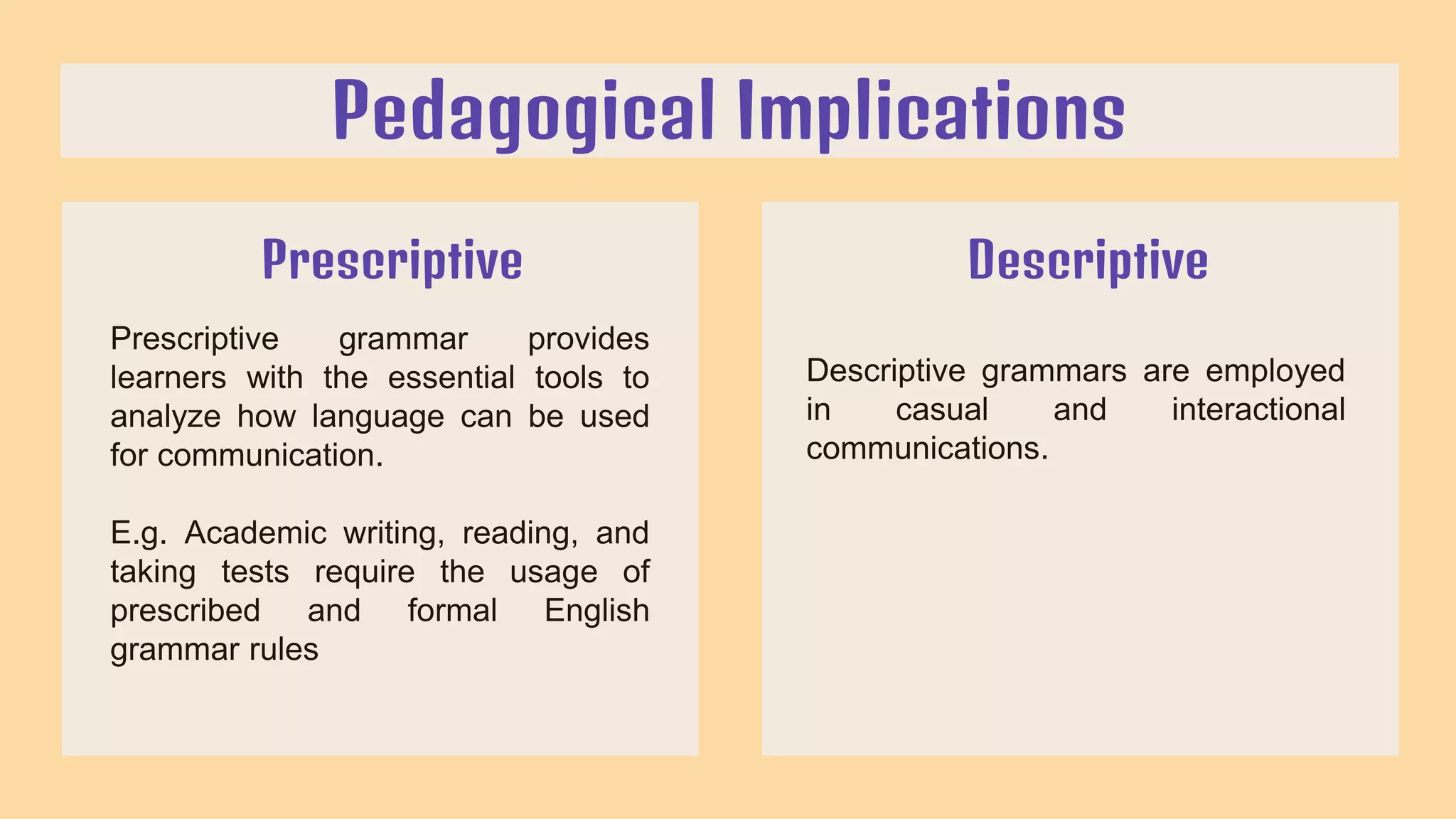
Descriptive grammars are employed
in casual and interactional
communications.
Prescriptive Descriptive
Prescriptive grammar provides
learners with the essential tools to
analyze how language can be used
for communication.
E.g. Academic writing, reading, and
taking tests require the usage of
prescribed and formal English
grammar rules
Examples
04
Prescriptive Examples
 In English, less goes with mass nouns (e.g. “ less money”), and “fewer” goes with
count nouns (e.g., “ fewer items.”)
 In English, speakers should not split infinitives (e.g., “to boldly go;“) instead, write or
say (“to go boldly.”)
 In English, speakers should not use passive voice (e.g., “The meeting was held by
the university;”) instead, write or say (“The university held the meeting.”)
 In English, speakers should avoid phrasal verbs (e.g., “come over to have some
tea;”) instead, write or say (e.g., “visit me to have some tea.”
Descriptive Examples
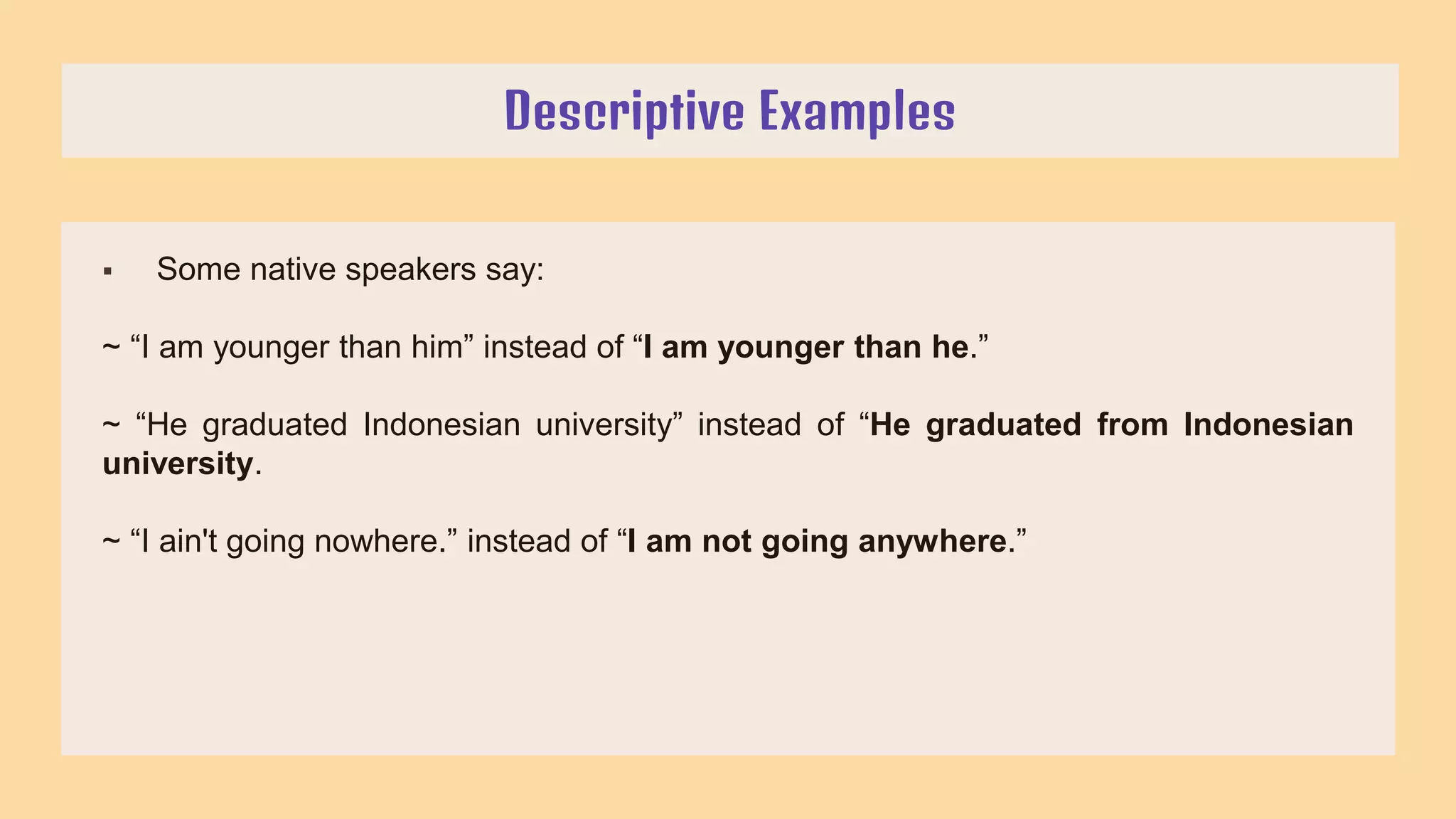
 Some native speakers say:
~ “I am younger than him” instead of “I am younger than he.”
~ “He graduated Indonesian university” instead of “He graduated from Indonesian
university.
~ “I ain't going nowhere.” instead of “I am not going anywhere.”
Advantages
Disadvantages
05
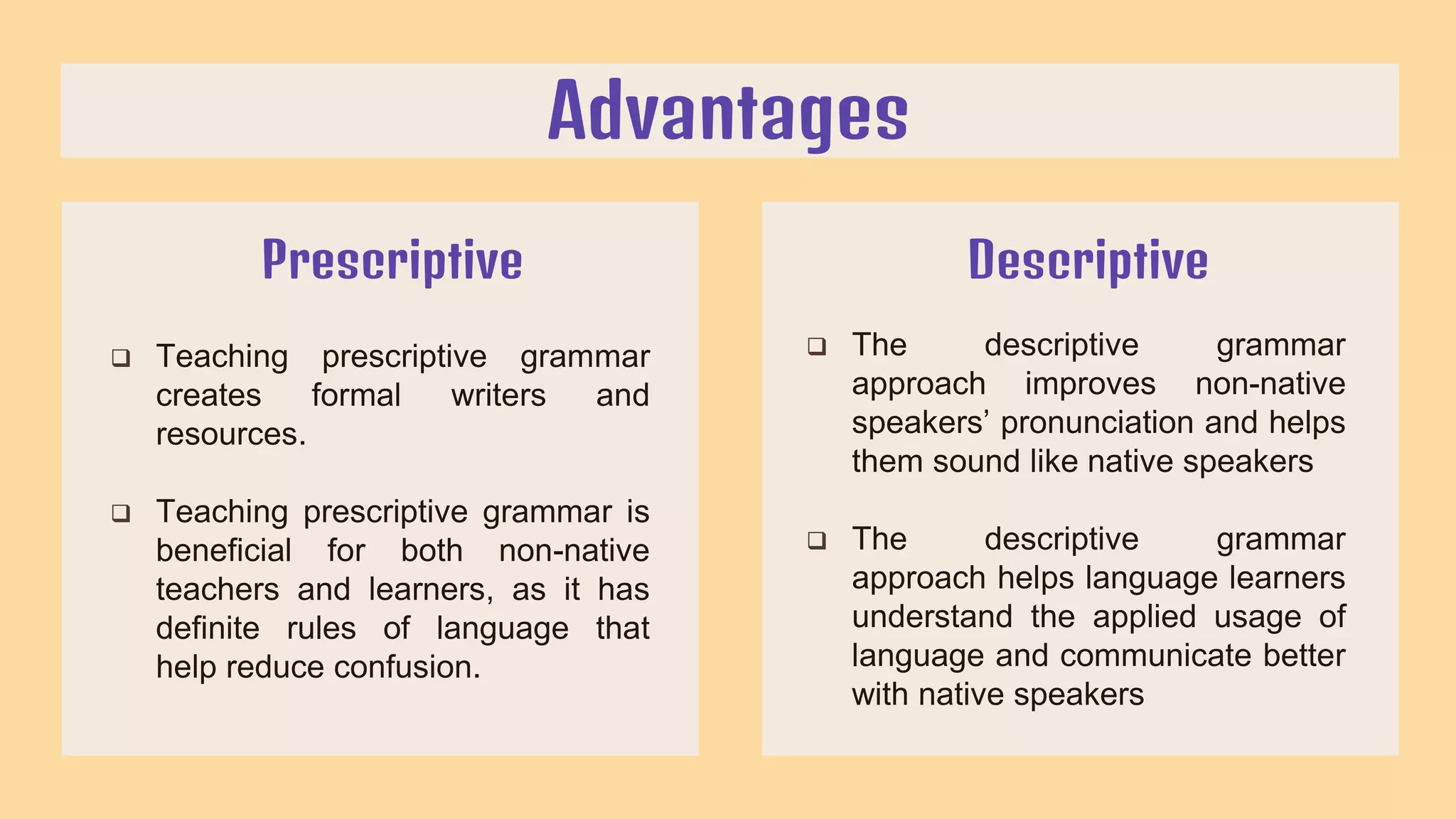
Advantages
 The descriptive grammar
approach improves non-native
speakers’ pronunciation and helps
them sound like native speakers
 The descriptive grammar
approach helps language learners
understand the applied usage of
language and communicate better
with native speakers
Prescriptive Descriptive
 Teaching prescriptive grammar
creates formal writers and
resources.
 Teaching prescriptive grammar is
beneficial for both non-native
teachers and learners, as it has
definite rules of language that
help reduce confusion.
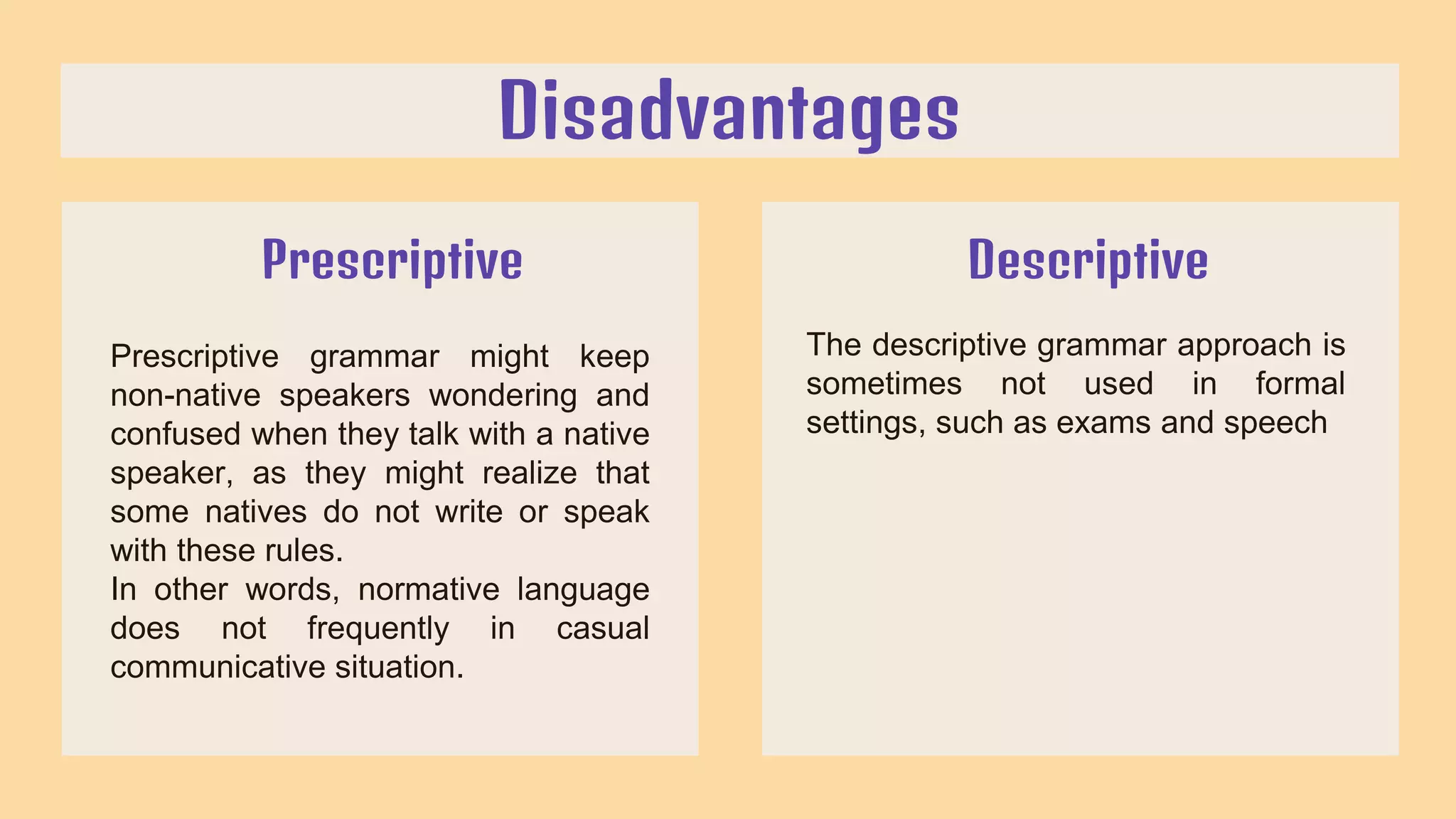
Disadvantages
The descriptive grammar approach is
sometimes not used in formal
settings, such as exams and speech
Prescriptive Descriptive
Prescriptive grammar might keep
non-native speakers wondering and
confused when they talk with a native
speaker, as they might realize that
some natives do not write or speak
with these rules.
In other words, normative language
does not frequently in casual
communicative situation.
Conclusion
06
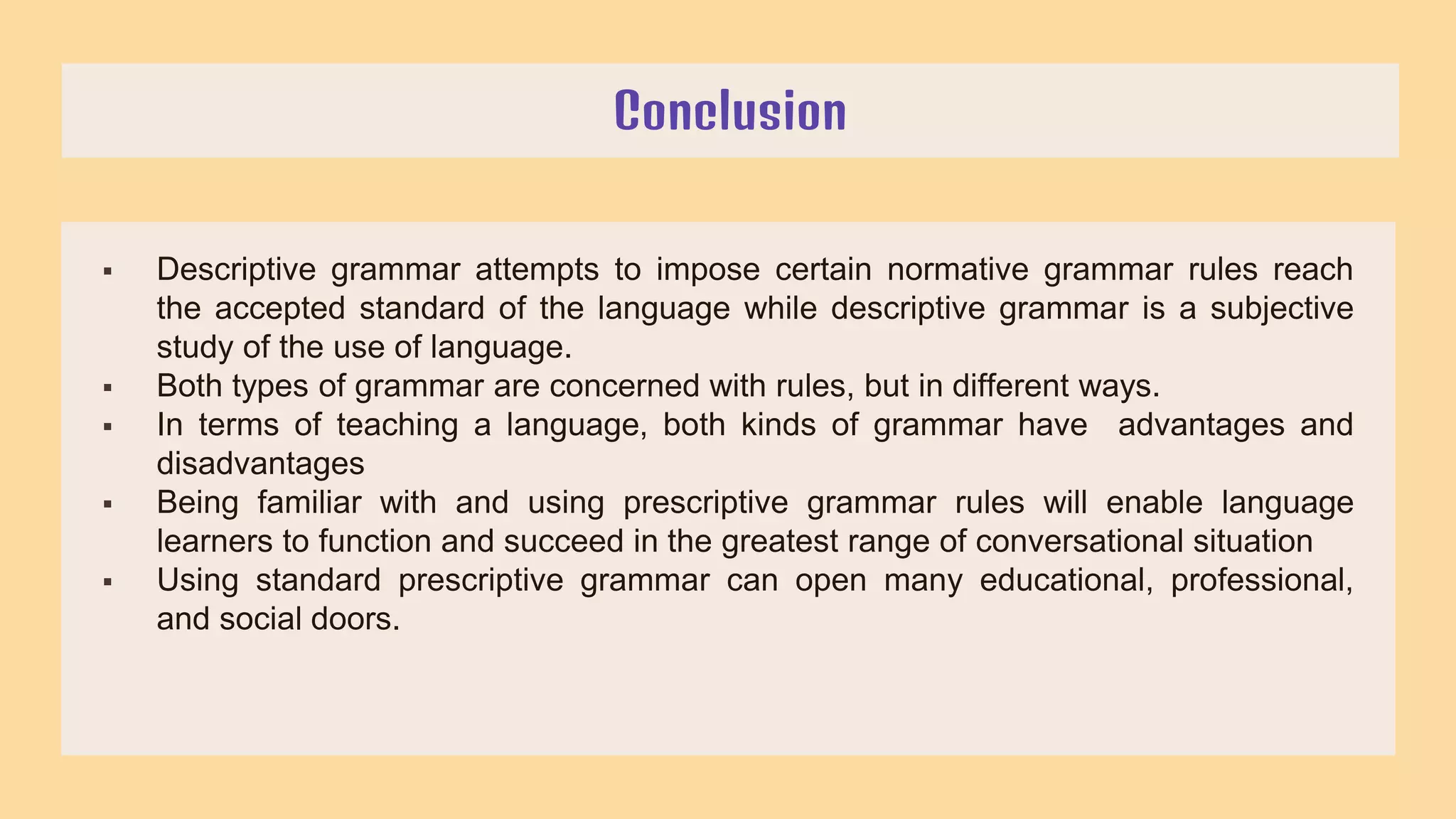
Conclusion
 Descriptive grammar attempts to impose certain normative grammar rules reach
the accepted standard of the language while descriptive grammar is a subjective
study of the use of language.
 Both types of grammar are concerned with rules, but in different ways.
 In terms of teaching a language, both kinds of grammar have advantages and
disadvantages
 Being familiar with and using prescriptive grammar rules will enable language
learners to function and succeed in the greatest range of conversational situation
 Using standard prescriptive grammar can open many educational, professional,
and social doors.
THANKS!

Group 2 - Prescriptive Grammar & Descriptive Grammar.pptx

  • 1.
    Group 2 • NirmaSelastiana R (G2Q122003) • Jusrianto (G2Q121017) • La Ode Muhammad Nur Rahim (G2Q121019) Prescriptive Grammar Descriptive Grammar
  • 2.
  • 3.
  • 4.
    Definition A descriptive grammaris a study of a language, its structure, and its rules as they are used in daily life including standard and nonstandard varieties. Prescriptive Descriptive How the grammar of a language is actually used in various contexts and for various purposes A prescriptive grammar specifies how a language should be used and what grammar rules should be followed Prescriptivist distinct between “good grammar” and “bad grammar,” and its primary focus is on standard forms of grammar and syntactic constructions
  • 5.
  • 6.
    Principles  The languageusage can vary according to varied speakers.  It does not consider what is ‘correct’ or incorrect grammar Prescriptive Descriptive  Prescriptive grammars serve to establish the language standard, in order to achieve effective and normative communication.  Long existed grammar rules created by the native speakers are the ‘correct’, and the variations are ‘incorrect.’
  • 7.
  • 8.
    Pedagogical Implications Descriptive grammarsare employed in casual and interactional communications. Prescriptive Descriptive Prescriptive grammar provides learners with the essential tools to analyze how language can be used for communication. E.g. Academic writing, reading, and taking tests require the usage of prescribed and formal English grammar rules
  • 9.
  • 10.
    Prescriptive Examples  InEnglish, less goes with mass nouns (e.g. “ less money”), and “fewer” goes with count nouns (e.g., “ fewer items.”)  In English, speakers should not split infinitives (e.g., “to boldly go;“) instead, write or say (“to go boldly.”)  In English, speakers should not use passive voice (e.g., “The meeting was held by the university;”) instead, write or say (“The university held the meeting.”)  In English, speakers should avoid phrasal verbs (e.g., “come over to have some tea;”) instead, write or say (e.g., “visit me to have some tea.”
  • 11.
    Descriptive Examples  Somenative speakers say: ~ “I am younger than him” instead of “I am younger than he.” ~ “He graduated Indonesian university” instead of “He graduated from Indonesian university. ~ “I ain't going nowhere.” instead of “I am not going anywhere.”
  • 12.
  • 13.
    Advantages  The descriptivegrammar approach improves non-native speakers’ pronunciation and helps them sound like native speakers  The descriptive grammar approach helps language learners understand the applied usage of language and communicate better with native speakers Prescriptive Descriptive  Teaching prescriptive grammar creates formal writers and resources.  Teaching prescriptive grammar is beneficial for both non-native teachers and learners, as it has definite rules of language that help reduce confusion.
  • 14.
    Disadvantages The descriptive grammarapproach is sometimes not used in formal settings, such as exams and speech Prescriptive Descriptive Prescriptive grammar might keep non-native speakers wondering and confused when they talk with a native speaker, as they might realize that some natives do not write or speak with these rules. In other words, normative language does not frequently in casual communicative situation.
  • 15.
  • 16.
    Conclusion  Descriptive grammarattempts to impose certain normative grammar rules reach the accepted standard of the language while descriptive grammar is a subjective study of the use of language.  Both types of grammar are concerned with rules, but in different ways.  In terms of teaching a language, both kinds of grammar have advantages and disadvantages  Being familiar with and using prescriptive grammar rules will enable language learners to function and succeed in the greatest range of conversational situation  Using standard prescriptive grammar can open many educational, professional, and social doors.
  • 17.