SHEAR ZONE
ASSAM UNIVERSITY, SILCHAR
DEPARTMENT OF EARTH SCIENCE
PRESENTED BY;
KUKI MONJORI BORUAH
CONTENT
 INTRODUCTION
 GENERAL CHARATERSTICS OF SHEAR ZONE
 GEOMETRY OF SHEAR ZONE
 TYPES OF SHEAR ZONE
 BRITTLE SHEAR ZONE
 DUCTILE SHEAR ZONE
 SEMI-BRITTLE SHEAR ZONE
 BRITTLE-DUCTILE SHEAR ZONE
 DETERMINATION OF SENSE OF SHEAR (SHEAR SENSE INDICATORS)
 SHEAR ZONE AND FAULT ZONE
 IMPORTANCE OF SHEAR ZONE
 CONCLUSION
 RFERENCES
What is a shear zone ?
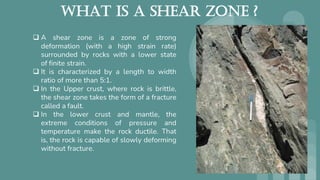
 A shear zone is a zone of strong
deformation (with a high strain rate)
surrounded by rocks with a lower state
of finite strain.
 It is characterized by a length to width
ratio of more than 5:1.
 In the Upper crust, where rock is brittle,
the shear zone takes the form of a fracture
called a fault.
 In the lower crust and mantle, the
extreme conditions of pressure and
temperature make the rock ductile. That
is, the rock is capable of slowly deforming
without fracture.
General characteristics of shear zone
 It may be hundreds of kilometers long and
tens of kilometers thick.
 In shear zone the deformation is
heterogeneous rater than homogenous.
 The center of a shear zone is where the
strain is highest.
 There are two types of shear in order of
their continuity.
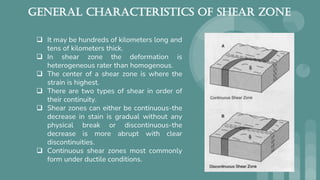
 Shear zones can either be continuous-the
decrease in stain is gradual without any
physical break or discontinuous-the
decrease is more abrupt with clear
discontinuities.
 Continuous shear zones most commonly
form under ductile conditions.
GEOMETRY OF SHEAR ZONE
 Shear zones can be planar or gently
curved and may have complex
geometry.
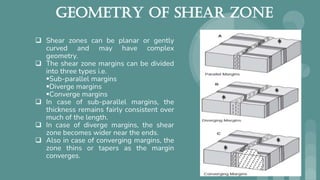
 The shear zone margins can be divided
into three types i.e.
Sub-parallel margins
Diverge margins
Converge margins
 In case of sub-parallel margins, the
thickness remains fairly consistent over
much of the length.
 In case of diverge margins, the shear
zone becomes wider near the ends.
 Also in case of converging margins, the
zone thins or tapers as the margin
converges.
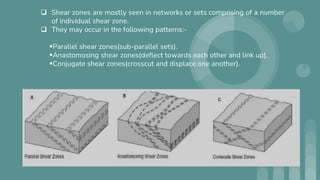
 Shear zones are mostly seen in networks or sets comprising of a number
of individual shear zone.
 They may occur in the following patterns:-
Parallel shear zones(sub-parallel sets).
Anastomosing shear zones(deflect towards each other and link up).
Conjugate shear zones(crosscut and displace one another).
TYPES OF SHEAR ZONE
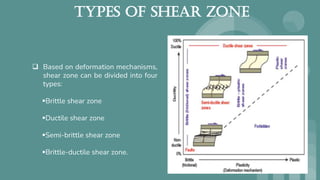
 Based on deformation mechanisms,
shear zone can be divided into four
types:
Brittle shear zone
Ductile shear zone
Semi-brittle shear zone
Brittle-ductile shear zone.
BRITTLE SHEAR ZONE
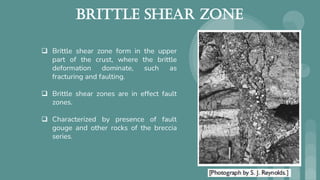
 Brittle shear zone form in the upper
part of the crust, where the brittle
deformation dominate, such as
fracturing and faulting.
 Brittle shear zones are in effect fault
zones.
 Characterized by presence of fault
gouge and other rocks of the breccia
series.
SEMI-BRITTLE SHEAR ZONE
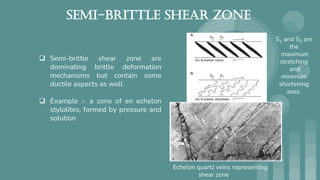
 Semi-brittle shear zone are
dominating brittle deformation
mechanisms but contain some
ductile aspects as well.
 Example :- a zone of en echelon
stylolites, formed by pressure and
solution
S1 and S3 are
the
maximum
stretching
and
minimum
shortening
axes.
Echelon quartz veins representing
shear zone
BRITTLE DUCTILE SHEAR ZONE
 Brittle-ductile shear zones contain evidence
of deformation by both brittle and ductile
mechanisms. Brittle-ductile shear zones
form when
1. The physical conditions permit brittle
and ductile deformation to occur at the
same time.
2. Different parts of a rock have different
mechanical properties.
3. A shear zone “strain hardens”.
4. A short-term change in physical
conditions, such as in strain rate,
causes the rock to switch from ductile
to brittle mechanisms or vice versa.
5. Physical conditions change
systematically during deformation.
6. A shear zone is reactivated under physical
conditions different from those in which the
shear zone originally formed.
 It contains mylonitic fabrics such as
a) Mylonitic foliations,
b) Lineation,
c) Boudins,
d) Rock fragments,
e) Porphyroclasts and
f) Some brittle aspects such as microfaults,
grain-scale fractures, microbreccias and
cataclasites.
Brittle and Ductile shear zones
DUCTILE SHEAR ZONE
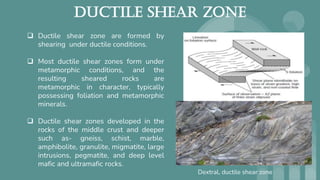
 Ductile shear zone are formed by
shearing under ductile conditions.
 Most ductile shear zones form under
metamorphic conditions, and the
resulting sheared rocks are
metamorphic in character, typically
possessing foliation and metamorphic
minerals.
 Ductile shear zones developed in the
rocks of the middle crust and deeper
such as- gneiss, schist, marble,
amphibolite, granulite, migmatite, large
intrusions, pegmatite, and deep level
mafic and ultramafic rocks.
Dextral, ductile shear zone
DETERMINATION OF SENSE OF
SHEAR (SHEAR SENSE INDICATOR)
 One of the most important aspects of the study of shear zones is to determine
the sense of shearing which has effected the relatively unsheared rocks on its
either side.
 Shear sense indicators are the typical structures associated with all kinds of
shear zones, especially the ductile shear zones, and observed on all scales.
 These structures are extremely useful in better understanding of tectonic
history of many regions.
 Different types of shear sense indicators are as follows
 Offset and deflection markers
 Foliation patterns
 Grain tail complexes
 Mica fish
 C-S and C-C’ structures
 Porphyroclasts and porphyroblasts
 Fractured grains
 Veins
 Fold (sheath fold)
Offset and Deflection Markers
 The offset and displacement of markers is functionally the simplest
indicator of shear zone.
 With assumed initial orientation initially oblique to the shear zone will
reflect the sense of relative displacement and width across the zone.
 The deflection of the marker across the ductile shear zone is due to
passive rotation which reflects the shear sense within the zone.
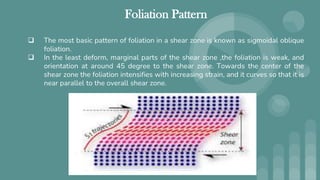
Foliation Pattern
 The most basic pattern of foliation in a shear zone is known as sigmoidal oblique
foliation.
 In the least deform, marginal parts of the shear zone ,the foliation is weak, and
orientation at around 45 degree to the shear zone. Towards the center of the
shear zone the foliation intensifies with increasing strain, and it curves so that it is
near parallel to the overall shear zone.
Grain Tail Complexes
 Grain in matrix may have tails that form during deformation , tails are
distinguishable from matrix.
 There are two types of tails :
1) σ- type : wedge shaped tails do not cross reference plane when tracing tail
away from grain.
2) δ- type: tails wrap around grain . So they cross cut reference plane when
tracing tail away from grain.
Mica Fish
 Single crystals of mica in a fine grained mylonitic matrix are called mica fish.
 Characteristic for mica fish are their lozenge shape and monoclinic shape
symmetry with one curve and one planner side.
 They lie with their long axis in the extensional quadrant of the deformation and
show a steeper inclination to the fabric attractor than mylonitic foliation, which
can be used as a shear sense indicator together with their asymmetry.
C-S and C-C’ Structures
 In some shear zones, strain is obviously partitioned such
that zones of intense shear, and grain size reduction,
alternate with zones of less intense strain, where the
foliation is more oblique and the grain size is coarser.
 This configuration is called C-S foliation (sometimes S-C).
The C-planes where ‘C’ stands for “cisaillement” in French,
meaning shearing).
 The S-planes (for “schistosité”) represent the less-
deformed zones and may be oriented up to 45° from the C-
planes and the shear zone boundary.
 The sense of rotation from S to C shows the sense of shear
on the overall shear zone
 C’s is a shear band that displaces an early foliations (i.e., C
for composite C/S
C-C’ Structure in a Micaceous
Mylonite
C-S Structure
Porphyroclasts & Porphyroblasts
 Rigid grains of one mineral within a more strongly
deformed matrix having a different mineralogy. Knowing
the shape due to noncoaxial deformation, we can define
the sense of shear.
 Porphyroclasts and other rigid inclusions may
accommodate deformation by becoming sliced up by
small-scale or grain-scale faults.
 The sense of displacement on such faults can be a shear-
sense indicator, but not a totally reliable one.
 Tails on porphyroclasts are are asymmetrical in the
direction of ductile flow
Blast : grain size increase
Clast : grain size decrease
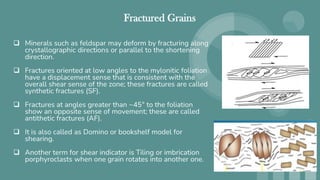
Fractured Grains
 Minerals such as feldspar may deform by fracturing along
crystallographic directions or parallel to the shortening
direction.
 Fractures oriented at low angles to the mylonitic foliation
have a displacement sense that is consistent with the
overall shear sense of the zone; these fractures are called
synthetic fractures (SF).
 Fractures at angles greater than ~45° to the foliation
show an opposite sense of movement; these are called
antithetic fractures (AF).
 It is also called as Domino or bookshelf model for
shearing.
 Another term for shear indicator is Tiling or imbrication
porphyroclasts when one grain rotates into another one.
Veins
 Most shear zone-related veins contain quartz
and calcite. These minerals are deposited
from the fluids that filled the opened
fractures.
 Most veins form "perpendicular" to the axis of
maximum extension, because this is the
direction in which tension fractures form.
Calcite extensions vein
Fold (Sheath fold)
 It is a are unusual, noncylindrical folds formed in some
strongly deformed rocks.
 They have strongly curved hinge lines and a rounded,
conical shape that looks like a wind sock.
 In planar outcrop faces, they may appear as elliptical
"eyes" defined by rings of lithologic layers.
 They are formed by lateral variations in particle
velocities within the flow regime, where one part of a
fold flows faster than material to either side.
 As folds in shear zones tighten, small irregularities on
their hinges are also amplified, with the result that
fold hinges may become strongly curved into
geometries that resemble the finger of a glove. These
are known as sheath folds
Progressive development of sheath folds in
shear zone. Initial asperities on the shear
zone margin (stage 1) propagate and
become strongly non-cylindrical folds (stage
2) that are tight to isoclinal parallel to the
lineation and have closed, curved hinges in
cuts perpendicular to it. Sketch by
Jeffreyfung (wikimedia.commons).
Folds in mylonitic marble. Looking at this section
(parallel to lineation), this might appear as
‘conventional’ right-verging folds. Rio Marina,
island of Elba. Photo Samuele Papeschi.
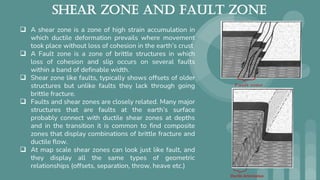
SHEAR ZONE AND FAULT ZONE
 A shear zone is a zone of high strain accumulation in
which ductile deformation prevails where movement
took place without loss of cohesion in the earth’s crust
 A Fault zone is a zone of brittle structures in which
loss of cohesion and slip occurs on several faults
within a band of definable width.
 Shear zone like faults, typically shows offsets of older
structures but unlike faults they lack through going
brittle fracture.
 Faults and shear zones are closely related. Many major
structures that are faults at the earth’s surface
probably connect with ductile shear zones at depths
and in the transition it is common to find composite
zones that display combinations of brittle fracture and
ductile flow.
 At map scale shear zones can look just like fault, and
they display all the same types of geometric
relationships (offsets, separation, throw, heave etc.)
Simplified model of the connection between faults, which normally form in the upper crust
and classic ductile shear zone. The transition is gradual and known as the brittle-plastic
transition. The depth depends on the temperature gradient and the mineralogy of the
crust.
IMPORTANCE OF SHEAR ZONE
 They are the major zones of weakness on the Earth’s crust, sometimes
extending into the upper mantle.
 They can be very long lived features and commonly show evidence of several
overprinting stages of activity.
 It helps in the studies of tectonics or plate boundaries where earthquakes and
volcanisms happened.
 Shear zones can host economically viable mineralizations, example being
important gold deposits in Precambrian terrains.
 Shear zones are one of the most commonly used kinematic indicator. This is
because of the abundant occurrence of these structures and the assumption
that there is a unique relationship between them and their causative stress
field
CONCLUSION
 Shear zones are tabular to sheet like, planar or curvi-planar zones in which
rocks are more highly strained than rocks adjacent to the zone.
 It may be hundreds of kilometers long and tens of kilometers thick with
highest strain at the center.
 It may be either continuous or discontinuous.
 Geometrically it can be planar or gently curved and or complex.
 The shear zone margins can be sub parallel, diverge and converge.
 Based on deformation mechanisms, shear zone can be- brittle shear zone,
ductile shear zone, semi-brittle shear zone and brittle-ductile shear zone.
 Features that reveal the sense of shear are shear-sense indicators and they are most
commonly observed in outcrop as well as microscopic scale.
 Offset and deflection markers, foliation patterns, grain tail complexes, mica
fish, C-S and C-C’ structures, porphyroclasts and porphyroblasts are some of
the important shear sense indicators.
 Faults and shear zones are closely related. In the upper crust where the rock
is brittle the shear zone takes the form of a fracture called a fault.
 It has many significance in geology.
REFERENCES
 Haakon Fossen: Structural Geology; Second Edition.
 Ghosh S.K. : Structural Geology Fundamentals and Modern Developments.
 https://www.academia.edu/1748228/Shear_Zones_Lecture
 https://www.sciencedirect.com/topics/earth-and-planetary-sciences/shear-
zone
 https://www.slideshare.net/urbez/shearzones
 https://www.sciencedirect.com/topics/engineering/shear-zone
 https://en.wikipedia.org/wiki/Shear_zone
 https://structuredatabase.wordpress.com/ductile-shear-sense-indicators/
THANK YOU

SHEAR ZONE.pptx

  • 1.
    SHEAR ZONE ASSAM UNIVERSITY,SILCHAR DEPARTMENT OF EARTH SCIENCE PRESENTED BY; KUKI MONJORI BORUAH
  • 2.
    CONTENT  INTRODUCTION  GENERALCHARATERSTICS OF SHEAR ZONE  GEOMETRY OF SHEAR ZONE  TYPES OF SHEAR ZONE  BRITTLE SHEAR ZONE  DUCTILE SHEAR ZONE  SEMI-BRITTLE SHEAR ZONE  BRITTLE-DUCTILE SHEAR ZONE  DETERMINATION OF SENSE OF SHEAR (SHEAR SENSE INDICATORS)  SHEAR ZONE AND FAULT ZONE  IMPORTANCE OF SHEAR ZONE  CONCLUSION  RFERENCES
  • 3.
    What is ashear zone ?  A shear zone is a zone of strong deformation (with a high strain rate) surrounded by rocks with a lower state of finite strain.  It is characterized by a length to width ratio of more than 5:1.  In the Upper crust, where rock is brittle, the shear zone takes the form of a fracture called a fault.  In the lower crust and mantle, the extreme conditions of pressure and temperature make the rock ductile. That is, the rock is capable of slowly deforming without fracture.
  • 4.
    General characteristics ofshear zone  It may be hundreds of kilometers long and tens of kilometers thick.  In shear zone the deformation is heterogeneous rater than homogenous.  The center of a shear zone is where the strain is highest.  There are two types of shear in order of their continuity.  Shear zones can either be continuous-the decrease in stain is gradual without any physical break or discontinuous-the decrease is more abrupt with clear discontinuities.  Continuous shear zones most commonly form under ductile conditions.
  • 5.
    GEOMETRY OF SHEARZONE  Shear zones can be planar or gently curved and may have complex geometry.  The shear zone margins can be divided into three types i.e. Sub-parallel margins Diverge margins Converge margins  In case of sub-parallel margins, the thickness remains fairly consistent over much of the length.  In case of diverge margins, the shear zone becomes wider near the ends.  Also in case of converging margins, the zone thins or tapers as the margin converges.
  • 6.
     Shear zonesare mostly seen in networks or sets comprising of a number of individual shear zone.  They may occur in the following patterns:- Parallel shear zones(sub-parallel sets). Anastomosing shear zones(deflect towards each other and link up). Conjugate shear zones(crosscut and displace one another).
  • 7.
    TYPES OF SHEARZONE  Based on deformation mechanisms, shear zone can be divided into four types: Brittle shear zone Ductile shear zone Semi-brittle shear zone Brittle-ductile shear zone.
  • 8.
    BRITTLE SHEAR ZONE Brittle shear zone form in the upper part of the crust, where the brittle deformation dominate, such as fracturing and faulting.  Brittle shear zones are in effect fault zones.  Characterized by presence of fault gouge and other rocks of the breccia series.
  • 9.
    SEMI-BRITTLE SHEAR ZONE Semi-brittle shear zone are dominating brittle deformation mechanisms but contain some ductile aspects as well.  Example :- a zone of en echelon stylolites, formed by pressure and solution S1 and S3 are the maximum stretching and minimum shortening axes. Echelon quartz veins representing shear zone
  • 10.
    BRITTLE DUCTILE SHEARZONE  Brittle-ductile shear zones contain evidence of deformation by both brittle and ductile mechanisms. Brittle-ductile shear zones form when 1. The physical conditions permit brittle and ductile deformation to occur at the same time. 2. Different parts of a rock have different mechanical properties. 3. A shear zone “strain hardens”. 4. A short-term change in physical conditions, such as in strain rate, causes the rock to switch from ductile to brittle mechanisms or vice versa. 5. Physical conditions change systematically during deformation.
  • 11.
    6. A shearzone is reactivated under physical conditions different from those in which the shear zone originally formed.  It contains mylonitic fabrics such as a) Mylonitic foliations, b) Lineation, c) Boudins, d) Rock fragments, e) Porphyroclasts and f) Some brittle aspects such as microfaults, grain-scale fractures, microbreccias and cataclasites. Brittle and Ductile shear zones
  • 12.
    DUCTILE SHEAR ZONE Ductile shear zone are formed by shearing under ductile conditions.  Most ductile shear zones form under metamorphic conditions, and the resulting sheared rocks are metamorphic in character, typically possessing foliation and metamorphic minerals.  Ductile shear zones developed in the rocks of the middle crust and deeper such as- gneiss, schist, marble, amphibolite, granulite, migmatite, large intrusions, pegmatite, and deep level mafic and ultramafic rocks. Dextral, ductile shear zone
  • 13.
    DETERMINATION OF SENSEOF SHEAR (SHEAR SENSE INDICATOR)  One of the most important aspects of the study of shear zones is to determine the sense of shearing which has effected the relatively unsheared rocks on its either side.  Shear sense indicators are the typical structures associated with all kinds of shear zones, especially the ductile shear zones, and observed on all scales.  These structures are extremely useful in better understanding of tectonic history of many regions.
  • 14.
     Different typesof shear sense indicators are as follows  Offset and deflection markers  Foliation patterns  Grain tail complexes  Mica fish  C-S and C-C’ structures  Porphyroclasts and porphyroblasts  Fractured grains  Veins  Fold (sheath fold)
  • 15.
    Offset and DeflectionMarkers  The offset and displacement of markers is functionally the simplest indicator of shear zone.  With assumed initial orientation initially oblique to the shear zone will reflect the sense of relative displacement and width across the zone.  The deflection of the marker across the ductile shear zone is due to passive rotation which reflects the shear sense within the zone.
  • 16.
    Foliation Pattern  Themost basic pattern of foliation in a shear zone is known as sigmoidal oblique foliation.  In the least deform, marginal parts of the shear zone ,the foliation is weak, and orientation at around 45 degree to the shear zone. Towards the center of the shear zone the foliation intensifies with increasing strain, and it curves so that it is near parallel to the overall shear zone.
  • 17.
    Grain Tail Complexes Grain in matrix may have tails that form during deformation , tails are distinguishable from matrix.  There are two types of tails : 1) σ- type : wedge shaped tails do not cross reference plane when tracing tail away from grain. 2) δ- type: tails wrap around grain . So they cross cut reference plane when tracing tail away from grain.
  • 18.
    Mica Fish  Singlecrystals of mica in a fine grained mylonitic matrix are called mica fish.  Characteristic for mica fish are their lozenge shape and monoclinic shape symmetry with one curve and one planner side.  They lie with their long axis in the extensional quadrant of the deformation and show a steeper inclination to the fabric attractor than mylonitic foliation, which can be used as a shear sense indicator together with their asymmetry.
  • 19.
    C-S and C-C’Structures  In some shear zones, strain is obviously partitioned such that zones of intense shear, and grain size reduction, alternate with zones of less intense strain, where the foliation is more oblique and the grain size is coarser.  This configuration is called C-S foliation (sometimes S-C). The C-planes where ‘C’ stands for “cisaillement” in French, meaning shearing).  The S-planes (for “schistosité”) represent the less- deformed zones and may be oriented up to 45° from the C- planes and the shear zone boundary.  The sense of rotation from S to C shows the sense of shear on the overall shear zone  C’s is a shear band that displaces an early foliations (i.e., C for composite C/S C-C’ Structure in a Micaceous Mylonite C-S Structure
  • 20.
    Porphyroclasts & Porphyroblasts Rigid grains of one mineral within a more strongly deformed matrix having a different mineralogy. Knowing the shape due to noncoaxial deformation, we can define the sense of shear.  Porphyroclasts and other rigid inclusions may accommodate deformation by becoming sliced up by small-scale or grain-scale faults.  The sense of displacement on such faults can be a shear- sense indicator, but not a totally reliable one.  Tails on porphyroclasts are are asymmetrical in the direction of ductile flow Blast : grain size increase Clast : grain size decrease
  • 21.
    Fractured Grains  Mineralssuch as feldspar may deform by fracturing along crystallographic directions or parallel to the shortening direction.  Fractures oriented at low angles to the mylonitic foliation have a displacement sense that is consistent with the overall shear sense of the zone; these fractures are called synthetic fractures (SF).  Fractures at angles greater than ~45° to the foliation show an opposite sense of movement; these are called antithetic fractures (AF).  It is also called as Domino or bookshelf model for shearing.  Another term for shear indicator is Tiling or imbrication porphyroclasts when one grain rotates into another one.
  • 22.
    Veins  Most shearzone-related veins contain quartz and calcite. These minerals are deposited from the fluids that filled the opened fractures.  Most veins form "perpendicular" to the axis of maximum extension, because this is the direction in which tension fractures form. Calcite extensions vein
  • 23.
    Fold (Sheath fold) It is a are unusual, noncylindrical folds formed in some strongly deformed rocks.  They have strongly curved hinge lines and a rounded, conical shape that looks like a wind sock.  In planar outcrop faces, they may appear as elliptical "eyes" defined by rings of lithologic layers.  They are formed by lateral variations in particle velocities within the flow regime, where one part of a fold flows faster than material to either side.  As folds in shear zones tighten, small irregularities on their hinges are also amplified, with the result that fold hinges may become strongly curved into geometries that resemble the finger of a glove. These are known as sheath folds Progressive development of sheath folds in shear zone. Initial asperities on the shear zone margin (stage 1) propagate and become strongly non-cylindrical folds (stage 2) that are tight to isoclinal parallel to the lineation and have closed, curved hinges in cuts perpendicular to it. Sketch by Jeffreyfung (wikimedia.commons). Folds in mylonitic marble. Looking at this section (parallel to lineation), this might appear as ‘conventional’ right-verging folds. Rio Marina, island of Elba. Photo Samuele Papeschi.
  • 24.
    SHEAR ZONE ANDFAULT ZONE  A shear zone is a zone of high strain accumulation in which ductile deformation prevails where movement took place without loss of cohesion in the earth’s crust  A Fault zone is a zone of brittle structures in which loss of cohesion and slip occurs on several faults within a band of definable width.  Shear zone like faults, typically shows offsets of older structures but unlike faults they lack through going brittle fracture.  Faults and shear zones are closely related. Many major structures that are faults at the earth’s surface probably connect with ductile shear zones at depths and in the transition it is common to find composite zones that display combinations of brittle fracture and ductile flow.  At map scale shear zones can look just like fault, and they display all the same types of geometric relationships (offsets, separation, throw, heave etc.)
  • 25.
    Simplified model ofthe connection between faults, which normally form in the upper crust and classic ductile shear zone. The transition is gradual and known as the brittle-plastic transition. The depth depends on the temperature gradient and the mineralogy of the crust.
  • 26.
    IMPORTANCE OF SHEARZONE  They are the major zones of weakness on the Earth’s crust, sometimes extending into the upper mantle.  They can be very long lived features and commonly show evidence of several overprinting stages of activity.  It helps in the studies of tectonics or plate boundaries where earthquakes and volcanisms happened.  Shear zones can host economically viable mineralizations, example being important gold deposits in Precambrian terrains.  Shear zones are one of the most commonly used kinematic indicator. This is because of the abundant occurrence of these structures and the assumption that there is a unique relationship between them and their causative stress field
  • 27.
    CONCLUSION  Shear zonesare tabular to sheet like, planar or curvi-planar zones in which rocks are more highly strained than rocks adjacent to the zone.  It may be hundreds of kilometers long and tens of kilometers thick with highest strain at the center.  It may be either continuous or discontinuous.  Geometrically it can be planar or gently curved and or complex.  The shear zone margins can be sub parallel, diverge and converge.  Based on deformation mechanisms, shear zone can be- brittle shear zone, ductile shear zone, semi-brittle shear zone and brittle-ductile shear zone.  Features that reveal the sense of shear are shear-sense indicators and they are most commonly observed in outcrop as well as microscopic scale.  Offset and deflection markers, foliation patterns, grain tail complexes, mica fish, C-S and C-C’ structures, porphyroclasts and porphyroblasts are some of the important shear sense indicators.  Faults and shear zones are closely related. In the upper crust where the rock is brittle the shear zone takes the form of a fracture called a fault.  It has many significance in geology.
  • 28.
    REFERENCES  Haakon Fossen:Structural Geology; Second Edition.  Ghosh S.K. : Structural Geology Fundamentals and Modern Developments.  https://www.academia.edu/1748228/Shear_Zones_Lecture  https://www.sciencedirect.com/topics/earth-and-planetary-sciences/shear- zone  https://www.slideshare.net/urbez/shearzones  https://www.sciencedirect.com/topics/engineering/shear-zone  https://en.wikipedia.org/wiki/Shear_zone  https://structuredatabase.wordpress.com/ductile-shear-sense-indicators/
  • 29.