CLASSIFICATION OF NERVE
INJURIES
KEERAT KUCKREJA
150301176
IV YEAR
ETIOLOGY
• Trauma is the major cause of nerve injuries
• Iatrogenic errors
• Delivery of LA
• Oral surgical procedures
• Endodontic procedures
• Periodontal surgeries
• Chemical agents
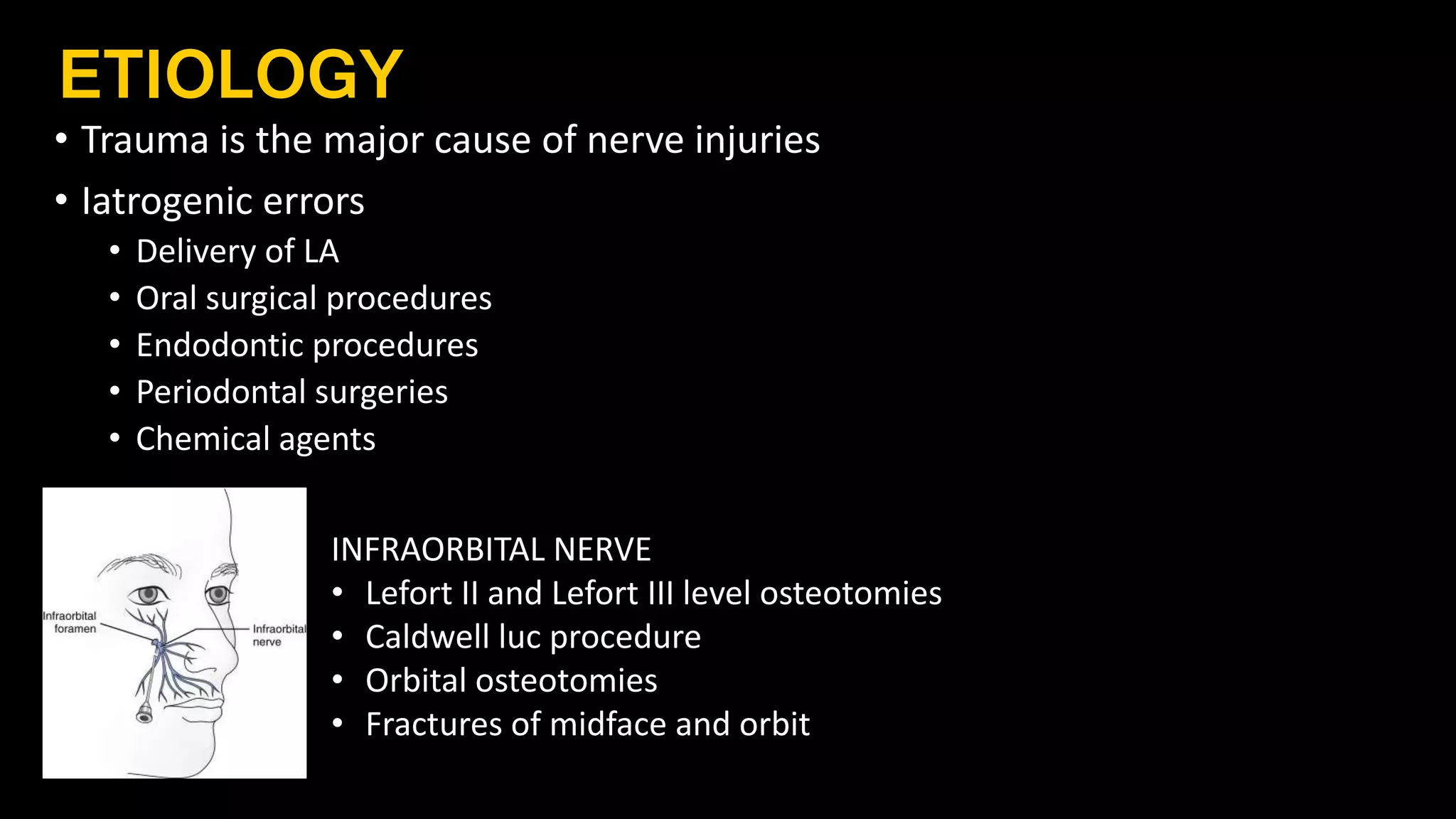
INFRAORBITAL NERVE
• Lefort II and Lefort III level osteotomies
• Caldwell luc procedure
• Orbital osteotomies
• Fractures of midface and orbit
LINGUAL NERVE
• Mandibular third molar removal
• Excision of submandibular and sublingual
glands
• Iatrogenic instrumentation of floor of mouth
• Mandibular tumor removal
• Osteotomies
INFERIOR ALVEOLAR NERVE
• Removal of any impacted mandibular tooth
• Endosteal implant placement
• Mandibular osteotomies
• Mandibular cyst and tumor removal
• Mandibular resection
• Orthognathic and preprosthetic surgeries
ANATOMY OF PERIPHERAL NERVE
SEDDON’S CLASSIFICATION (1942)
SEDDON CLASSIFIED NERVE INJURIES
INTO ACC TO THE AMOUNT OF
NERVE TISSUE DAMAGED AND
TISSUE STILL INTACT:
• NEUROPRAXIA
• AXONOTMESIS
• NEUROTMESIS
NEUROPRAXIA:
• Mild temporary injury due to compression or retraction of nerve
• There is a conduction block due to anoxia from the interruption of epineural or
endoneural blood supply causing intrafasicular edema
• No axonal degeneration distal to the site of injury
• Temporary conduction block (sensory loss)
• Spontaneous recovery within 4 weeks
• No surgical intervention required
AXONOTMESIS:
• Disruption or loss of continuity of some axons , which undergo Wallerian
degeneration distal to the site of injury
• General structure of the nerve remains intact
• Prolonged conduction failure
• Intial signs of recovery do not appear until after 1-3 months
• Eventual recovery less than normal (paresis and hypoesthesia)
• Sensory nerve injuries may develop persistent painful sensation (dysesthesia)
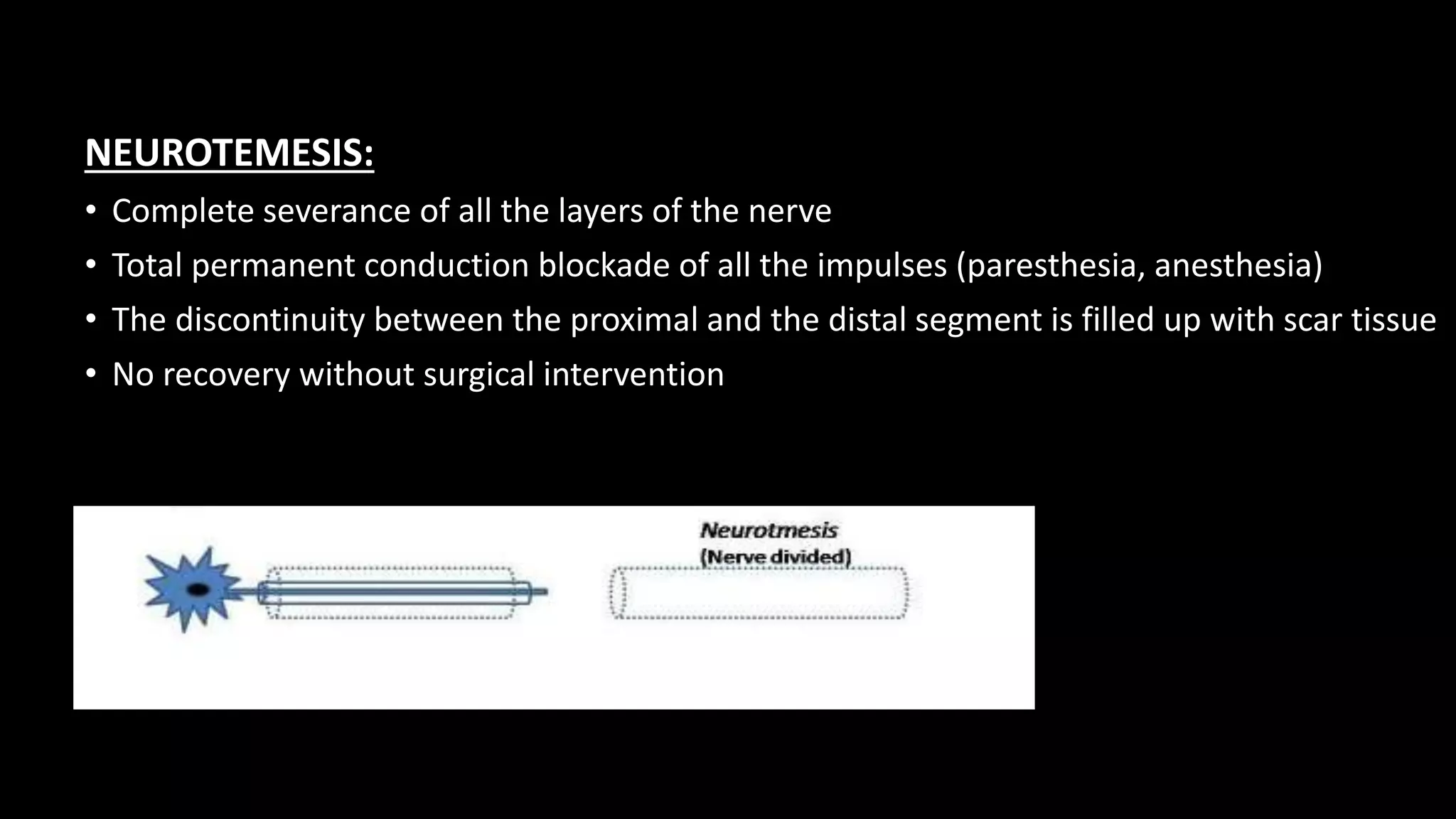
NEUROTEMESIS:
• Complete severance of all the layers of the nerve
• Total permanent conduction blockade of all the impulses (paresthesia, anesthesia)
• The discontinuity between the proximal and the distal segment is filled up with scar tissue
• No recovery without surgical intervention
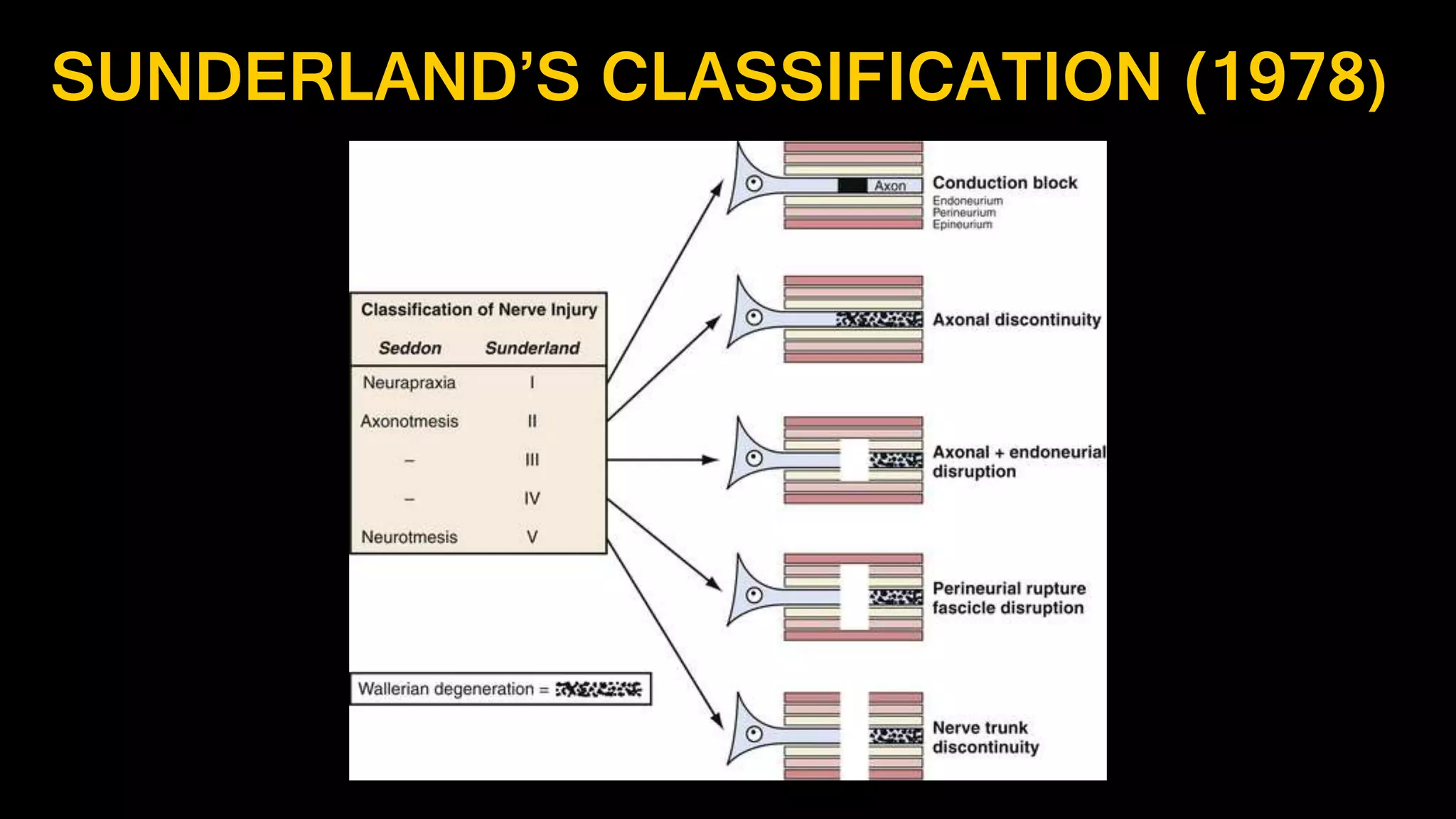
SUNDERLAND’S CLASSIFICATION (1978)
STAGES OF NERVE HEALING
CLINICAL FEATURES
• Deep seated pain
• Diffuse and continuous in nature
• Functional loss if motor nerve is involved
• Drooling
• Tongue biting
• Thermal burns
• Changes in speech
• Swallowing
• Taste perception alterations
• The area supplied by the sensory branch may become hyperesthetic of
hypoesthetic.
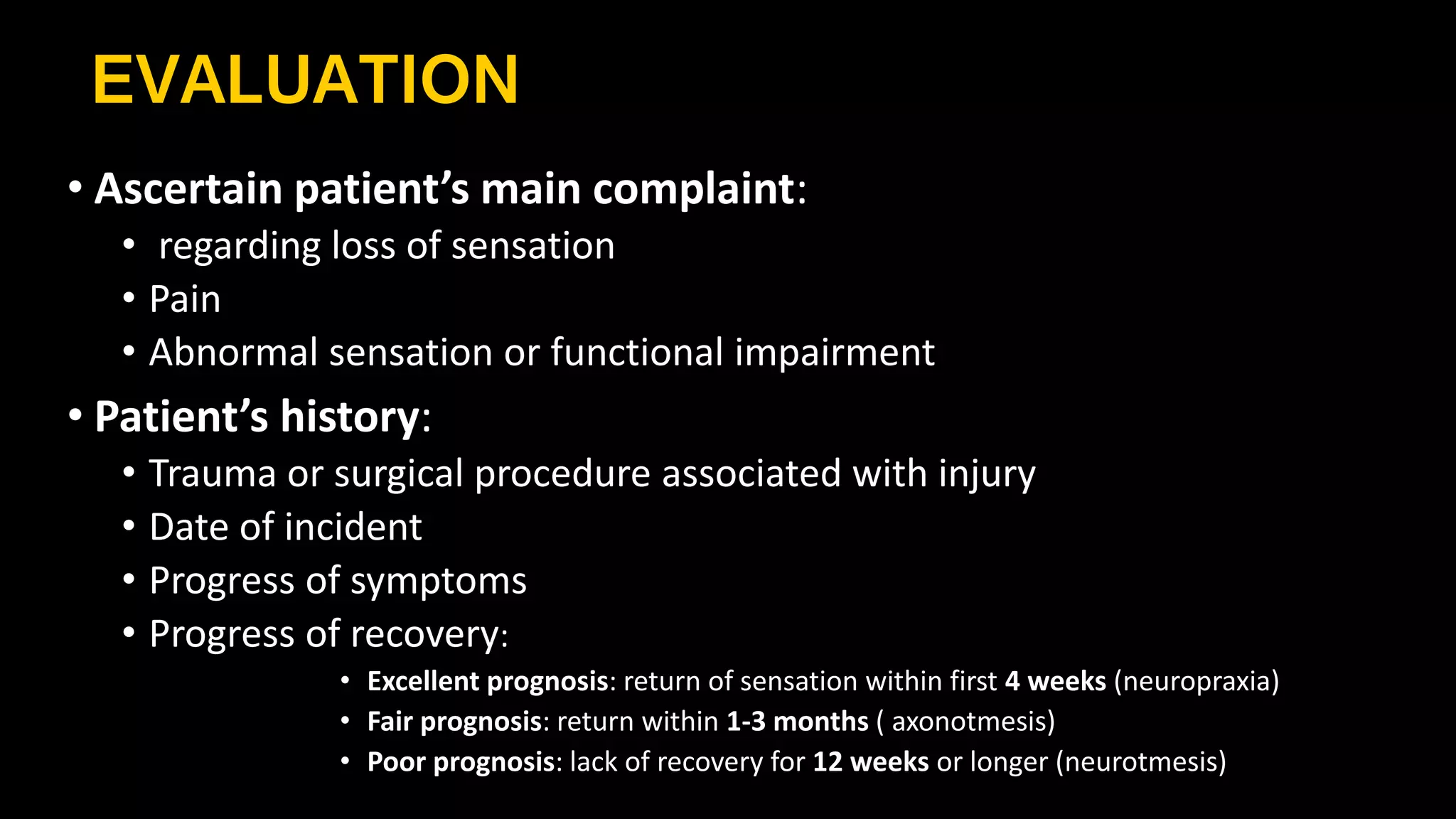
EVALUATION
• Ascertain patient’s main complaint:
• regarding loss of sensation
• Pain
• Abnormal sensation or functional impairment
• Patient’s history:
• Trauma or surgical procedure associated with injury
• Date of incident
• Progress of symptoms
• Progress of recovery:
• Excellent prognosis: return of sensation within first 4 weeks (neuropraxia)
• Fair prognosis: return within 1-3 months ( axonotmesis)
• Poor prognosis: lack of recovery for 12 weeks or longer (neurotmesis)
CLINICAL NEUROSENSORY EXAMINATION:
• Static light touch
• Brush directional discrimination
• Two point discrimination
• Pin pressure nociceptive discrimination
• Thermal discrimination
STEP 1: MAP THE AREA OF SENSORY DISTURBANCE
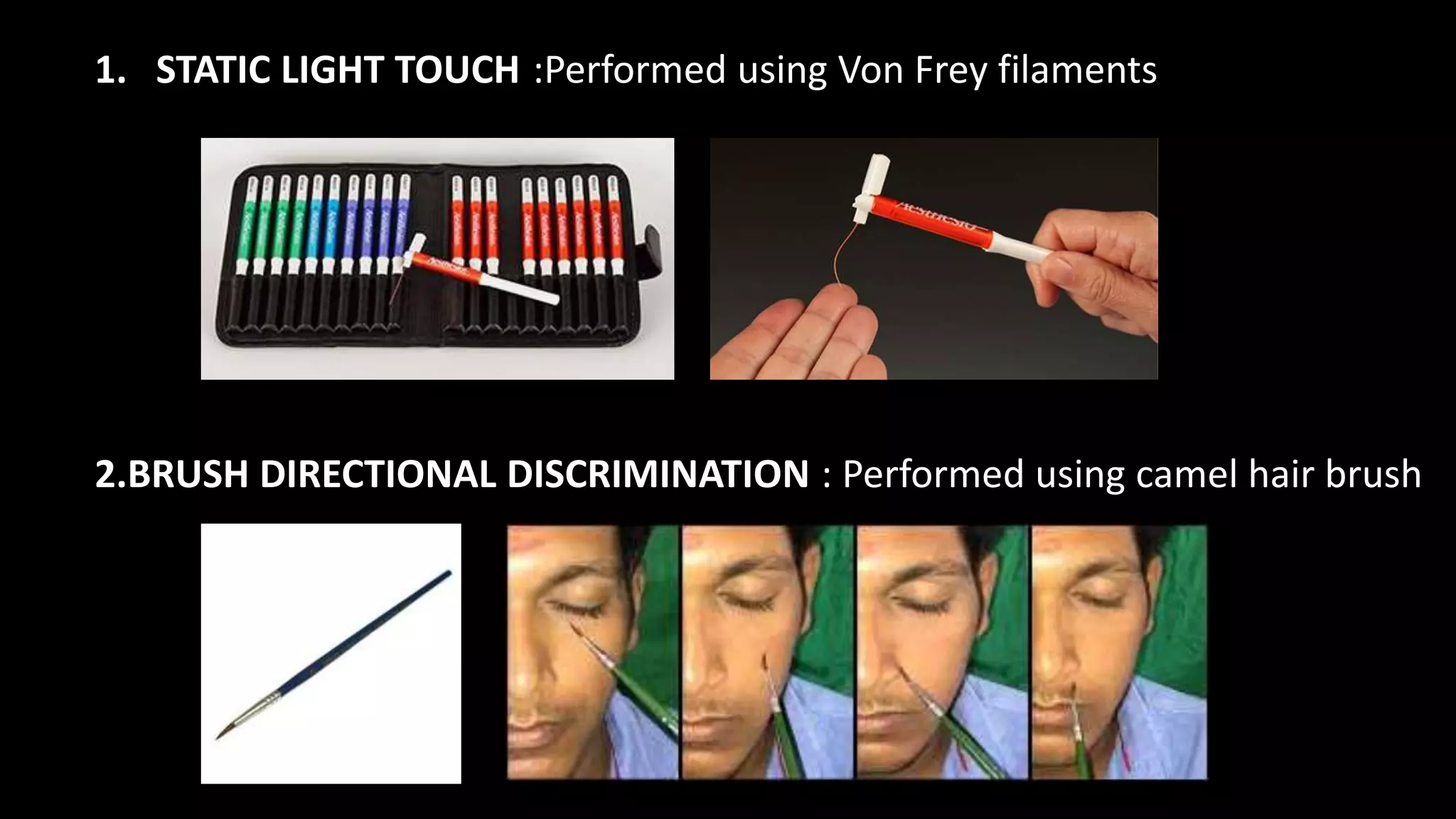
1. STATIC LIGHT TOUCH :Performed using Von Frey filaments
2.BRUSH DIRECTIONAL DISCRIMINATION : Performed using camel hair brush
3.TWO POINT DISCRIMINATOR
4.PIN PRESSURE NOCICEPTION
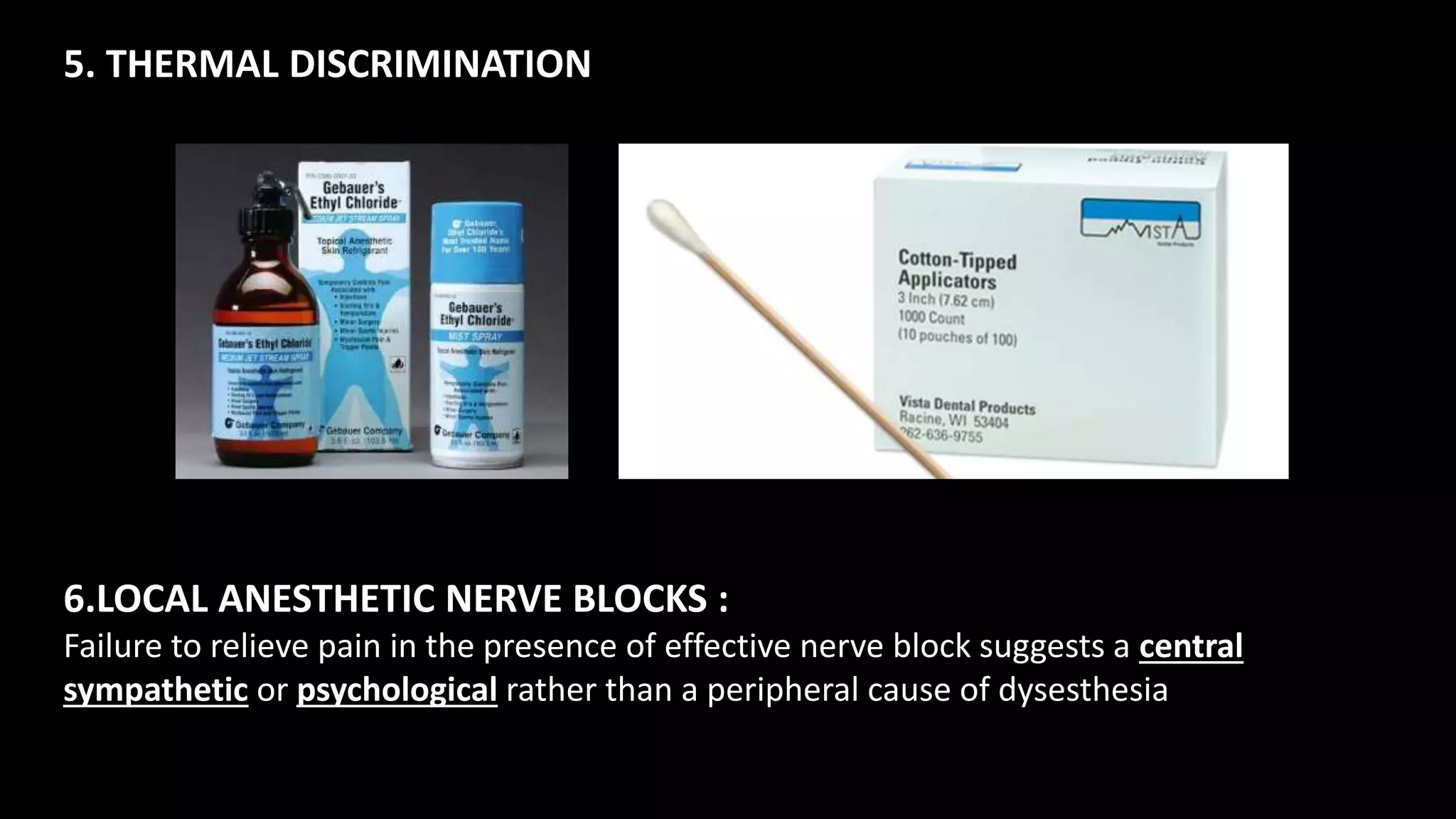
5. THERMAL DISCRIMINATION
6.LOCAL ANESTHETIC NERVE BLOCKS :
Failure to relieve pain in the presence of effective nerve block suggests a central
sympathetic or psychological rather than a peripheral cause of dysesthesia
MANAGEMENT
• MEDICAL MANAGEMENT:
Topical Anesthetics 5% viscous lidocaine
gel
NSAIDS Ketoprofen 10-20%
PLO base
Sympathomimetics Clonidine 0.01% PLO
base or patch
Anticonvulsants Carbamazepne 2% PLO
base
TCA Amitriptyline 2% PLO
base
Topical medications Systemic Pharmacological
Agents
Local anesthetics
Corticosteroids
NSAIDS
Antidepressants
Muscle relaxants
Benzodiazepines
• SURGICAL MANAGEMENT:
Indications for Microneurosurgery Contraindications for Microneurosurgery:
Observed nerve severance Central neuropathic pain
Total anesthesia beyond 3 months Dysesthesia not abolished by the LA nerve block
Dysesthesia beyond 4 months Improving sensation
Sever hypoesthesia without improvement beyond 4
months
Medically compromised patient
Excessive delay after injury
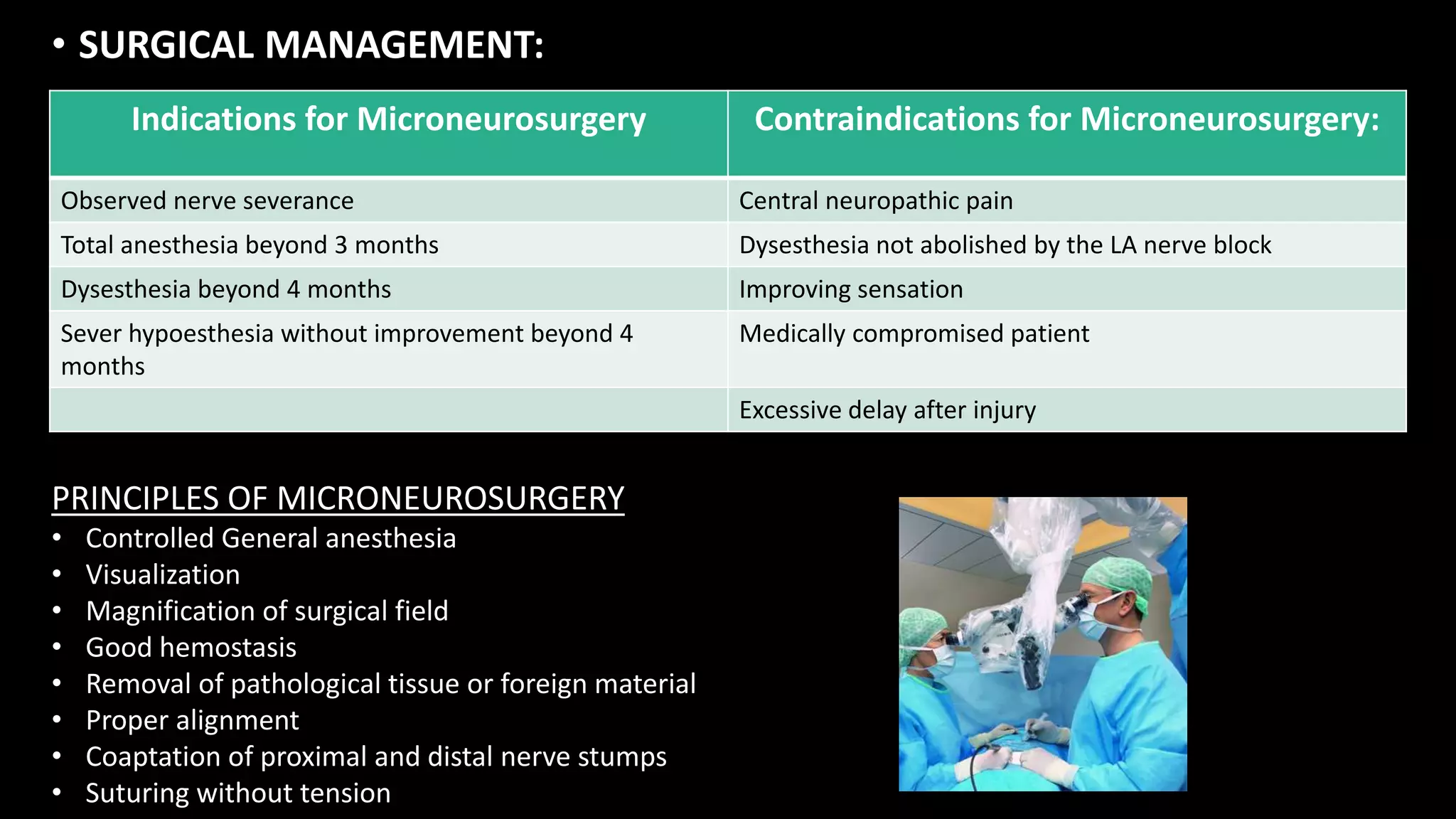
PRINCIPLES OF MICRONEUROSURGERY
• Controlled General anesthesia
• Visualization
• Magnification of surgical field
• Good hemostasis
• Removal of pathological tissue or foreign material
• Proper alignment
• Coaptation of proximal and distal nerve stumps
• Suturing without tension
SURGICAL APPROACH
IN CASE OF WIDER GAPS
NERVE REGENRATION
• An Autogenous nerve graft
is interposed between
nerve stumps to eliminate
tension
• The Great auricular and
the Sural nerves are
common donors
• Short span (1-3cm) nerve
gaps can be repaired with
guided nerve regeneration
• Axonal growth directed by
a tube made up of
alloplastic materials or
autogenous tissues
• The peripheral nerve guidance conduit is surgically implanted, the proximal
and the distal nerve stumps are sutured into the conduit,
• This creates a physical guiding pathway for nerve growth as well as a reservoir
of growth factors that further guide the sprouting daughter axons in the
proximal nerve stump
POST OPERATIVER MANAGEMENT
• Standard protocols are followed regarding
antibiotics, analgesics, fluids and discharge
• The neck sutures are removed at 5-7 days after
surgery and leg sutures after 10 days
POST OPERATIVE COURSE
• Variable period of complete anetgesia ,sometimes upto 3 months
• Regrowth occurs at 3mm/day ,that means 3 cm in 1 month
• Dysesthesia is always possible after nerve surgery
• Best prognosis for an anesthetic nerve operated on within 3 months
BIBLIOGRAPHY
1.Tubbs RS , Rizk E, Shoja MM, Loukas M, Barbaro N, Spinner RJ, Nerves
and Nerve injuries
2. Trigeminal nerve Injury and Management , Kristopher Lee (OMFS ,
mount Sinai hospital
3. Nilima Malik text book for oral surgery
4. Google images
CLASSIFICATION OF NERVE INJURIES

CLASSIFICATION OF NERVE INJURIES

  • 1.
    CLASSIFICATION OF NERVE INJURIES KEERATKUCKREJA 150301176 IV YEAR
  • 2.
    ETIOLOGY • Trauma isthe major cause of nerve injuries • Iatrogenic errors • Delivery of LA • Oral surgical procedures • Endodontic procedures • Periodontal surgeries • Chemical agents INFRAORBITAL NERVE • Lefort II and Lefort III level osteotomies • Caldwell luc procedure • Orbital osteotomies • Fractures of midface and orbit
  • 3.
    LINGUAL NERVE • Mandibularthird molar removal • Excision of submandibular and sublingual glands • Iatrogenic instrumentation of floor of mouth • Mandibular tumor removal • Osteotomies INFERIOR ALVEOLAR NERVE • Removal of any impacted mandibular tooth • Endosteal implant placement • Mandibular osteotomies • Mandibular cyst and tumor removal • Mandibular resection • Orthognathic and preprosthetic surgeries
  • 4.
  • 5.
    SEDDON’S CLASSIFICATION (1942) SEDDONCLASSIFIED NERVE INJURIES INTO ACC TO THE AMOUNT OF NERVE TISSUE DAMAGED AND TISSUE STILL INTACT: • NEUROPRAXIA • AXONOTMESIS • NEUROTMESIS
  • 6.
    NEUROPRAXIA: • Mild temporaryinjury due to compression or retraction of nerve • There is a conduction block due to anoxia from the interruption of epineural or endoneural blood supply causing intrafasicular edema • No axonal degeneration distal to the site of injury • Temporary conduction block (sensory loss) • Spontaneous recovery within 4 weeks • No surgical intervention required
  • 7.
    AXONOTMESIS: • Disruption orloss of continuity of some axons , which undergo Wallerian degeneration distal to the site of injury • General structure of the nerve remains intact • Prolonged conduction failure • Intial signs of recovery do not appear until after 1-3 months • Eventual recovery less than normal (paresis and hypoesthesia) • Sensory nerve injuries may develop persistent painful sensation (dysesthesia)
  • 8.
    NEUROTEMESIS: • Complete severanceof all the layers of the nerve • Total permanent conduction blockade of all the impulses (paresthesia, anesthesia) • The discontinuity between the proximal and the distal segment is filled up with scar tissue • No recovery without surgical intervention
  • 9.
  • 10.
  • 11.
    CLINICAL FEATURES • Deepseated pain • Diffuse and continuous in nature • Functional loss if motor nerve is involved • Drooling • Tongue biting • Thermal burns • Changes in speech • Swallowing • Taste perception alterations • The area supplied by the sensory branch may become hyperesthetic of hypoesthetic.
  • 12.
    EVALUATION • Ascertain patient’smain complaint: • regarding loss of sensation • Pain • Abnormal sensation or functional impairment • Patient’s history: • Trauma or surgical procedure associated with injury • Date of incident • Progress of symptoms • Progress of recovery: • Excellent prognosis: return of sensation within first 4 weeks (neuropraxia) • Fair prognosis: return within 1-3 months ( axonotmesis) • Poor prognosis: lack of recovery for 12 weeks or longer (neurotmesis)
  • 13.
    CLINICAL NEUROSENSORY EXAMINATION: •Static light touch • Brush directional discrimination • Two point discrimination • Pin pressure nociceptive discrimination • Thermal discrimination STEP 1: MAP THE AREA OF SENSORY DISTURBANCE
  • 14.
    1. STATIC LIGHTTOUCH :Performed using Von Frey filaments 2.BRUSH DIRECTIONAL DISCRIMINATION : Performed using camel hair brush
  • 15.
    3.TWO POINT DISCRIMINATOR 4.PINPRESSURE NOCICEPTION
  • 16.
    5. THERMAL DISCRIMINATION 6.LOCALANESTHETIC NERVE BLOCKS : Failure to relieve pain in the presence of effective nerve block suggests a central sympathetic or psychological rather than a peripheral cause of dysesthesia
  • 17.
    MANAGEMENT • MEDICAL MANAGEMENT: TopicalAnesthetics 5% viscous lidocaine gel NSAIDS Ketoprofen 10-20% PLO base Sympathomimetics Clonidine 0.01% PLO base or patch Anticonvulsants Carbamazepne 2% PLO base TCA Amitriptyline 2% PLO base Topical medications Systemic Pharmacological Agents Local anesthetics Corticosteroids NSAIDS Antidepressants Muscle relaxants Benzodiazepines
  • 18.
    • SURGICAL MANAGEMENT: Indicationsfor Microneurosurgery Contraindications for Microneurosurgery: Observed nerve severance Central neuropathic pain Total anesthesia beyond 3 months Dysesthesia not abolished by the LA nerve block Dysesthesia beyond 4 months Improving sensation Sever hypoesthesia without improvement beyond 4 months Medically compromised patient Excessive delay after injury PRINCIPLES OF MICRONEUROSURGERY • Controlled General anesthesia • Visualization • Magnification of surgical field • Good hemostasis • Removal of pathological tissue or foreign material • Proper alignment • Coaptation of proximal and distal nerve stumps • Suturing without tension
  • 19.
  • 20.
    IN CASE OFWIDER GAPS NERVE REGENRATION • An Autogenous nerve graft is interposed between nerve stumps to eliminate tension • The Great auricular and the Sural nerves are common donors • Short span (1-3cm) nerve gaps can be repaired with guided nerve regeneration • Axonal growth directed by a tube made up of alloplastic materials or autogenous tissues • The peripheral nerve guidance conduit is surgically implanted, the proximal and the distal nerve stumps are sutured into the conduit, • This creates a physical guiding pathway for nerve growth as well as a reservoir of growth factors that further guide the sprouting daughter axons in the proximal nerve stump
  • 21.
    POST OPERATIVER MANAGEMENT •Standard protocols are followed regarding antibiotics, analgesics, fluids and discharge • The neck sutures are removed at 5-7 days after surgery and leg sutures after 10 days POST OPERATIVE COURSE • Variable period of complete anetgesia ,sometimes upto 3 months • Regrowth occurs at 3mm/day ,that means 3 cm in 1 month • Dysesthesia is always possible after nerve surgery • Best prognosis for an anesthetic nerve operated on within 3 months
  • 22.
    BIBLIOGRAPHY 1.Tubbs RS ,Rizk E, Shoja MM, Loukas M, Barbaro N, Spinner RJ, Nerves and Nerve injuries 2. Trigeminal nerve Injury and Management , Kristopher Lee (OMFS , mount Sinai hospital 3. Nilima Malik text book for oral surgery 4. Google images