Material Recovery
Facility

- Solid waste management
Presented by:
K. Vaithinathan
M.Tech (GET)
Reg.No: 13307009
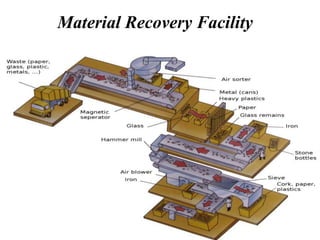
Material Recovery Facility

Ma
Introduction
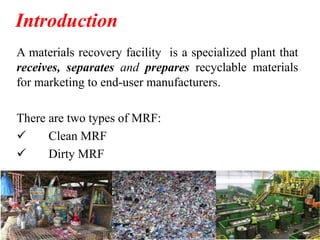
A materials recovery facility is a specialized plant that
receives, separates and prepares recyclable materials
for marketing to end-user manufacturers.
There are two types of MRF:

Clean MRF

Dirty MRF
Principle of Material Recovery Facility
• Mixed solid waste are separated based on their source for
recovery of materials.
• The process depends on degree of source separation of
waste.
• The nature and design of each unit process accommodate
the physical and chemical characteristics of the source
material.
• Resource recovery plays an important role in the
economies of developing nations
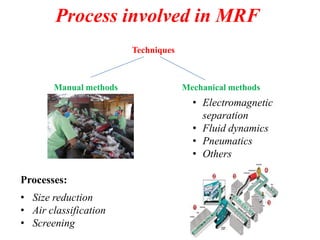
Process involved in MRF
Techniques

Manual methods

Mechanical methods

• Electromagnetic
separation
• Fluid dynamics
• Pneumatics
• Others
Processes:
• Size reduction
• Air classification
• Screening
Manual Processing
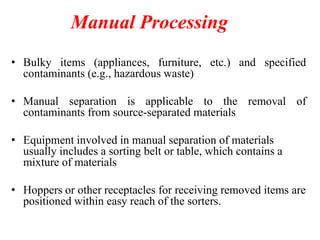
• Bulky items (appliances, furniture, etc.) and specified
contaminants (e.g., hazardous waste)
• Manual separation is applicable to the removal of
contaminants from source-separated materials

• Equipment involved in manual separation of materials
usually includes a sorting belt or table, which contains a
mixture of materials
• Hoppers or other receptacles for receiving removed items are
positioned within easy reach of the sorters.
Manual Processing
•
•
•
•
•
•

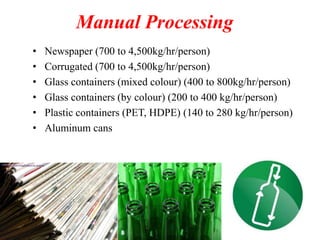
Newspaper (700 to 4,500kg/hr/person)
Corrugated (700 to 4,500kg/hr/person)
Glass containers (mixed colour) (400 to 800kg/hr/person)
Glass containers (by colour) (200 to 400 kg/hr/person)
Plastic containers (PET, HDPE) (140 to 280 kg/hr/person)
Aluminum cans
Mechanical Separation
•
•
•
•
•
•
•
•

Size reduction
Glass separation
Air classification
Non-ferrous separation
Screening
Densification
Magnetic separation
Conveyors
Size reduction Technique
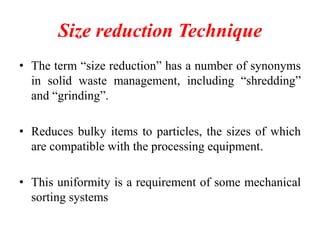
• The term “size reduction” has a number of synonyms
in solid waste management, including “shredding”
and “grinding”.
• Reduces bulky items to particles, the sizes of which
are compatible with the processing equipment.
• This uniformity is a requirement of some mechanical
sorting systems
Size reduction Technique
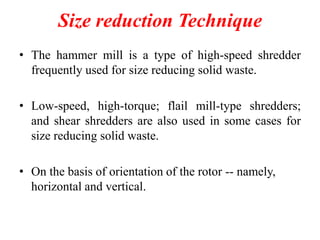
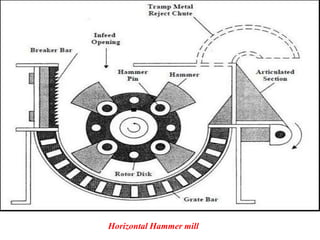
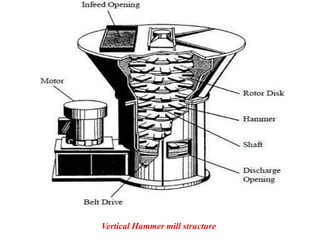
• The hammer mill is a type of high-speed shredder
frequently used for size reducing solid waste.
• Low-speed, high-torque; flail mill-type shredders;
and shear shredders are also used in some cases for
size reducing solid waste.
• On the basis of orientation of the rotor -- namely,
horizontal and vertical.
Horizontal Hammer mill
Vertical Hammer mill structure
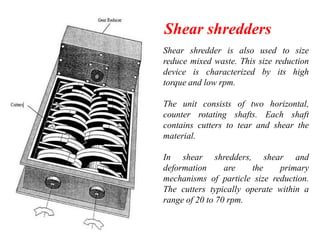
Shear shredders
Shear shredder is also used to size
reduce mixed waste. This size reduction
device is characterized by its high
torque and low rpm.
The unit consists of two horizontal,
counter rotating shafts. Each shaft
contains cutters to tear and shear the
material.
In shear shredders, shear and
deformation
are
the
primary
mechanisms of particle size reduction.
The cutters typically operate within a
range of 20 to 70 rpm.
AIR classification
• Air classification is a process of separating categories of
materials by way of differences in their respective
aerodynamic characteristics.
• The aerodynamic characteristic of a particular material is
primarily a function of the size, geometry, and density of the
particles.

• The suspended fraction conventionally is referred to as the
“air classified light fraction” and the settled fraction is termed
“air-classified heavy fraction”.
• The confined volume in which the separation takes place is
called an “air classifier”.
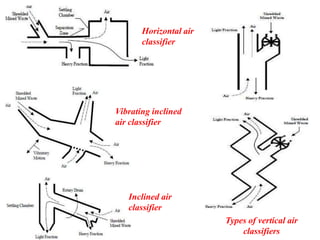
Horizontal air
classifier

Vibrating inclined
air classifier

Inclined air
classifier
Types of vertical air
classifiers
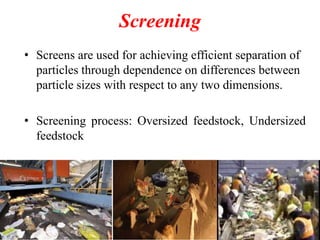
Screening
• Screens are used for achieving efficient separation of
particles through dependence on differences between
particle sizes with respect to any two dimensions.
• Screening process: Oversized feedstock, Undersized
feedstock
Types of Screening
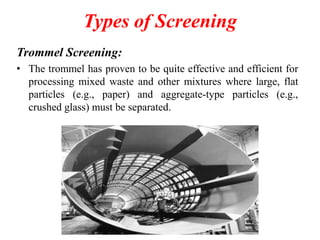
Trommel Screening:
• The trommel has proven to be quite effective and efficient for
processing mixed waste and other mixtures where large, flat
particles (e.g., paper) and aggregate-type particles (e.g.,
crushed glass) must be separated.
Types of Screening
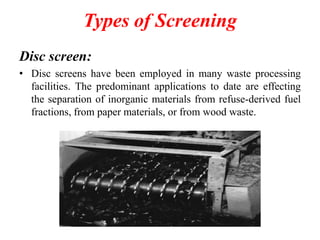
Disc screen:
• Disc screens have been employed in many waste processing
facilities. The predominant applications to date are effecting
the separation of inorganic materials from refuse-derived fuel
fractions, from paper materials, or from wood waste.
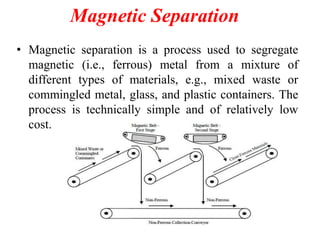
Magnetic Separation
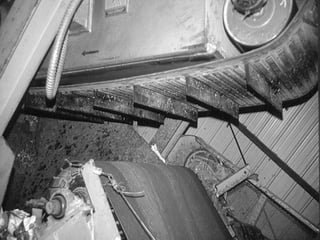
• Magnetic separation is a process used to segregate
magnetic (i.e., ferrous) metal from a mixture of
different types of materials, e.g., mixed waste or
commingled metal, glass, and plastic containers. The
process is technically simple and of relatively low
cost.
Aluminium and Glass Separation
• The predominant non-ferrous metal represented in the
waste stream is usually aluminium, and it is oftentimes a
target for recovery.
• In the case of aluminium, heavy media and eddy current
separation are possibilities.
• Eddy current separation is, at present, the more
commercially feasible.
• Separation is brought about by the ejection of aluminium
particles from a moving waste stream due to the force
exerted on the metallic particles as they pass through an
electromagnetic flux generated by the equipment.
Conclusion
• By Material recovery facility the Waste
management system functions efficiently.
• MRF methods provides recycling of raw
materials for Industrial uses.
Material Recovery Facility- MSW

Material Recovery Facility- MSW

  • 1.
    Material Recovery Facility - Solidwaste management Presented by: K. Vaithinathan M.Tech (GET) Reg.No: 13307009
  • 2.
  • 3.
    Introduction A materials recoveryfacility is a specialized plant that receives, separates and prepares recyclable materials for marketing to end-user manufacturers. There are two types of MRF:  Clean MRF  Dirty MRF
  • 4.
    Principle of MaterialRecovery Facility • Mixed solid waste are separated based on their source for recovery of materials. • The process depends on degree of source separation of waste. • The nature and design of each unit process accommodate the physical and chemical characteristics of the source material. • Resource recovery plays an important role in the economies of developing nations
  • 5.
    Process involved inMRF Techniques Manual methods Mechanical methods • Electromagnetic separation • Fluid dynamics • Pneumatics • Others Processes: • Size reduction • Air classification • Screening
  • 6.
    Manual Processing • Bulkyitems (appliances, furniture, etc.) and specified contaminants (e.g., hazardous waste) • Manual separation is applicable to the removal of contaminants from source-separated materials • Equipment involved in manual separation of materials usually includes a sorting belt or table, which contains a mixture of materials • Hoppers or other receptacles for receiving removed items are positioned within easy reach of the sorters.
  • 7.
    Manual Processing • • • • • • Newspaper (700to 4,500kg/hr/person) Corrugated (700 to 4,500kg/hr/person) Glass containers (mixed colour) (400 to 800kg/hr/person) Glass containers (by colour) (200 to 400 kg/hr/person) Plastic containers (PET, HDPE) (140 to 280 kg/hr/person) Aluminum cans
  • 8.
    Mechanical Separation • • • • • • • • Size reduction Glassseparation Air classification Non-ferrous separation Screening Densification Magnetic separation Conveyors
  • 9.
    Size reduction Technique •The term “size reduction” has a number of synonyms in solid waste management, including “shredding” and “grinding”. • Reduces bulky items to particles, the sizes of which are compatible with the processing equipment. • This uniformity is a requirement of some mechanical sorting systems
  • 10.
    Size reduction Technique •The hammer mill is a type of high-speed shredder frequently used for size reducing solid waste. • Low-speed, high-torque; flail mill-type shredders; and shear shredders are also used in some cases for size reducing solid waste. • On the basis of orientation of the rotor -- namely, horizontal and vertical.
  • 11.
  • 12.
  • 13.
    Shear shredders Shear shredderis also used to size reduce mixed waste. This size reduction device is characterized by its high torque and low rpm. The unit consists of two horizontal, counter rotating shafts. Each shaft contains cutters to tear and shear the material. In shear shredders, shear and deformation are the primary mechanisms of particle size reduction. The cutters typically operate within a range of 20 to 70 rpm.
  • 14.
    AIR classification • Airclassification is a process of separating categories of materials by way of differences in their respective aerodynamic characteristics. • The aerodynamic characteristic of a particular material is primarily a function of the size, geometry, and density of the particles. • The suspended fraction conventionally is referred to as the “air classified light fraction” and the settled fraction is termed “air-classified heavy fraction”. • The confined volume in which the separation takes place is called an “air classifier”.
  • 15.
    Horizontal air classifier Vibrating inclined airclassifier Inclined air classifier Types of vertical air classifiers
  • 16.
    Screening • Screens areused for achieving efficient separation of particles through dependence on differences between particle sizes with respect to any two dimensions. • Screening process: Oversized feedstock, Undersized feedstock
  • 17.
    Types of Screening TrommelScreening: • The trommel has proven to be quite effective and efficient for processing mixed waste and other mixtures where large, flat particles (e.g., paper) and aggregate-type particles (e.g., crushed glass) must be separated.
  • 18.
    Types of Screening Discscreen: • Disc screens have been employed in many waste processing facilities. The predominant applications to date are effecting the separation of inorganic materials from refuse-derived fuel fractions, from paper materials, or from wood waste.
  • 19.
    Magnetic Separation • Magneticseparation is a process used to segregate magnetic (i.e., ferrous) metal from a mixture of different types of materials, e.g., mixed waste or commingled metal, glass, and plastic containers. The process is technically simple and of relatively low cost.
  • 21.
    Aluminium and GlassSeparation • The predominant non-ferrous metal represented in the waste stream is usually aluminium, and it is oftentimes a target for recovery. • In the case of aluminium, heavy media and eddy current separation are possibilities. • Eddy current separation is, at present, the more commercially feasible. • Separation is brought about by the ejection of aluminium particles from a moving waste stream due to the force exerted on the metallic particles as they pass through an electromagnetic flux generated by the equipment.
  • 22.
    Conclusion • By Materialrecovery facility the Waste management system functions efficiently. • MRF methods provides recycling of raw materials for Industrial uses.