CONDUCTING POLYMERS
JUSTIN K GEORGE
ME CHEMICAL ENGINEERING
15MCH003
GUIDE – Dr. KANHAIYA JETHANI
DEPARTMENT OF CHEMICAL ENGINEERING
AISSMS COE PUNE -01
Contents
1. Types of Conducting Polymers
2. Intrinsically Conducting polymers
3. Extrinsically conducting polymers
4. Plot of conductivity Vs doping
5. Conductivity Vs Temperature
6. Various Applications
7. Advantages And Disadvantages
8. Current Visibility
9. Future Aspects
10. Conclusion
11. Reference
12. Questions
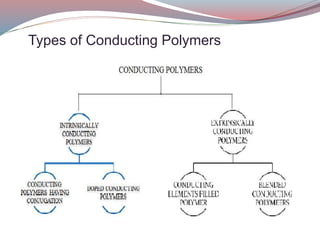
Types of Conducting Polymers
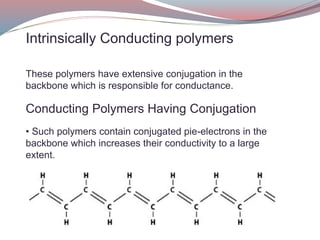
Intrinsically Conducting polymers
These polymers have extensive conjugation in the
backbone which is responsible for conductance.
Conducting Polymers Having Conjugation
• Such polymers contain conjugated pie-electrons in the
backbone which increases their conductivity to a large
extent.
Doped Conducting Polymers
The second condition is that the plastic has to be
disturbed - either by removing electrons from
(oxidation), or inserting them into (reduction), the
material.The process is known as DOPING.
There are two types of doping:
1-oxidation with Lewis Acid (called p-doping).
2-Reduction with Lewis Base (called n-doping).
1-oxidation with Lewis Acid (or p-doping)
2- Reduction with Lewis Base ( called n-doping)
Extrinsically conducting polymers
•The conductivity of these polymers is due to the addition of
external ingredients.
• When carbon black or some metal oxides or metallic fibers
are added, the polymer becomes conductive.
•The minimum concentration of the element required for the
conductivity is called percolation threshold.
Plot of conductivity vs doping
Conductivity increases up to a certain doping level
200
100
0.0 0.1 0.2
Doping level (dopant/CH unit)
Conductivity
(S/cm)
Conductivity Vs Temperature
Various Applications
Conducting polymers have many uses.
• Anti-static substances for photographic film
• Corrosion Inhibitors
• Compact Capacitors
• Anti Static Coating
• Electromagnetic shielding for computers
• "Smart Windows"
• A second generation of conducting polymers have been
developed these have industrial uses like:
• Transistors
• Light Emitting Diodes (LEDs)
• Lasers used in flat televisions
• Solar cells
• Displays in mobile telephones and mini-format television
screens
Advantages And Disadvantages
Advantages
 Used because of either their light weight, biological compatibility
 Increase speed and reduce power consumption
 We can make flexible transparent displays
Disadvantages
 Manufacturing costs is very high
 Material cost of conductive polymer is high
 Material of conductive polymer may become toxic after use
 Poor solubility in solvents and required suitable dispersion medium
 Conducting polymer have inability to directly melt process
 If we make IC by conductive polymer than the resulting IC are more
sensitive and can be easily damaged by static discharge at a very low
voltage
Current Visibility
 Organic Light Emitting Diodes (OLED) And Organic Polymer Solar Cell
The Organic Electronics Association is an international platform to
promote applications of organic semiconductors
 Conductive polymer products with embedded and improved
electromagnetic interference (EMI) and electrostatic discharge (ESD)
protection have led to both prototypes and products.
 Typical conductive polymers must be “doped” to produce high
conductivity.
Future Aspects
 If we can produce conductive polymer at very low cost then we can
reduce electrical energy wastage during energy transportation.
 The increased conductivity of modern conductive polymers means
enough power can be put through the device at low voltage to generate
practical amount of light.
 To make programmable floors for robotics and AGV’s (Auto Guided
Vehicles)
Due to the biocompatibility of some conducting polymers they may be
used to transport small electrical signals through the body, i.e. act as
artificial nerves.
Conclusion
• Conductive polymer or more precisely intrinsically conducting
polymer(ICPs) are polymer that conduct electricity
• Conducting polymers are unique as possible substitute for metallic
conductor and semiconductor.
• If we can produce conductive polymer at very low cost it will make a
tremendous changes in the electric field.
• It is able to use in electrical ,electronics and in medical fields.
Reference
1. Skotheim T.A., ed. Handbook of Conducting Polymers,Vol-1 & 2,
Marcell Dekker, New York (1986)
2. Chen C.Ku and Raimond Liepins, Electrical Properties of Polymers,
Hanser Publishers, New York
3. Bakhshi A.K, Tailoring electrically conducting polymers: An
overview,, Indian Journal of Chemistry 31A (1992),291
4. Bakhshi A.K, Investigation of Electronic Conduction in Proteins and
DNA, Progress in Biophysical Molecular Biology 61(1994),187
5. Ferraro J.R and J.M.Williams, Introduction to Synthetic Electrical
Conductors,Academic Press , New York (1987)
6. Bredas J.L and G.B.Street, Polarons and Bipolarons, Accounts of
Chemical Research 18(1985),309-315
Questions ?
Conducting polymers 2 justin

Conducting polymers 2 justin

  • 1.
    CONDUCTING POLYMERS JUSTIN KGEORGE ME CHEMICAL ENGINEERING 15MCH003 GUIDE – Dr. KANHAIYA JETHANI DEPARTMENT OF CHEMICAL ENGINEERING AISSMS COE PUNE -01
  • 2.
    Contents 1. Types ofConducting Polymers 2. Intrinsically Conducting polymers 3. Extrinsically conducting polymers 4. Plot of conductivity Vs doping 5. Conductivity Vs Temperature 6. Various Applications 7. Advantages And Disadvantages 8. Current Visibility 9. Future Aspects 10. Conclusion 11. Reference 12. Questions
  • 3.
  • 4.
    Intrinsically Conducting polymers Thesepolymers have extensive conjugation in the backbone which is responsible for conductance. Conducting Polymers Having Conjugation • Such polymers contain conjugated pie-electrons in the backbone which increases their conductivity to a large extent.
  • 6.
    Doped Conducting Polymers Thesecond condition is that the plastic has to be disturbed - either by removing electrons from (oxidation), or inserting them into (reduction), the material.The process is known as DOPING. There are two types of doping: 1-oxidation with Lewis Acid (called p-doping). 2-Reduction with Lewis Base (called n-doping).
  • 7.
    1-oxidation with LewisAcid (or p-doping)
  • 8.
    2- Reduction withLewis Base ( called n-doping)
  • 9.
    Extrinsically conducting polymers •Theconductivity of these polymers is due to the addition of external ingredients. • When carbon black or some metal oxides or metallic fibers are added, the polymer becomes conductive. •The minimum concentration of the element required for the conductivity is called percolation threshold.
  • 10.
    Plot of conductivityvs doping Conductivity increases up to a certain doping level 200 100 0.0 0.1 0.2 Doping level (dopant/CH unit) Conductivity (S/cm)
  • 12.
  • 13.
    Various Applications Conducting polymershave many uses. • Anti-static substances for photographic film • Corrosion Inhibitors • Compact Capacitors • Anti Static Coating • Electromagnetic shielding for computers • "Smart Windows" • A second generation of conducting polymers have been developed these have industrial uses like: • Transistors • Light Emitting Diodes (LEDs) • Lasers used in flat televisions • Solar cells • Displays in mobile telephones and mini-format television screens
  • 14.
    Advantages And Disadvantages Advantages Used because of either their light weight, biological compatibility  Increase speed and reduce power consumption  We can make flexible transparent displays
  • 15.
    Disadvantages  Manufacturing costsis very high  Material cost of conductive polymer is high  Material of conductive polymer may become toxic after use  Poor solubility in solvents and required suitable dispersion medium  Conducting polymer have inability to directly melt process  If we make IC by conductive polymer than the resulting IC are more sensitive and can be easily damaged by static discharge at a very low voltage
  • 16.
    Current Visibility  OrganicLight Emitting Diodes (OLED) And Organic Polymer Solar Cell The Organic Electronics Association is an international platform to promote applications of organic semiconductors  Conductive polymer products with embedded and improved electromagnetic interference (EMI) and electrostatic discharge (ESD) protection have led to both prototypes and products.  Typical conductive polymers must be “doped” to produce high conductivity.
  • 17.
    Future Aspects  Ifwe can produce conductive polymer at very low cost then we can reduce electrical energy wastage during energy transportation.  The increased conductivity of modern conductive polymers means enough power can be put through the device at low voltage to generate practical amount of light.  To make programmable floors for robotics and AGV’s (Auto Guided Vehicles) Due to the biocompatibility of some conducting polymers they may be used to transport small electrical signals through the body, i.e. act as artificial nerves.
  • 18.
    Conclusion • Conductive polymeror more precisely intrinsically conducting polymer(ICPs) are polymer that conduct electricity • Conducting polymers are unique as possible substitute for metallic conductor and semiconductor. • If we can produce conductive polymer at very low cost it will make a tremendous changes in the electric field. • It is able to use in electrical ,electronics and in medical fields.
  • 19.
    Reference 1. Skotheim T.A.,ed. Handbook of Conducting Polymers,Vol-1 & 2, Marcell Dekker, New York (1986) 2. Chen C.Ku and Raimond Liepins, Electrical Properties of Polymers, Hanser Publishers, New York 3. Bakhshi A.K, Tailoring electrically conducting polymers: An overview,, Indian Journal of Chemistry 31A (1992),291 4. Bakhshi A.K, Investigation of Electronic Conduction in Proteins and DNA, Progress in Biophysical Molecular Biology 61(1994),187 5. Ferraro J.R and J.M.Williams, Introduction to Synthetic Electrical Conductors,Academic Press , New York (1987) 6. Bredas J.L and G.B.Street, Polarons and Bipolarons, Accounts of Chemical Research 18(1985),309-315
  • 20.