Software Quality Assurance
Session 6 – Software configuration
       Management -Need
Software configuration Management
• Changes to requirements drive the design
• Design changes affect the code
Need for SCM
• Think of these
  – If fully tested program doesn’t work
  – A difficult bug that was fixed at great expense
    suddenly reappears
Without Control
•   Simultaneous update
•   Shared code
•   Common code           Problems
•   Versions

                     Waste enormous amount of
                      time
Control system
• To answer the questions
  – What is my current s/w configuration?
  – What is its status?
  – How do I control changes to my configuration?
  – What changes have been made to s/w?
  – Do anyone else’s changes affect my software?
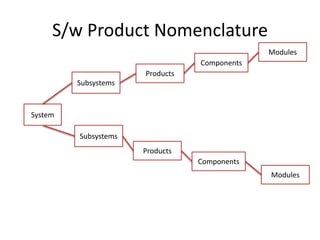
S/w Product Nomenclature
                                              Modules
                                 Components
                      Products
         Subsystems


System

         Subsystems
                      Products
                                 Components
                                              Modules
Terms in nomenclature
•   System – package of all software
•   Subsystem – Large systems into subsystems
•   Product – all subsystems contain products
•   Components – next level of product
•   Module – lowest level – individual functions
Implementation & building
• Implementation – 2 things happen at same
  time
  – Modules developed, enhanced, tested & repaired
  – Modules assembled into
    components, products, subsystems and systems
• Building process
  – Modules changed to add functions or repair
    problems
cont..
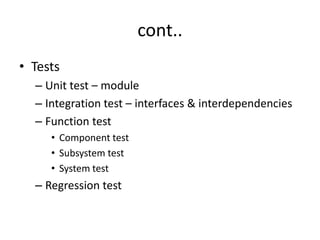
• Tests
  – Unit test – module
  – Integration test – interfaces & interdependencies
  – Function test
     • Component test
     • Subsystem test
     • System test
  – Regression test
SCM Functions & Responsibilities
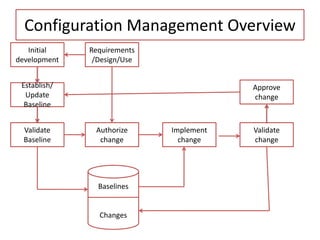
Configuration Management Overview
   Initial    Requirements
development    /Design/Use


 Establish/                              Approve
  Update                                 change
  Baseline


  Validate     Authorize     Implement   Validate
  Baseline      change         change    change


                Baselines


                Changes
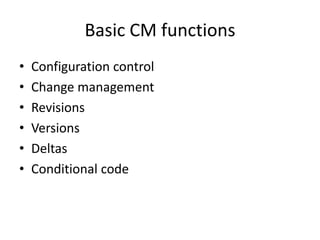
Basic CM functions
•   Configuration control
•   Change management
•   Revisions
•   Versions
•   Deltas
•   Conditional code
1. Configuration Control
• Task revolves around one official copy of the code
• To protect every system revision – to keep a
  separate official copy of each revision level.
   – Lot of storage
   – Code divergence
   – Coordination
• Solution – keep only one official copy with one
  common library
• Approved changes can be permitted – common
  library be the official source for all common code
2. Revisions
• Numbering system to identify separately
  – Test
  – Module
  – Component
  – Product
  – System
• Development – cycle of revision , integration
  & test
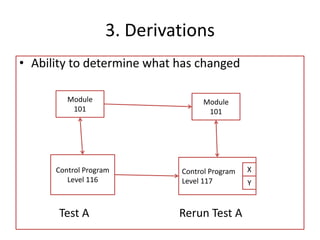
3. Derivations
• Ability to determine what has changed

         Module                   Module
          101                      101


      Control Program       Control Program   X
         Level 116          Level 117         Y


       Test A               Rerun Test A
3. Derivations(contd…)
• Information in derivation record
  – Revision level of each module
  – Revision level of the tools used to
    assemble, compile, link, load, and execute the
    programs & tests
  – Test cases used & their revision levels
  – Test data employed
  – Files used
  – s/w & h/w system configuration
  – Operational procedures
  – If not a stand-alone test, a record of job streams being
    executed.
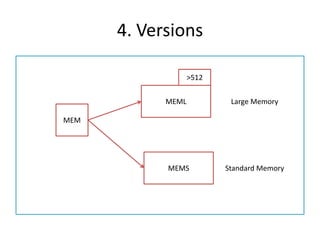
4. Versions

                   >512


            MEML           Large Memory

MEM


            MEMS          Standard Memory
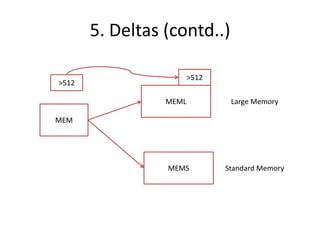
5. Deltas
• Versions introduces multiple copies of same
  code
• To handle this
  – Store base module (MEM) together with the
    changes required it to make it into MEML
  – When maintenance is required on MEM, can be
    made directly – no interference with delta code
  – Similarly to MEML without affecting MEM
5. Deltas (contd..)

                        >512
>512

                 MEML           Large Memory

MEM


                 MEMS          Standard Memory
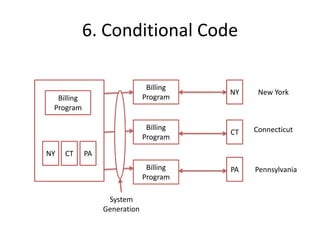
6. Conditional Code

                               Billing
                                         NY    New York
  Billing                     Program
 Program

                               Billing        Connecticut
                                         CT
                              Program

NY   CT     PA
                               Billing   PA   Pennsylvania
                              Program

                  System
                 Generation
Baselines
• Foundation for configuration management
• Provides the official standard on which
  subsequent work is based
• After an initial baseline is established &
  frozen, every change is recorded as a delta
  until the next baseline is set.
Baseline scope
• For code control, baseline contains all project
  code
• The items to be included in implementation
  phase are:
   –   Current level of each module
   –   Current level of each test case
   –   Current level of tools used(compiler, assembler…)
   –   Current level of any special test /operational data
   –   Current level of macros, libraries & files
   –   Current level of installation / operating procedures
Baseline control
• Baseline protection from unauthorized change
• To do this approach in two parts
  – Locking –charge-out,charge-in procedure
  – Regression testing
CM records
•   Change requse
•   Change log
•   Test report
•   Problem report
•   Every report has its own contents
•   Examble – sample change log contents
    – Change identification
        • Change number
        • Date changed
    – Implementation responsibility
        • Name, address, phone, organization
    – Implementation
        •   Source & object code
        •   Documentation
        •   Change dependencies
        •   Tests run & results
CM Responsibilities
• Configuration manager
• Module ownership
• Change Control Board (CCB)
1. Configuration Manager
• Responsibilities
  – Develop, document & distribute SCM procedures
  – Establish system baseline including backup
    provisions
  – Ensure that no unauthorized changes made to
    baseline
  – Ensure all changes are recorded
  – Ensure all baseline changes are regression tested
  – Provide the focal point for exception resolution
2. Module Ownership
• Responsibilities
  – Know & understand the module design
  – Provide advice to everyone who works on or
    interfaces with the module
  – Serve as technical control point for all module
    modifications
  – Ensure module integrity by reviewing all changes
    & conducting periodic regression tests.
3. Change Control Board
• CCB needs the following information on each proposed change:
   –   Size
   –   Alternatives
   –   Complexity
   –   Schedule
   –   Impact
   –   Cost
   –   Severity
   –   Relationship to other changes
   –   Test
   –   Resources
   –   System impact
   –   Benefits
   –   Politics
   –   Change maturity
3. CCB(contd..)
• Additional information needed prior to
  release:
  – Final source &/ object code for the change
  – Final documentation changes
  – Evidence of successful inspection & test of code &
    documentation

Software Configuration Management

  • 1.
    Software Quality Assurance Session6 – Software configuration Management -Need
  • 2.
    Software configuration Management •Changes to requirements drive the design • Design changes affect the code
  • 3.
    Need for SCM •Think of these – If fully tested program doesn’t work – A difficult bug that was fixed at great expense suddenly reappears
  • 4.
    Without Control • Simultaneous update • Shared code • Common code Problems • Versions Waste enormous amount of time
  • 5.
    Control system • Toanswer the questions – What is my current s/w configuration? – What is its status? – How do I control changes to my configuration? – What changes have been made to s/w? – Do anyone else’s changes affect my software?
  • 6.
    S/w Product Nomenclature Modules Components Products Subsystems System Subsystems Products Components Modules
  • 7.
    Terms in nomenclature • System – package of all software • Subsystem – Large systems into subsystems • Product – all subsystems contain products • Components – next level of product • Module – lowest level – individual functions
  • 8.
    Implementation & building •Implementation – 2 things happen at same time – Modules developed, enhanced, tested & repaired – Modules assembled into components, products, subsystems and systems • Building process – Modules changed to add functions or repair problems
  • 9.
    cont.. • Tests – Unit test – module – Integration test – interfaces & interdependencies – Function test • Component test • Subsystem test • System test – Regression test
  • 10.
    SCM Functions &Responsibilities
  • 11.
    Configuration Management Overview Initial Requirements development /Design/Use Establish/ Approve Update change Baseline Validate Authorize Implement Validate Baseline change change change Baselines Changes
  • 12.
    Basic CM functions • Configuration control • Change management • Revisions • Versions • Deltas • Conditional code
  • 13.
    1. Configuration Control •Task revolves around one official copy of the code • To protect every system revision – to keep a separate official copy of each revision level. – Lot of storage – Code divergence – Coordination • Solution – keep only one official copy with one common library • Approved changes can be permitted – common library be the official source for all common code
  • 14.
    2. Revisions • Numberingsystem to identify separately – Test – Module – Component – Product – System • Development – cycle of revision , integration & test
  • 15.
    3. Derivations • Abilityto determine what has changed Module Module 101 101 Control Program Control Program X Level 116 Level 117 Y Test A Rerun Test A
  • 16.
    3. Derivations(contd…) • Informationin derivation record – Revision level of each module – Revision level of the tools used to assemble, compile, link, load, and execute the programs & tests – Test cases used & their revision levels – Test data employed – Files used – s/w & h/w system configuration – Operational procedures – If not a stand-alone test, a record of job streams being executed.
  • 17.
    4. Versions >512 MEML Large Memory MEM MEMS Standard Memory
  • 18.
    5. Deltas • Versionsintroduces multiple copies of same code • To handle this – Store base module (MEM) together with the changes required it to make it into MEML – When maintenance is required on MEM, can be made directly – no interference with delta code – Similarly to MEML without affecting MEM
  • 19.
    5. Deltas (contd..) >512 >512 MEML Large Memory MEM MEMS Standard Memory
  • 20.
    6. Conditional Code Billing NY New York Billing Program Program Billing Connecticut CT Program NY CT PA Billing PA Pennsylvania Program System Generation
  • 21.
    Baselines • Foundation forconfiguration management • Provides the official standard on which subsequent work is based • After an initial baseline is established & frozen, every change is recorded as a delta until the next baseline is set.
  • 22.
    Baseline scope • Forcode control, baseline contains all project code • The items to be included in implementation phase are: – Current level of each module – Current level of each test case – Current level of tools used(compiler, assembler…) – Current level of any special test /operational data – Current level of macros, libraries & files – Current level of installation / operating procedures
  • 23.
    Baseline control • Baselineprotection from unauthorized change • To do this approach in two parts – Locking –charge-out,charge-in procedure – Regression testing
  • 24.
    CM records • Change requse • Change log • Test report • Problem report • Every report has its own contents • Examble – sample change log contents – Change identification • Change number • Date changed – Implementation responsibility • Name, address, phone, organization – Implementation • Source & object code • Documentation • Change dependencies • Tests run & results
  • 25.
    CM Responsibilities • Configurationmanager • Module ownership • Change Control Board (CCB)
  • 26.
    1. Configuration Manager •Responsibilities – Develop, document & distribute SCM procedures – Establish system baseline including backup provisions – Ensure that no unauthorized changes made to baseline – Ensure all changes are recorded – Ensure all baseline changes are regression tested – Provide the focal point for exception resolution
  • 27.
    2. Module Ownership •Responsibilities – Know & understand the module design – Provide advice to everyone who works on or interfaces with the module – Serve as technical control point for all module modifications – Ensure module integrity by reviewing all changes & conducting periodic regression tests.
  • 28.
    3. Change ControlBoard • CCB needs the following information on each proposed change: – Size – Alternatives – Complexity – Schedule – Impact – Cost – Severity – Relationship to other changes – Test – Resources – System impact – Benefits – Politics – Change maturity
  • 29.
    3. CCB(contd..) • Additionalinformation needed prior to release: – Final source &/ object code for the change – Final documentation changes – Evidence of successful inspection & test of code & documentation