Chapter 3
Agile Software Development
Ian Sommerville, Software Engineering, 10th Edition
Pearson Education, Addison-Wesley
Compiled by Yohannes S.
12/16/2024
Topics covered
Agile methods
Plan-driven and agile development
Agile development techniques
Agile project management
Scrum
Scaling up agile methods
 Exercise: Select suitable Agile project management tool
18/03/2019 Agile Software Development 2
12/16/2024
The Problem(s) with Software Development
18/03/2019 Agile Software Development 3
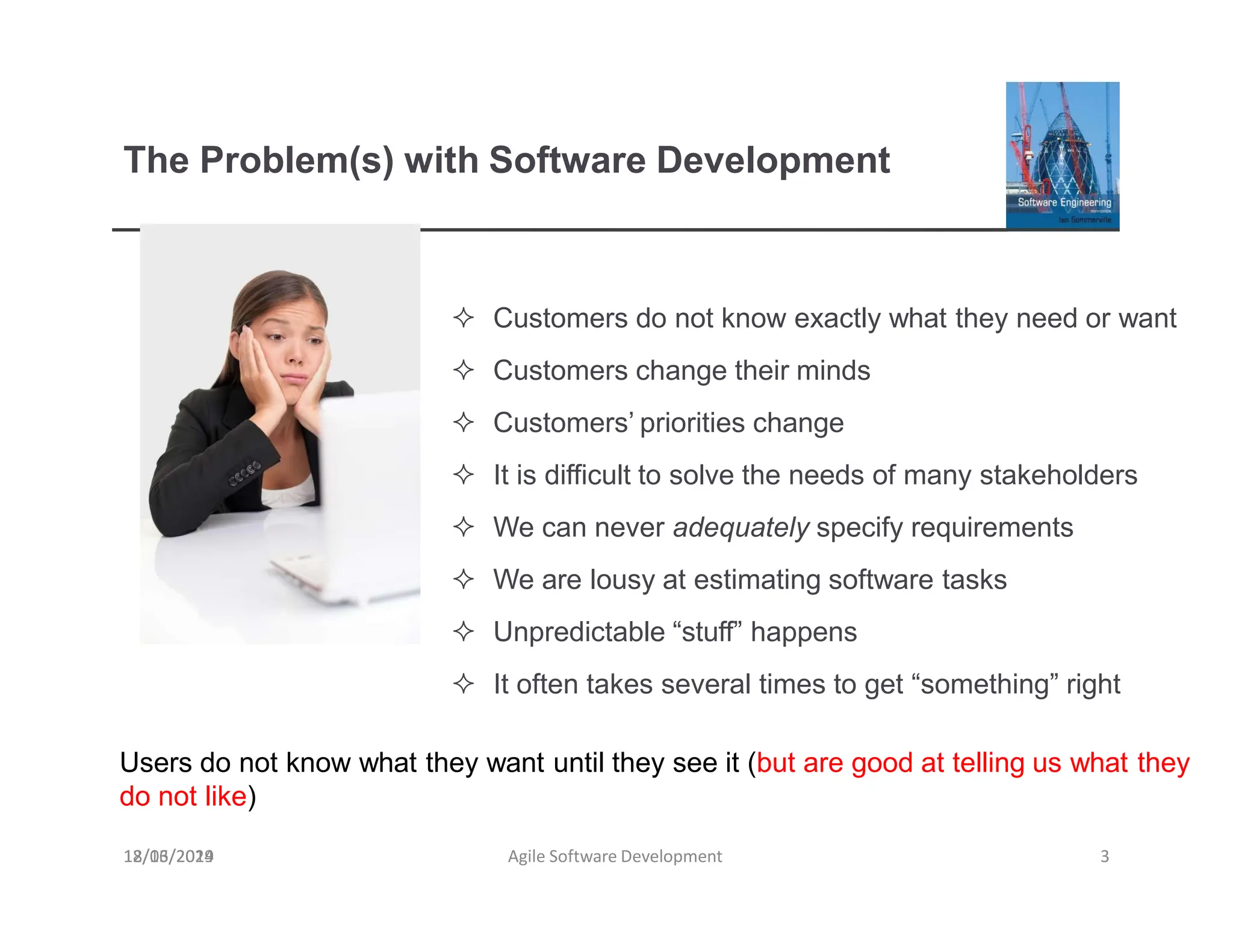
 Customers do not know exactly what they need or want
 Customers change their minds
 Customers’ priorities change
 It is difficult to solve the needs of many stakeholders
 We can never adequately specify requirements
 We are lousy at estimating software tasks
 Unpredictable “stuff” happens
 It often takes several times to get “something” right
Users do not know what they want until they see it (but are good at telling us what they
do not like)
12/16/2024
Rapid software development
Rapid development and delivery is now often the most important requirement for
software systems
▪Businesses operate in a fast–changing environment
▪Software has to evolve quickly to reflect changing business needs
Rapid software development
▪Specification, design and implementation are inter-leaved
▪System is developed as a series of versions with stakeholders involved in version
evaluation
4
12/16/2024
Agile Methods
Dissatisfaction with the overheads involved in software design methods led to the creation
of agile methods. These methods:
▪Focus on the code rather than the design
▪Are based on an iterative approach to software development
▪Are intended to deliver working software quickly and evolve this quickly to meet
changing requirements
The aim of agile methods is to reduce overheads in the software process (e.g. by limiting
documentation) and to be able to respond quickly to changing requirements without excessive
rework
Agile Manifesto
18/03/2019 Agile Software Development 6
We are uncovering better ways of developing software by doing it and helping othersdo
it.Through this work we have come to value:
Individuals and interactions over processes and tools
Working software over comprehensive documentation
Customer collaborationover contract negotiation
Responding to change over followinga plan
That is, while there is value in the items on the right, we value the items on the left more.
 http://agilemanifesto.org/
12/16/2024
Principles behind the Manifesto
18/03/2019 Agile Software Development 7
1. Our highest priority is to satisfy the customer through early and continuous delivery of valuable
software.
2. Welcome changing requirements, even late in development. Agile processes harness change for the
customer'scompetitive advantage.
3. Deliver working software frequently, from a couple of weeks to a couple of months, with a
preference to theshorter timescale.
4. Business people and developers must work together daily throughout theproject.
5. Build projects around motivated individuals. Give them the environment and support they need, and
trustthem to get the job done.
6. The most efficient and effective method of conveying information to and within a development
team is face-to-faceconversation.
12/16/2024
Principles behind the Manifesto
18/03/2019 Agile Software Development 8
7. Working software is the primary measure of progress.
8. Agile processes promote sustainable development. The sponsors, developers, and
users should be able to maintain a constant pace indefinitely.
9. Continuous attention to technical excellence and good design enhances agility.
10.Simplicity--the art of maximizing the amount of work not done--is essential.
11.The best architectures, requirements,and designs emerge from self- organizing teams.
12.At regular intervals, the team reflects on how to become more effective, then tunes and adjusts
its behavior accordingly.
Source: http://agilemanifesto.org/principles.html
12/16/2024
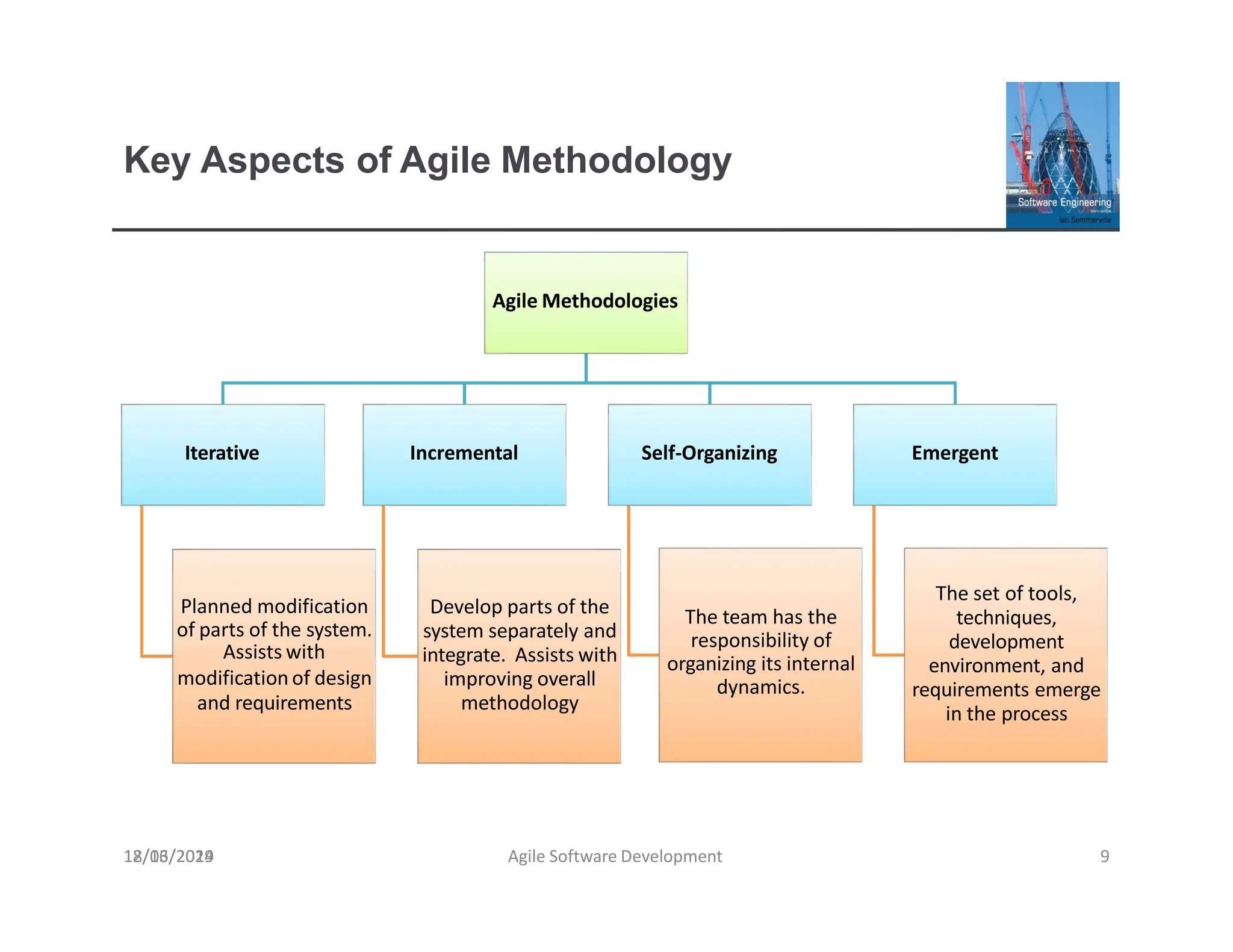
Key Aspects of Agile Methodology
Agile Methodologies
Iterative
Planned modification
of parts of the system.
Assists with
modification of design
and requirements
Incremental
Develop parts of the
system separately and
integrate. Assists with
improving overall
methodology
Self-Organizing
The team has the
responsibility of
organizing its internal
dynamics.
Emergent
The set of tools,
techniques,
development
environment, and
requirements emerge
in the process
18/03/2019 Agile Software Development 9
12/16/2024
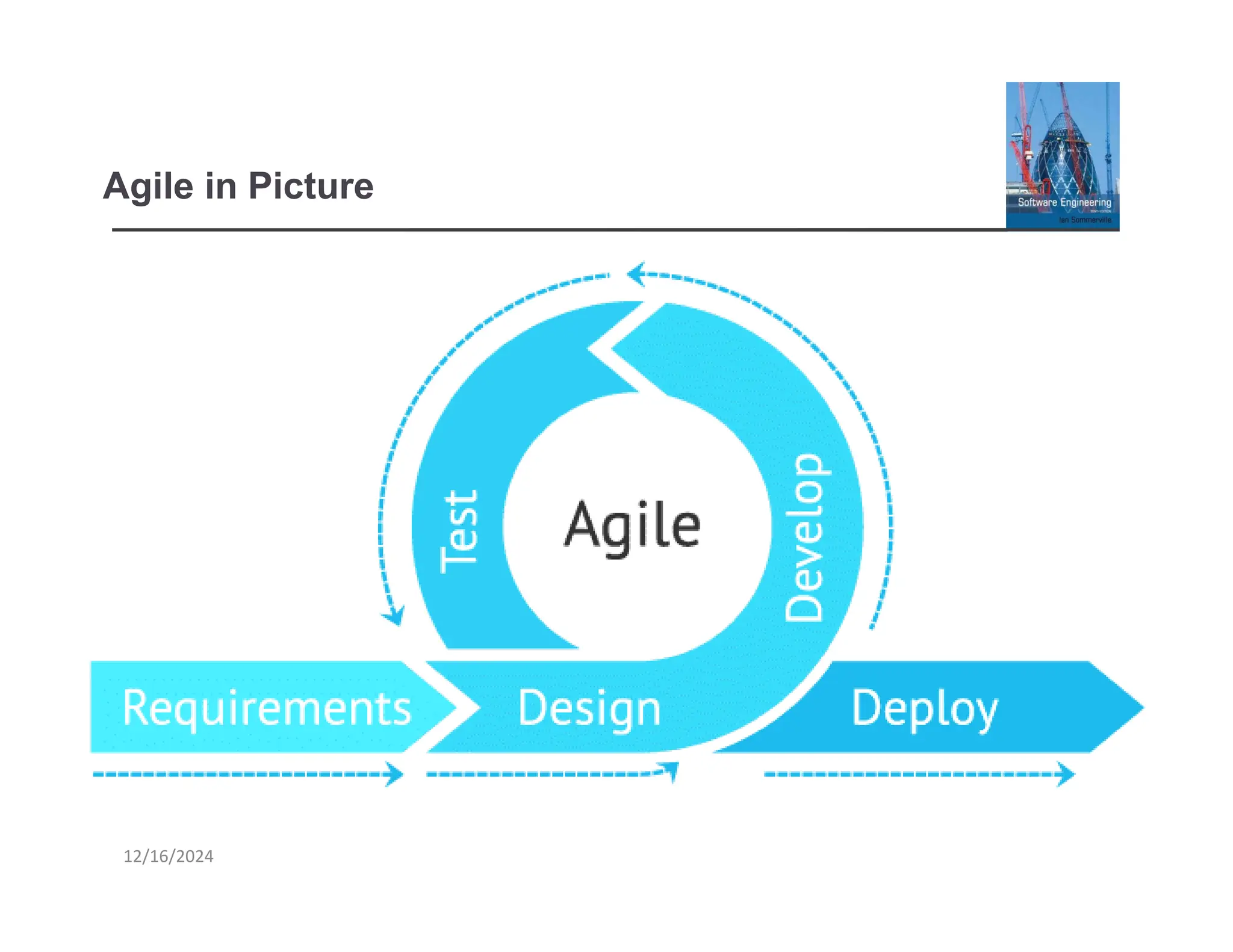
Agile in Picture
12/16/2024
12/16/2024
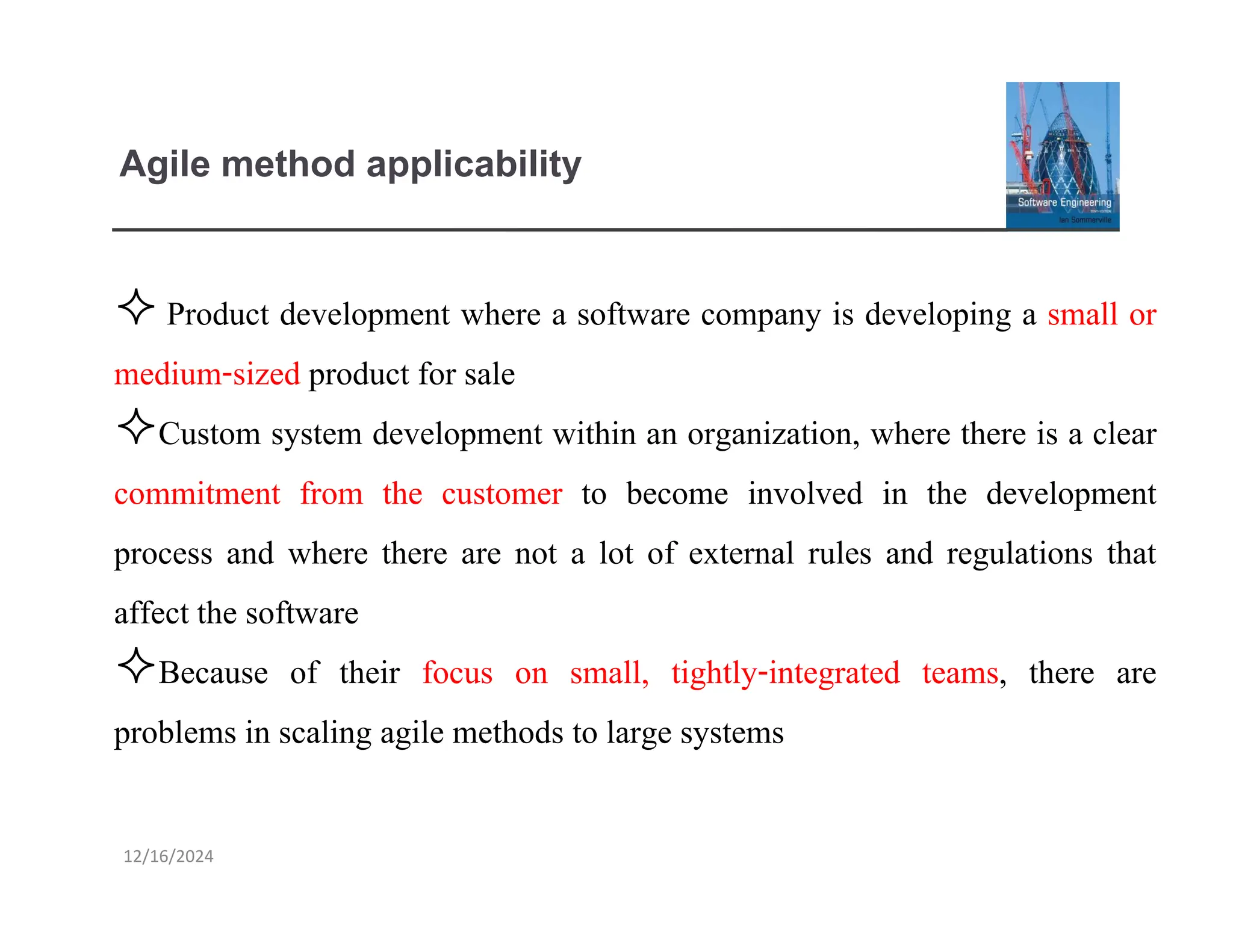
Agile method applicability
 Product development where a software company is developing a small or
medium-sized product for sale
Custom system development within an organization, where there is a clear
commitment from the customer to become involved in the development
process and where there are not a lot of external rules and regulations that
affect the software
Because of their focus on small, tightly-integrated teams, there are
problems in scaling agile methods to large systems
12/16/2024
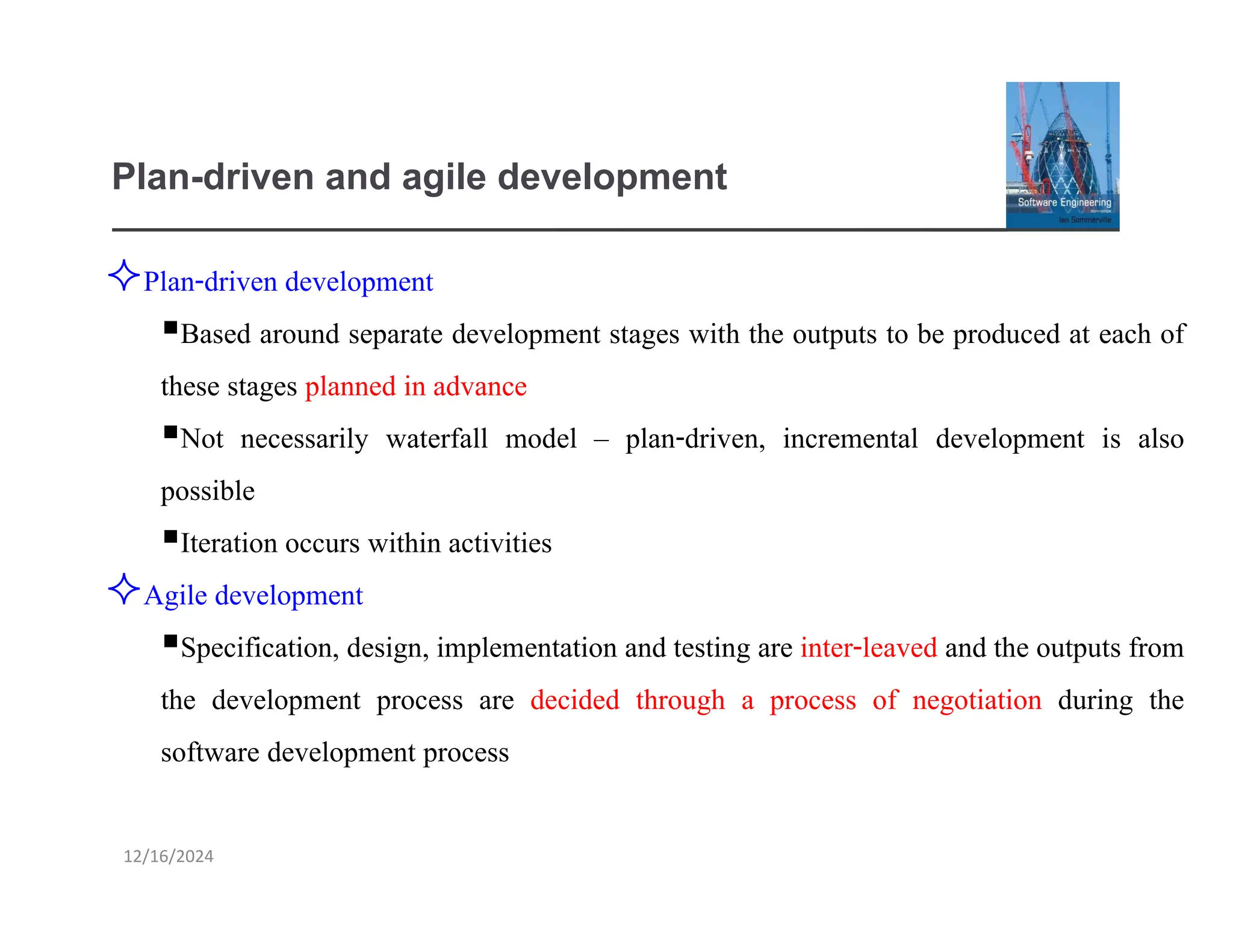
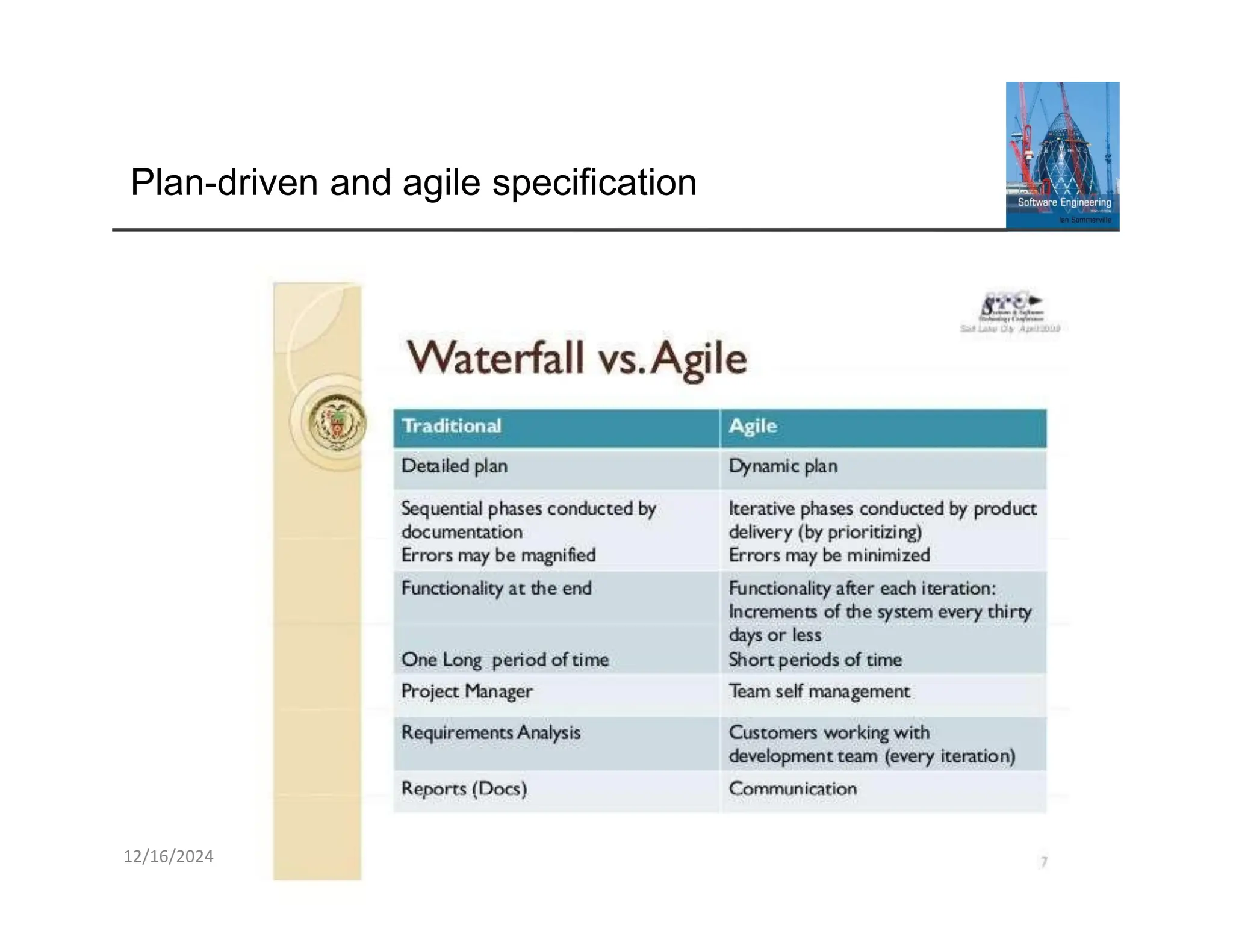
Plan-driven and agile development
Plan-driven development
▪Based around separate development stages with the outputs to be produced at each of
these stages planned in advance
▪Not necessarily waterfall model – plan-driven, incremental development is also
possible
▪Iteration occurs within activities
Agile development
▪Specification, design, implementation and testing are inter-leaved and the outputs from
the development process are decided through a process of negotiation during the
software development process
12/16/2024
Plan-driven and agile specification
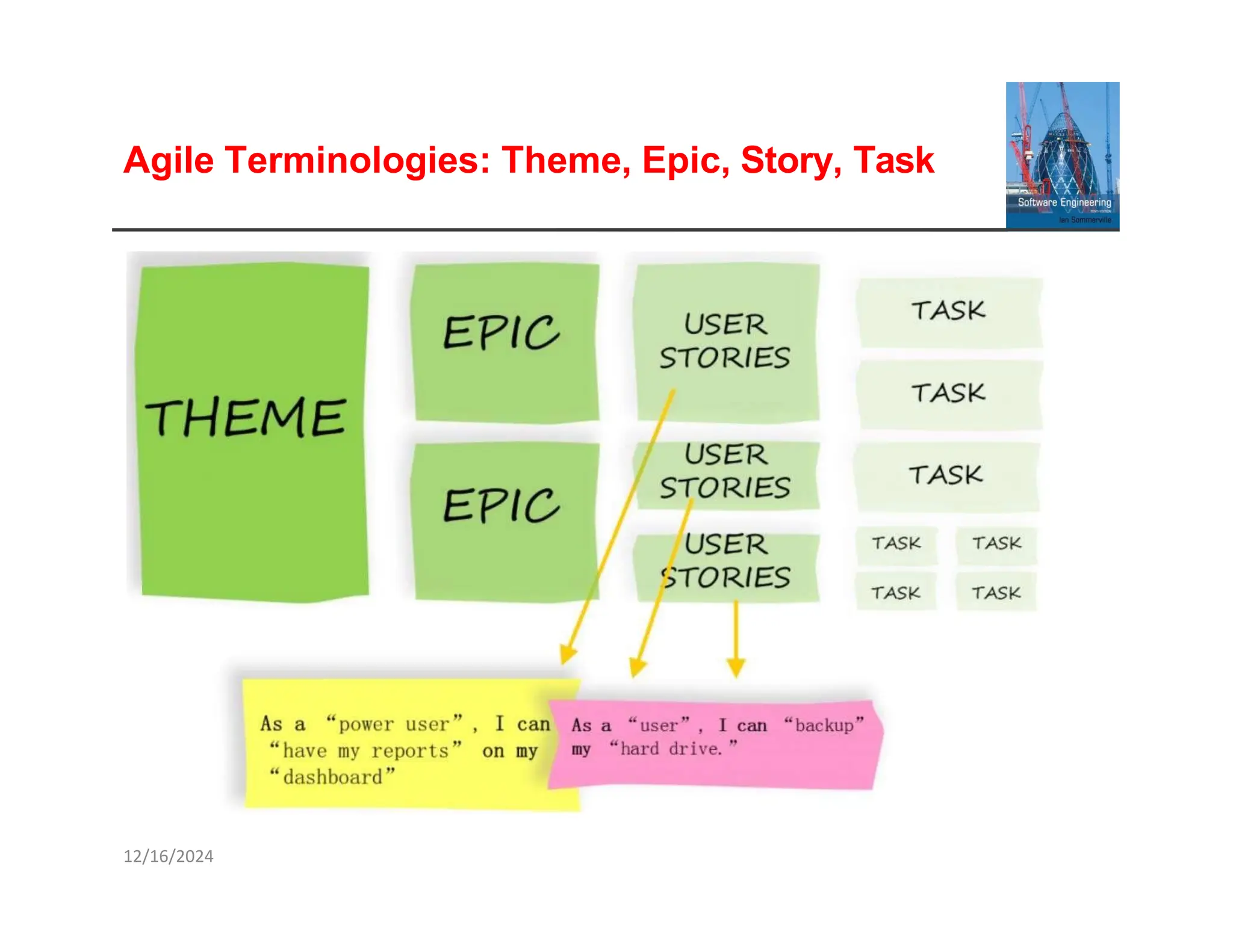
Agile Terminologies: Theme, Epic, Story, Task
12/16/2024
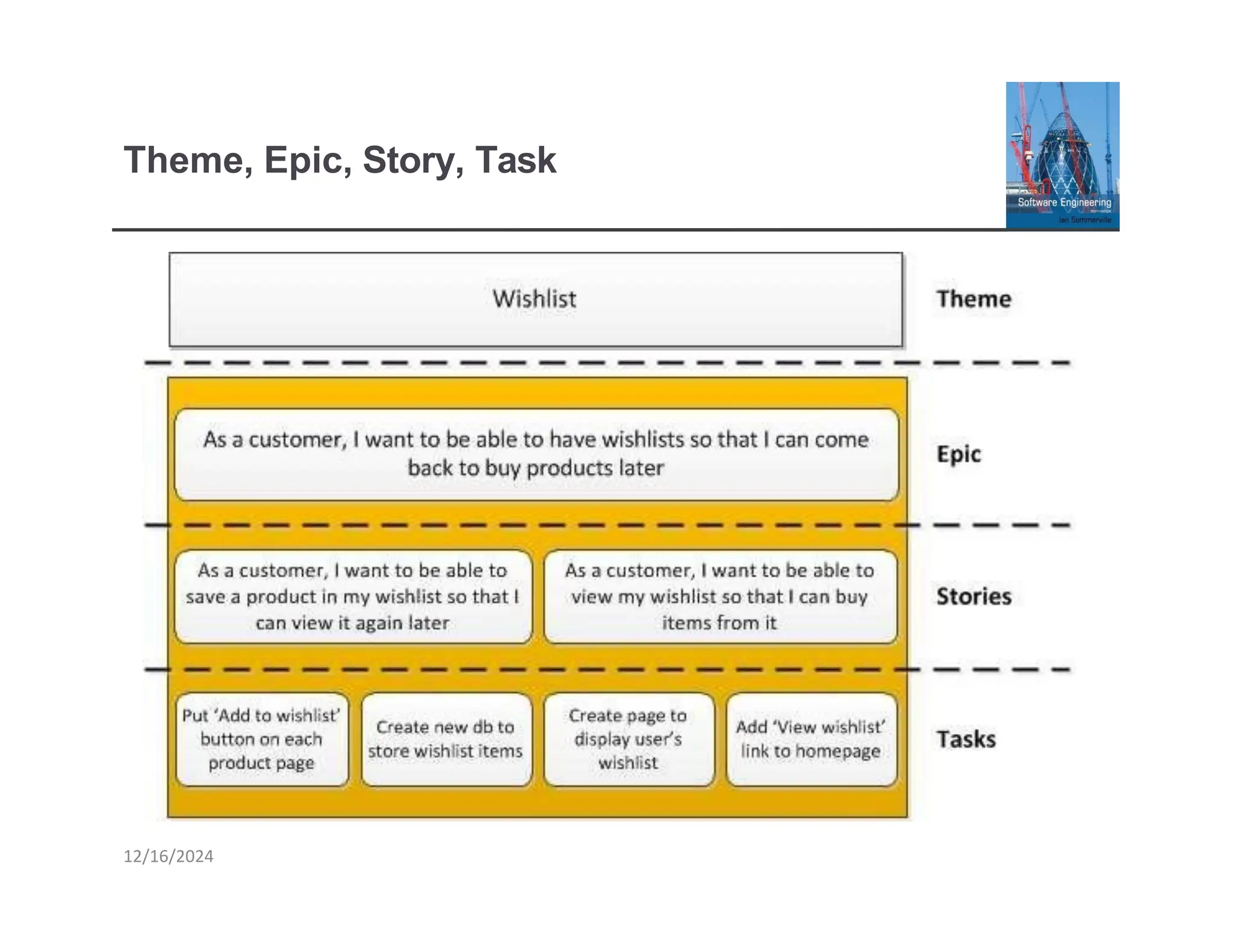
Theme, Epic, Story, Task
12/16/2024
Stories – aka Product Backlog Item, Work Item
12/16/2024
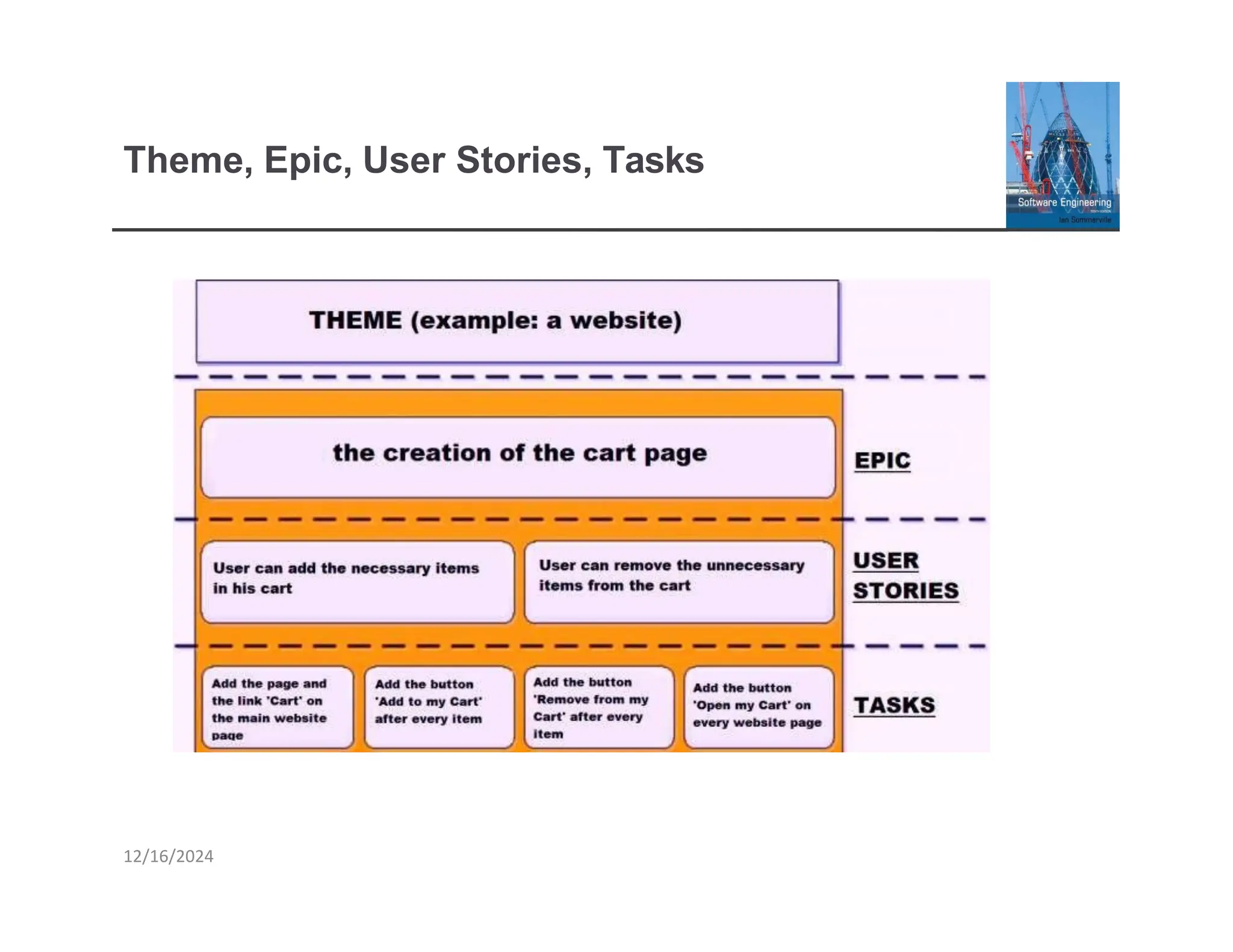
A story is an individualfeature or requirement that the client (and business) wants. It is
something that is deliverable (i.e. production ready) within a single sprint.
Stories are often written in a specific format:
▪ As a [enduserofthe requiredfeature]
▪ I want [actualthing theuserwantsto be ableto do oncethe featureislive – so oftencontainsa
verb]
▪ So that[why theywant this feature/ the benefitthisfeature brings]
An example story: As a customer, I want to be able to save a product in my wishlist so
that I can view it again later.
Story Walls
12/16/2024
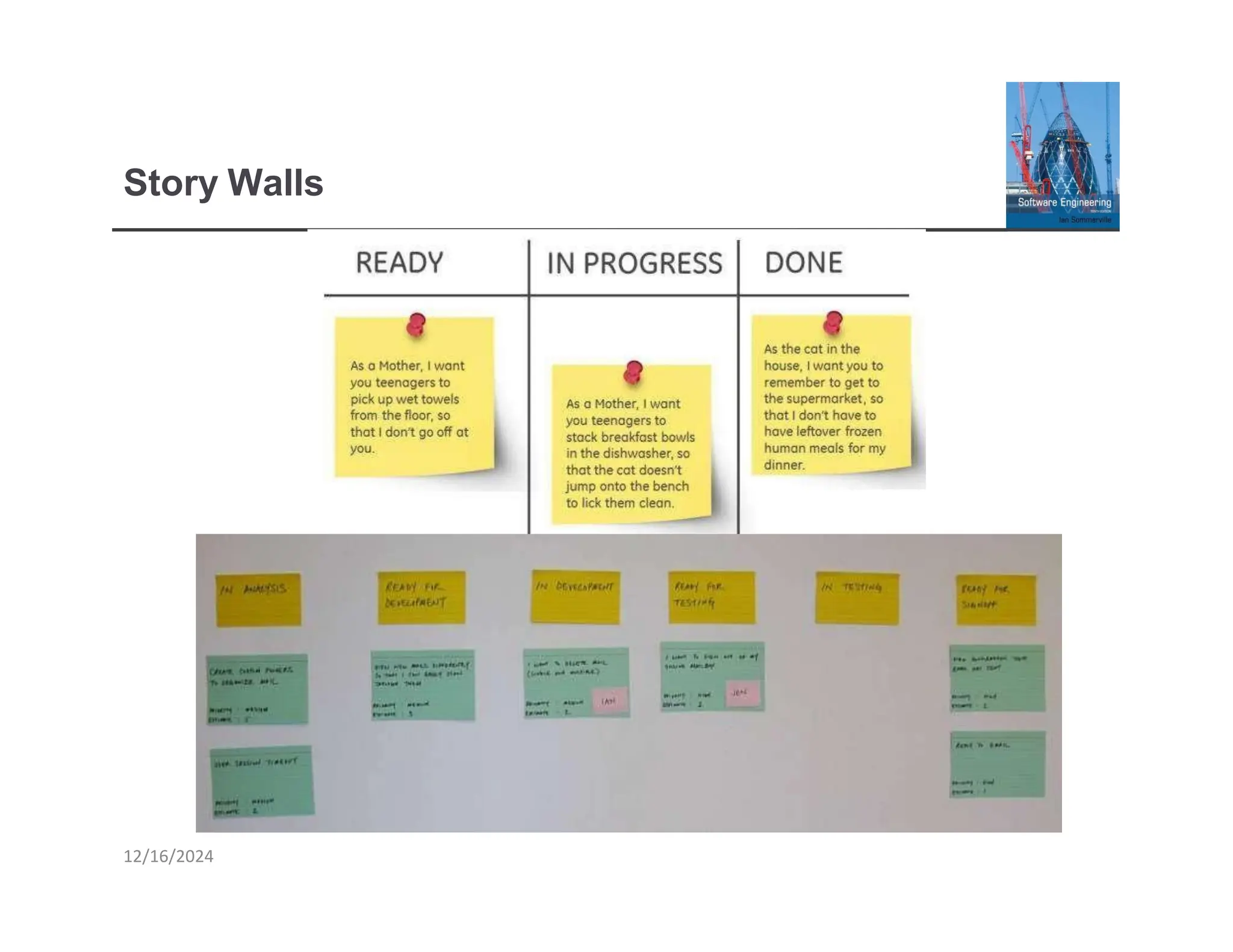
Astory wall is a very common and effective information radiatorthat
displays the status of each card in the currentiterationor sprint.
The team movesa card through each column as it gets completed.
Story Walls
12/16/2024
Epic
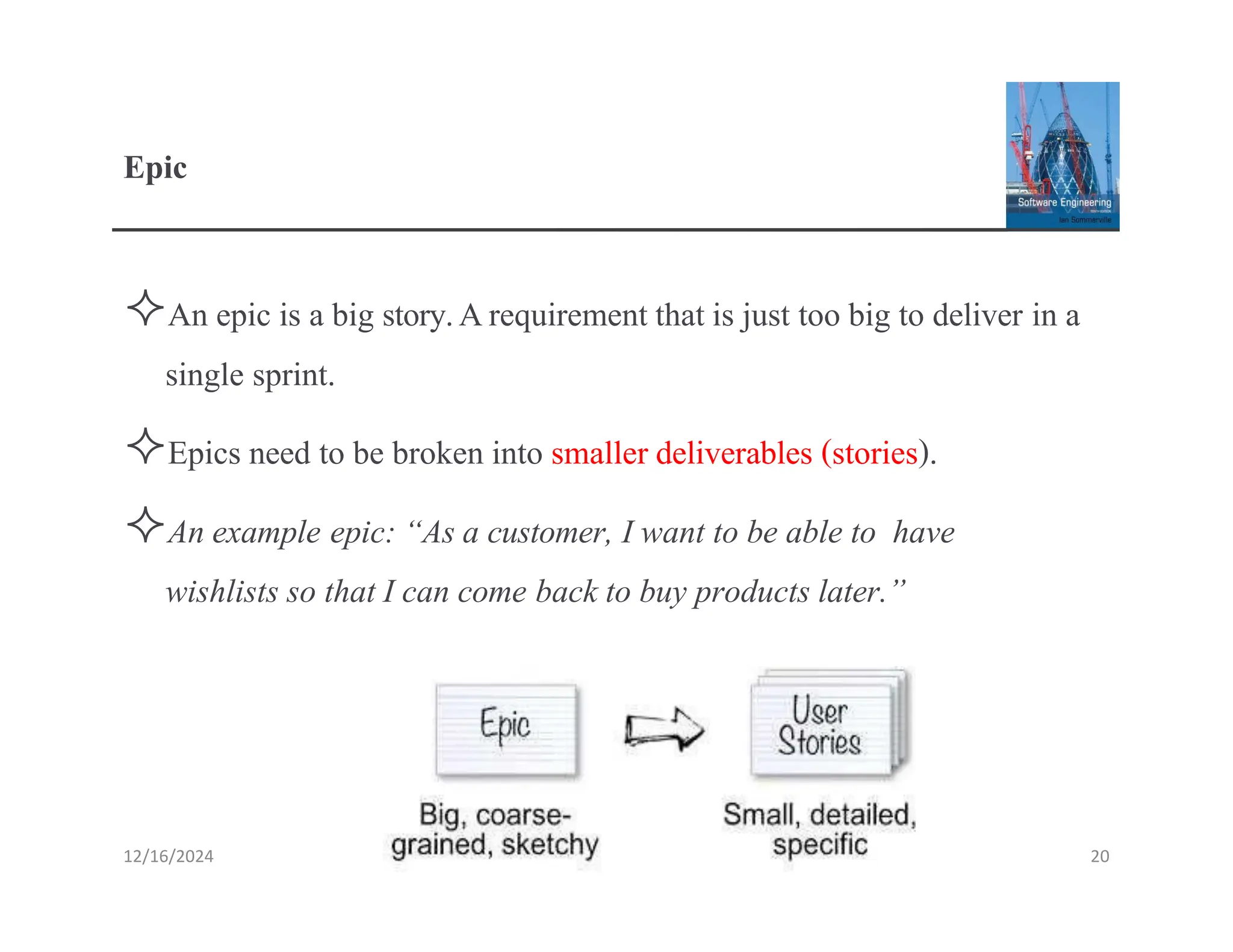
An epic is a big story.Arequirement that is just too big to deliver in a
single sprint.
Epics need to be broken into smaller deliverables (stories).
An example epic: “As a customer, I want to be able to have
wishlists so that I can come back to buy products later.”
12/16/2024 20
Theme
Acollection of stories by category.Abasket or bucket of
stories. By its nature, an epic can also be a theme in itself.
An example theme: “Wishlist”.
12/16/2024
Tasks
The elements of a story.
Stepping stones to take the story to ‘Done’.
Tasks often follow the SMART acronym: specific, measurable,
achievable, relevant, time-boxed.
An example task: “Put ‘Add to wishlist’ button on each product page.”
12/16/2024
Theme, Epic, User Stories, Tasks
12/16/2024
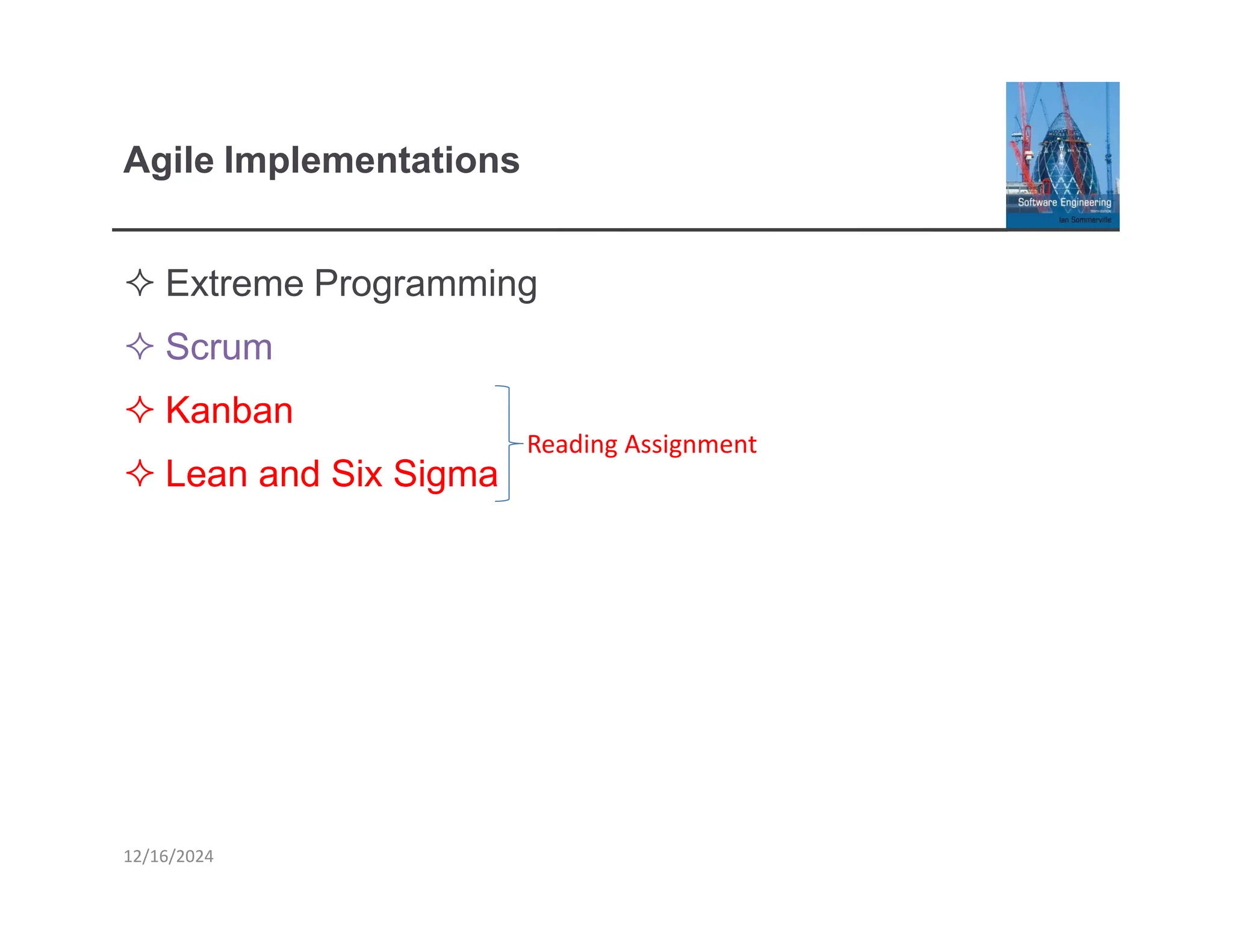
Agile Implementations
 Extreme Programming
 Scrum
 Kanban
 Lean and Six Sigma
12/16/2024
Reading Assignment
Extreme programming
12/16/2024
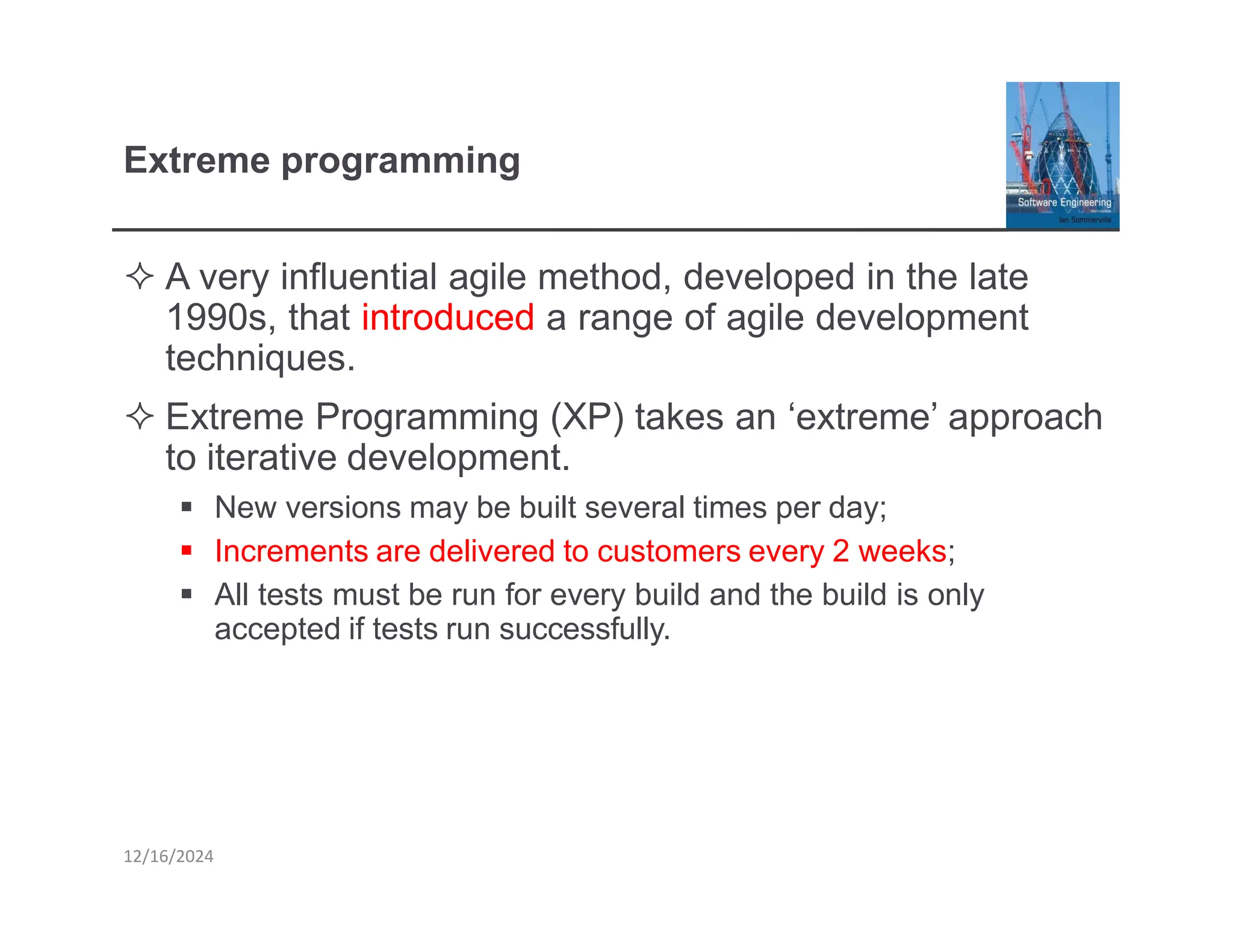
 A very influential agile method, developed in the late
1990s, that introduced a range of agile development
techniques.
 Extreme Programming (XP) takes an ‘extreme’ approach
to iterative development.
▪ New versions may be built several times per day;
▪ Increments are delivered to customers every 2 weeks;
▪ All tests must be run for every build and the build is only
accepted if tests run successfully.
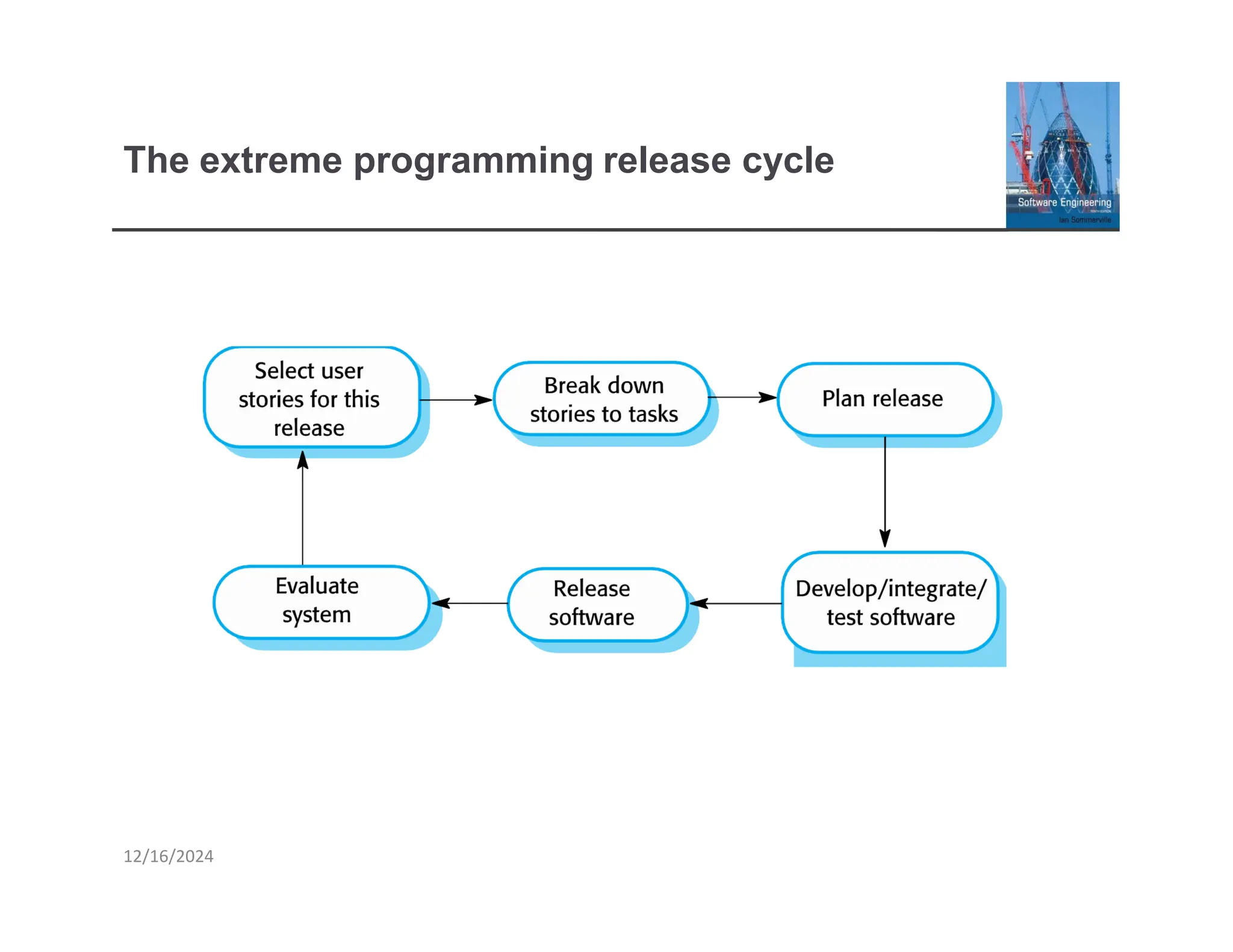
The extreme programming release cycle
12/16/2024
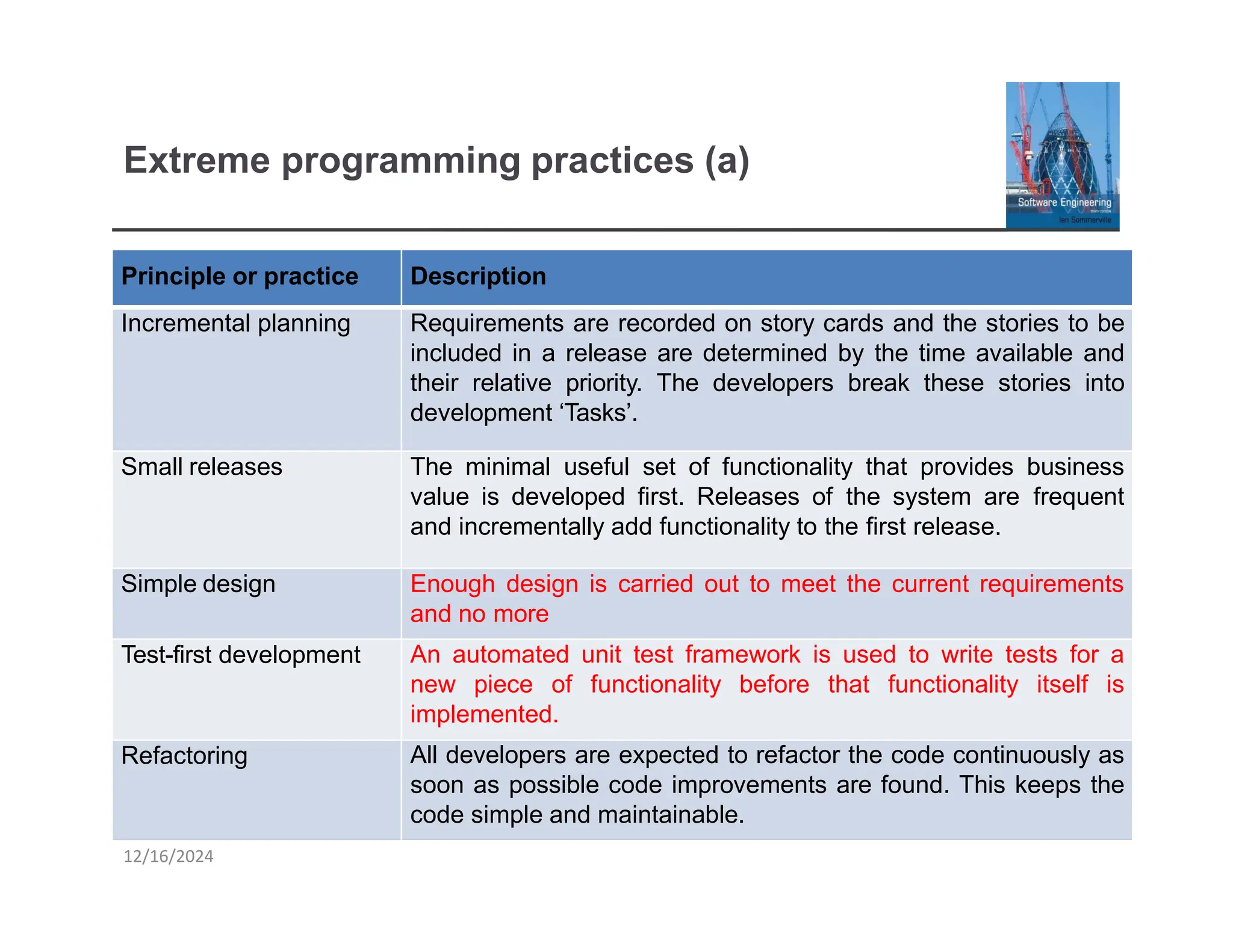
Extreme programming practices (a)
Principle or practice
Incremental planning
12/16/2024
Description
Requirements are recorded on story cards and the stories to be
included in a release are determined by the time available and
their relative priority. The developers break these stories into
development ‘Tasks’.
Small releases The minimal useful set of functionality that provides business
value is developed first. Releases of the system are frequent
and incrementally add functionality to the first release.
Simple design
Test-first development
Refactoring
Enough design is carried out to meet the current requirements
and no more
An automated unit test framework is used to write tests for a
new piece of functionality before that functionality itself is
implemented.
All developers are expected to refactor the code continuously as
soon as possible code improvements are found. This keeps the
code simple and maintainable.
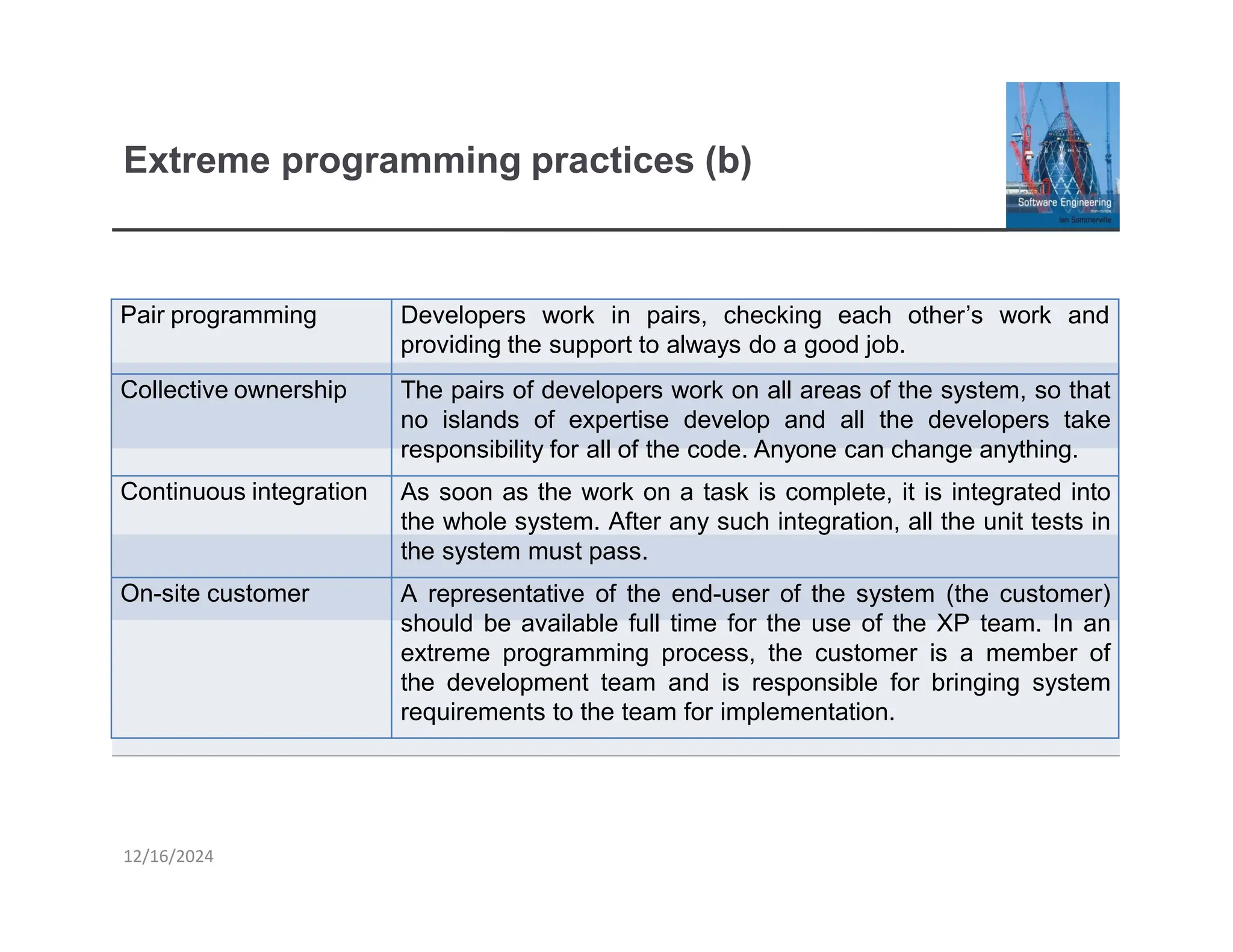
Extreme programming practices (b)
Pair programming Developers work in pairs, checking each other’s work and
providing the support to always do a good job.
Collective ownership The pairs of developers work on all areas of the system, so that
no islands of expertise develop and all the developers take
responsibility for all of the code. Anyone can change anything.
Continuous integration As soon as the work on a task is complete, it is integrated into
the whole system. After any such integration, all the unit tests in
the system must pass.
On-site customer A representative of the end-user of the system (the customer)
should be available full time for the use of the XP team. In an
extreme programming process, the customer is a member of
the development team and is responsible for bringing system
requirements to the team for implementation.
12/16/2024
Scrum
12/16/2024
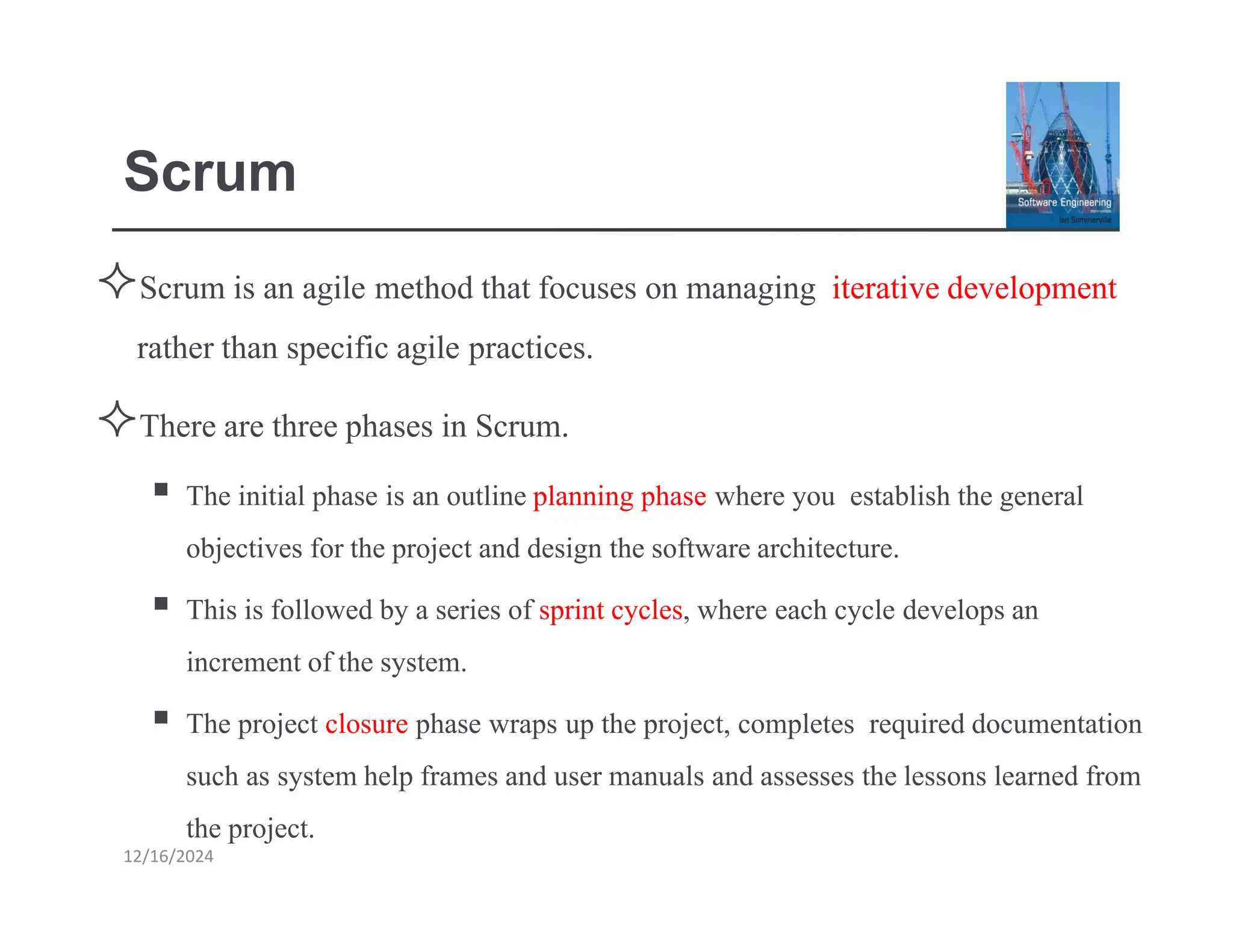
Scrum is an agile method that focuses on managing iterativedevelopment
rather than specific agile practices.
There are three phases in Scrum.
▪ The initial phase is an outline planning phase where you establish the general
objectives for the project and design the softwarearchitecture.
▪ This is followed by a series of sprint cycles, where each cycle develops an
increment ofthe system.
▪ The project closure phase wraps up the project, completes required documentation
such as system help frames and user manuals and assesses the lessons learned from
the project.
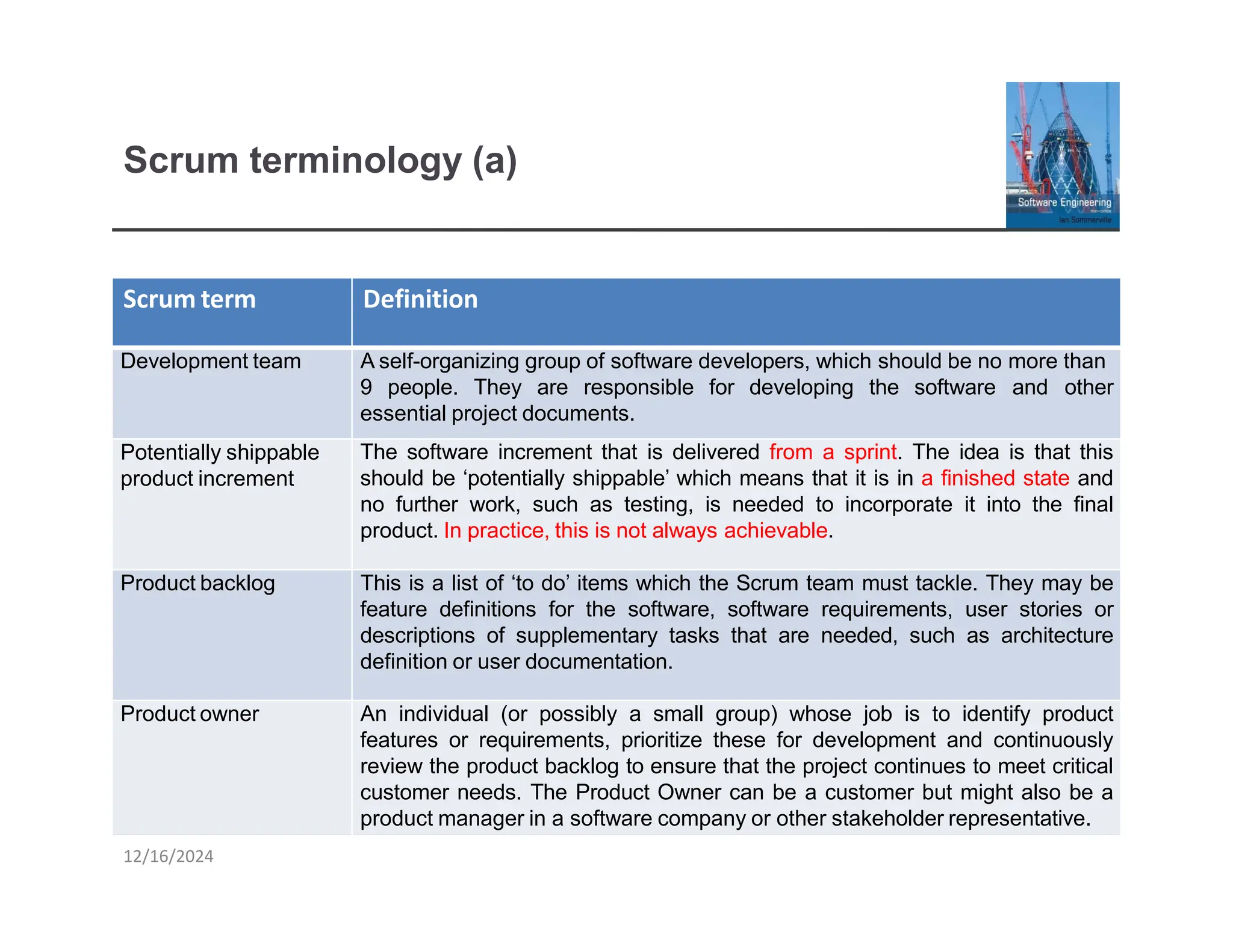
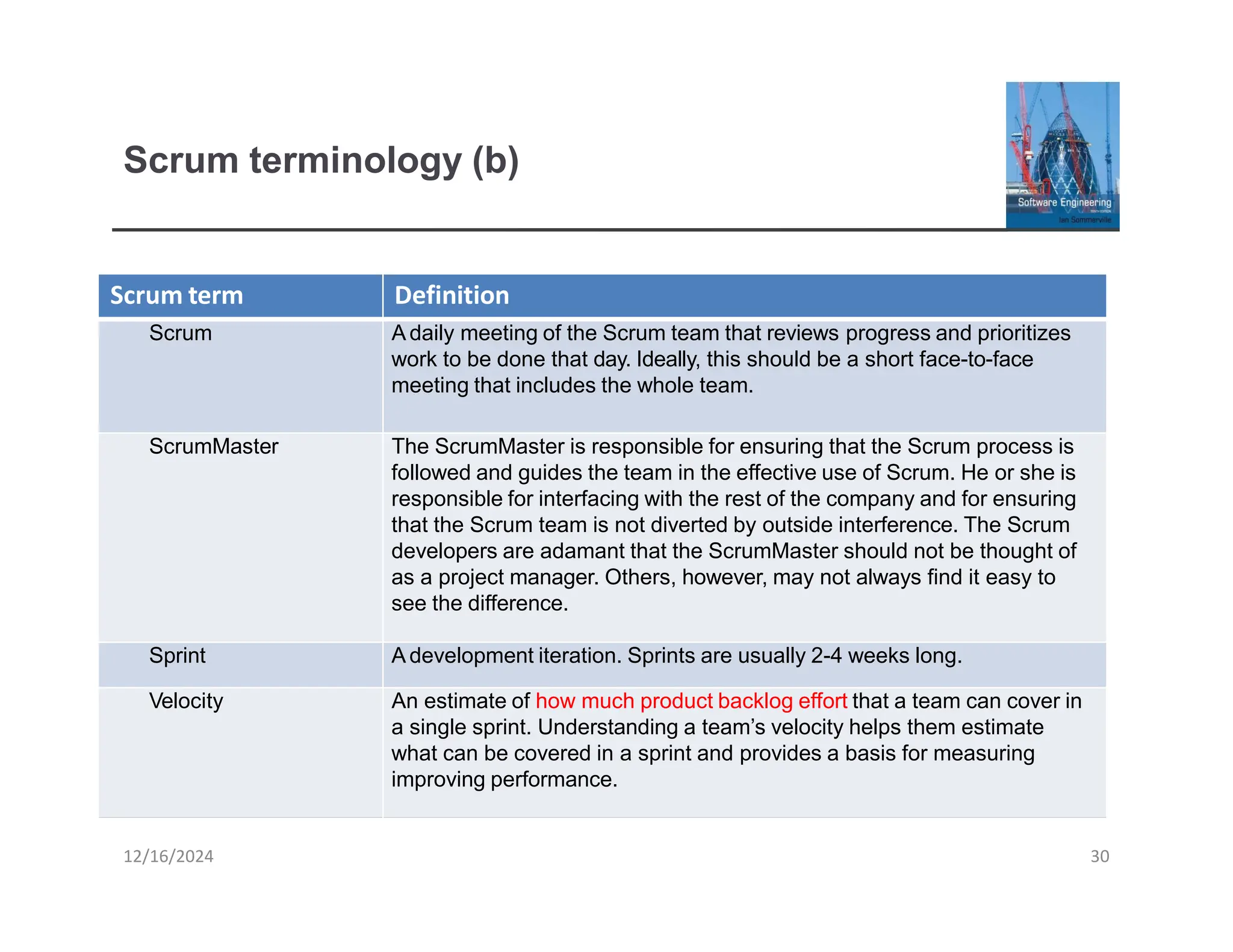
Scrum terminology (a)
Scrum term
12/16/2024
Definition
Development team
Potentially shippable
product increment
A self-organizing group of software developers, which should be no more than
9 people. They are responsible for developing the software and other
essential project documents.
The software increment that is delivered from a sprint. The idea is that this
should be ‘potentially shippable’ which means that it is in a finished state and
no further work, such as testing, is needed to incorporate it into the final
product. In practice, this is not always achievable.
Product backlog This is a list of ‘to do’ items which the Scrum team must tackle. They may be
feature definitions for the software, software requirements, user stories or
descriptions of supplementary tasks that are needed, such as architecture
definition or user documentation.
Product owner An individual (or possibly a small group) whose job is to identify product
features or requirements, prioritize these for development and continuously
review the product backlog to ensure that the project continues to meet critical
customer needs. The Product Owner can be a customer but might also be a
product manager in a software company or other stakeholder representative.
Scrum terminology (b)
Scrum term
Scrum
12/16/2024 30
Definition
A daily meeting of the Scrum team that reviews progress and prioritizes
work to be done that day. Ideally, this should be a short face-to-face
meeting that includes the whole team.
ScrumMaster The ScrumMaster is responsible for ensuring that the Scrum process is
followed and guides the team in the effective use of Scrum. He or she is
responsible for interfacing with the rest of the company and for ensuring
that the Scrum team is not diverted by outside interference. The Scrum
developers are adamant that the ScrumMaster should not be thought of
as a project manager. Others, however, may not always find it easy to
see the difference.
Sprint A development iteration. Sprints are usually 2-4 weeks long.
Velocity An estimate of how much product backlog effort that a team can cover in
a single sprint. Understanding a team’s velocity helps them estimate
what can be covered in a sprint and provides a basis for measuring
improving performance.
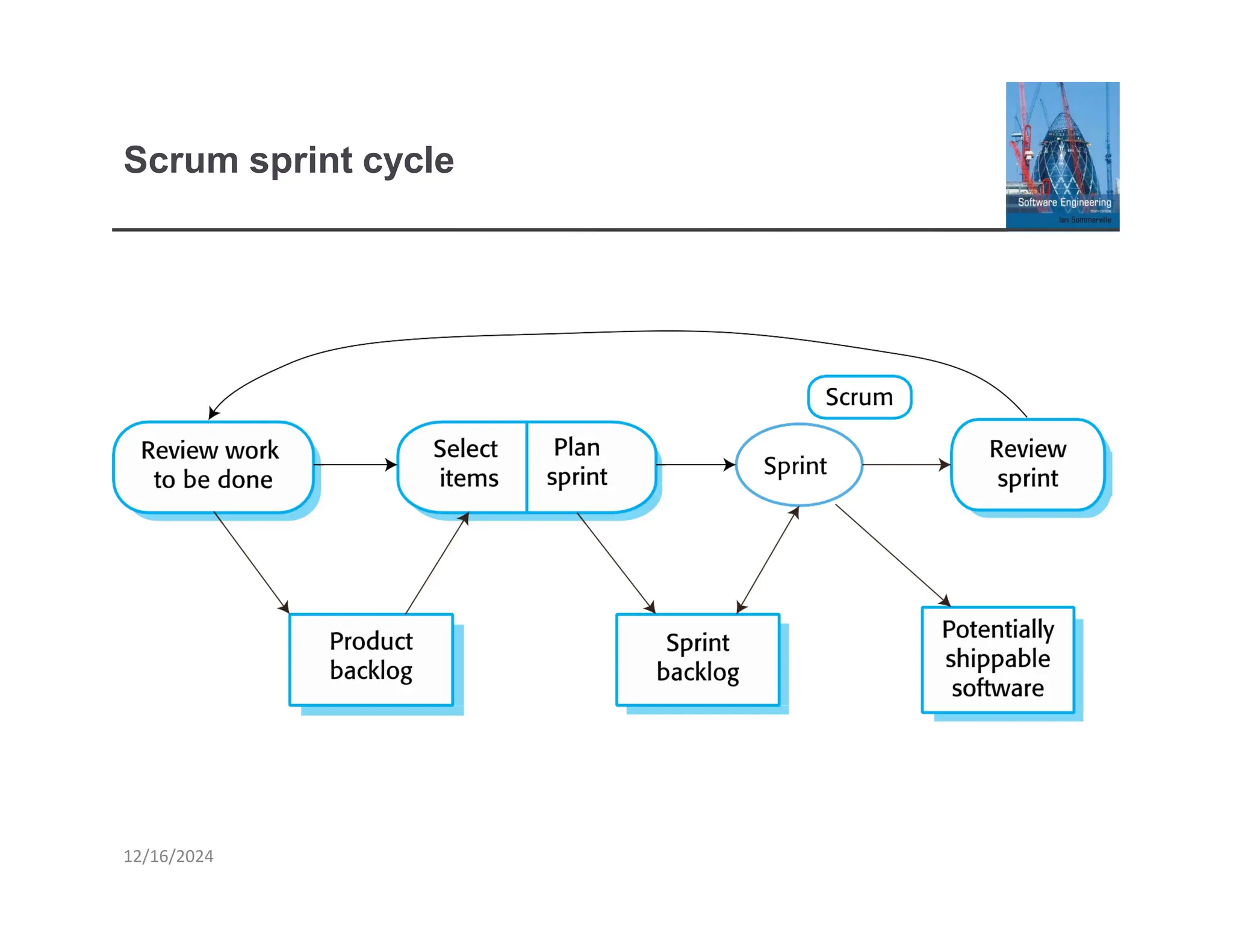
Scrum sprint cycle
12/16/2024
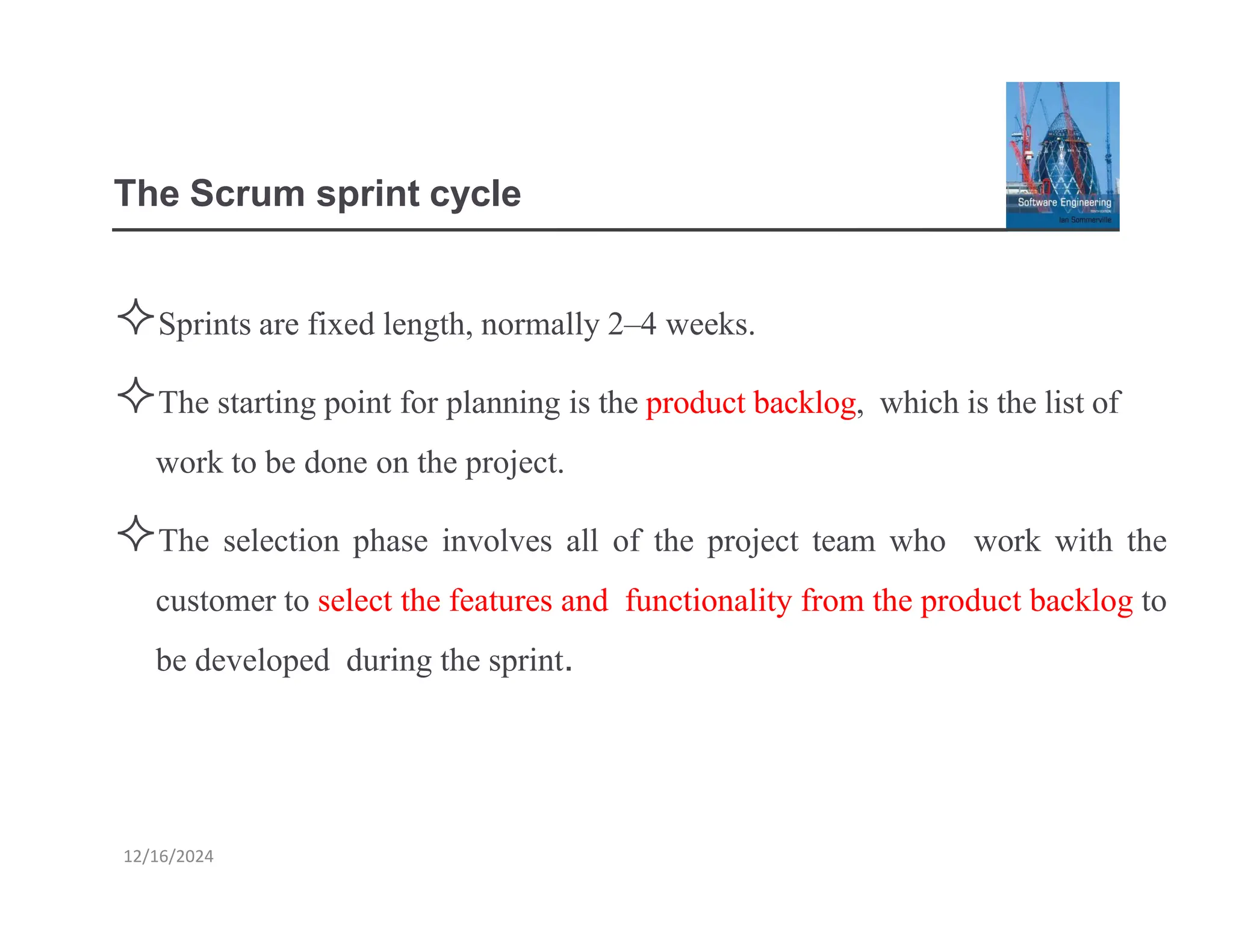
The Scrum sprint cycle
Sprints are fixed length, normally 2–4 weeks.
The starting point for planning is the product backlog, which is the list of
work to be done on the project.
The selection phase involves all of the project team who work with the
customer to select the features and functionality from the product backlog to
be developed during the sprint.
12/16/2024
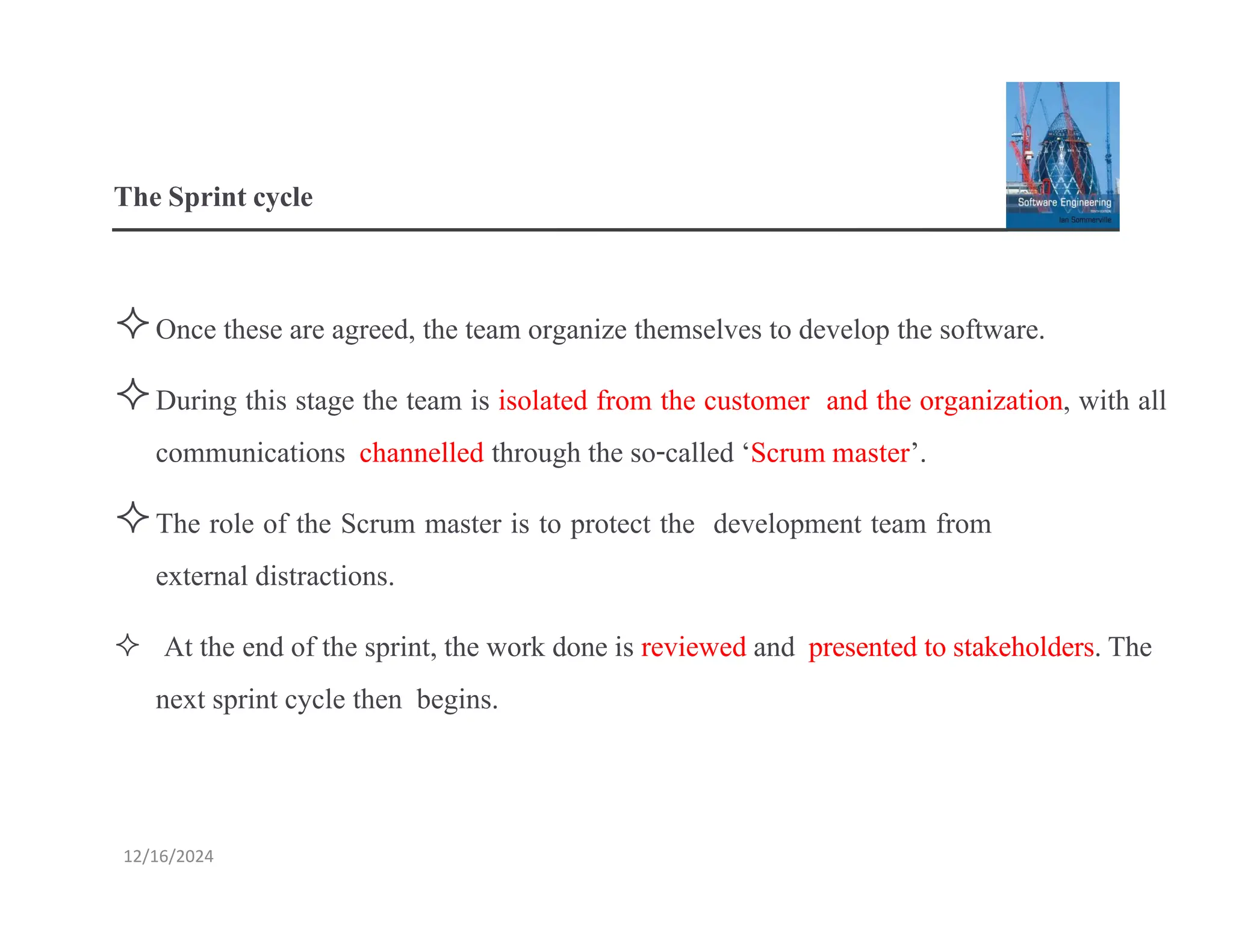
TheSprintcycle
Once these are agreed, the team organize themselves to develop the software.
During this stage the team is isolated from the customer and the organization, with all
communications channelled through the so-called ‘Scrum master’.
The role of the Scrum master is to protect the development team from
external distractions.
 At the end of the sprint, the work done is reviewed and presented to stakeholders.The
next sprint cycle then begins.
12/16/2024
Teamwork in Scrum
12/16/2024
The ‘Scrummaster’ is a facilitatorwho arrangesdaily meetings,tracks the
backlog of work to be done, records decisions, measures progress against the
backlog and communicateswith customersand management outside of the
team.
The whole team attends short daily meetings (Scrums) where all team
members share information, describe their progress since the last meeting,
problems that have arisen and what is planned for the following day.
▪ This means that everyone on the team knows what is going on and, if problems
arise, can re-plan short-term workto cope with them.
Scrum benefits
The product is broken down into a set of manageable and understandable chunks.
Unstable requirements do not hold up progress.
The whole team have visibility of everything and consequently team
communication is improved.
Customers see on-timedelivery of increments and gain feedback on how the product
works.
Trust between customers and developers is established and a positive culture is created
in which everyone expects the project to succeed.
12/16/2024
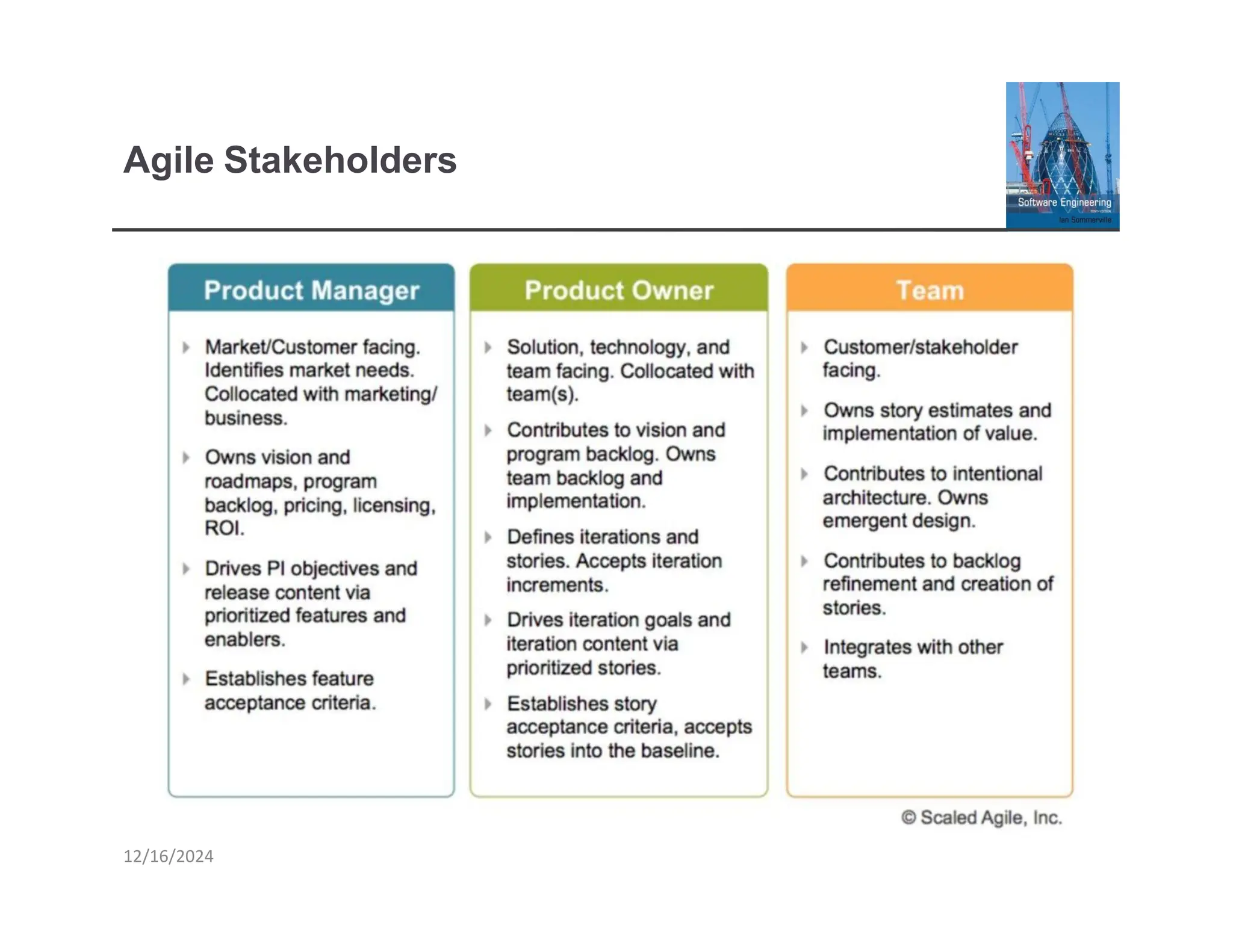
Agile Stakeholders
12/16/2024
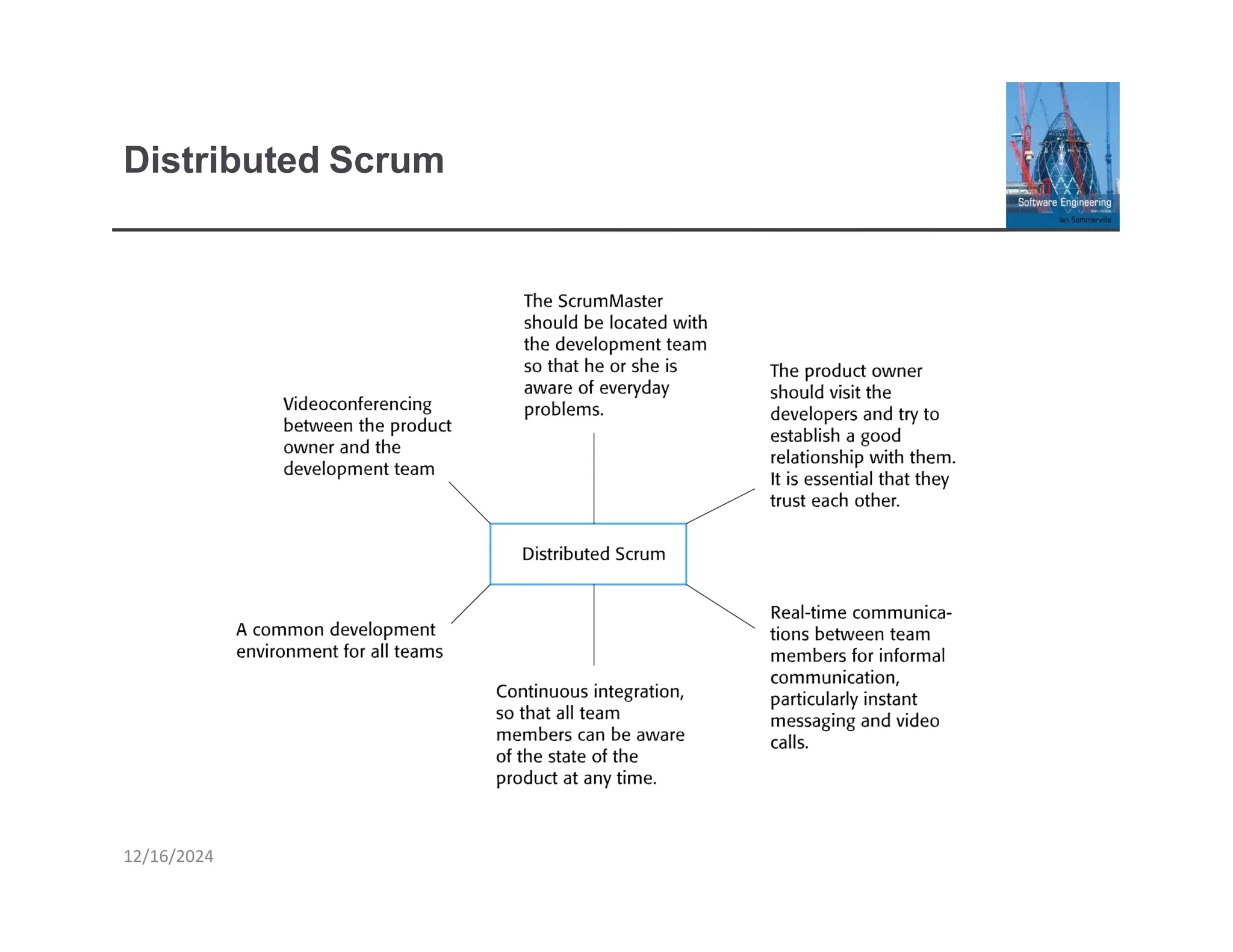
Distributed Scrum
12/16/2024
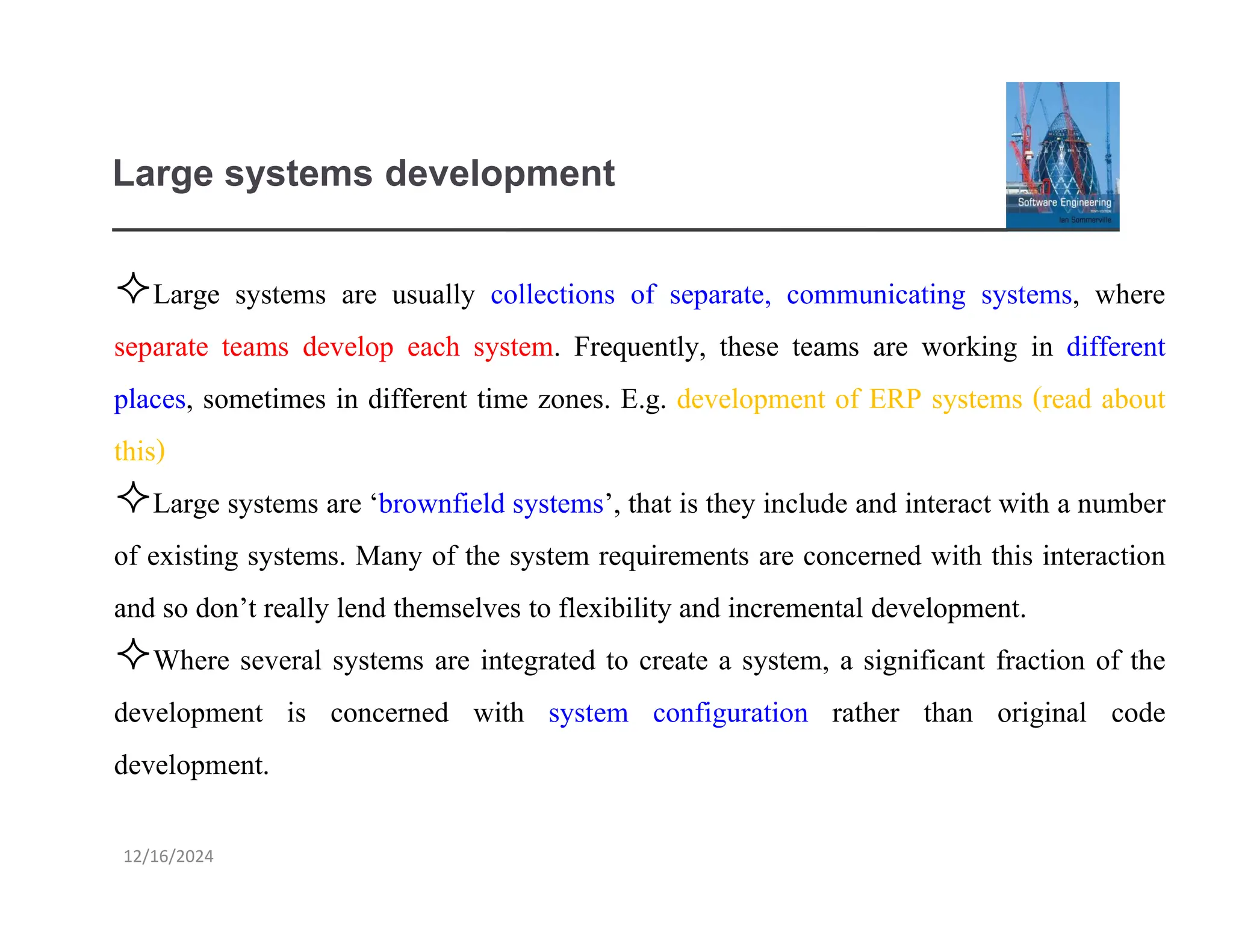
Scrum vs. Extreme Programming
12/16/2024
12/16/2024
Large systems development
Large systems are usually collections of separate, communicating systems, where
separate teams develop each system. Frequently, these teams are working in different
places, sometimes in different time zones. E.g. development of ERP systems (read about
this)
Large systems are ‘brownfield systems’, that is they include and interact with a number
of existing systems. Many of the system requirements are concerned with this interaction
and so don’t really lend themselves to flexibility and incremental development.
Where several systems are integrated to create a system, a significant fraction of the
development is concerned with system configuration rather than original code
development.
Class Discussion: 5 marks
12/16/2024
Greenfield vs. Brownfield System/Project ?
Greenfield: A brand new one, developed from scratch, and not based on any existing
systems, code or infrastructure
Brownfield: Built upon already existing projects, code or other resources.
12/16/2024
Large systems development
Large systems and their development processes are often constrained by external rules
and regulations limiting the way that they can be developed
Large systems have a long procurement and development time. It is difficult to
maintain coherent teams who know about the system over that period as, inevitably,
people move on to other jobs and projects.
Large systems usually have a diverse set of stakeholders. It is practically impossible to
involve all of these different stakeholders in the development process.
12/16/2024
Scaling out and scaling up
Scaling up is concerned with using agile methods for developing large software
systems that cannot be developed by a small team
Scaling out is concerned with how agile methods can be introduced across a large
organization with many years of software development experience
When scaling agile methods it is essential to maintain agile fundamentals
▪Flexible planning, frequent system releases, continuous integration, test-driven
development, and good team communications
12/16/2024
Scaling up to large systems
▪ Scaling up focuses on applying agile principles to develop large software systems.
▪ Why- these systems are too complex or large to be developed by a small team.
▪ Approach - instead of having just one agile team, multiple agile teams are coordinated to
work on parts of the system.
▪ Goal - deliver large, cohesive software products without losing agility.
Example: For a large ERP system, scaling up might involve breaking the system into modules
and assigning multiple agile teams to work on specific features, such as Finance, HR, and
Inventory Management.
12/16/2024
Scaling out to large companies
▪ Scaling out focuses on spreading agile practices across a large organization.
▪ Key Challenge - many organizations are used to old, traditional methods (waterfall)
▪ Approach - introduce agile methods gradually, ensuring teams adopt agile values
(flexibility, collaboration, iteration).
▪ Goal - promote a cultural shift where the entire organization operates with agile
fundamentals.
Example: If your company has several departments (e.g., software, quality assurance, IT
support), scaling out ensures all teams use agile methodologies like sprint planning, stand-
ups, and frequent releases.
Key Takeaway
12/16/2024
▪ Scaling Up → Focuses on managing large systems with multiple agile teams
▪ Scaling Out → Focuses on adopting agile practices across the organization
▪ Both approaches rely on agile fundamentals to succeed
Agile project management
12/16/2024
Rol of Software Project Managers: Ensure software is delivered on time and within budget.
Plan-Driven Approach: Managers create a detailed plan specifying
▪ What will be delivered,
▪ When it will be delivered,and
▪ Who will develop thedeliverables.
Agile Approach: Focuses on incremental development and practices used in agile methods,
requiring a more flexible and adaptive approach.
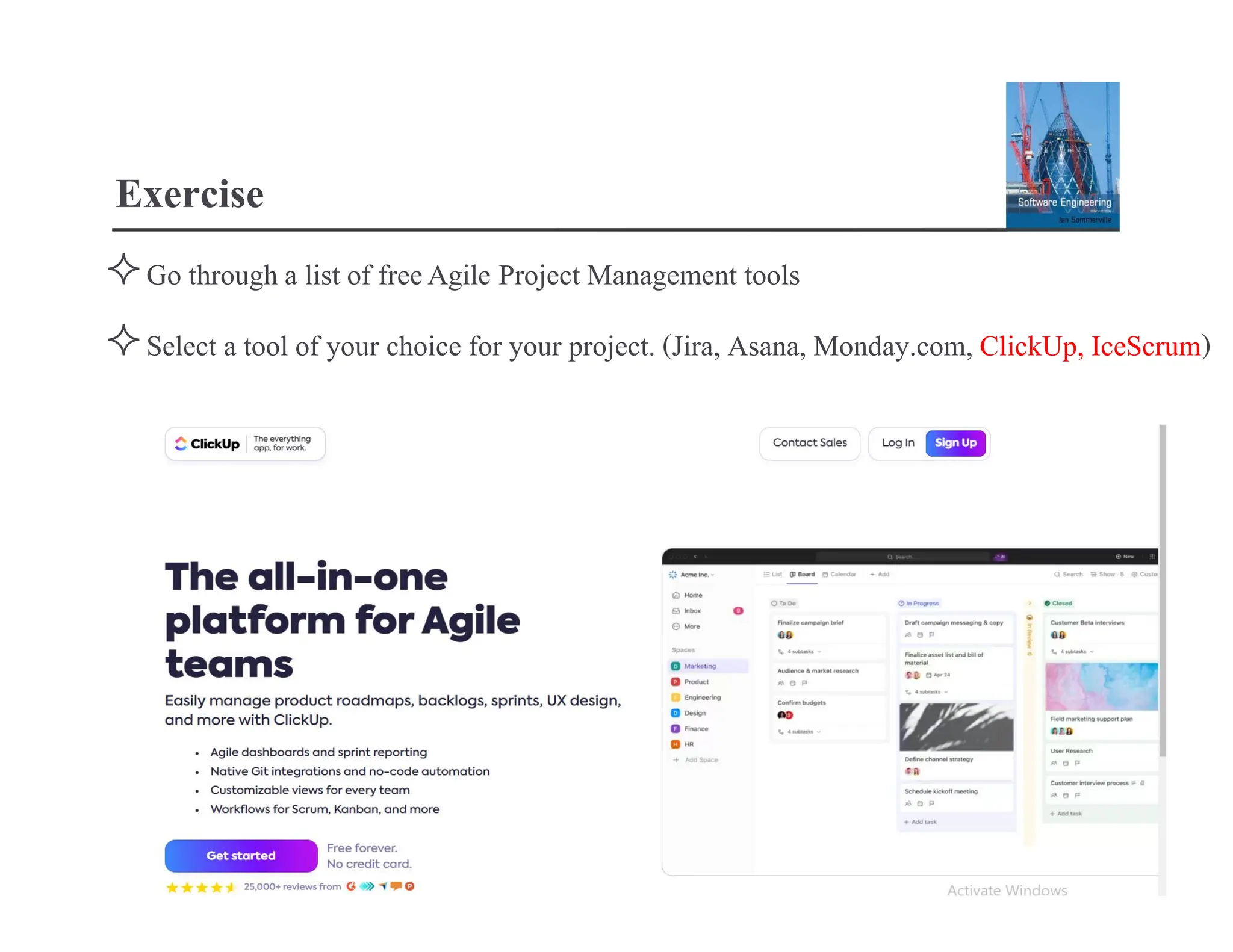
Go through a list of freeAgile Project Management tools
Select a tool of your choice for your project. (Jira, Asana, Monday.com, ClickUp, IceScrum)
12/16/2024 40
Exercise
Exercise/Project
▪ Form a team containing not more thanfive members
▪ Select project title
▪ Define objective/s, purposes
▪ Conduct feasibility study
▪ Write about the system’s overview
▪ Select the process model best fits for applying tothe development of your system
▪ Study software project managementtools
▪ Select preferable tool
▪ Practice tool
▪ Apply scrum schemes (create product backlogs, create themes, create epics, write user stories, write
tasks)
▪ Provide a light-weightrequirementspecification document (keeping its agility)
▪ Incorporate common system models that can represent the user stories you write.
12/16/2024
Project Deliverable
✓ Comprehensive User Story (Light-weight requirements specification document) contains:
• Descriptive title
• Objectives/purposes
• System overview
• Agile requirements specification: List of product backlogs, themes, epics, user
stories and tasks
• Some requirements modeling (such as use case, sequence, activity, class) based
on the specified user stories
• Scrum teams (product owner, development team and scrum master) with their
roles and responsibilities. Assign the roles from your team members
• The name and number of sprints including the list of features implemented in
each sprint with their duration.
• Practice with the aid of tools
12/16/2024
12/16/2024

Chapter 3 - Agile Software Development.pdf

  • 1.
    Chapter 3 Agile SoftwareDevelopment Ian Sommerville, Software Engineering, 10th Edition Pearson Education, Addison-Wesley Compiled by Yohannes S. 12/16/2024
  • 2.
    Topics covered Agile methods Plan-drivenand agile development Agile development techniques Agile project management Scrum Scaling up agile methods  Exercise: Select suitable Agile project management tool 18/03/2019 Agile Software Development 2 12/16/2024
  • 3.
    The Problem(s) withSoftware Development 18/03/2019 Agile Software Development 3  Customers do not know exactly what they need or want  Customers change their minds  Customers’ priorities change  It is difficult to solve the needs of many stakeholders  We can never adequately specify requirements  We are lousy at estimating software tasks  Unpredictable “stuff” happens  It often takes several times to get “something” right Users do not know what they want until they see it (but are good at telling us what they do not like) 12/16/2024
  • 4.
    Rapid software development Rapiddevelopment and delivery is now often the most important requirement for software systems ▪Businesses operate in a fast–changing environment ▪Software has to evolve quickly to reflect changing business needs Rapid software development ▪Specification, design and implementation are inter-leaved ▪System is developed as a series of versions with stakeholders involved in version evaluation 4
  • 5.
    12/16/2024 Agile Methods Dissatisfaction withthe overheads involved in software design methods led to the creation of agile methods. These methods: ▪Focus on the code rather than the design ▪Are based on an iterative approach to software development ▪Are intended to deliver working software quickly and evolve this quickly to meet changing requirements The aim of agile methods is to reduce overheads in the software process (e.g. by limiting documentation) and to be able to respond quickly to changing requirements without excessive rework
  • 6.
    Agile Manifesto 18/03/2019 AgileSoftware Development 6 We are uncovering better ways of developing software by doing it and helping othersdo it.Through this work we have come to value: Individuals and interactions over processes and tools Working software over comprehensive documentation Customer collaborationover contract negotiation Responding to change over followinga plan That is, while there is value in the items on the right, we value the items on the left more.  http://agilemanifesto.org/ 12/16/2024
  • 7.
    Principles behind theManifesto 18/03/2019 Agile Software Development 7 1. Our highest priority is to satisfy the customer through early and continuous delivery of valuable software. 2. Welcome changing requirements, even late in development. Agile processes harness change for the customer'scompetitive advantage. 3. Deliver working software frequently, from a couple of weeks to a couple of months, with a preference to theshorter timescale. 4. Business people and developers must work together daily throughout theproject. 5. Build projects around motivated individuals. Give them the environment and support they need, and trustthem to get the job done. 6. The most efficient and effective method of conveying information to and within a development team is face-to-faceconversation. 12/16/2024
  • 8.
    Principles behind theManifesto 18/03/2019 Agile Software Development 8 7. Working software is the primary measure of progress. 8. Agile processes promote sustainable development. The sponsors, developers, and users should be able to maintain a constant pace indefinitely. 9. Continuous attention to technical excellence and good design enhances agility. 10.Simplicity--the art of maximizing the amount of work not done--is essential. 11.The best architectures, requirements,and designs emerge from self- organizing teams. 12.At regular intervals, the team reflects on how to become more effective, then tunes and adjusts its behavior accordingly. Source: http://agilemanifesto.org/principles.html 12/16/2024
  • 9.
    Key Aspects ofAgile Methodology Agile Methodologies Iterative Planned modification of parts of the system. Assists with modification of design and requirements Incremental Develop parts of the system separately and integrate. Assists with improving overall methodology Self-Organizing The team has the responsibility of organizing its internal dynamics. Emergent The set of tools, techniques, development environment, and requirements emerge in the process 18/03/2019 Agile Software Development 9 12/16/2024
  • 10.
  • 11.
    12/16/2024 Agile method applicability Product development where a software company is developing a small or medium-sized product for sale Custom system development within an organization, where there is a clear commitment from the customer to become involved in the development process and where there are not a lot of external rules and regulations that affect the software Because of their focus on small, tightly-integrated teams, there are problems in scaling agile methods to large systems
  • 12.
    12/16/2024 Plan-driven and agiledevelopment Plan-driven development ▪Based around separate development stages with the outputs to be produced at each of these stages planned in advance ▪Not necessarily waterfall model – plan-driven, incremental development is also possible ▪Iteration occurs within activities Agile development ▪Specification, design, implementation and testing are inter-leaved and the outputs from the development process are decided through a process of negotiation during the software development process
  • 13.
  • 14.
    Agile Terminologies: Theme,Epic, Story, Task 12/16/2024
  • 15.
    Theme, Epic, Story,Task 12/16/2024
  • 16.
    Stories – akaProduct Backlog Item, Work Item 12/16/2024 A story is an individualfeature or requirement that the client (and business) wants. It is something that is deliverable (i.e. production ready) within a single sprint. Stories are often written in a specific format: ▪ As a [enduserofthe requiredfeature] ▪ I want [actualthing theuserwantsto be ableto do oncethe featureislive – so oftencontainsa verb] ▪ So that[why theywant this feature/ the benefitthisfeature brings] An example story: As a customer, I want to be able to save a product in my wishlist so that I can view it again later.
  • 17.
    Story Walls 12/16/2024 Astory wallis a very common and effective information radiatorthat displays the status of each card in the currentiterationor sprint. The team movesa card through each column as it gets completed.
  • 18.
  • 19.
    Epic An epic isa big story.Arequirement that is just too big to deliver in a single sprint. Epics need to be broken into smaller deliverables (stories). An example epic: “As a customer, I want to be able to have wishlists so that I can come back to buy products later.” 12/16/2024 20
  • 20.
    Theme Acollection of storiesby category.Abasket or bucket of stories. By its nature, an epic can also be a theme in itself. An example theme: “Wishlist”. 12/16/2024
  • 21.
    Tasks The elements ofa story. Stepping stones to take the story to ‘Done’. Tasks often follow the SMART acronym: specific, measurable, achievable, relevant, time-boxed. An example task: “Put ‘Add to wishlist’ button on each product page.” 12/16/2024
  • 22.
    Theme, Epic, UserStories, Tasks 12/16/2024
  • 23.
    Agile Implementations  ExtremeProgramming  Scrum  Kanban  Lean and Six Sigma 12/16/2024 Reading Assignment
  • 24.
    Extreme programming 12/16/2024  Avery influential agile method, developed in the late 1990s, that introduced a range of agile development techniques.  Extreme Programming (XP) takes an ‘extreme’ approach to iterative development. ▪ New versions may be built several times per day; ▪ Increments are delivered to customers every 2 weeks; ▪ All tests must be run for every build and the build is only accepted if tests run successfully.
  • 25.
    The extreme programmingrelease cycle 12/16/2024
  • 26.
    Extreme programming practices(a) Principle or practice Incremental planning 12/16/2024 Description Requirements are recorded on story cards and the stories to be included in a release are determined by the time available and their relative priority. The developers break these stories into development ‘Tasks’. Small releases The minimal useful set of functionality that provides business value is developed first. Releases of the system are frequent and incrementally add functionality to the first release. Simple design Test-first development Refactoring Enough design is carried out to meet the current requirements and no more An automated unit test framework is used to write tests for a new piece of functionality before that functionality itself is implemented. All developers are expected to refactor the code continuously as soon as possible code improvements are found. This keeps the code simple and maintainable.
  • 27.
    Extreme programming practices(b) Pair programming Developers work in pairs, checking each other’s work and providing the support to always do a good job. Collective ownership The pairs of developers work on all areas of the system, so that no islands of expertise develop and all the developers take responsibility for all of the code. Anyone can change anything. Continuous integration As soon as the work on a task is complete, it is integrated into the whole system. After any such integration, all the unit tests in the system must pass. On-site customer A representative of the end-user of the system (the customer) should be available full time for the use of the XP team. In an extreme programming process, the customer is a member of the development team and is responsible for bringing system requirements to the team for implementation. 12/16/2024
  • 28.
    Scrum 12/16/2024 Scrum is anagile method that focuses on managing iterativedevelopment rather than specific agile practices. There are three phases in Scrum. ▪ The initial phase is an outline planning phase where you establish the general objectives for the project and design the softwarearchitecture. ▪ This is followed by a series of sprint cycles, where each cycle develops an increment ofthe system. ▪ The project closure phase wraps up the project, completes required documentation such as system help frames and user manuals and assesses the lessons learned from the project.
  • 29.
    Scrum terminology (a) Scrumterm 12/16/2024 Definition Development team Potentially shippable product increment A self-organizing group of software developers, which should be no more than 9 people. They are responsible for developing the software and other essential project documents. The software increment that is delivered from a sprint. The idea is that this should be ‘potentially shippable’ which means that it is in a finished state and no further work, such as testing, is needed to incorporate it into the final product. In practice, this is not always achievable. Product backlog This is a list of ‘to do’ items which the Scrum team must tackle. They may be feature definitions for the software, software requirements, user stories or descriptions of supplementary tasks that are needed, such as architecture definition or user documentation. Product owner An individual (or possibly a small group) whose job is to identify product features or requirements, prioritize these for development and continuously review the product backlog to ensure that the project continues to meet critical customer needs. The Product Owner can be a customer but might also be a product manager in a software company or other stakeholder representative.
  • 30.
    Scrum terminology (b) Scrumterm Scrum 12/16/2024 30 Definition A daily meeting of the Scrum team that reviews progress and prioritizes work to be done that day. Ideally, this should be a short face-to-face meeting that includes the whole team. ScrumMaster The ScrumMaster is responsible for ensuring that the Scrum process is followed and guides the team in the effective use of Scrum. He or she is responsible for interfacing with the rest of the company and for ensuring that the Scrum team is not diverted by outside interference. The Scrum developers are adamant that the ScrumMaster should not be thought of as a project manager. Others, however, may not always find it easy to see the difference. Sprint A development iteration. Sprints are usually 2-4 weeks long. Velocity An estimate of how much product backlog effort that a team can cover in a single sprint. Understanding a team’s velocity helps them estimate what can be covered in a sprint and provides a basis for measuring improving performance.
  • 31.
  • 32.
    The Scrum sprintcycle Sprints are fixed length, normally 2–4 weeks. The starting point for planning is the product backlog, which is the list of work to be done on the project. The selection phase involves all of the project team who work with the customer to select the features and functionality from the product backlog to be developed during the sprint. 12/16/2024
  • 33.
    TheSprintcycle Once these areagreed, the team organize themselves to develop the software. During this stage the team is isolated from the customer and the organization, with all communications channelled through the so-called ‘Scrum master’. The role of the Scrum master is to protect the development team from external distractions.  At the end of the sprint, the work done is reviewed and presented to stakeholders.The next sprint cycle then begins. 12/16/2024
  • 34.
    Teamwork in Scrum 12/16/2024 The‘Scrummaster’ is a facilitatorwho arrangesdaily meetings,tracks the backlog of work to be done, records decisions, measures progress against the backlog and communicateswith customersand management outside of the team. The whole team attends short daily meetings (Scrums) where all team members share information, describe their progress since the last meeting, problems that have arisen and what is planned for the following day. ▪ This means that everyone on the team knows what is going on and, if problems arise, can re-plan short-term workto cope with them.
  • 35.
    Scrum benefits The productis broken down into a set of manageable and understandable chunks. Unstable requirements do not hold up progress. The whole team have visibility of everything and consequently team communication is improved. Customers see on-timedelivery of increments and gain feedback on how the product works. Trust between customers and developers is established and a positive culture is created in which everyone expects the project to succeed. 12/16/2024
  • 36.
  • 37.
  • 38.
    Scrum vs. ExtremeProgramming 12/16/2024
  • 39.
    12/16/2024 Large systems development Largesystems are usually collections of separate, communicating systems, where separate teams develop each system. Frequently, these teams are working in different places, sometimes in different time zones. E.g. development of ERP systems (read about this) Large systems are ‘brownfield systems’, that is they include and interact with a number of existing systems. Many of the system requirements are concerned with this interaction and so don’t really lend themselves to flexibility and incremental development. Where several systems are integrated to create a system, a significant fraction of the development is concerned with system configuration rather than original code development.
  • 40.
    Class Discussion: 5marks 12/16/2024 Greenfield vs. Brownfield System/Project ? Greenfield: A brand new one, developed from scratch, and not based on any existing systems, code or infrastructure Brownfield: Built upon already existing projects, code or other resources.
  • 41.
    12/16/2024 Large systems development Largesystems and their development processes are often constrained by external rules and regulations limiting the way that they can be developed Large systems have a long procurement and development time. It is difficult to maintain coherent teams who know about the system over that period as, inevitably, people move on to other jobs and projects. Large systems usually have a diverse set of stakeholders. It is practically impossible to involve all of these different stakeholders in the development process.
  • 42.
    12/16/2024 Scaling out andscaling up Scaling up is concerned with using agile methods for developing large software systems that cannot be developed by a small team Scaling out is concerned with how agile methods can be introduced across a large organization with many years of software development experience When scaling agile methods it is essential to maintain agile fundamentals ▪Flexible planning, frequent system releases, continuous integration, test-driven development, and good team communications
  • 43.
    12/16/2024 Scaling up tolarge systems ▪ Scaling up focuses on applying agile principles to develop large software systems. ▪ Why- these systems are too complex or large to be developed by a small team. ▪ Approach - instead of having just one agile team, multiple agile teams are coordinated to work on parts of the system. ▪ Goal - deliver large, cohesive software products without losing agility. Example: For a large ERP system, scaling up might involve breaking the system into modules and assigning multiple agile teams to work on specific features, such as Finance, HR, and Inventory Management.
  • 44.
    12/16/2024 Scaling out tolarge companies ▪ Scaling out focuses on spreading agile practices across a large organization. ▪ Key Challenge - many organizations are used to old, traditional methods (waterfall) ▪ Approach - introduce agile methods gradually, ensuring teams adopt agile values (flexibility, collaboration, iteration). ▪ Goal - promote a cultural shift where the entire organization operates with agile fundamentals. Example: If your company has several departments (e.g., software, quality assurance, IT support), scaling out ensures all teams use agile methodologies like sprint planning, stand- ups, and frequent releases.
  • 45.
    Key Takeaway 12/16/2024 ▪ ScalingUp → Focuses on managing large systems with multiple agile teams ▪ Scaling Out → Focuses on adopting agile practices across the organization ▪ Both approaches rely on agile fundamentals to succeed
  • 46.
    Agile project management 12/16/2024 Rolof Software Project Managers: Ensure software is delivered on time and within budget. Plan-Driven Approach: Managers create a detailed plan specifying ▪ What will be delivered, ▪ When it will be delivered,and ▪ Who will develop thedeliverables. Agile Approach: Focuses on incremental development and practices used in agile methods, requiring a more flexible and adaptive approach.
  • 47.
    Go through alist of freeAgile Project Management tools Select a tool of your choice for your project. (Jira, Asana, Monday.com, ClickUp, IceScrum) 12/16/2024 40 Exercise
  • 48.
    Exercise/Project ▪ Form ateam containing not more thanfive members ▪ Select project title ▪ Define objective/s, purposes ▪ Conduct feasibility study ▪ Write about the system’s overview ▪ Select the process model best fits for applying tothe development of your system ▪ Study software project managementtools ▪ Select preferable tool ▪ Practice tool ▪ Apply scrum schemes (create product backlogs, create themes, create epics, write user stories, write tasks) ▪ Provide a light-weightrequirementspecification document (keeping its agility) ▪ Incorporate common system models that can represent the user stories you write. 12/16/2024
  • 49.
    Project Deliverable ✓ ComprehensiveUser Story (Light-weight requirements specification document) contains: • Descriptive title • Objectives/purposes • System overview • Agile requirements specification: List of product backlogs, themes, epics, user stories and tasks • Some requirements modeling (such as use case, sequence, activity, class) based on the specified user stories • Scrum teams (product owner, development team and scrum master) with their roles and responsibilities. Assign the roles from your team members • The name and number of sprints including the list of features implemented in each sprint with their duration. • Practice with the aid of tools 12/16/2024
  • 50.