By,
JYOTIRMOY ROY
B.Phrm.6th sem
BCDA COLLEGE OF PHARMACY AND TECHNOLOGY
78, Jessore Road(South), Hridaypur, Barasat, Kolkata – 700127
OBJECTIVES
1. What is LIMS ?
2. Why LIMS ?
3. LIMS Contents
4. How LIMS Work & Work Flow
5. Screen of LIMS Software
6. Functionalities of LIMS
7. Advantages of LIMS
8. Disadvantages of LIMS
9. Conclusion
10. References
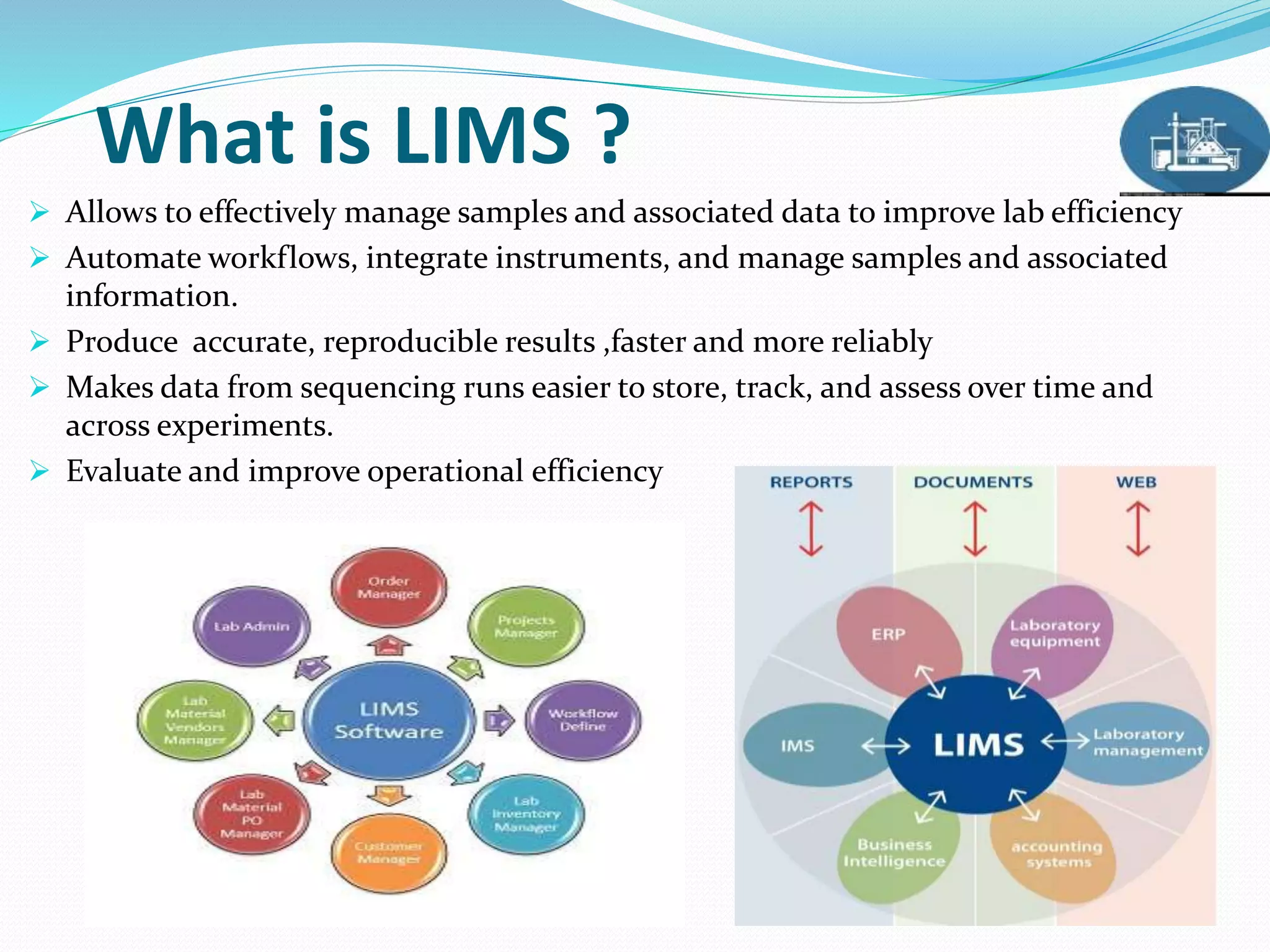
What is LIMS ?
 Allows to effectively manage samples and associated data to improve lab efficiency
 Automate workflows, integrate instruments, and manage samples and associated
information.
 Produce accurate, reproducible results ,faster and more reliably
 Makes data from sequencing runs easier to store, track, and assess over time and
across experiments.
 Evaluate and improve operational efficiency
LIMS Contents
 Customers
 Collection sites
 Preservatives
 Analysis method
 Employees
 Passwords
 Tests & test results
 Bottle types
 Sample matrix
 Parameters
 Control limits
LIMS also includes:
 Sample Tracking
 Sophisticated Query Searching
 Instrument Integration
 Powerful Reporting
Functionality
 Integrated Bar-coding
 Integrated QA/QC Functions
 Full Audit Trail
 Enterprise system Integration
HOW LIMS WORKS ?
LIMS work flow
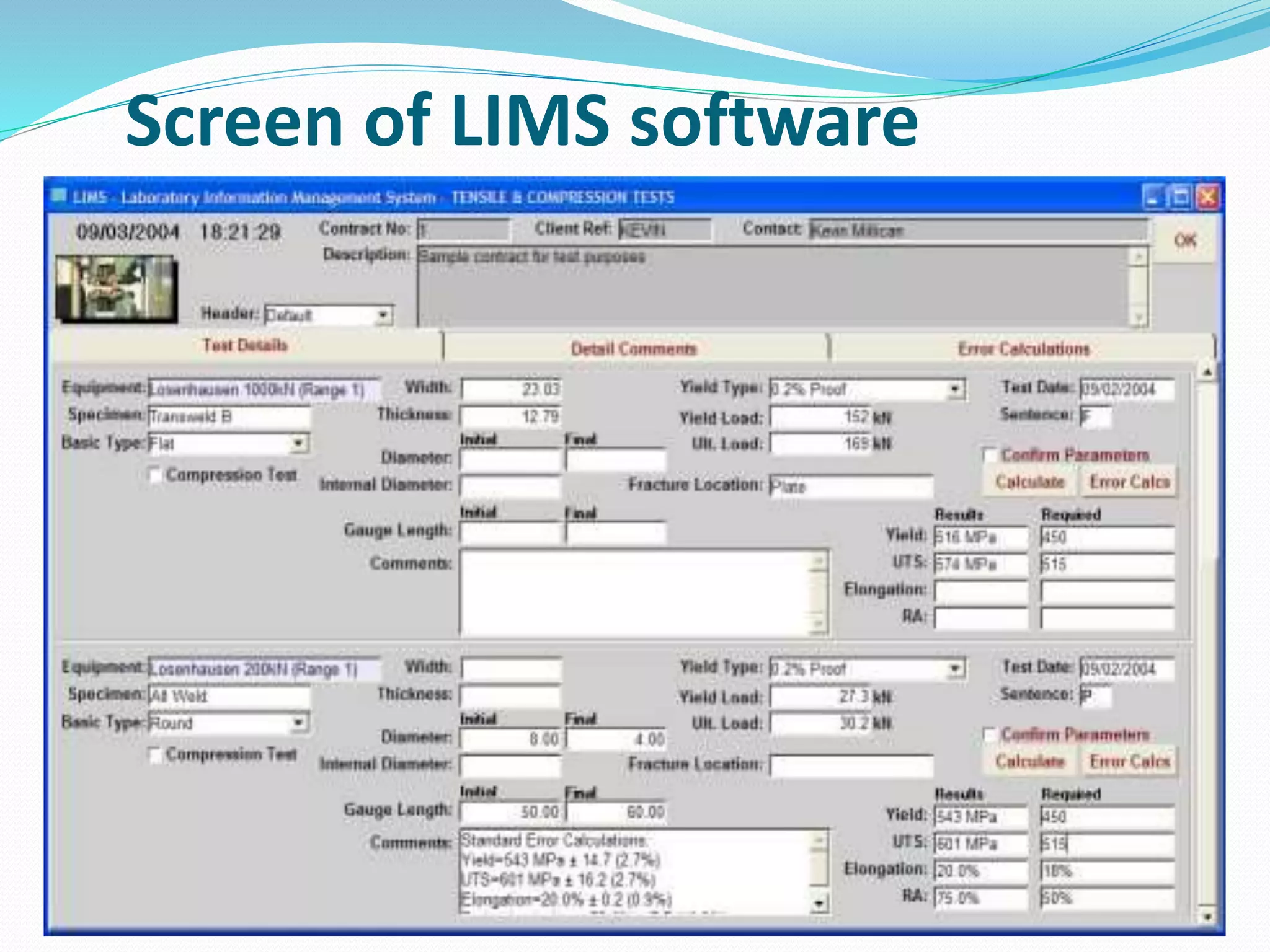
Screen of LIMS software
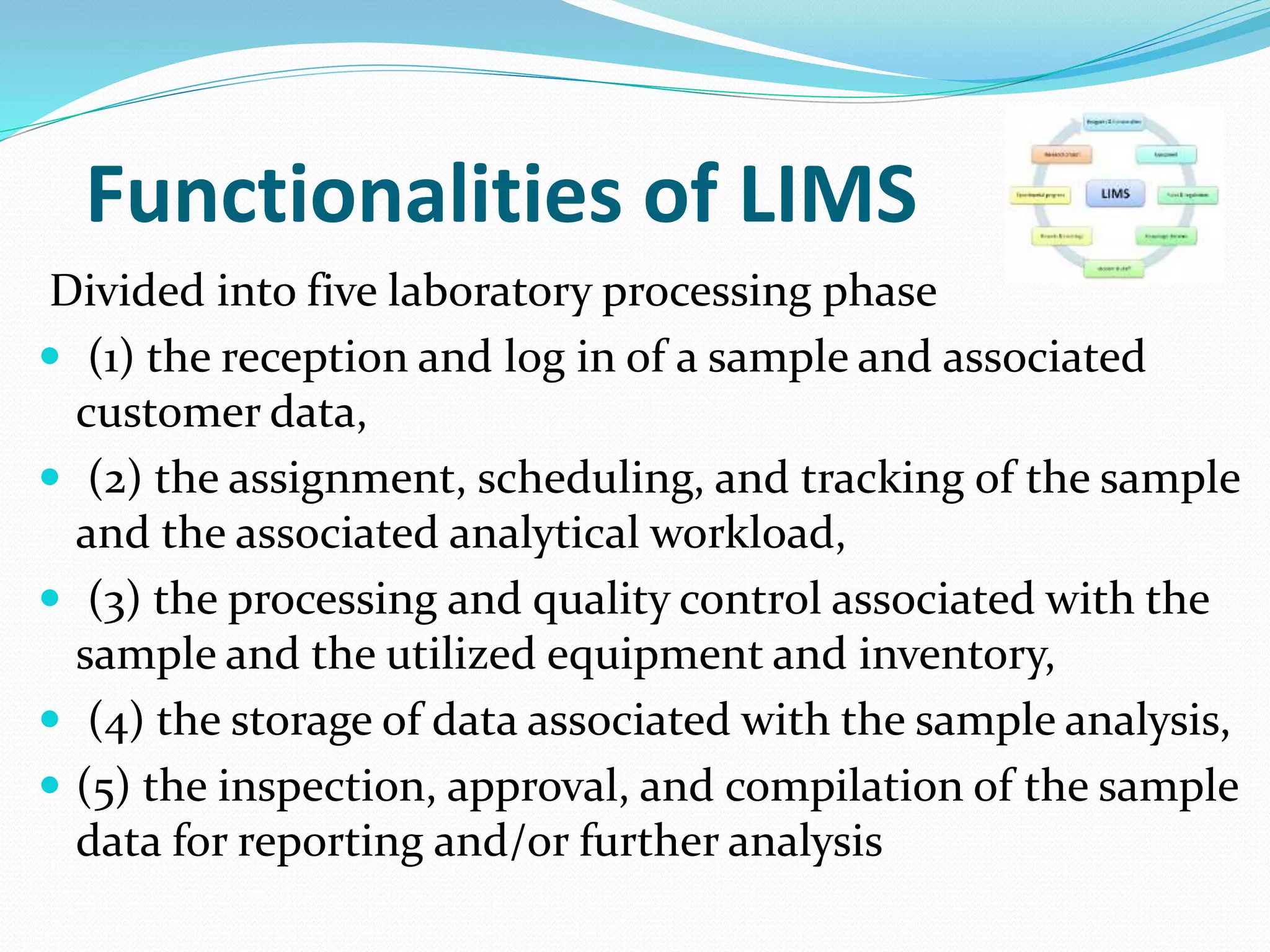
Functionalities of LIMS
Divided into five laboratory processing phase
 (1) the reception and log in of a sample and associated
customer data,
 (2) the assignment, scheduling, and tracking of the sample
and the associated analytical workload,
 (3) the processing and quality control associated with the
sample and the utilized equipment and inventory,
 (4) the storage of data associated with the sample analysis,
 (5) the inspection, approval, and compilation of the sample
data for reporting and/or further analysis
Functionalities of LIMS
Additional functions
 audit management
 Barcode handling
 chain of custody
 Compliance
 customer relationship
management
 document management
 instrument calibration and
maintenance
 inventory and equipment
management
 manual and electronic data
entry
 method management
 personnel and workload
management
 quality assurance and
control
 Reports
 time tracking
 Traceability
 workflows
Advantages of LIMS
 Very fast report access & queries
 Reduction in paperwork
 Improved data quality (reduction in errors)
 Improved operational efficiency
 Simple to use Excel-like formulas
 Increased productivity (reduction of routine tasks)
 Productivity gains (instrument interfacing and auto-reporting)
 Integration with other departments/business systems
 Reduces transcription errors
 Increases throughput
 Avoids duplication
 ROI (Return On Investment is typically within 1 year)
Disadvances of LIMS
 Training—Personnel training is required
 Time to adapt to a new system
 Cost—Purchase and maintenance are the most
expensive parts of a computerized system, and the costs
can be prohibitive in some settings.
 Physical restrictions
 Need for back-up system—All computer information
must be carefully backed up.
 Loss of data due to a damaged disk or system crash
cannot be tolerated, and backup systems will be critical
CONCLUSION
 A computerized system for laboratory data is often
called a laboratory information management system
and is referred to by the acronym LIMS or LIS.
 The use of a computerized system is becoming more
common in laboratories around the world.
 An appropriately designed and installed LIMS brings
accuracy and accessibility to the flow of samples and
data in the clinical laboratory.
REFERNCES
 Vaughan, Alan (20 August 2006). "LIMS: The Laboratory ERP".
LIMSfinder.com
 McLelland, Alan (1998). "What is a LIMS - a laboratory toy, or a critical
IT component?" Royal Society of Chemistry.
 Laboratory Informatics Institute, Inc. Archived from on June 27, 2011.
 Gibbon, G.A. (1996).Laboratory Automation and Information
Management.
 D. O. Skobelev; T. M. Zaytseva; A. D. Kozlov; V. L. Perepelitsa; A. S.
Makarova (2011). "Laboratory information management systems in the
work of the analytic laboratory" Measurement Techniques.
 Tomiello, Kathryn (21 February 2007). "Regulatory compliance drives
LIMS". Design World.
 WHO/CDC/CLSI Laboratory Quality
http://www.aphl.org/aphlprograms/global/initiatives/Pages/lis.aspx
THANK YOU

Laboratory information management system (LIMS)

  • 1.
    By, JYOTIRMOY ROY B.Phrm.6th sem BCDACOLLEGE OF PHARMACY AND TECHNOLOGY 78, Jessore Road(South), Hridaypur, Barasat, Kolkata – 700127
  • 2.
    OBJECTIVES 1. What isLIMS ? 2. Why LIMS ? 3. LIMS Contents 4. How LIMS Work & Work Flow 5. Screen of LIMS Software 6. Functionalities of LIMS 7. Advantages of LIMS 8. Disadvantages of LIMS 9. Conclusion 10. References
  • 3.
    What is LIMS?  Allows to effectively manage samples and associated data to improve lab efficiency  Automate workflows, integrate instruments, and manage samples and associated information.  Produce accurate, reproducible results ,faster and more reliably  Makes data from sequencing runs easier to store, track, and assess over time and across experiments.  Evaluate and improve operational efficiency
  • 4.
    LIMS Contents  Customers Collection sites  Preservatives  Analysis method  Employees  Passwords  Tests & test results  Bottle types  Sample matrix  Parameters  Control limits LIMS also includes:  Sample Tracking  Sophisticated Query Searching  Instrument Integration  Powerful Reporting Functionality  Integrated Bar-coding  Integrated QA/QC Functions  Full Audit Trail  Enterprise system Integration
  • 5.
  • 6.
  • 7.
  • 8.
    Functionalities of LIMS Dividedinto five laboratory processing phase  (1) the reception and log in of a sample and associated customer data,  (2) the assignment, scheduling, and tracking of the sample and the associated analytical workload,  (3) the processing and quality control associated with the sample and the utilized equipment and inventory,  (4) the storage of data associated with the sample analysis,  (5) the inspection, approval, and compilation of the sample data for reporting and/or further analysis
  • 9.
    Functionalities of LIMS Additionalfunctions  audit management  Barcode handling  chain of custody  Compliance  customer relationship management  document management  instrument calibration and maintenance  inventory and equipment management  manual and electronic data entry  method management  personnel and workload management  quality assurance and control  Reports  time tracking  Traceability  workflows
  • 10.
    Advantages of LIMS Very fast report access & queries  Reduction in paperwork  Improved data quality (reduction in errors)  Improved operational efficiency  Simple to use Excel-like formulas  Increased productivity (reduction of routine tasks)  Productivity gains (instrument interfacing and auto-reporting)  Integration with other departments/business systems  Reduces transcription errors  Increases throughput  Avoids duplication  ROI (Return On Investment is typically within 1 year)
  • 11.
    Disadvances of LIMS Training—Personnel training is required  Time to adapt to a new system  Cost—Purchase and maintenance are the most expensive parts of a computerized system, and the costs can be prohibitive in some settings.  Physical restrictions  Need for back-up system—All computer information must be carefully backed up.  Loss of data due to a damaged disk or system crash cannot be tolerated, and backup systems will be critical
  • 12.
    CONCLUSION  A computerizedsystem for laboratory data is often called a laboratory information management system and is referred to by the acronym LIMS or LIS.  The use of a computerized system is becoming more common in laboratories around the world.  An appropriately designed and installed LIMS brings accuracy and accessibility to the flow of samples and data in the clinical laboratory.
  • 13.
    REFERNCES  Vaughan, Alan(20 August 2006). "LIMS: The Laboratory ERP". LIMSfinder.com  McLelland, Alan (1998). "What is a LIMS - a laboratory toy, or a critical IT component?" Royal Society of Chemistry.  Laboratory Informatics Institute, Inc. Archived from on June 27, 2011.  Gibbon, G.A. (1996).Laboratory Automation and Information Management.  D. O. Skobelev; T. M. Zaytseva; A. D. Kozlov; V. L. Perepelitsa; A. S. Makarova (2011). "Laboratory information management systems in the work of the analytic laboratory" Measurement Techniques.  Tomiello, Kathryn (21 February 2007). "Regulatory compliance drives LIMS". Design World.  WHO/CDC/CLSI Laboratory Quality http://www.aphl.org/aphlprograms/global/initiatives/Pages/lis.aspx
  • 14.