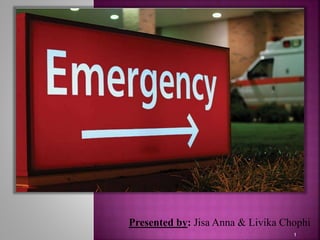
Presented by: Jisa Anna & Livika Chophi
1
 It is an integral part of an hospital
 Microcosm of the hospital as whole
 front door of the hospital
 Portal of entry that interacts with the
highest volume of patients requiring critical
care.
2
 Emergency has been defined as a condition
determined clinically or considered by
patient or his/her relatives as requiring
urgent medical services, failing which , it
could result in los of life or limb….WHO
 Medical emergency is a situation when
patient requires urgent and high quality
medical care to prevent loss of life or limb
and/ or to initiates action for the restoration
of normal healthy life.
3
 Provision of immediate & correct life saving
treatment at all times and for all situations
 Collection of casualties
 Rapid institution of BLS to critically ill at
site, en route and in hospital
 Information centre to render advice on
telephone or in person on simple medical
queries
 Capacity and capability to provide effective
management during disaster situations.
4
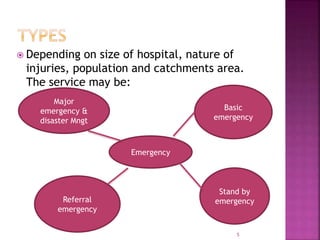
 Depending on size of hospital, nature of
injuries, population and catchments area.
The service may be:
Emergency
Major
emergency &
disaster Mngt
Referral
emergency
Basic
emergency
Stand by
emergency
5
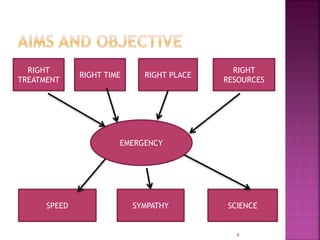
RIGHT
TREATMENT
EMERGENCY
RIGHT TIME RIGHT PLACE
RIGHT
RESOURCES
SPEED SYMPATHY SCIENCE
6
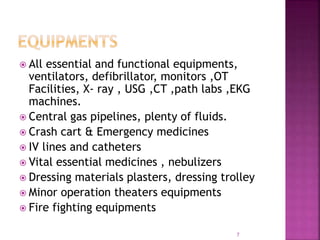
 All essential and functional equipments,
ventilators, defibrillator, monitors ,OT
Facilities, X- ray , USG ,CT ,path labs ,EKG
machines.
 Central gas pipelines, plenty of fluids.
 Crash cart & Emergency medicines
 IV lines and catheters
 Vital essential medicines , nebulizers
 Dressing materials plasters, dressing trolley
 Minor operation theaters equipments
 Fire fighting equipments
7
LOCATION
 Should be located on the ground floor
 Direct access from the main road
 Separate approach , other than OPD with
a spacious parking area
 Location adjacent to OPD
 Well lightened and boldly sig posted both
for day and night
 A helipad is required for major trauma
centre, hilly or unapproachable areas
8
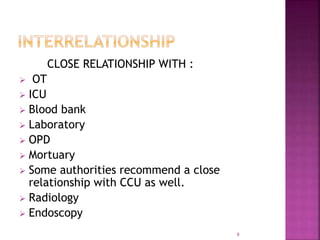
CLOSE RELATIONSHIP WITH :
 OT
 ICU
 Blood bank
 Laboratory
 OPD
 Mortuary
 Some authorities recommend a close
relationship with CCU as well.
 Radiology
 Endoscopy
9
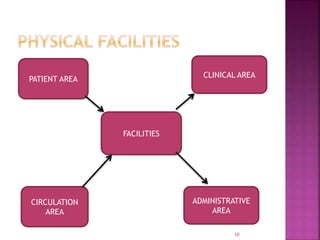
FACILITIES
PATIENT AREA
CLINICAL AREA
ADMINISTRATIVE
AREA
CIRCULATION
AREA
10
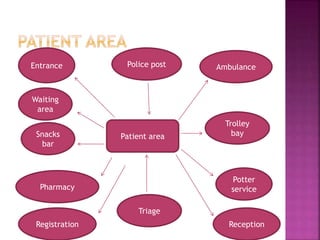
Potter
service
Entrance
Snacks
bar
Ambulance
Waiting
area
Registration
Pharmacy
Triage
Reception
Patient area
Police post
Trolley
bay
11
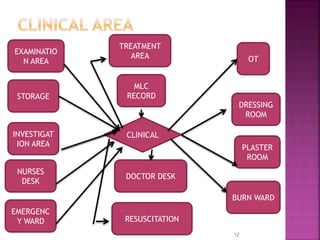
STORAGE
EXAMINATIO
N AREA
EMERGENC
Y WARD
TREATMENT
AREA
DRESSING
ROOM
MLC
RECORD
BURN WARD
PLASTER
ROOM
NURSES
DESK
OT
INVESTIGAT
ION AREA
CLINICAL
DOCTOR DESK
RESUSCITATION
12
CORRIDOORS
RAMPS
STAIRS
TROLLEYS
LIFTS
CIRCULATION
AREA
13
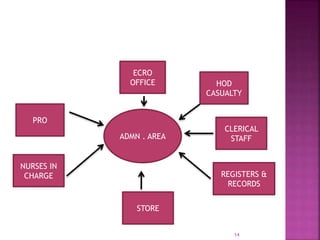
ECRO
OFFICE
CLERICAL
STAFF
NURSES IN
CHARGE REGISTERS &
RECORDS
PRO
HOD
CASUALTY
STORE
ADMN . AREA
14
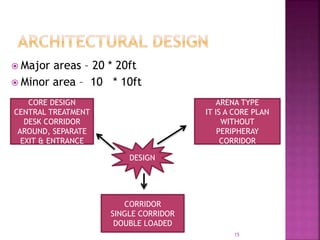
 Major areas – 20 * 20ft
 Minor area – 10 * 10ft
CORE DESIGN
CENTRAL TREATMENT
DESK CORRIDOR
AROUND, SEPARATE
EXIT & ENTRANCE
ARENA TYPE
IT IS A CORE PLAN
WITHOUT
PERIPHERAY
CORRIDOR
CORRIDOR
SINGLE CORRIDOR
DOUBLE LOADED
DESIGN
15
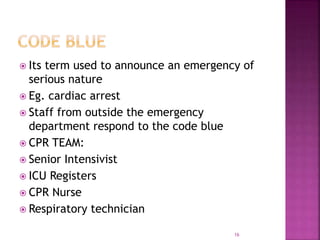
 Its term used to announce an emergency of
serious nature
 Eg. cardiac arrest
 Staff from outside the emergency
department respond to the code blue
 CPR TEAM:
 Senior Intensivist
 ICU Registers
 CPR Nurse
 Respiratory technician
16
17
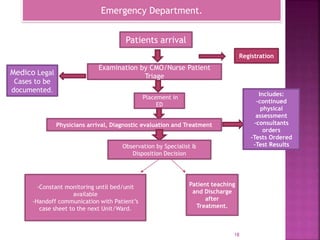
Emergency Department.
Patients arrival
Examination by CMO/Nurse Patient
Triage
Placement in
ED
Physicians arrival, Diagnostic evaluation and Treatment
Observation by Specialist &
Disposition Decision
Includes:
-continued
physical
assessment
-consultants
orders
-Tests Ordered
-Test Results
-Constant monitoring until bed/unit
available
-Handoff communication with Patient’s
case sheet to the next Unit/Ward.
Patient teaching
and Discharge
after
Treatment.
Medico Legal
Cases to be
documented.
Registration
18
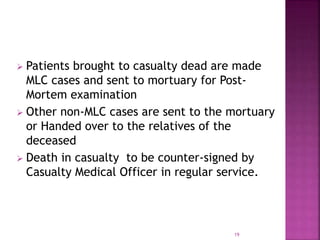
 Patients brought to casualty dead are made
MLC cases and sent to mortuary for Post-
Mortem examination
 Other non-MLC cases are sent to the mortuary
or Handed over to the relatives of the
deceased
 Death in casualty to be counter-signed by
Casualty Medical Officer in regular service.
19
Disaster management committee-
preferably headed by H.O.D ,
Anaesthetist , Surgery, Orthopaedic.
20
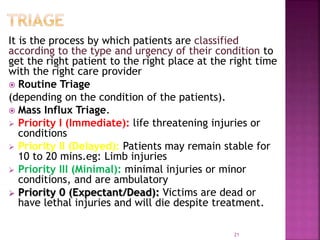
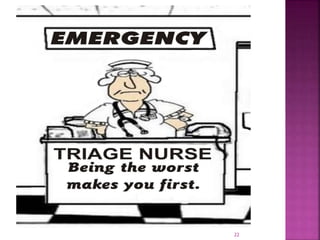
It is the process by which patients are classified
according to the type and urgency of their condition to
get the right patient to the right place at the right time
with the right care provider
 Routine Triage
(depending on the condition of the patients).
 Mass Influx Triage.
 Priority I (Immediate): life threatening injuries or
conditions
 Priority II (Delayed): Patients may remain stable for
10 to 20 mins.eg: Limb injuries
 Priority III (Minimal): minimal injuries or minor
conditions, and are ambulatory
 Priority 0 (Expectant/Dead): Victims are dead or
have lethal injuries and will die despite treatment.
21
22
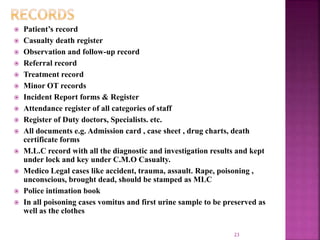
 Patient’s record
 Casualty death register
 Observation and follow-up record
 Referral record
 Treatment record
 Minor OT records
 Incident Report forms & Register
 Attendance register of all categories of staff
 Register of Duty doctors, Specialists. etc.
 All documents e.g. Admission card , case sheet , drug charts, death
certificate forms
 M.L.C record with all the diagnostic and investigation results and kept
under lock and key under C.M.O Casualty.
 Medico Legal cases like accident, trauma, assault. Rape, poisoning ,
unconscious, brought dead, should be stamped as MLC
 Police intimation book
 In all poisoning cases vomitus and first urine sample to be preserved as
well as the clothes
23
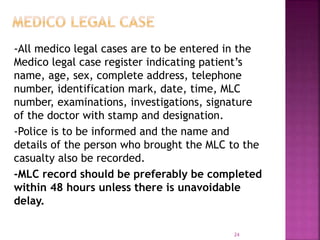
-All medico legal cases are to be entered in the
Medico legal case register indicating patient’s
name, age, sex, complete address, telephone
number, identification mark, date, time, MLC
number, examinations, investigations, signature
of the doctor with stamp and designation.
-Police is to be informed and the name and
details of the person who brought the MLC to the
casualty also be recorded.
-MLC record should be preferably be completed
within 48 hours unless there is unavoidable
delay.
24
Duties of staff in Emergency Department
Chief Medical Officer In-charge
- checks the punctuality of the other Medical officers
and Resident Doctors
- prepares the duty rooster for the doctors
- Supervisory rounds of equipment's and drugs
- Checks registers, documents, Medico legal register
and registration register
- Supervise the maintenance of sanitation and Bio
medical waste management
- Responsible for training re-organisation classes of
all categories.
- Drill for emergency management/ disaster action
plan
25
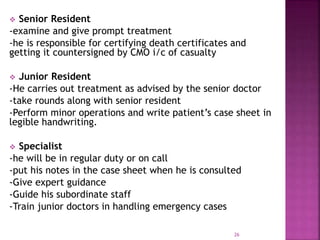
 Senior Resident
-examine and give prompt treatment
-he is responsible for certifying death certificates and
getting it countersigned by CMO i/c of casualty
 Junior Resident
-He carries out treatment as advised by the senior doctor
-take rounds along with senior resident
-Perform minor operations and write patient’s case sheet in
legible handwriting.
 Specialist
-he will be in regular duty or on call
-put his notes in the case sheet when he is consulted
-Give expert guidance
-Guide his subordinate staff
-Train junior doctors in handling emergency cases
26
 D.N.S/ A.N.S/ Sister-in-charge
-She is responsible for the efficient working of the
Emergency Department
-Prepare duty rooster
-Store essential drugs, i.v. fluids, ensure all the
equipment's are in working order.
-ensures that all equipment's are in working order. E.g,
suction apparatus, Central oxygen supply, Boyles
apparatus.
-Nursing Personnel will seek guidance of Nursing
Superintendent and appraise her day to day problems.
 Nursing staff.
-carry out Doctor’s orders
-maintain the vitals
-pack dead bodies
27
 Nursing Attendants/ward boy/Aya’s
-assist nursing staff in patient care
- Getting the indent from stores and also
sterilised items from C.S.S.D
-transferring patient to other ward/units
-assist Nursing Personnel in packing dead body
-carry out any work assigned by superiors
 House Keeping.
-keep the area neat and clean
-perform all the duties as required by the
supervisor.
-change soiled linen
-transport dead bodies to the mortuary
28
 Stretcher Bearer.
-He will be on duty near the entrance of the casualty.
-He will assist in transferring the patients from
Ambulance to Casualty.
-Trained in First Aid Treatment.
 Security Guards.
Duty as per rooster prepared by the Security
officer/CMO
-Regulating the flow of patients or their attendants
-Security of the area is answerable to CMO casualty
for any untoward incidence
-He will perform any other duty as required by his
supervisor/Security officer.
29
30
 An ambulance is a vehicle for transportation
of sick or injured people to, from or between
places of treatment for an illness or
injury, and in some instances will also
provide out of hospital medical care to the
patient. The word is often associated with
road going emergency ambulances which
form part of an emergency medical service,
administering emergency care to those with
acute medical problems.
31
 Physician
 Nurse
 Paramedic/senior paramedic
 Ambulance care assistants
 Ambulance driver
 call handler/emergency medical dispatcher
It should have a proper parking space,
-Separate entrance.
-Spacious Parking area.
-Adjacent to OPD
-Steps/Ramp.
32
33
34
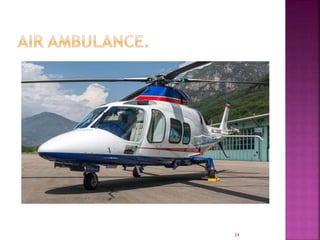
 Air Ambulance Aviation is the flying ICU by
helicopter and flights, around the world
with all multi-speciality, medical care with
the experts in 24/ 7*365 days any where
any time, for the purpose of saving the
lives of people around us.
35
 Air ambulance Advance ICU support
 Medical escort 24/7
 all the multi speciality
 Doctor and aero nurse will available in air ambulance
 ICU to ICU transfers (inter-hospital intensive care patients)
 Ventilator-dependent patients
 Cardiac emergencies
 Multi-trauma cases
 Spinal cord/head injury
 rehabilitation
 Transplant recipients
 Babies and children needing emergency
 Medical attention ,ACLS , ITLS Care
 Medical equipment's’ transport s high-density infusion pump,
cardiac monitor ,ventilator, defibrillator
36
has different type of the air ambulance to help the society in
all the ne of rescue mainly its is classifieds as per
-Air ambulance Helicopter
-Air ambulance Flights
-Air ambulance Seaplane
-Air ambulance Space
shuttle
37
38

Emergency Services

  • 1.
    Presented by: JisaAnna & Livika Chophi 1
  • 2.
     It isan integral part of an hospital  Microcosm of the hospital as whole  front door of the hospital  Portal of entry that interacts with the highest volume of patients requiring critical care. 2
  • 3.
     Emergency hasbeen defined as a condition determined clinically or considered by patient or his/her relatives as requiring urgent medical services, failing which , it could result in los of life or limb….WHO  Medical emergency is a situation when patient requires urgent and high quality medical care to prevent loss of life or limb and/ or to initiates action for the restoration of normal healthy life. 3
  • 4.
     Provision ofimmediate & correct life saving treatment at all times and for all situations  Collection of casualties  Rapid institution of BLS to critically ill at site, en route and in hospital  Information centre to render advice on telephone or in person on simple medical queries  Capacity and capability to provide effective management during disaster situations. 4
  • 5.
     Depending onsize of hospital, nature of injuries, population and catchments area. The service may be: Emergency Major emergency & disaster Mngt Referral emergency Basic emergency Stand by emergency 5
  • 6.
    RIGHT TREATMENT EMERGENCY RIGHT TIME RIGHTPLACE RIGHT RESOURCES SPEED SYMPATHY SCIENCE 6
  • 7.
     All essentialand functional equipments, ventilators, defibrillator, monitors ,OT Facilities, X- ray , USG ,CT ,path labs ,EKG machines.  Central gas pipelines, plenty of fluids.  Crash cart & Emergency medicines  IV lines and catheters  Vital essential medicines , nebulizers  Dressing materials plasters, dressing trolley  Minor operation theaters equipments  Fire fighting equipments 7
  • 8.
    LOCATION  Should belocated on the ground floor  Direct access from the main road  Separate approach , other than OPD with a spacious parking area  Location adjacent to OPD  Well lightened and boldly sig posted both for day and night  A helipad is required for major trauma centre, hilly or unapproachable areas 8
  • 9.
    CLOSE RELATIONSHIP WITH:  OT  ICU  Blood bank  Laboratory  OPD  Mortuary  Some authorities recommend a close relationship with CCU as well.  Radiology  Endoscopy 9
  • 10.
  • 11.
  • 12.
    STORAGE EXAMINATIO N AREA EMERGENC Y WARD TREATMENT AREA DRESSING ROOM MLC RECORD BURNWARD PLASTER ROOM NURSES DESK OT INVESTIGAT ION AREA CLINICAL DOCTOR DESK RESUSCITATION 12
  • 13.
  • 14.
    ECRO OFFICE CLERICAL STAFF NURSES IN CHARGE REGISTERS& RECORDS PRO HOD CASUALTY STORE ADMN . AREA 14
  • 15.
     Major areas– 20 * 20ft  Minor area – 10 * 10ft CORE DESIGN CENTRAL TREATMENT DESK CORRIDOR AROUND, SEPARATE EXIT & ENTRANCE ARENA TYPE IT IS A CORE PLAN WITHOUT PERIPHERAY CORRIDOR CORRIDOR SINGLE CORRIDOR DOUBLE LOADED DESIGN 15
  • 16.
     Its termused to announce an emergency of serious nature  Eg. cardiac arrest  Staff from outside the emergency department respond to the code blue  CPR TEAM:  Senior Intensivist  ICU Registers  CPR Nurse  Respiratory technician 16
  • 17.
  • 18.
    Emergency Department. Patients arrival Examinationby CMO/Nurse Patient Triage Placement in ED Physicians arrival, Diagnostic evaluation and Treatment Observation by Specialist & Disposition Decision Includes: -continued physical assessment -consultants orders -Tests Ordered -Test Results -Constant monitoring until bed/unit available -Handoff communication with Patient’s case sheet to the next Unit/Ward. Patient teaching and Discharge after Treatment. Medico Legal Cases to be documented. Registration 18
  • 19.
     Patients broughtto casualty dead are made MLC cases and sent to mortuary for Post- Mortem examination  Other non-MLC cases are sent to the mortuary or Handed over to the relatives of the deceased  Death in casualty to be counter-signed by Casualty Medical Officer in regular service. 19
  • 20.
    Disaster management committee- preferablyheaded by H.O.D , Anaesthetist , Surgery, Orthopaedic. 20
  • 21.
    It is theprocess by which patients are classified according to the type and urgency of their condition to get the right patient to the right place at the right time with the right care provider  Routine Triage (depending on the condition of the patients).  Mass Influx Triage.  Priority I (Immediate): life threatening injuries or conditions  Priority II (Delayed): Patients may remain stable for 10 to 20 mins.eg: Limb injuries  Priority III (Minimal): minimal injuries or minor conditions, and are ambulatory  Priority 0 (Expectant/Dead): Victims are dead or have lethal injuries and will die despite treatment. 21
  • 22.
  • 23.
     Patient’s record Casualty death register  Observation and follow-up record  Referral record  Treatment record  Minor OT records  Incident Report forms & Register  Attendance register of all categories of staff  Register of Duty doctors, Specialists. etc.  All documents e.g. Admission card , case sheet , drug charts, death certificate forms  M.L.C record with all the diagnostic and investigation results and kept under lock and key under C.M.O Casualty.  Medico Legal cases like accident, trauma, assault. Rape, poisoning , unconscious, brought dead, should be stamped as MLC  Police intimation book  In all poisoning cases vomitus and first urine sample to be preserved as well as the clothes 23
  • 24.
    -All medico legalcases are to be entered in the Medico legal case register indicating patient’s name, age, sex, complete address, telephone number, identification mark, date, time, MLC number, examinations, investigations, signature of the doctor with stamp and designation. -Police is to be informed and the name and details of the person who brought the MLC to the casualty also be recorded. -MLC record should be preferably be completed within 48 hours unless there is unavoidable delay. 24
  • 25.
    Duties of staffin Emergency Department Chief Medical Officer In-charge - checks the punctuality of the other Medical officers and Resident Doctors - prepares the duty rooster for the doctors - Supervisory rounds of equipment's and drugs - Checks registers, documents, Medico legal register and registration register - Supervise the maintenance of sanitation and Bio medical waste management - Responsible for training re-organisation classes of all categories. - Drill for emergency management/ disaster action plan 25
  • 26.
     Senior Resident -examineand give prompt treatment -he is responsible for certifying death certificates and getting it countersigned by CMO i/c of casualty  Junior Resident -He carries out treatment as advised by the senior doctor -take rounds along with senior resident -Perform minor operations and write patient’s case sheet in legible handwriting.  Specialist -he will be in regular duty or on call -put his notes in the case sheet when he is consulted -Give expert guidance -Guide his subordinate staff -Train junior doctors in handling emergency cases 26
  • 27.
     D.N.S/ A.N.S/Sister-in-charge -She is responsible for the efficient working of the Emergency Department -Prepare duty rooster -Store essential drugs, i.v. fluids, ensure all the equipment's are in working order. -ensures that all equipment's are in working order. E.g, suction apparatus, Central oxygen supply, Boyles apparatus. -Nursing Personnel will seek guidance of Nursing Superintendent and appraise her day to day problems.  Nursing staff. -carry out Doctor’s orders -maintain the vitals -pack dead bodies 27
  • 28.
     Nursing Attendants/wardboy/Aya’s -assist nursing staff in patient care - Getting the indent from stores and also sterilised items from C.S.S.D -transferring patient to other ward/units -assist Nursing Personnel in packing dead body -carry out any work assigned by superiors  House Keeping. -keep the area neat and clean -perform all the duties as required by the supervisor. -change soiled linen -transport dead bodies to the mortuary 28
  • 29.
     Stretcher Bearer. -Hewill be on duty near the entrance of the casualty. -He will assist in transferring the patients from Ambulance to Casualty. -Trained in First Aid Treatment.  Security Guards. Duty as per rooster prepared by the Security officer/CMO -Regulating the flow of patients or their attendants -Security of the area is answerable to CMO casualty for any untoward incidence -He will perform any other duty as required by his supervisor/Security officer. 29
  • 30.
  • 31.
     An ambulanceis a vehicle for transportation of sick or injured people to, from or between places of treatment for an illness or injury, and in some instances will also provide out of hospital medical care to the patient. The word is often associated with road going emergency ambulances which form part of an emergency medical service, administering emergency care to those with acute medical problems. 31
  • 32.
     Physician  Nurse Paramedic/senior paramedic  Ambulance care assistants  Ambulance driver  call handler/emergency medical dispatcher It should have a proper parking space, -Separate entrance. -Spacious Parking area. -Adjacent to OPD -Steps/Ramp. 32
  • 33.
  • 34.
  • 35.
     Air AmbulanceAviation is the flying ICU by helicopter and flights, around the world with all multi-speciality, medical care with the experts in 24/ 7*365 days any where any time, for the purpose of saving the lives of people around us. 35
  • 36.
     Air ambulanceAdvance ICU support  Medical escort 24/7  all the multi speciality  Doctor and aero nurse will available in air ambulance  ICU to ICU transfers (inter-hospital intensive care patients)  Ventilator-dependent patients  Cardiac emergencies  Multi-trauma cases  Spinal cord/head injury  rehabilitation  Transplant recipients  Babies and children needing emergency  Medical attention ,ACLS , ITLS Care  Medical equipment's’ transport s high-density infusion pump, cardiac monitor ,ventilator, defibrillator 36
  • 37.
    has different typeof the air ambulance to help the society in all the ne of rescue mainly its is classifieds as per -Air ambulance Helicopter -Air ambulance Flights -Air ambulance Seaplane -Air ambulance Space shuttle 37
  • 38.