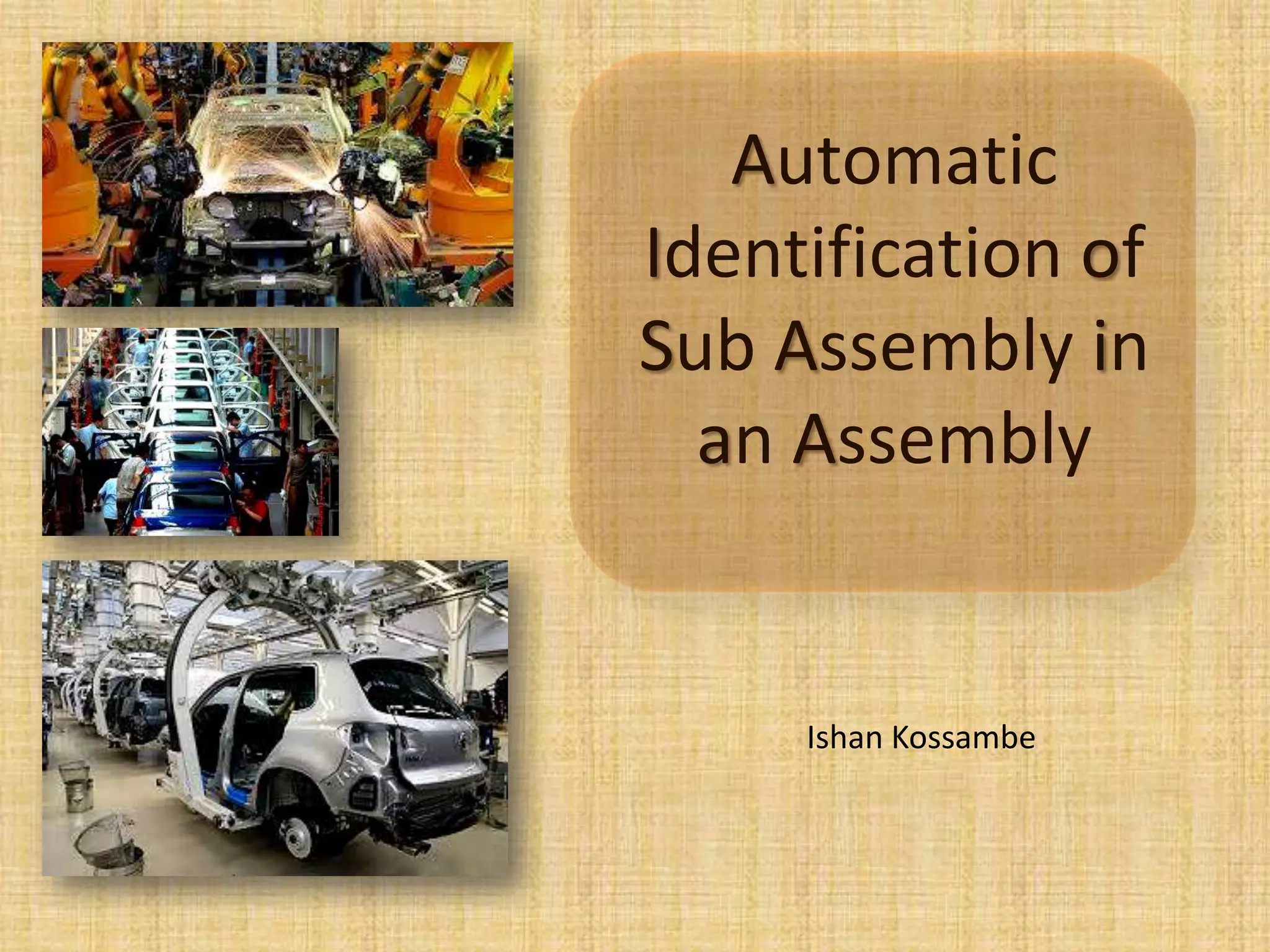
Automatic
Identification of
Sub Assembly in
an Assembly
Ishan Kossambe
Content
• Introduction
• Literature review
• Methodology
• Implementation
• Conclusion
Introduction
• Assembly
• Need
• Objectives
Assembly
• Hierarchical process
• Information and complex relationships
• Consists of combination of sub assembly
• Better final assembly
Need
• Complex assembly = Number of subassembly
• Assembly planning
• Assembly cost
• Frequent changes in design
• Automatic Assembly planning
Objective
• Extracting information from computer database
• Building of liaisons
• Use of API of CAD Software
• Develop an algorithm
Literature Review
• Several papers have been published
• Most of the sub assembly detection techniques makes use of
mathematical models
• Automation of subassembly detection
• Reducing human interference
Zussman
• Object graph
• Kinematic Relationship
Dini and
Satochi
• Rules for generation of sequencing
Ong and
Wang
• Made use of connectivity and relationship
Zhang
• Mathematical models and computer program
Methodology
1. Generation of database
2. Development of Algorithm
3. Implementation
Generation of Database
• Mating relations in the assembly are required to decide about the sub-
assemblies
• Code is written which extracts the mating relations
• It is stored in the database
Algorithm
start
EXTRACT INFORMATION
STORE IN DATABASE
.
MATE
MATERI
AL TYPE
PART
EXTRACT THE MATE INFORMATION AND
NUMBER OF PARTS
A
A
DOES PART
i HAS A
MATE
WITH PART
j
SAVE THE PART
CONSIDER A
PART AND
COMPARE WITH
OTHER PARTS
DOES PART j
HAS A MATE
WITH THE i
UNSAVED
PART
COUNT
DON’T COUNT
B
B
COUNT=1
PART i AND SAVED j
PARTS IS NOT A SUB
ASSEMBLY
SUB ASSEMBLY
END
DON’T SAVE
REPEATTILLi≤NUMBEROFPARTS
REPEATTILLj≤NUMBEROFPARTSSAVED
NO
YES
YES
NO
YES
NO
Implementation
• Crane Hook Assembly
• Extraction of mating relations using AME Algorithm
• Execution of Sub-assembly detection algorithm
Crane Hook Assembly
Extraction Of Mating Relations
Conclusion
• Reduction in number of parts to be handled during assembly.
• Assembly cost and time.
• Automation.
• Feasible sub-assembly detection.
Future Scope
• Validating assemblies.
• Feasible sub-assembly detection.
References
• J. L. Nevins and D. E. Whitney, “Concurrent design of product and processes,” McGraw-Hill, New York, 1989.
• U. Rembold, C. Blume, and R. Dillmann, “Computer- integrated manufacturing technology and systems,” Mar-cel
Dekker, New York, 1985.
• S. S. F. Smith, “Using multiple genetic operators to re-duce premature convergence in genetic assembly plan-
ning,” Computers in Industry, Vol. 54, Iss. 1, pp. 35–49, May 2004.
• E. Zussman, E. Lenz and M. Shpitalni, “An approach to the automatic assembly planning problem”, Annals
CIRP, 39(1), pp. 33–36, 1990.
• Dini, G.; Santochi, M., “Automated sequencing and sub-assembly detection in assembly planning”, Annals of the
CIRP, Vol.41, 1992.
• Ong, N.S.; Wong, Y.C., “Automatic Sub-assembly detection from a product Model for disassembly sequence
generation”, International journal of Advanced Manufacturing technology, Vol.15, 1999, pp. 425-431.
• Y.Z. Zhang, J. Ni, Z.Q. Lin, X.M. Lai, “Automated sequencing and sub-assembly detection in automobile body
assembly planning”, Journal of Materials Processing Technology, 129 (2002) 490–494.
• Arun Tom Mathew; C. S. P. Rao, “A Novel Method of Using API to Generate Liaison Relationships from an
Assembly”, Journal of Software Engineering & Applications, 2010, 3: 167-175
Thank You

Sub assemblies

  • 1.
    Automatic Identification of Sub Assemblyin an Assembly Ishan Kossambe
  • 2.
    Content • Introduction • Literaturereview • Methodology • Implementation • Conclusion
  • 3.
  • 4.
    Assembly • Hierarchical process •Information and complex relationships • Consists of combination of sub assembly • Better final assembly
  • 5.
    Need • Complex assembly= Number of subassembly • Assembly planning • Assembly cost • Frequent changes in design • Automatic Assembly planning
  • 8.
    Objective • Extracting informationfrom computer database • Building of liaisons • Use of API of CAD Software • Develop an algorithm
  • 9.
    Literature Review • Severalpapers have been published • Most of the sub assembly detection techniques makes use of mathematical models • Automation of subassembly detection • Reducing human interference
  • 10.
    Zussman • Object graph •Kinematic Relationship Dini and Satochi • Rules for generation of sequencing Ong and Wang • Made use of connectivity and relationship Zhang • Mathematical models and computer program
  • 11.
    Methodology 1. Generation ofdatabase 2. Development of Algorithm 3. Implementation
  • 12.
    Generation of Database •Mating relations in the assembly are required to decide about the sub- assemblies • Code is written which extracts the mating relations • It is stored in the database
  • 14.
    Algorithm start EXTRACT INFORMATION STORE INDATABASE . MATE MATERI AL TYPE PART EXTRACT THE MATE INFORMATION AND NUMBER OF PARTS A
  • 15.
    A DOES PART i HASA MATE WITH PART j SAVE THE PART CONSIDER A PART AND COMPARE WITH OTHER PARTS DOES PART j HAS A MATE WITH THE i UNSAVED PART COUNT DON’T COUNT B B COUNT=1 PART i AND SAVED j PARTS IS NOT A SUB ASSEMBLY SUB ASSEMBLY END DON’T SAVE REPEATTILLi≤NUMBEROFPARTS REPEATTILLj≤NUMBEROFPARTSSAVED NO YES YES NO YES NO
  • 16.
    Implementation • Crane HookAssembly • Extraction of mating relations using AME Algorithm • Execution of Sub-assembly detection algorithm
  • 17.
  • 18.
  • 19.
    Conclusion • Reduction innumber of parts to be handled during assembly. • Assembly cost and time. • Automation. • Feasible sub-assembly detection.
  • 20.
    Future Scope • Validatingassemblies. • Feasible sub-assembly detection.
  • 21.
    References • J. L.Nevins and D. E. Whitney, “Concurrent design of product and processes,” McGraw-Hill, New York, 1989. • U. Rembold, C. Blume, and R. Dillmann, “Computer- integrated manufacturing technology and systems,” Mar-cel Dekker, New York, 1985. • S. S. F. Smith, “Using multiple genetic operators to re-duce premature convergence in genetic assembly plan- ning,” Computers in Industry, Vol. 54, Iss. 1, pp. 35–49, May 2004. • E. Zussman, E. Lenz and M. Shpitalni, “An approach to the automatic assembly planning problem”, Annals CIRP, 39(1), pp. 33–36, 1990. • Dini, G.; Santochi, M., “Automated sequencing and sub-assembly detection in assembly planning”, Annals of the CIRP, Vol.41, 1992. • Ong, N.S.; Wong, Y.C., “Automatic Sub-assembly detection from a product Model for disassembly sequence generation”, International journal of Advanced Manufacturing technology, Vol.15, 1999, pp. 425-431. • Y.Z. Zhang, J. Ni, Z.Q. Lin, X.M. Lai, “Automated sequencing and sub-assembly detection in automobile body assembly planning”, Journal of Materials Processing Technology, 129 (2002) 490–494. • Arun Tom Mathew; C. S. P. Rao, “A Novel Method of Using API to Generate Liaison Relationships from an Assembly”, Journal of Software Engineering & Applications, 2010, 3: 167-175
  • 22.

Editor's Notes

  • #5 Carries large amount of information and complex relationships
  • #6 But assembly planning still poses a challenge like the description of assembly data and information specifically. There is much interest in reducing the cost of assembly activities.Assembly costs account for 10–30% of total industrial product labor costs [1], and as much as 50% of product manufacturing cost [2, 3]
  • #9 Relational models represent geometric relations in the form of mating features between individual parts or subassemblies called liaisons.
  • #10 E. Zussman, E. Lenz and M. Shpitalni, “An approach to the automatic assembly planning problem”, Annals CIRP, 39(1), pp. 33–36, 1990An object graph is generated which links the objects with a kinematics relationship between the objects. Subassemblies are formed from the object graph by grouping components into pairs, which have a kinematics relationship