IntuitLabs.com | @Intuit 1 © Intuit 
When to use it 
You have a number of ideas and need to evaluate and narrow 
your focus. 
How to use it 
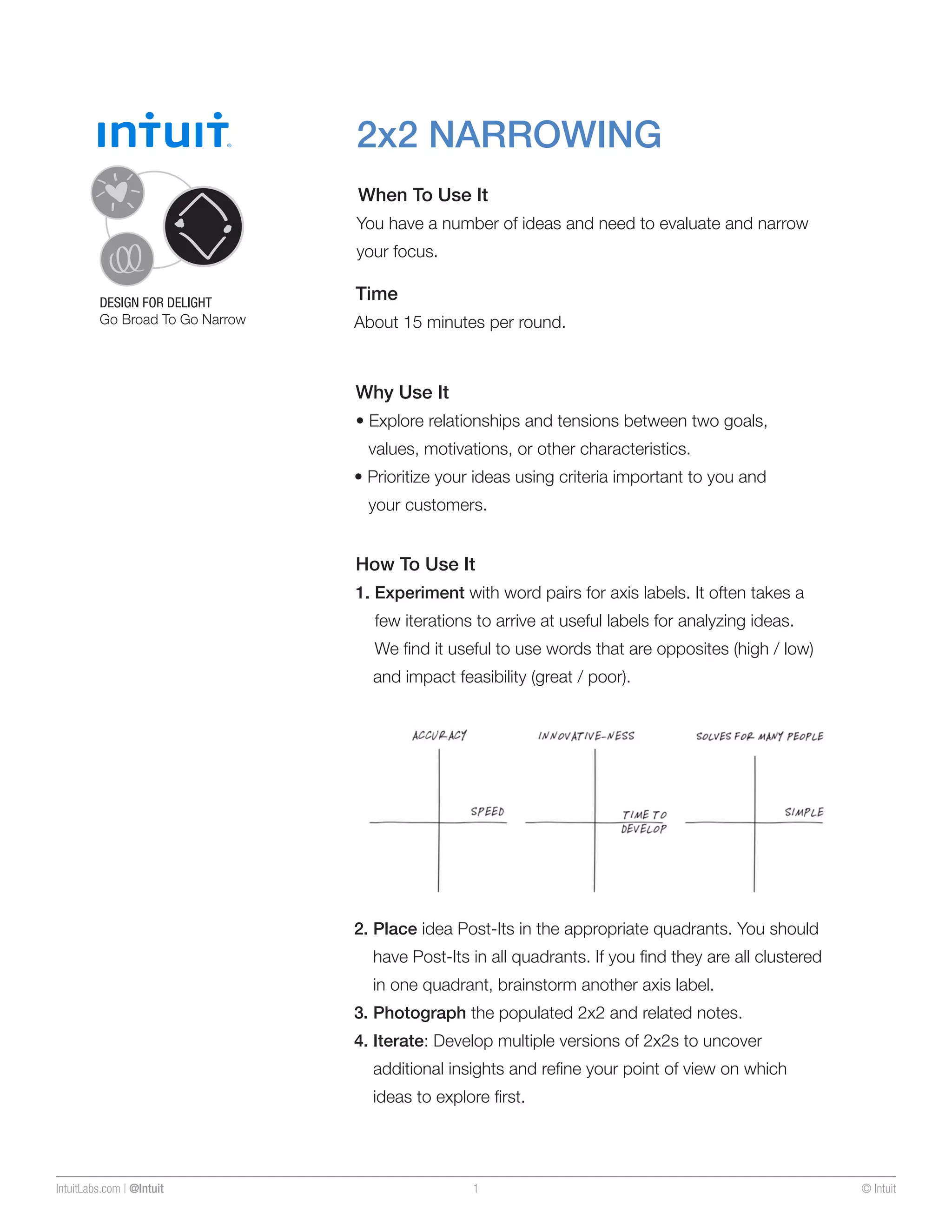
1. Experiment with word pairs for axis labels. It often takes a 
few iterations to arrive at useful labels for analyzing ideas. 
We find it useful to use words that are opposites (high / low) 
and impact feasibility (great / poor). 
2. Place idea Post-Its in the appropriate quadrants. You should 
have Post-Its in all quadrants. If you find they are all clustered 
in one quadrant, brainstorm another axis label. 
3. Photograph the populated 2x2 and related notes. 
4. Iterate: Develop multiple versions of 2x2s to uncover 
additional insights and refine your point of view on which 
ideas to explore first. 
2x2 NARROWING 
Why use it 
• Explore relationships and tensions between two goals, 
values, motivations, or other characteristics. 
• Prioritize your ideas using criteria important to you and 
your customers. 
Time 
About 15 minutes per round. 
DESIGN FOR DELIGHT 
Go broad to go narrow
© Intuit INT2UIT IntuitLabs.com | @In2tuit 
Tips 
• Make sure the best outcome is located in the upper-right 
quadrant of the 2x2. 
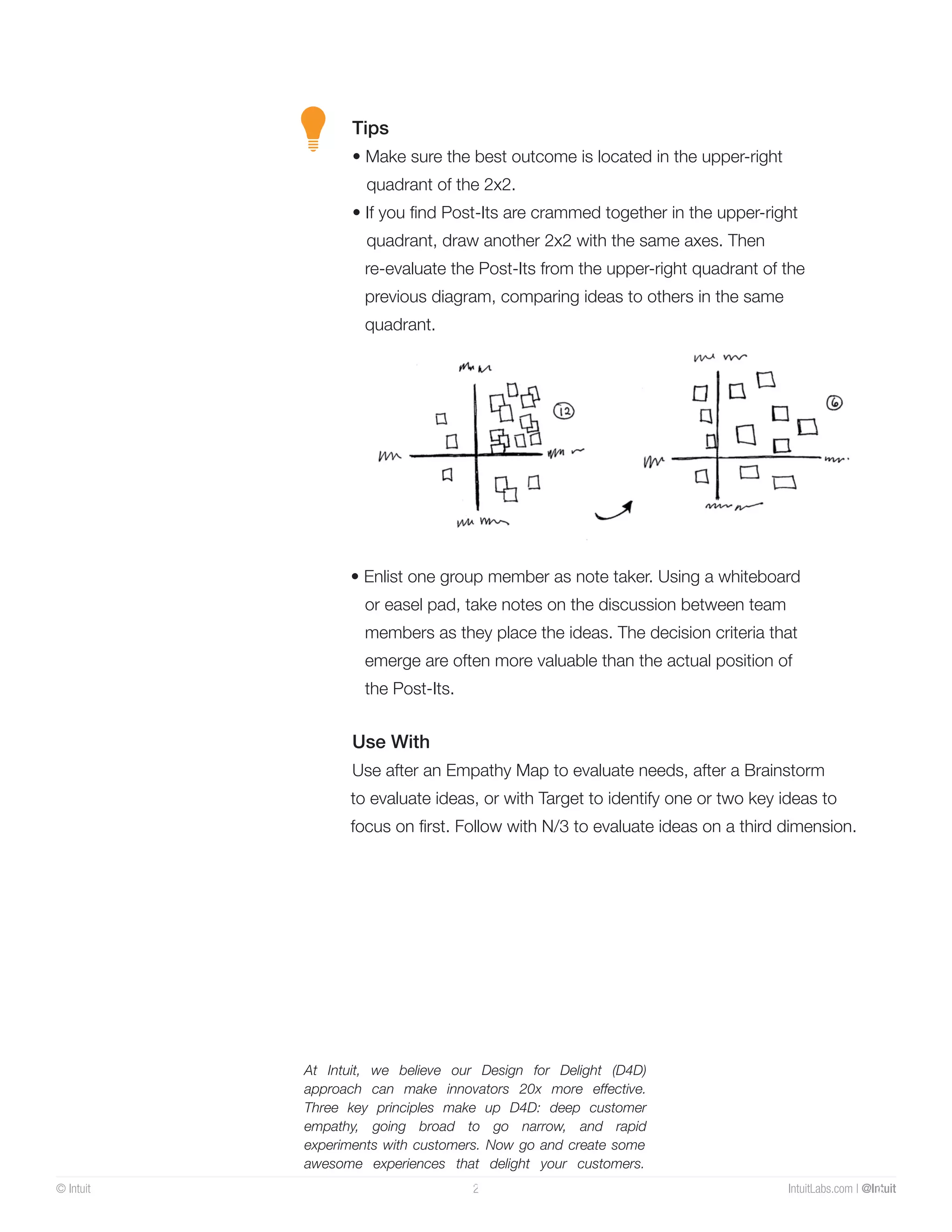
• If you find Post-Its are crammed together in the upper-right 
quadrant, draw another 2x2 with the same axes. Then 
re-evaluate the Post-Its from the upper-right quadrant of the 
previous diagram, comparing ideas to others in the same 
quadrant. 
• Enlist one group member as note taker. Using a whiteboard 
or easel pad, take notes on the discussion between team 
members as they place the ideas. The decision criteria that 
emerge are often more valuable than the actual position of 
the Post-Its. 
Use with 
Use after an Empathy Map to evaluate needs, after a Brainstorm 
to evaluate ideas, or with Target to identify one or two key ideas to 
focus on first. Follow with N/3 to evaluate ideas on a third dimension. 
At Intuit, we believe our Design for Delight (D4D) 
approach can make innovators 20x more effective. 
Three key principles make up D4D: deep customer 
empathy, going broad to go narrow, and rapid 
experiments with customers. Now go and create some 
awesome experiences that delight your customers.

D4D Tools: 2x2 Narrowing

  • 1.
    IntuitLabs.com | @Intuit1 © Intuit When to use it You have a number of ideas and need to evaluate and narrow your focus. How to use it 1. Experiment with word pairs for axis labels. It often takes a few iterations to arrive at useful labels for analyzing ideas. We find it useful to use words that are opposites (high / low) and impact feasibility (great / poor). 2. Place idea Post-Its in the appropriate quadrants. You should have Post-Its in all quadrants. If you find they are all clustered in one quadrant, brainstorm another axis label. 3. Photograph the populated 2x2 and related notes. 4. Iterate: Develop multiple versions of 2x2s to uncover additional insights and refine your point of view on which ideas to explore first. 2x2 NARROWING Why use it • Explore relationships and tensions between two goals, values, motivations, or other characteristics. • Prioritize your ideas using criteria important to you and your customers. Time About 15 minutes per round. DESIGN FOR DELIGHT Go broad to go narrow
  • 2.
    © Intuit INT2UITIntuitLabs.com | @In2tuit Tips • Make sure the best outcome is located in the upper-right quadrant of the 2x2. • If you find Post-Its are crammed together in the upper-right quadrant, draw another 2x2 with the same axes. Then re-evaluate the Post-Its from the upper-right quadrant of the previous diagram, comparing ideas to others in the same quadrant. • Enlist one group member as note taker. Using a whiteboard or easel pad, take notes on the discussion between team members as they place the ideas. The decision criteria that emerge are often more valuable than the actual position of the Post-Its. Use with Use after an Empathy Map to evaluate needs, after a Brainstorm to evaluate ideas, or with Target to identify one or two key ideas to focus on first. Follow with N/3 to evaluate ideas on a third dimension. At Intuit, we believe our Design for Delight (D4D) approach can make innovators 20x more effective. Three key principles make up D4D: deep customer empathy, going broad to go narrow, and rapid experiments with customers. Now go and create some awesome experiences that delight your customers.