1© 2015 Atlas Solutions, LLC // Case Study: Atlas & NetBooster
THE RESULTS:
Demographics
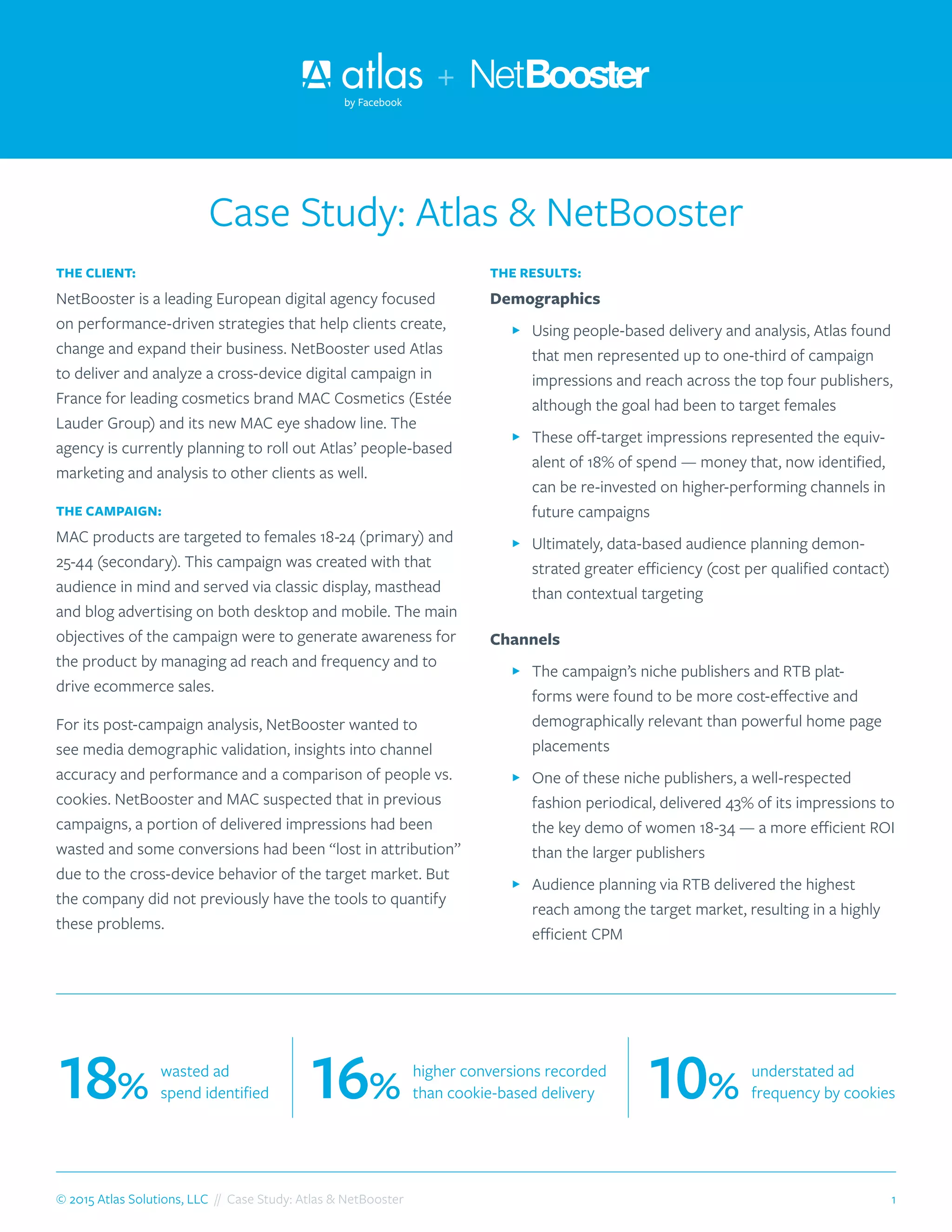
ɖɖ Using people-based delivery and analysis, Atlas found
that men represented up to one-third of campaign
impressions and reach across the top four publishers,
although the goal had been to target females
ɖɖ These off-target impressions represented the equiv-
alent of 18% of spend — money that, now identified,
can be re-invested on higher-performing channels in
future campaigns
ɖɖ Ultimately, data-based audience planning demon-
strated greater efficiency (cost per qualified contact)
than contextual targeting
Channels
ɖɖ The campaign’s niche publishers and RTB plat-
forms were found to be more cost-effective and
demographically relevant than powerful home page
placements
ɖɖ One of these niche publishers, a well-respected
fashion periodical, delivered 43% of its impressions to
the key demo of women 18-34 — a more efficient ROI
than the larger publishers
ɖɖ Audience planning via RTB delivered the highest
reach among the target market, resulting in a highly
efficient CPM
THE CLIENT:
NetBooster is a leading European digital agency focused
on performance-driven strategies that help clients create,
change and expand their business. NetBooster used Atlas
to deliver and analyze a cross-device digital campaign in
France for leading cosmetics brand MAC Cosmetics (Estée
Lauder Group) and its new MAC eye shadow line. The
agency is currently planning to roll out Atlas’ people-based
marketing and analysis to other clients as well.
THE CAMPAIGN:
MAC products are targeted to females 18-24 (primary) and
25-44 (secondary). This campaign was created with that
audience in mind and served via classic display, masthead
and blog advertising on both desktop and mobile. The main
objectives of the campaign were to generate awareness for
the product by managing ad reach and frequency and to
drive ecommerce sales.
For its post-campaign analysis, NetBooster wanted to
see media demographic validation, insights into channel
accuracy and performance and a comparison of people vs.
cookies. NetBooster and MAC suspected that in previous
campaigns, a portion of delivered impressions had been
wasted and some conversions had been “lost in attribution”
due to the cross-device behavior of the target market. But
the company did not previously have the tools to quantify
these problems.
Case Study: Atlas & NetBooster
+
wasted ad
spend identified18%
understated ad
frequency by cookies10%
higher conversions recorded
than cookie-based delivery16%
2© 2015 Atlas Solutions, LLC // Case Study: Atlas & NetBooster
“Every decision that was made in the past
two years based on cookie data was wrong
— it was better than nothing, but it was still
wrong. With Atlas, we now have people-
based insights and better visibility into the
customer journey, so we can deliver more
efficient campaigns and better value for
our clients.”
- Yann Gabay, France & Southern Europe Director, NetBooster
People vs. Cookies
ɖɖ People-based delivery recorded 16% higher conver-
sions than cookie-based delivery — demonstrating
the value of understanding mobile data and measur-
ing cross-device conversions in future campaigns
ɖɖ True, people-based, cost per sale was revealed to
be 16% lower than the CPS measured with cookies,
allowing for better budget allocation in future
campaigns
ɖɖ Cookies overstated the campaign’s reach by 9%,
so the client paid for more impressions than they
received. Atlas’ people-based delivery gave MAC and
NetBooster full reach visibility for the first time
ɖɖ Cookies understated ad frequency by 10%

Atlas successstory netbooster

  • 1.
    1© 2015 AtlasSolutions, LLC // Case Study: Atlas & NetBooster THE RESULTS: Demographics ɖɖ Using people-based delivery and analysis, Atlas found that men represented up to one-third of campaign impressions and reach across the top four publishers, although the goal had been to target females ɖɖ These off-target impressions represented the equiv- alent of 18% of spend — money that, now identified, can be re-invested on higher-performing channels in future campaigns ɖɖ Ultimately, data-based audience planning demon- strated greater efficiency (cost per qualified contact) than contextual targeting Channels ɖɖ The campaign’s niche publishers and RTB plat- forms were found to be more cost-effective and demographically relevant than powerful home page placements ɖɖ One of these niche publishers, a well-respected fashion periodical, delivered 43% of its impressions to the key demo of women 18-34 — a more efficient ROI than the larger publishers ɖɖ Audience planning via RTB delivered the highest reach among the target market, resulting in a highly efficient CPM THE CLIENT: NetBooster is a leading European digital agency focused on performance-driven strategies that help clients create, change and expand their business. NetBooster used Atlas to deliver and analyze a cross-device digital campaign in France for leading cosmetics brand MAC Cosmetics (Estée Lauder Group) and its new MAC eye shadow line. The agency is currently planning to roll out Atlas’ people-based marketing and analysis to other clients as well. THE CAMPAIGN: MAC products are targeted to females 18-24 (primary) and 25-44 (secondary). This campaign was created with that audience in mind and served via classic display, masthead and blog advertising on both desktop and mobile. The main objectives of the campaign were to generate awareness for the product by managing ad reach and frequency and to drive ecommerce sales. For its post-campaign analysis, NetBooster wanted to see media demographic validation, insights into channel accuracy and performance and a comparison of people vs. cookies. NetBooster and MAC suspected that in previous campaigns, a portion of delivered impressions had been wasted and some conversions had been “lost in attribution” due to the cross-device behavior of the target market. But the company did not previously have the tools to quantify these problems. Case Study: Atlas & NetBooster + wasted ad spend identified18% understated ad frequency by cookies10% higher conversions recorded than cookie-based delivery16%
  • 2.
    2© 2015 AtlasSolutions, LLC // Case Study: Atlas & NetBooster “Every decision that was made in the past two years based on cookie data was wrong — it was better than nothing, but it was still wrong. With Atlas, we now have people- based insights and better visibility into the customer journey, so we can deliver more efficient campaigns and better value for our clients.” - Yann Gabay, France & Southern Europe Director, NetBooster People vs. Cookies ɖɖ People-based delivery recorded 16% higher conver- sions than cookie-based delivery — demonstrating the value of understanding mobile data and measur- ing cross-device conversions in future campaigns ɖɖ True, people-based, cost per sale was revealed to be 16% lower than the CPS measured with cookies, allowing for better budget allocation in future campaigns ɖɖ Cookies overstated the campaign’s reach by 9%, so the client paid for more impressions than they received. Atlas’ people-based delivery gave MAC and NetBooster full reach visibility for the first time ɖɖ Cookies understated ad frequency by 10%