Addressable Audiences:
Data Considerations for
People-Based Marketing
Presentationby:
NicoleTabatabai
January10,2019
Agenda
• Definition & Importance
• Data Landscape
• Sources
• Mechanisms
• Methods
• Attribution
• Scorecard
Addressable Audiences:
People-Based Marketing
Source: Experian, Experian Powers the Global Shift Toward Addressable Marketing
Addressability is the process of customizing
marketing messages to match the personal lifecycle
needs of specific consumers at a specific point in
their purchase cycle, thereby optimizing relevance.
You can draw on various data sources to build a
profile of each individual prospect you want to
target.
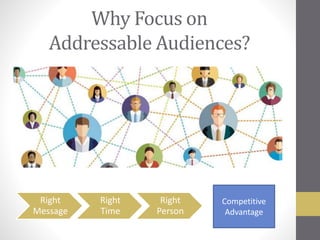
Why Focus on
Addressable Audiences?
Right
Message
Right
Time
Right
Person
Competitive
Advantage
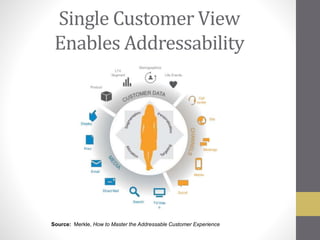
Single Customer View
Enables Addressability
Source: Merkle, How to Master the Addressable Customer Experience
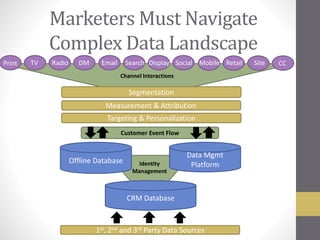
Marketers Must Navigate
Complex Data Landscape
1st, 2nd and 3rd Party Data Sources
Identity
Management
Offline Database
Data Mgmt
Platform
CRM Database
Channel Interactions
Print CCTV Radio DM Email Search Display Social Mobile Retail Site
Targeting & Personalization
Measurement & Attribution
Segmentation
Customer Event Flow
Considerations Across
Data Landscape
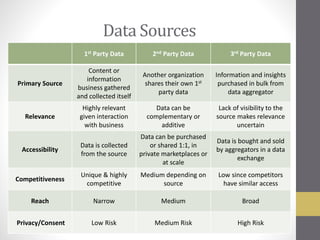
Data Sources
1st Party Data 2nd Party Data 3rd Party Data
Primary Source
Content or
information
business gathered
and collected itself
Another organization
shares their own 1st
party data
Information and insights
purchased in bulk from
data aggregator
Relevance
Highly relevant
given interaction
with business
Data can be
complementary or
additive
Lack of visibility to the
source makes relevance
uncertain
Accessibility
Data is collected
from the source
Data can be purchased
or shared 1:1, in
private marketplaces or
at scale
Data is bought and sold
by aggregators in a data
exchange
Competitiveness
Unique & highly
competitive
Medium depending on
source
Low since competitors
have similar access
Reach Narrow Medium Broad
Privacy/Consent Low Risk Medium Risk High Risk
Market Rapidly Changing
Since GDPR Launched
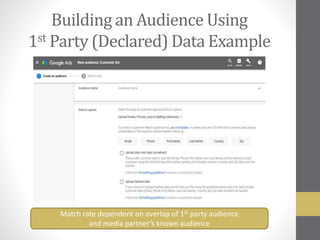
Building an Audience Using
1st Party (Declared) Data Example
Match rate dependent on overlap of 1st party audience
and media partner’s known audience
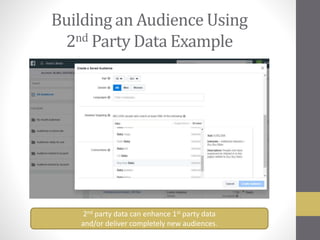
Building an Audience Using
2nd Party Data Example
2nd party data can enhance 1st party data
and/or deliver completely new audiences.
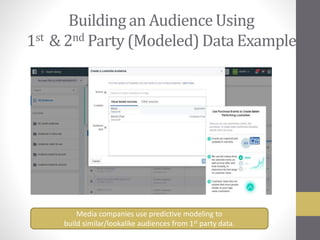
Building an Audience Using
1st & 2nd Party (Modeled) Data Example
Media companies use predictive modeling to
build similar/lookalike audiences from 1st party data.
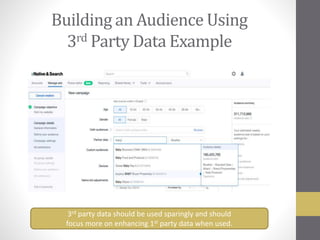
Building an Audience Using
3rd Party Data Example
3rd party data should be used sparingly and should
focus more on enhancing 1st party data when used.
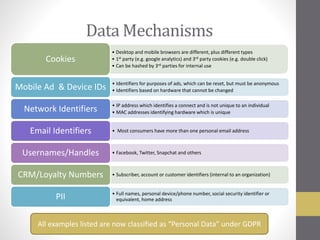
Data Mechanisms
• Desktop and mobile browsers are different, plus different types
• 1st party (e.g. google analytics) and 3rd party cookies (e.g. double click)
• Can be hashed by 3rd parties for internal use
Cookies
• Identifiers for purposes of ads, which can be reset, but must be anonymous
• Identifiers based on hardware that cannot be changedMobile Ad & Device IDs
• IP address which identifies a connect and is not unique to an individual
• MAC addresses identifying hardware which is uniqueNetwork Identifiers
• Most consumers have more than one personal email addressEmail Identifiers
• Facebook, Twitter, Snapchat and othersUsernames/Handles
• Subscriber, account or customer identifiers (internal to an organization)CRM/Loyalty Numbers
• Full names, personal device/phone number, social security identifier or
equivalent, home addressPII
All examples listed are now classified as “Personal Data” under GDPR
Cookies Are Pervasive
But Not Perfect
• Users do not represent actual people; they are only a count of
unique ID’s
• Users are not shared by different browsers, devices, or locations
• Users are easily deleted and often deleted by the people they
supposedly represent
• Users are only unique to a specific time period and after that time
are reset (typically 30 days)
• Users can use private/incognito mode on their browser or install ad
blockers
• Cookies are browser based and therefore not useful in the mobile
ecosystem with predominant app usage
• Safari browser bans all third-party cookies from web sites
• Third party advertising providers like Criteo and AdRoll are losing
coverage of their pixels across the web due to GDPR
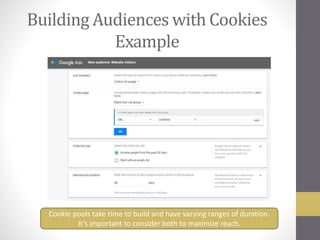
Building Audiences with Cookies
Example
Cookie pools take time to build and have varying ranges of duration.
It’s important to consider both to maximize reach.
Growth in Mobile Shifting
Importance to Device Tracking
Mobile Ad ID: Strings of hexadecimal digits assigned to a mobile device
• Identifier for Advertising (IDFA): iOS device key
• Google Advertising ID (AAID): Android device key
• Windows Advertising ID (WAID): Windows device key
• Set by the OS and are common and persist across all app publishers; there is
no need to sync data from one app to another
Challenges:
• While IDs are persistent across individual mobile devices, they can be reset
by the user
• If a user deletes their ID, the data must be deleted
• Companies are prohibited from making permanent connections between
users and their IDs
• Apple users can block ad tracking entirely which resets the mobile ID to zeros
• Each OS has tremendous control over the ad experience
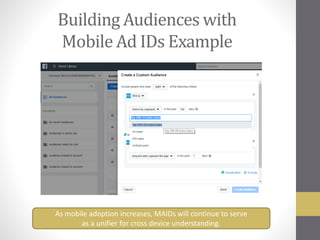
Building Audiences with
Mobile Ad IDs Example
As mobile adoption increases, MAIDs will continue to serve
as a unifier for cross device understanding.
Email Remains Main Universal ID
But Poses Challenges
Acquiring email intelligently
• Opt-in process for obtaining permission impacts quality of user (e.g.
single vs. double opt-in)
• Form complexity (e.g. validation check) & sophistication (amount of
data requested) impacts user quality and experience
• Renting or buying lists violates the rules of consent under GDPR and
harm sender reputation from ESP and ISP
• Appending emails to known customers records can be used if the
recipient previously did business with the sender (i.e. purchased
something)
Managing the email database
• Opt-out process can impact unsubscribe rate
• Hard bounces, multiple soft bounces, and inactive users who receive
emails impact deliverability
• Emails can be used outside of ESPs which impacts decision to delete
records
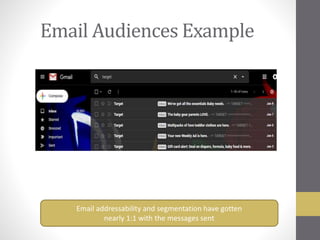
Email Audiences Example
Email addressability and segmentation have gotten
nearly 1:1 with the messages sent
Identity Management Requires
Data Matching
Data matching attempts to bring together two or more records that
belong to the same person and link them
Challenges:
• Errors, variations, and missing data on the information used to match
records
• Differences in data captured and maintained in databases (e.g different
date of birth compared to age)
• Outdated data and timing on updates to databases
• Other data validity problems include misspellings, extra or missing
letters, transposed numbers, etc.
• 100% match rate is unrealistic
Methods:
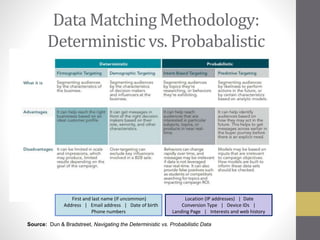
• Deterministic (exact): two or more records match exactly
• Probabilistic (fuzzy): calculates probability that two records refer to
same entity
Data Matching Methodology:
Deterministic vs. Probabalistic
Source: Dun & Bradstreet, Navigating the Deterministic vs. Probabilistic Data
First and last name (if uncommon)
Address | Email address | Date of birth
Phone numbers
Location (IP addresses) | Date
Conversion Type | Device IDs |
Landing Page | Interests and web history
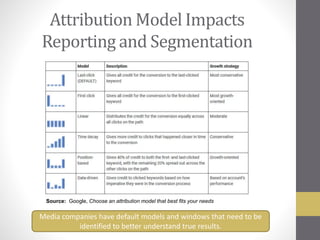
Attribution Model Impacts
Reporting and Segmentation
Source: Google, Choose an attribution model that best fits your needs
Media companies have default models and windows that need to be
identified to better understand true results.
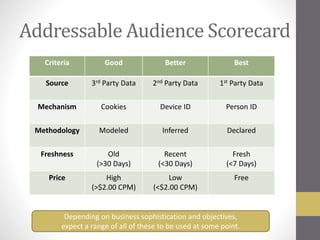
Addressable Audience Scorecard
Criteria Good Better Best
Source 3rd Party Data 2nd Party Data 1st Party Data
Mechanism Cookies Device ID Person ID
Methodology Modeled Inferred Declared
Freshness Old
(>30 Days)
Recent
(<30 Days)
Fresh
(<7 Days)
Price High
(>$2.00 CPM)
Low
(<$2.00 CPM)
Free
Depending on business sophistication and objectives,
expect a range of all of these to be used at some point.
Thanks!
ContactInfo:
NicoleTabatabai
@ntabatabai(twitter)
linkedin.com/in/ntabatabai/
Any Questions?

Addressable Audiences: Data Considerations for People-Based Marketing

  • 1.
    Addressable Audiences: Data Considerationsfor People-Based Marketing Presentationby: NicoleTabatabai January10,2019
  • 2.
    Agenda • Definition &Importance • Data Landscape • Sources • Mechanisms • Methods • Attribution • Scorecard
  • 3.
    Addressable Audiences: People-Based Marketing Source:Experian, Experian Powers the Global Shift Toward Addressable Marketing Addressability is the process of customizing marketing messages to match the personal lifecycle needs of specific consumers at a specific point in their purchase cycle, thereby optimizing relevance. You can draw on various data sources to build a profile of each individual prospect you want to target.
  • 4.
    Why Focus on AddressableAudiences? Right Message Right Time Right Person Competitive Advantage
  • 5.
    Single Customer View EnablesAddressability Source: Merkle, How to Master the Addressable Customer Experience
  • 6.
    Marketers Must Navigate ComplexData Landscape 1st, 2nd and 3rd Party Data Sources Identity Management Offline Database Data Mgmt Platform CRM Database Channel Interactions Print CCTV Radio DM Email Search Display Social Mobile Retail Site Targeting & Personalization Measurement & Attribution Segmentation Customer Event Flow
  • 7.
  • 8.
    Data Sources 1st PartyData 2nd Party Data 3rd Party Data Primary Source Content or information business gathered and collected itself Another organization shares their own 1st party data Information and insights purchased in bulk from data aggregator Relevance Highly relevant given interaction with business Data can be complementary or additive Lack of visibility to the source makes relevance uncertain Accessibility Data is collected from the source Data can be purchased or shared 1:1, in private marketplaces or at scale Data is bought and sold by aggregators in a data exchange Competitiveness Unique & highly competitive Medium depending on source Low since competitors have similar access Reach Narrow Medium Broad Privacy/Consent Low Risk Medium Risk High Risk
  • 9.
  • 10.
    Building an AudienceUsing 1st Party (Declared) Data Example Match rate dependent on overlap of 1st party audience and media partner’s known audience
  • 11.
    Building an AudienceUsing 2nd Party Data Example 2nd party data can enhance 1st party data and/or deliver completely new audiences.
  • 12.
    Building an AudienceUsing 1st & 2nd Party (Modeled) Data Example Media companies use predictive modeling to build similar/lookalike audiences from 1st party data.
  • 13.
    Building an AudienceUsing 3rd Party Data Example 3rd party data should be used sparingly and should focus more on enhancing 1st party data when used.
  • 14.
    Data Mechanisms • Desktopand mobile browsers are different, plus different types • 1st party (e.g. google analytics) and 3rd party cookies (e.g. double click) • Can be hashed by 3rd parties for internal use Cookies • Identifiers for purposes of ads, which can be reset, but must be anonymous • Identifiers based on hardware that cannot be changedMobile Ad & Device IDs • IP address which identifies a connect and is not unique to an individual • MAC addresses identifying hardware which is uniqueNetwork Identifiers • Most consumers have more than one personal email addressEmail Identifiers • Facebook, Twitter, Snapchat and othersUsernames/Handles • Subscriber, account or customer identifiers (internal to an organization)CRM/Loyalty Numbers • Full names, personal device/phone number, social security identifier or equivalent, home addressPII All examples listed are now classified as “Personal Data” under GDPR
  • 15.
    Cookies Are Pervasive ButNot Perfect • Users do not represent actual people; they are only a count of unique ID’s • Users are not shared by different browsers, devices, or locations • Users are easily deleted and often deleted by the people they supposedly represent • Users are only unique to a specific time period and after that time are reset (typically 30 days) • Users can use private/incognito mode on their browser or install ad blockers • Cookies are browser based and therefore not useful in the mobile ecosystem with predominant app usage • Safari browser bans all third-party cookies from web sites • Third party advertising providers like Criteo and AdRoll are losing coverage of their pixels across the web due to GDPR
  • 16.
    Building Audiences withCookies Example Cookie pools take time to build and have varying ranges of duration. It’s important to consider both to maximize reach.
  • 17.
    Growth in MobileShifting Importance to Device Tracking Mobile Ad ID: Strings of hexadecimal digits assigned to a mobile device • Identifier for Advertising (IDFA): iOS device key • Google Advertising ID (AAID): Android device key • Windows Advertising ID (WAID): Windows device key • Set by the OS and are common and persist across all app publishers; there is no need to sync data from one app to another Challenges: • While IDs are persistent across individual mobile devices, they can be reset by the user • If a user deletes their ID, the data must be deleted • Companies are prohibited from making permanent connections between users and their IDs • Apple users can block ad tracking entirely which resets the mobile ID to zeros • Each OS has tremendous control over the ad experience
  • 18.
    Building Audiences with MobileAd IDs Example As mobile adoption increases, MAIDs will continue to serve as a unifier for cross device understanding.
  • 19.
    Email Remains MainUniversal ID But Poses Challenges Acquiring email intelligently • Opt-in process for obtaining permission impacts quality of user (e.g. single vs. double opt-in) • Form complexity (e.g. validation check) & sophistication (amount of data requested) impacts user quality and experience • Renting or buying lists violates the rules of consent under GDPR and harm sender reputation from ESP and ISP • Appending emails to known customers records can be used if the recipient previously did business with the sender (i.e. purchased something) Managing the email database • Opt-out process can impact unsubscribe rate • Hard bounces, multiple soft bounces, and inactive users who receive emails impact deliverability • Emails can be used outside of ESPs which impacts decision to delete records
  • 20.
    Email Audiences Example Emailaddressability and segmentation have gotten nearly 1:1 with the messages sent
  • 21.
    Identity Management Requires DataMatching Data matching attempts to bring together two or more records that belong to the same person and link them Challenges: • Errors, variations, and missing data on the information used to match records • Differences in data captured and maintained in databases (e.g different date of birth compared to age) • Outdated data and timing on updates to databases • Other data validity problems include misspellings, extra or missing letters, transposed numbers, etc. • 100% match rate is unrealistic Methods: • Deterministic (exact): two or more records match exactly • Probabilistic (fuzzy): calculates probability that two records refer to same entity
  • 22.
    Data Matching Methodology: Deterministicvs. Probabalistic Source: Dun & Bradstreet, Navigating the Deterministic vs. Probabilistic Data First and last name (if uncommon) Address | Email address | Date of birth Phone numbers Location (IP addresses) | Date Conversion Type | Device IDs | Landing Page | Interests and web history
  • 23.
    Attribution Model Impacts Reportingand Segmentation Source: Google, Choose an attribution model that best fits your needs Media companies have default models and windows that need to be identified to better understand true results.
  • 24.
    Addressable Audience Scorecard CriteriaGood Better Best Source 3rd Party Data 2nd Party Data 1st Party Data Mechanism Cookies Device ID Person ID Methodology Modeled Inferred Declared Freshness Old (>30 Days) Recent (<30 Days) Fresh (<7 Days) Price High (>$2.00 CPM) Low (<$2.00 CPM) Free Depending on business sophistication and objectives, expect a range of all of these to be used at some point.
  • 25.

Editor's Notes

  • #2 Give very brief summary of my background.
  • #4 https://www.slideshare.net/jezfawcett/addressable-marketing
  • #6 https://www.slideshare.net/MerkleCRM/how-to-master-the-addressable-customer-experience
  • #7 https://www.merkleinc.com/blog/addressable-audience-mart https://www.slideshare.net/MerkleCRM/how-to-master-the-addressable-customer-experience
  • #9 https://piwik.pro/blog/guide-dmp-terminology/ https://audience.42matters.com/post/first-second-third-party-data-programmatic-advertising https://econsultancy.com/gdpr-what-future-for-first-second-and-third-party-data/ https://www.pubexec.com/article/facebook-bans-3rd-party-data-media-companies/
  • #10 https://marketingland.com/facebooks-removal-of-third-party-targeting-data-what-we-know-237260 https://martechtoday.com/kenshoo-teams-up-with-experian-to-offer-third-party-data-for-facebook-campaigns-227995
  • #11 https://www.wordstream.com/blog/ws/2015/10/05/adwords-customer-match
  • #15 https://near.co/engineering/the-how-and-why-of-id-unification.php
  • #16 https://www.callsource.com/blog/tracking-attribution-with-cookies-vs-non-cookies/ https://www.finjanmobile.com/mobile-device-ad-tracking/ https://www.siliconrepublic.com/enterprise/gdpr-tracking-cookies
  • #18 https://medium.com/the-mobile-source/mobile-data-primer-the-mobile-ad-id-cd7999e74c25 https://www.finjanmobile.com/mobile-device-ad-tracking/
  • #20 https://www.mytotalretail.com/article/poor-data-quality-creating-challenges-email-message-delivery/all/ https://blog.hubspot.com/blog/tabid/6307/bid/32892/why-purchasing-email-lists-is-always-a-bad-idea.aspx https://thedma.org/resources/compliance-resources/permission-at-a-glance-dmas-marketing-permissions-guidance/ https://canopylabs.com/blog/what-is-a-universal-customer-id-ucid-and-why-does-your-business-need-one/
  • #22 https://blog.targeto.io/cross-device-targeting-647a0c626736 https://www.slideshare.net/synchrony/introduction-to-data-linkage?qid=777416df-1d48-4803-8e5d-7d85e9e83817&v=&b=&from_search=14
  • #23 https://www.dnb.com/perspectives/marketing-sales/deterministic-vs-probabilistic-data.html https://www.conversantmedia.com/blog/2016/04/21/all-devices-and-cookies-matter-but-can-you-match-them-to-real-people
  • #24 https://support.google.com/google-ads/answer/7002714