ASIA PACIFIC EDITION
LESSONS
LEARNED
in Digital Advertising
INTRODUCTION
While advertising has evolved tremendously with the advent of new digital
technologies, its goal today is much the same as it has always been – to
elicit feelings, emotions, perceptions and actions that ultimately increase
sales and build brand loyalty. Finding ways to do this in the most efficient
manner is vital, and being able to quantify a return on a marketing investment
is a must. As digital advertising continues to grow in importance and
sophistication, so does the need for guiding principles about how to get the
most out of this medium.
Through comScore’s extensive, global research in the digital advertising
space, we’ve identified key Lessons Learned in Digital Advertising that help
shed light on the current state of the industry and guide us on a path toward
more effective planning, stronger evaluation and overall improved results for
media buyers and sellers.
© 2015 comScore, Inc.
comScore®, MMX™, validated Campaign Essentials™ (vCE®), validated Media Essentials™ (vME™), Action Lift™ and Brand Survey
Lift™ (BSL™) are the trademarks of comScore, Inc. All other trademarks are the property of their owners. For information about the
proprietary technology used in comScore products, please refer to www.comscore.com/About_comScore/Patents.
Key Lessons Learned
1.	Clicks are at best an incomplete – and at worst
a misleading – metric.
2.	Cookie-based targeting and measurement can lead
to inaccurate campaign planning, execution and evaluation.
3.	Viewability, brand safety and non-human traffic measurement
can provide much-needed transparency in an increasingly
opaque, programmatic world.
4.	Industry benchmarks can help media buyers and sellers
set campaign delivery expectations.
5.	In-flight optimisation of campaign delivery can have
powerful brand-building and ROI impact.
6.	As the media environment fragments, campaign and audience
measurement must adopt a unified, Multi-Platform view
of the consumer.
PAGE 4
1.	Clicks are at best an
incomplete – and at worst
a misleading – metric.
PAGE 5
WHITHER THE CLICK
In the early days of digital advertising, many relied on the click-through rate (CTR)
as a means of gauging advertising effectiveness. The click gained its popularity
for three core reasons:
1.	 It is a simple, fast and inexpensive metric, making it easy for media buyers
to evaluate campaigns and for media sellers to prove their worth – as long as
it is a relevant measure of advertising effectiveness.
2.	 Search advertising’s dominance helped popularise the click-through rate
as a direct response measure of success.
3.	 The novelty of display ads in the early days of online advertising meant that
many more people were likely to click on an ad than they are today.
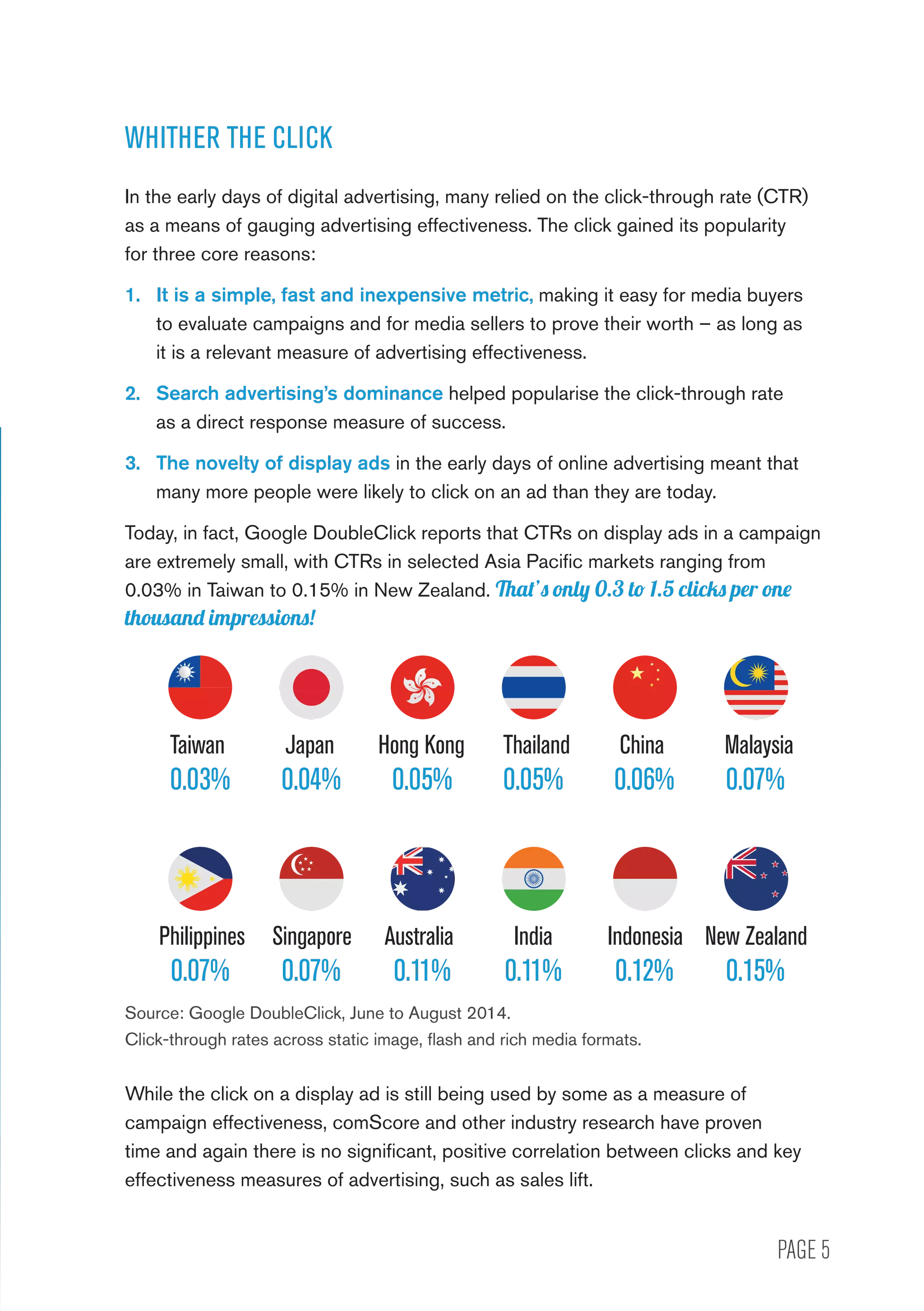
Today, in fact, Google DoubleClick reports that CTRs on display ads in a campaign
are extremely small, with CTRs in selected Asia Pacific markets ranging from
0.03% in Taiwan to 0.15% in New Zealand. That’s only 0.3 to 1.5 clicks per one
thousand impressions!
Source: Google DoubleClick, June to August 2014.
Click-through rates across static image, flash and rich media formats.
While the click on a display ad is still being used by some as a measure of
campaign effectiveness, comScore and other industry research have proven
time and again there is no significant, positive correlation between clicks and key
effectiveness measures of advertising, such as sales lift.
0.03%
0.07%
0.06%
0.12%
0.05%
0.11%
0.04%
0.07%
0.07%
0.15%
0.05%
0.11%
Taiwan Japan Hong Kong Thailand China Malaysia
Philippines Singapore Australia India Indonesia New Zealand
PAGE 6
IF NOT THE CLICK, THEN WHAT?
Does the fact that so few people click on ads mean that online advertising does not
work? The answer: a resounding “No”! Instead, it points to the simple, yet powerful
fact that relying solely on a CTR is incomplete and often misleading. Fortunately,
there are a variety of other metrics that can be used to demonstrate the impact of
online advertising.
comScore conducted a series of seminal studies in 2009 and 2010 titled
“Whither the Click?” that proved digital can be a powerful and effective means
of brand building. The studies showed that display ads are able to lift key
behavioural metrics – such as site visitation, the number of branded search
queries, and both online and offline sales – all despite very low CTRs.

More recent comScore research has revealed that the relationship between online
advertising and brand building continues to hold true today. A recent series of
comScore Action LiftTM
studies conducted in Western Europe (namely the UK, Ireland,
France, Italy and Spain) revealed the following positive campaign results in the face of
minimal CTRs:
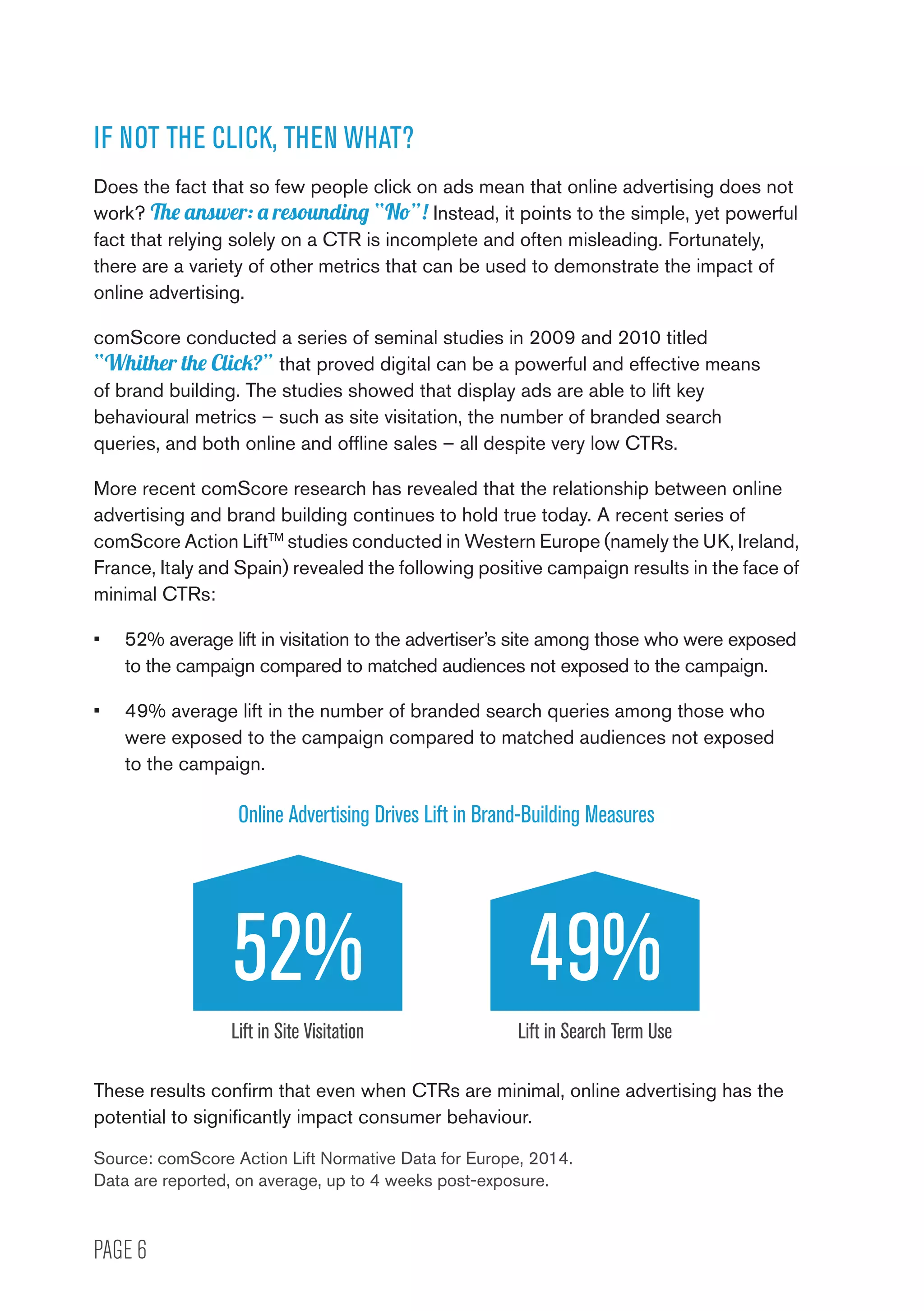
•	 52% average lift in visitation to the advertiser’s site among those who were exposed
to the campaign compared to matched audiences not exposed to the campaign.
•	 49% average lift in the number of branded search queries among those who
were exposed to the campaign compared to matched audiences not exposed
to the campaign.
Online Advertising Drives Lift in Brand-Building Measures
Lift in Search Term UseLift in Site Visitation
52% 49%
These results confirm that even when CTRs are minimal, online advertising has the
potential to significantly impact consumer behaviour.
Source: comScore Action Lift Normative Data for Europe, 2014.
Data are reported, on average, up to 4 weeks post-exposure.
CONTEXT MATTERS
The publisher environment in which the ad units are seen also plays a role in
impacting consumer behaviour. A comScore study conducted in conjunction
with the UK Association of Online Publishers (AOP) found that advertising
on original content sites, which includes publishers such as newspapers,
magazines and TV/radio broadcasters, can be measurably more effective
versus other online environments.
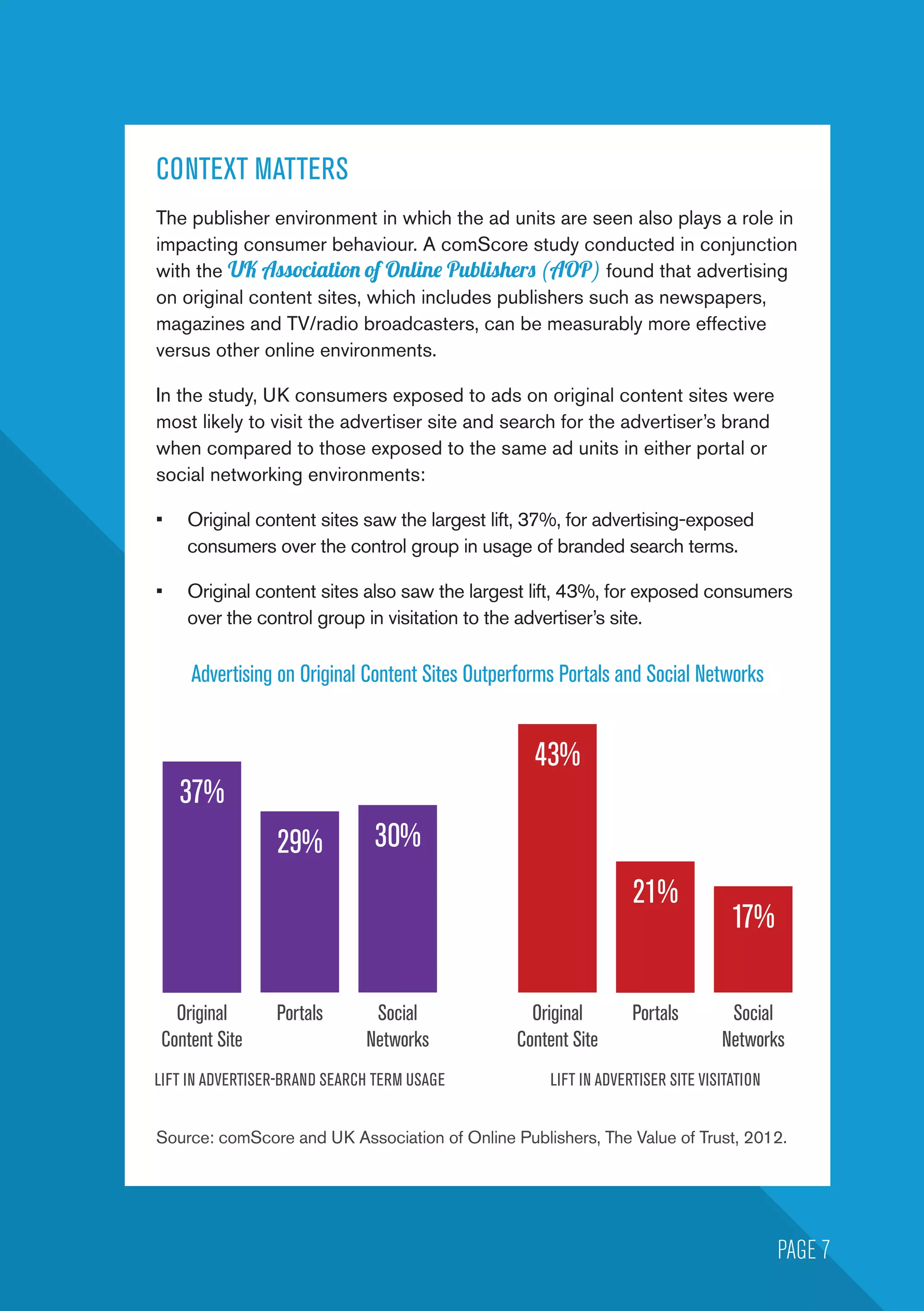
In the study, UK consumers exposed to ads on original content sites were
most likely to visit the advertiser site and search for the advertiser’s brand
when compared to those exposed to the same ad units in either portal or
social networking environments:
•	 Original content sites saw the largest lift, 37%, for advertising-exposed
consumers over the control group in usage of branded search terms.
•	 Original content sites also saw the largest lift, 43%, for exposed consumers
over the control group in visitation to the advertiser’s site.
PAGE 7
Advertising on Original Content Sites Outperforms Portals and Social Networks
Original
Content Site
LIFT IN ADVERTISER-BRAND SEARCH TERM USAGE LIFT IN ADVERTISER SITE VISITATION
Original
Content Site
Portals PortalsSocial
Networks
Social
Networks
37%
29% 30%
43%
21%
17%
Source: comScore and UK Association of Online Publishers, The Value of Trust, 2012.
PAGE 8
2.	Cookie-based targeting and
measurement can lead to
inaccurate campaign planning,
execution and evaluation.
PAGE 9
COOKIE DELETION  TARGETING
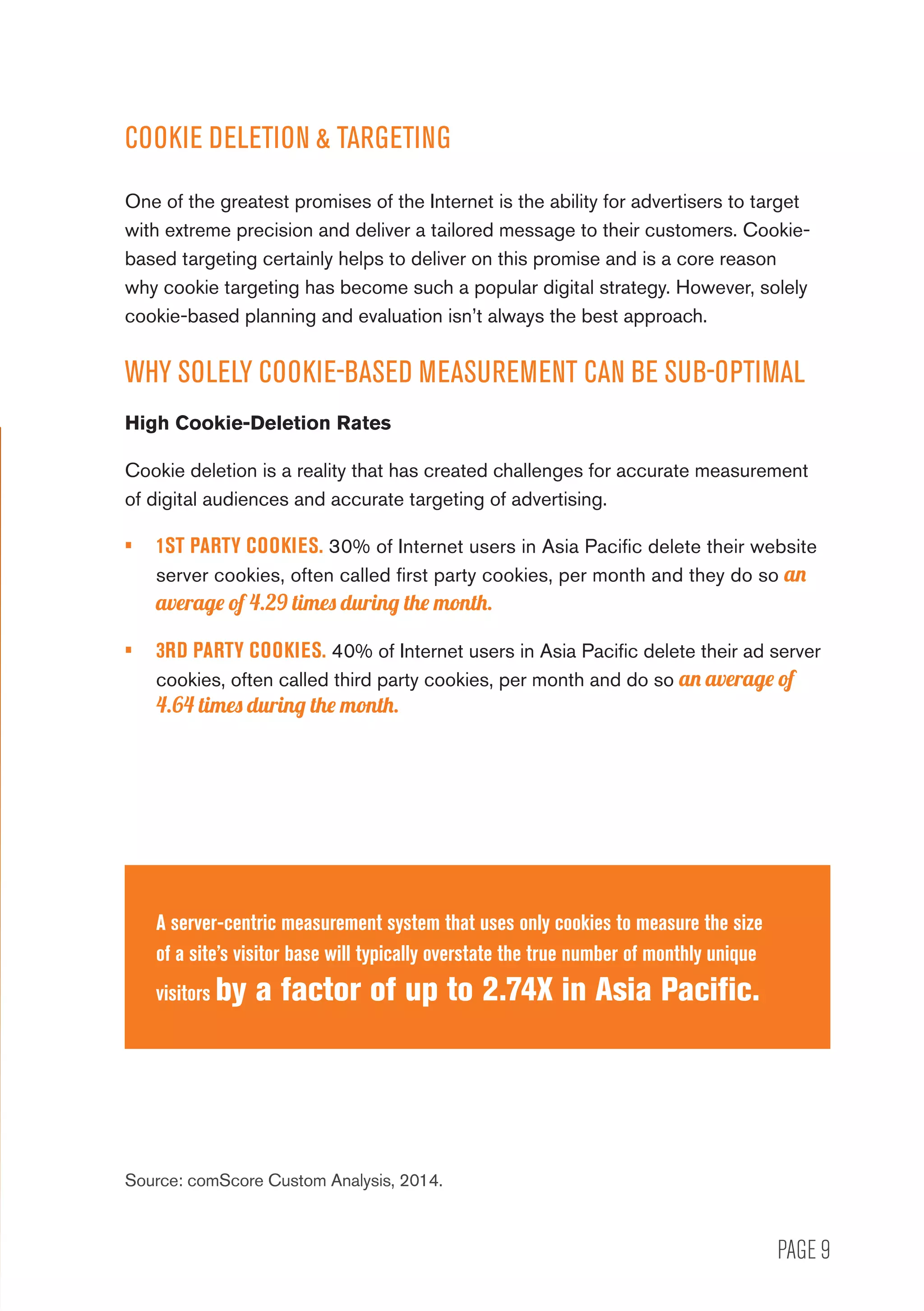
One of the greatest promises of the Internet is the ability for advertisers to target
with extreme precision and deliver a tailored message to their customers. Cookie-
based targeting certainly helps to deliver on this promise and is a core reason
why cookie targeting has become such a popular digital strategy. However, solely
cookie-based planning and evaluation isn’t always the best approach.
WHY SOLELY COOKIE-BASED MEASUREMENT CAN BE SUB-OPTIMAL
High Cookie-Deletion Rates
Cookie deletion is a reality that has created challenges for accurate measurement
of digital audiences and accurate targeting of advertising.
•	 1ST PARTY COOKIES. 30% of Internet users in Asia Pacific delete their website
server cookies, often called first party cookies, per month and they do so an
average of 4.29 times during the month.
•	 3RD PARTY COOKIES. 40% of Internet users in Asia Pacific delete their ad server
cookies, often called third party cookies, per month and do so an average of
4.64 times during the month.
A server-centric measurement system that uses only cookies to measure the size
of a site’s visitor base will typically overstate the true number of monthly unique
visitors by a factor of up to 2.74X in Asia Pacific.
Source: comScore Custom Analysis, 2014.
PAGE 10
COOKIE DELETION  CAMPAIGN EVALUATION
When it comes to campaign evaluation, these high levels of cookie deletion can
wreak havoc on results provided by ad or website servers.
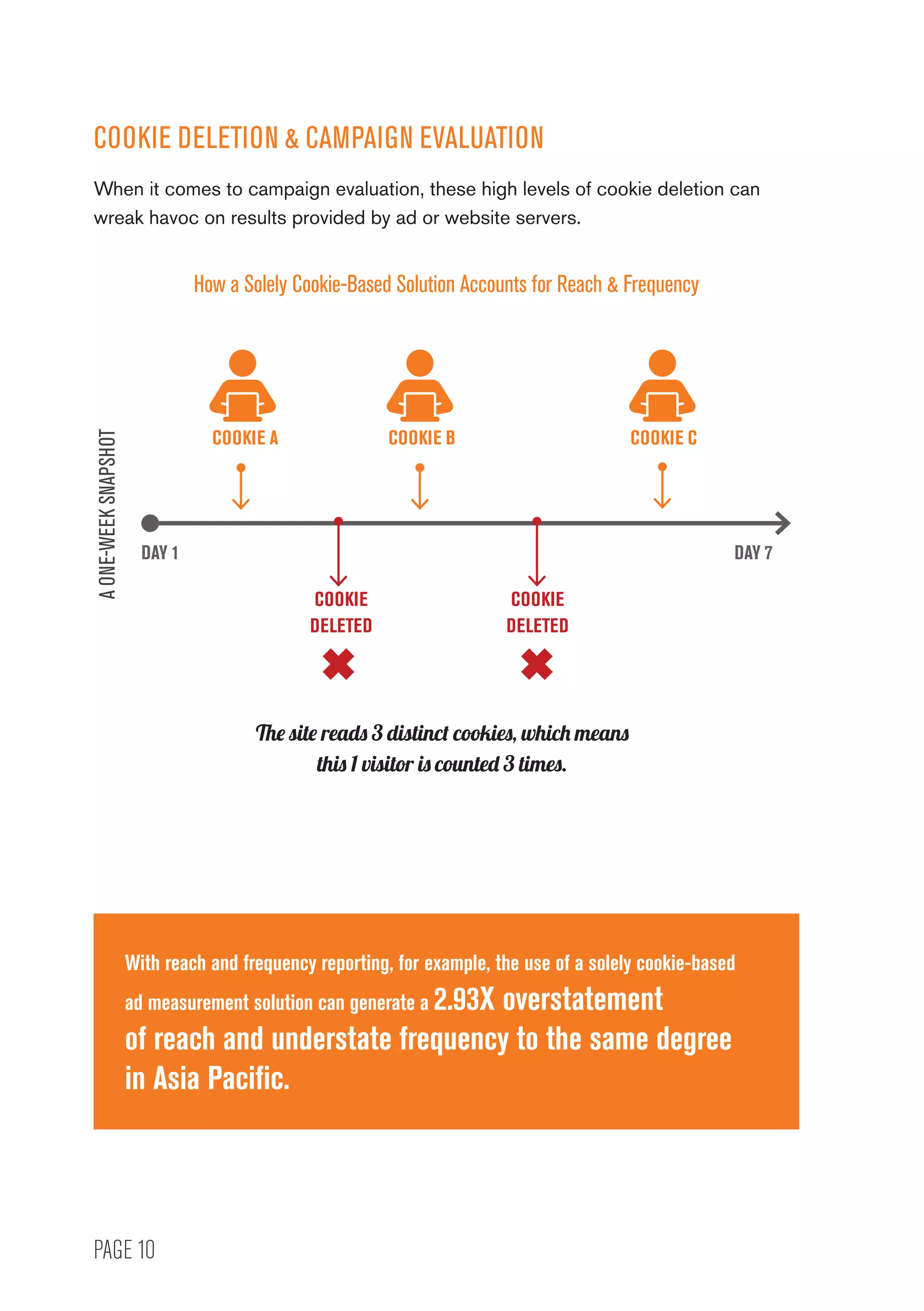
With reach and frequency reporting, for example, the use of a solely cookie-based
ad measurement solution can generate a 2.93X overstatement
of reach and understate frequency to the same degree
in Asia Pacific.
COOKIE A
DAY 1
AONE-WEEKSNAPSHOT
DAY 7
COOKIE
DELETED
COOKIE
DELETED
COOKIE B COOKIE C
The site reads 3 distinct cookies, which means
this 1 visitor is counted 3 times.
How a Solely Cookie-Based Solution Accounts for Reach  Frequency
COOKIES MEASURE COMPUTERS, NOT PEOPLE
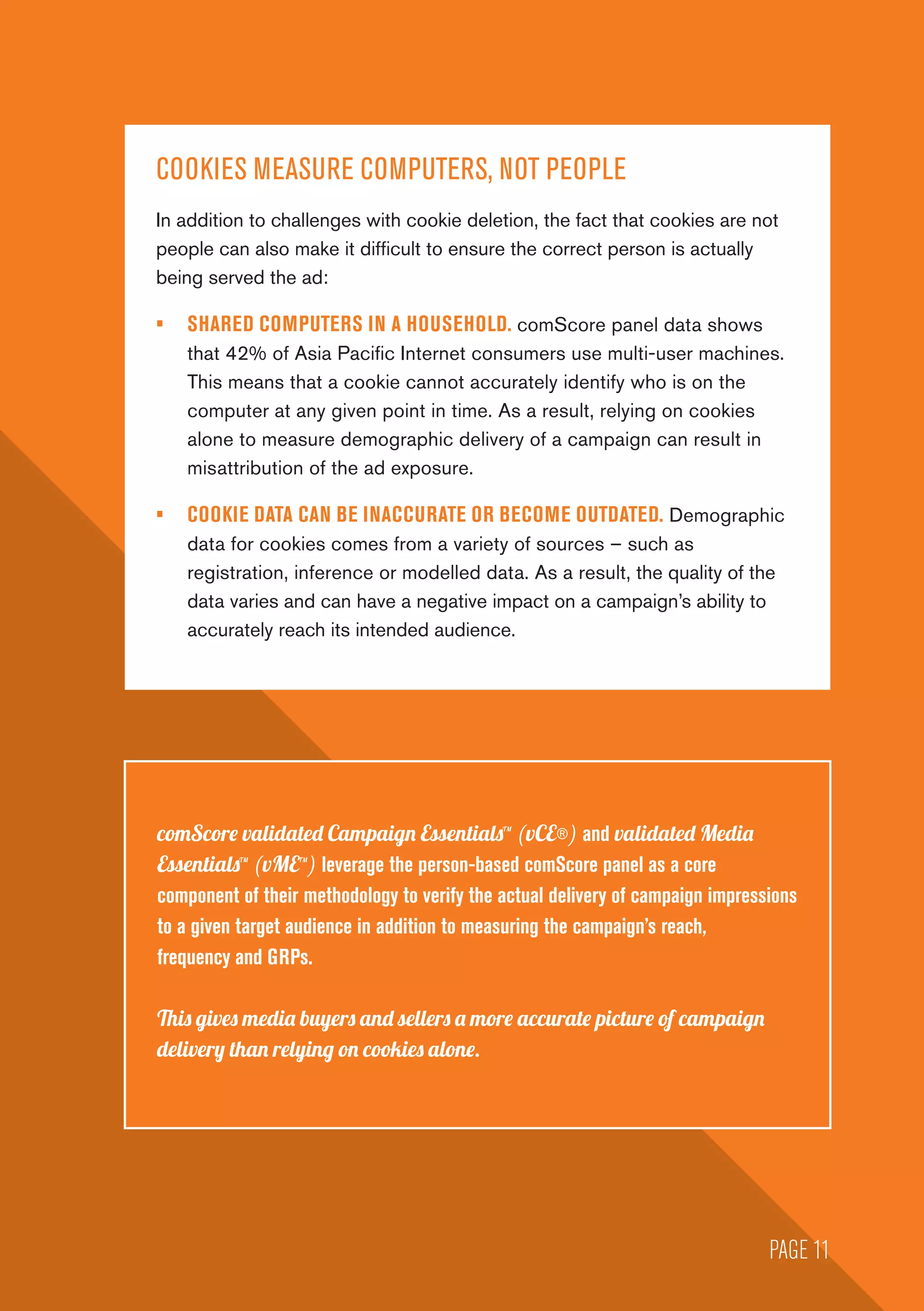
In addition to challenges with cookie deletion, the fact that cookies are not
people can also make it difficult to ensure the correct person is actually
being served the ad:
•	 SHARED COMPUTERS IN A HOUSEHOLD. comScore panel data shows
that 42% of Asia Pacific Internet consumers use multi-user machines.
This means that a cookie cannot accurately identify who is on the
computer at any given point in time. As a result, relying on cookies
alone to measure demographic delivery of a campaign can result in
misattribution of the ad exposure.
•	 COOKIE DATA CAN BE INACCURATE OR BECOME OUTDATED. Demographic
data for cookies comes from a variety of sources – such as
registration, inference or modelled data. As a result, the quality of the
data varies and can have a negative impact on a campaign’s ability to
accurately reach its intended audience.
comScore validated Campaign Essentials™ (vCE®) and validated Media
Essentials™ (vME™) leverage the person-based comScore panel as a core
component of their methodology to verify the actual delivery of campaign impressions
to a given target audience in addition to measuring the campaign’s reach,
frequency and GRPs.
This gives media buyers and sellers a more accurate picture of campaign
delivery than relying on cookies alone.
PAGE 11
PAGE 12
3.	Viewability, brand safety and
non-human traffic measurement
can provide much-needed
transparency in an increasingly
opaque, programmatic world.
PAGE 13
VERIFYING CAMPAIGN DELIVERY
For many in the online advertising space, programmatic audience buying has been
heralded as the ideal solution to current ecosystem challenges – with its ability to
reduce costs while potentially enabling improved targeting accuracy and ROI.
However, with this shift from high-touch, direct buying to low-touch, automated
transactions, it can be difficult to discern the quality of campaign delivery as
it relates to viewability, brand safety and non-human traffic. Having access to
campaign delivery data in real-time can provide much-needed transparency to the
market and offer significant benefits to media buyers and sellers.
comScore vCE defines viewability in line with the U.S. Media Rating Council’s
(MRC’s) definition, which states that 50% of the display ad’s pixels must be viewable
in the user’s browser for at least one second.
VIEWABILITY BRAND SAFETY NON-HUMAN TRAFFIC
(NHT)
PAGE 14
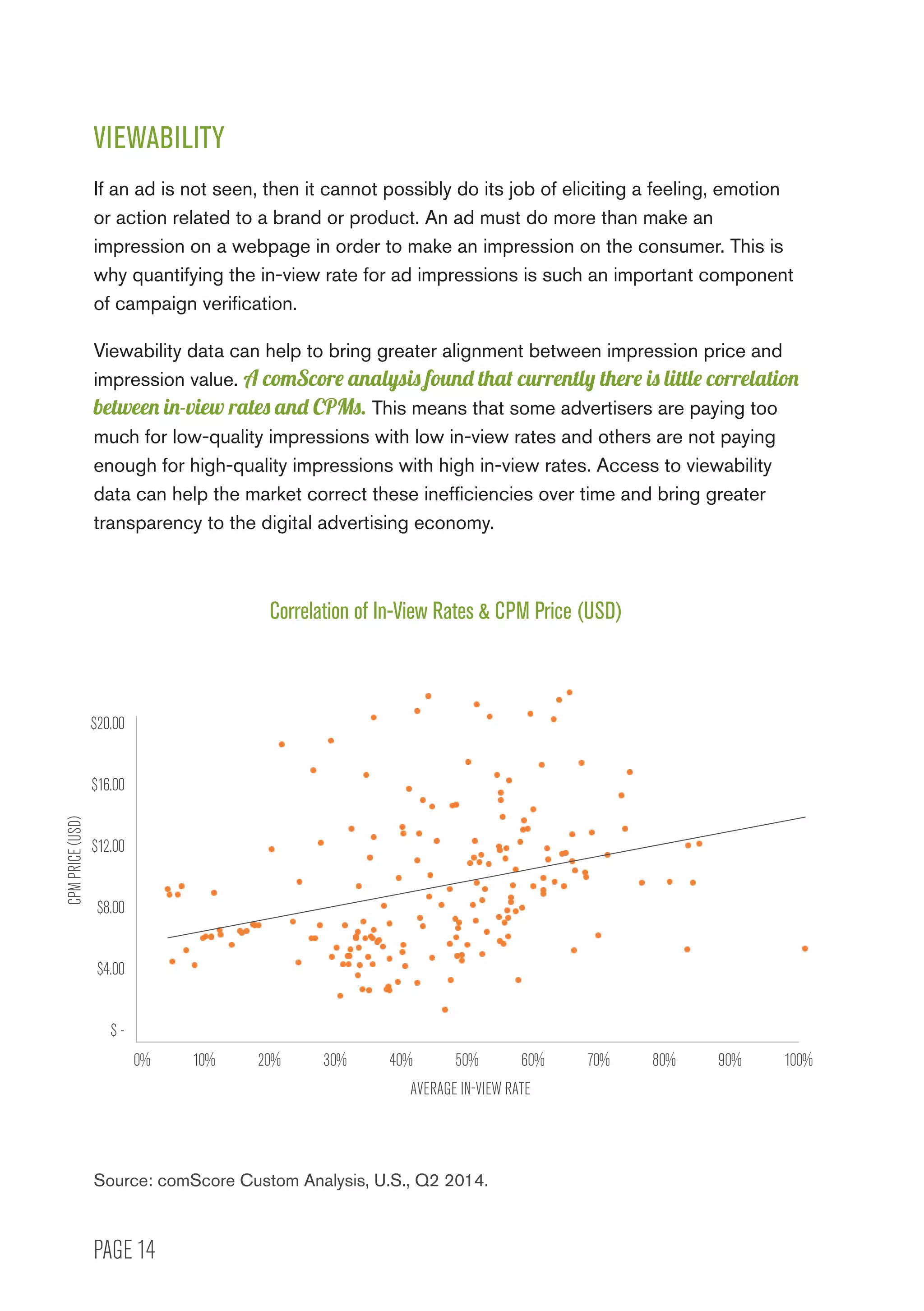
Source: comScore Custom Analysis, U.S., Q2 2014.
Correlation of In-View Rates  CPM Price (USD)
$20.00
$16.00
$12.00
$8.00
$4.00
$ -
CPMPRICE(USD)
AVERAGE IN-VIEW RATE
0% 10% 20% 30% 40% 50% 60% 70% 80% 90% 100%
VIEWABILITY
If an ad is not seen, then it cannot possibly do its job of eliciting a feeling, emotion
or action related to a brand or product. An ad must do more than make an
impression on a webpage in order to make an impression on the consumer. This is
why quantifying the in-view rate for ad impressions is such an important component
of campaign verification.
Viewability data can help to bring greater alignment between impression price and
impression value. A comScore analysis found that currently there is little correlation
between in-view rates and CPMs. This means that some advertisers are paying too
much for low-quality impressions with low in-view rates and others are not paying
enough for high-quality impressions with high in-view rates. Access to viewability
data can help the market correct these inefficiencies over time and bring greater
transparency to the digital advertising economy.
BRAND SAFETY
While topics of viewability and in-target performance often dominate
discussions around campaign delivery, brand safety is another important
component of quality delivery that cannot be overlooked. Having an ad
appear next to questionable content not only detracts from the brand
message but can also have a negative impact on brand perceptions. For
example, if an ad for a fast food restaurant runs next to a health news story
about a study linking fast food to heart disease, the impact of the ad is likely
to be more harmful than positive.
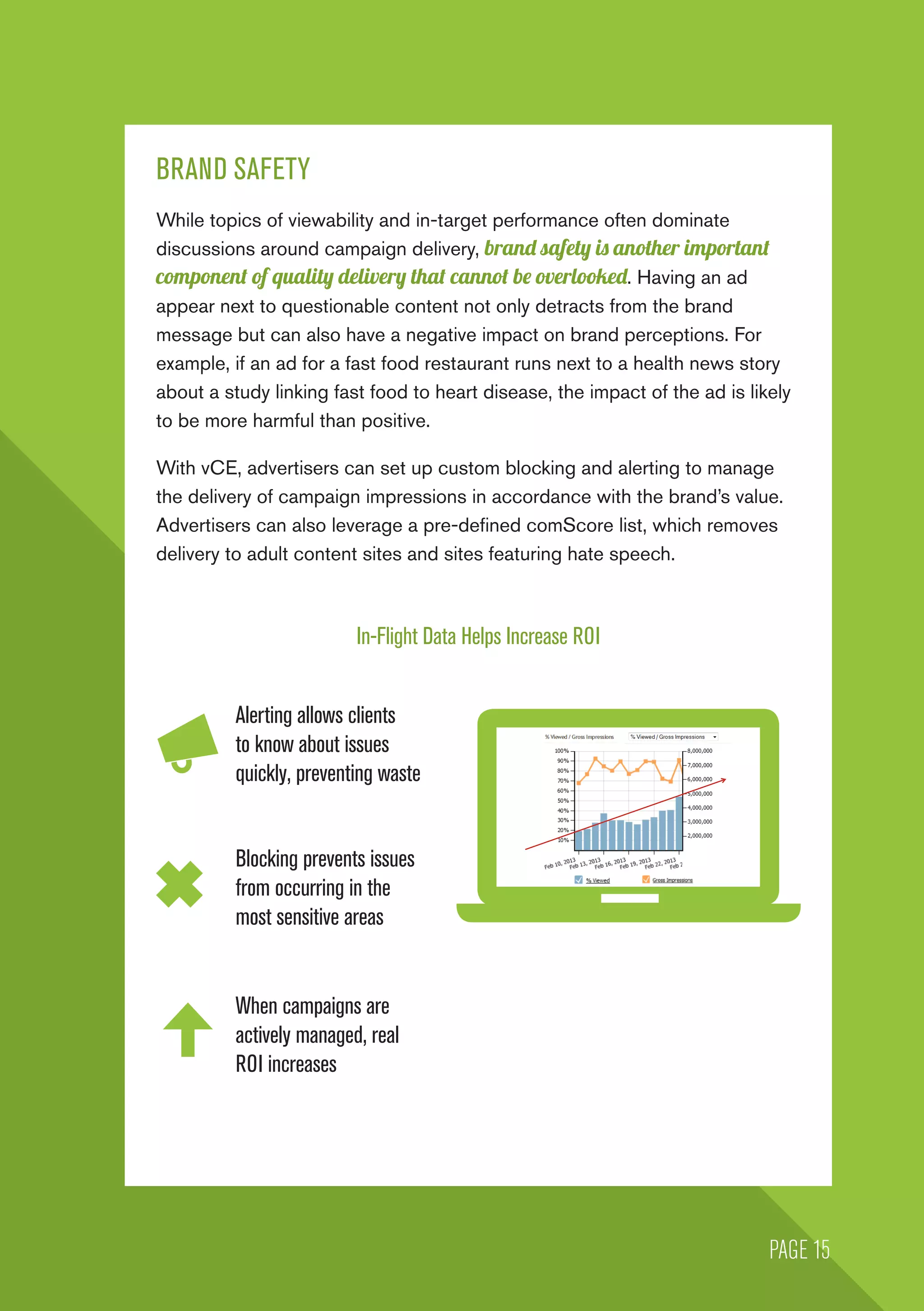
With vCE, advertisers can set up custom blocking and alerting to manage
the delivery of campaign impressions in accordance with the brand’s value.
Advertisers can also leverage a pre-defined comScore list, which removes
delivery to adult content sites and sites featuring hate speech.
In-Flight Data Helps Increase ROI
Alerting allows clients
to know about issues
quickly, preventing waste
Blocking prevents issues
from occurring in the
most sensitive areas
When campaigns are
actively managed, real
ROI increases
PAGE 15
PAGE 16
NON-HUMAN TRAFFIC
Invalid web traffic – often referred to as non-human traffic – can wreak havoc on
campaign delivery and diminish the value of digital as a successful advertising
medium. Specifically, non-human traffic can decrease viewability rates, dilute site
audiences and drive up impression counts. Being able to verify that campaign
impressions are delivered to humans – not spiders or bots – is critical to accurately
gauging campaign effectiveness. This type of transparency helps to ensure that
advertisers get the most out of their digital investments and that quality websites,
networks and exchanges realise the full value of the audiences they deliver.
vCE uses a triple detection technology to measure non-human traffic across
both audiences and campaigns. The comScore panel is a particularly important
component because to know what is non-human, you need to know what is human.
The comScore 2-million-person panel uniquely distinguishes human behaviour from
non-human activity. This helps detect non-human traffic that census-level tools,
such as tags, bots and spiders, alone cannot detect.
comScore defines non-human traffic as traffic to a website that is generated
– either intentionally or unintentionally – by non-human sources.
comScore Triple Detection Technology
AD TAGS SITE BEACONS HUMAN PANEL
WITHOUT A LARGE GLOBAL PANEL, COMPREHENSIVE NON-HUMAN
TRAFFIC MEASUREMENT IS NOT POSSIBLE.
PAGE 17
PAGE 18
4.	Industry benchmarks can help
media buyers and sellers set
campaign delivery expectations.
PAGE 19
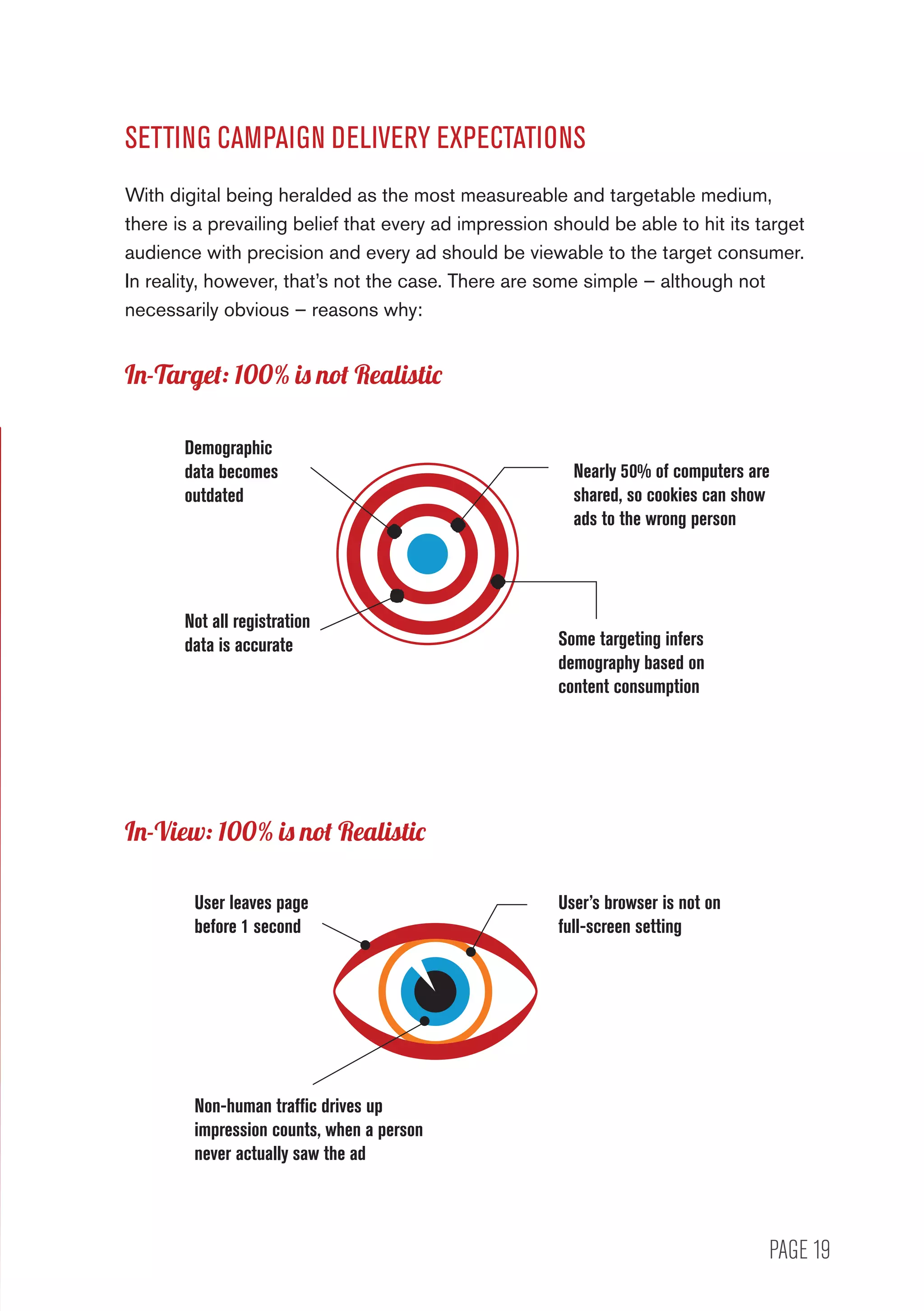
SETTING CAMPAIGN DELIVERY EXPECTATIONS
With digital being heralded as the most measureable and targetable medium,
there is a prevailing belief that every ad impression should be able to hit its target
audience with precision and every ad should be viewable to the target consumer.
In reality, however, that’s not the case. There are some simple – although not
necessarily obvious – reasons why:
Demographic
data becomes
outdated
Nearly 50% of computers are
shared, so cookies can show
ads to the wrong person
Not all registration
data is accurate Some targeting infers
demography based on
content consumption
User’s browser is not on
full-screen setting
User leaves page
before 1 second
Non-human traffic drives up
impression counts, when a person
never actually saw the ad
In-View: 100% is not Realistic
In-Target: 100% is not Realistic
PAGE 20
IF 100% ACCURACY IS NOT NORMAL, THEN WHAT IS?
Unfortunately, there is not a simple answer to this question, since there is no such
thing as a normal campaign. Industry benchmarks, however, can be used to help
set delivery expectations and provide a powerful indicator of relative campaign
performance. At comScore, we have amassed learnings from measuring billions
of campaign impressions around the globe and these learnings can help guide
the industry.
IN-TARGET BENCHMARKS
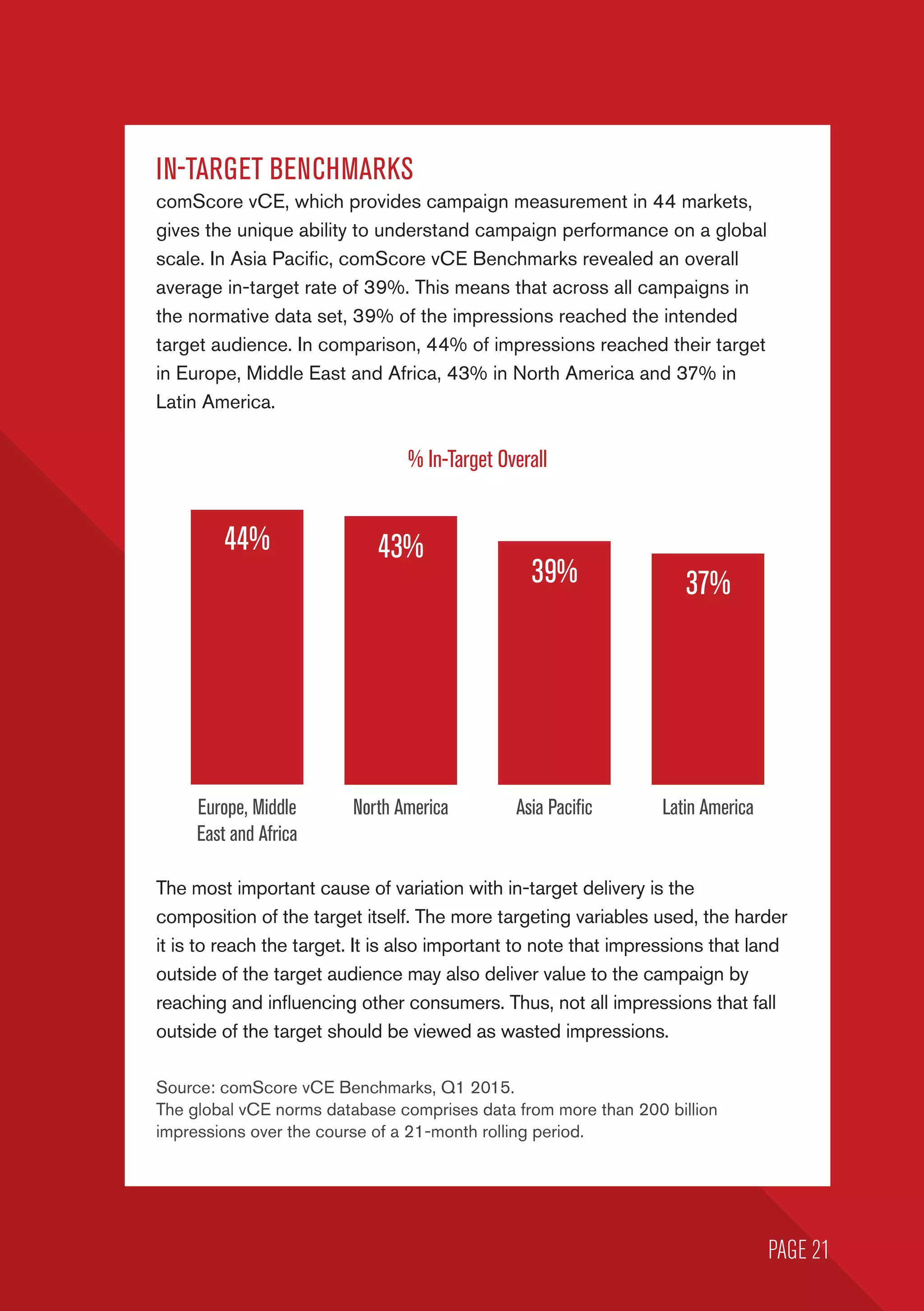
comScore vCE, which provides campaign measurement in 44 markets,
gives the unique ability to understand campaign performance on a global
scale. In Asia Pacific, comScore vCE Benchmarks revealed an overall
average in-target rate of 39%. This means that across all campaigns in
the normative data set, 39% of the impressions reached the intended
target audience. In comparison, 44% of impressions reached their target
in Europe, Middle East and Africa, 43% in North America and 37% in
Latin America.
Source: comScore vCE Benchmarks, Q1 2015.
The global vCE norms database comprises data from more than 200 billion
impressions over the course of a 21-month rolling period.
% In-Target Overall
Europe, Middle
East and Africa
North America Asia Pacific Latin America
44% 43%
39% 37%
PAGE 21
The most important cause of variation with in-target delivery is the
composition of the target itself. The more targeting variables used, the harder
it is to reach the target. It is also important to note that impressions that land
outside of the target audience may also deliver value to the campaign by
reaching and influencing other consumers. Thus, not all impressions that fall
outside of the target should be viewed as wasted impressions.
PAGE 22
IN-VIEW BENCHMARKS
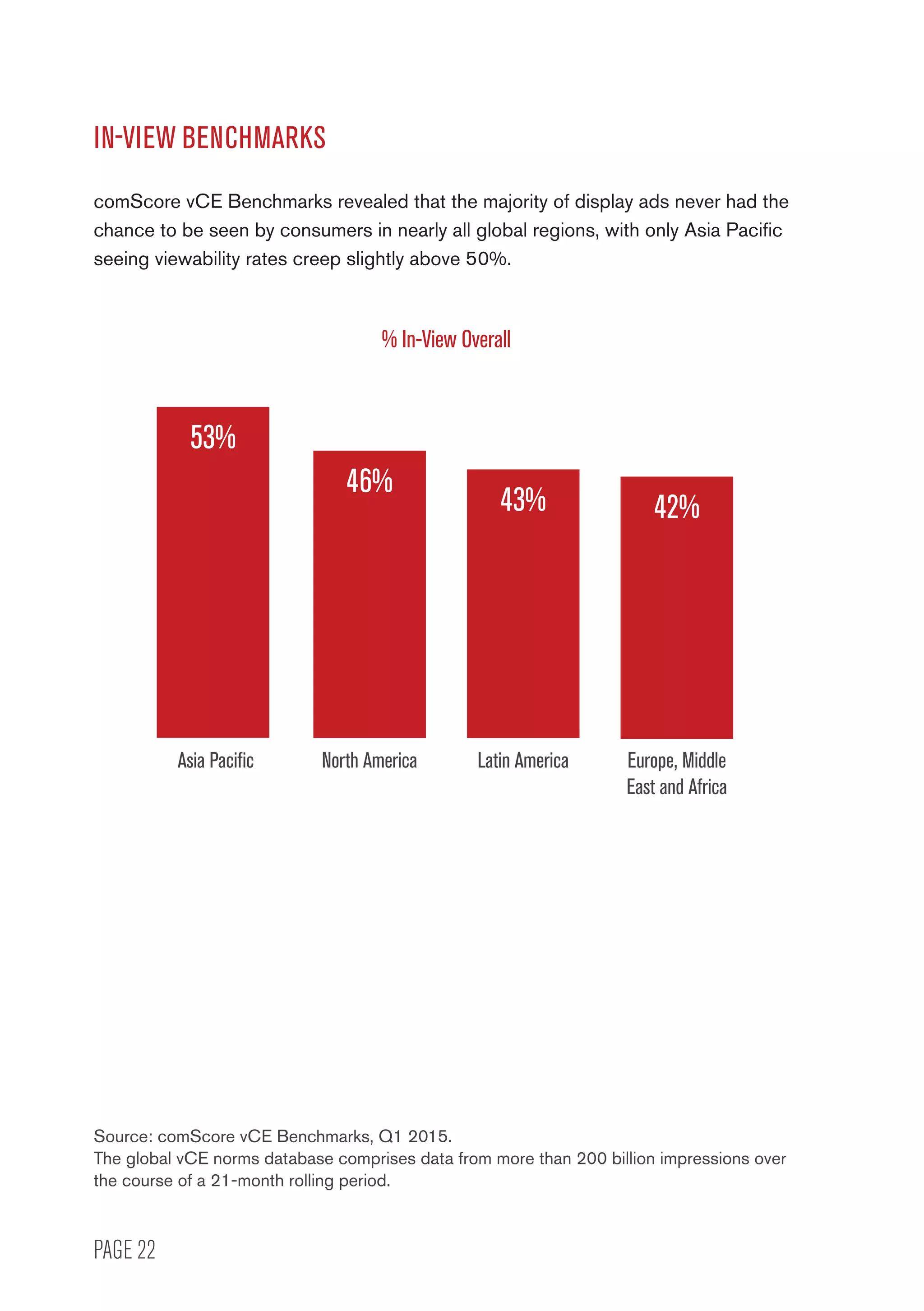
comScore vCE Benchmarks revealed that the majority of display ads never had the
chance to be seen by consumers in nearly all global regions, with only Asia Pacific
seeing viewability rates creep slightly above 50%.
Source: comScore vCE Benchmarks, Q1 2015.
The global vCE norms database comprises data from more than 200 billion impressions over
the course of a 21-month rolling period.
% In-View Overall
Asia Pacific North America Latin America Europe, Middle
East and Africa
53%
46%
43% 42%
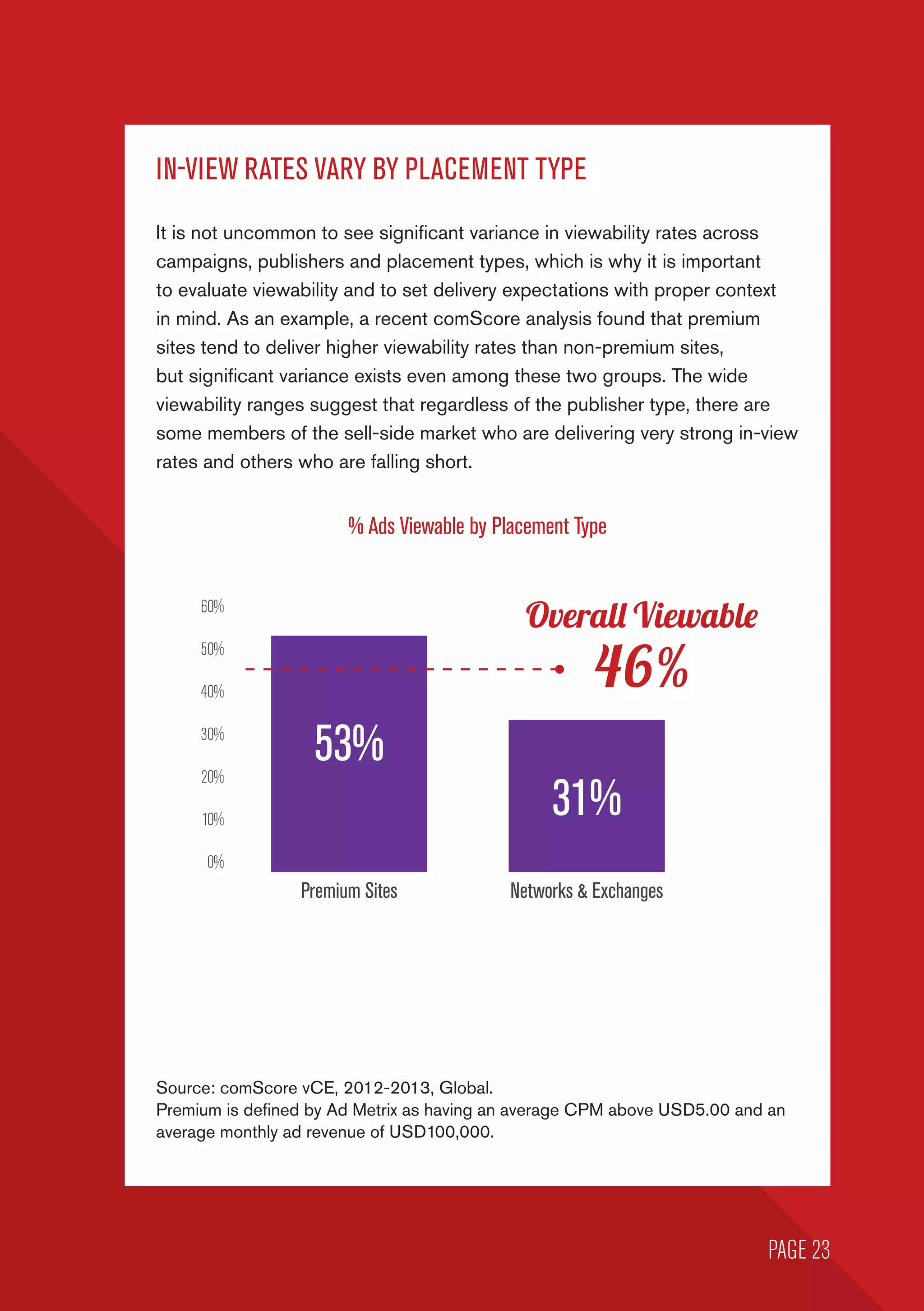
IN-VIEW RATES VARY BY PLACEMENT TYPE
It is not uncommon to see significant variance in viewability rates across
campaigns, publishers and placement types, which is why it is important
to evaluate viewability and to set delivery expectations with proper context
in mind. As an example, a recent comScore analysis found that premium
sites tend to deliver higher viewability rates than non-premium sites,
but significant variance exists even among these two groups. The wide
viewability ranges suggest that regardless of the publisher type, there are
some members of the sell-side market who are delivering very strong in-view
rates and others who are falling short.
Source: comScore vCE, 2012-2013, Global.
Premium is defined by Ad Metrix as having an average CPM above USD5.00 and an
average monthly ad revenue of USD100,000.
% Ads Viewable by Placement Type
Premium Sites Networks  Exchanges
53%
31%
60%
50%
40%
30%
20%
10%
0%
Overall Viewable
46%
PAGE 23
PAGE 24
5.	In-flight optimisation of
campaign delivery can have
powerful brand-building and
ROI impact.
PAGE 25
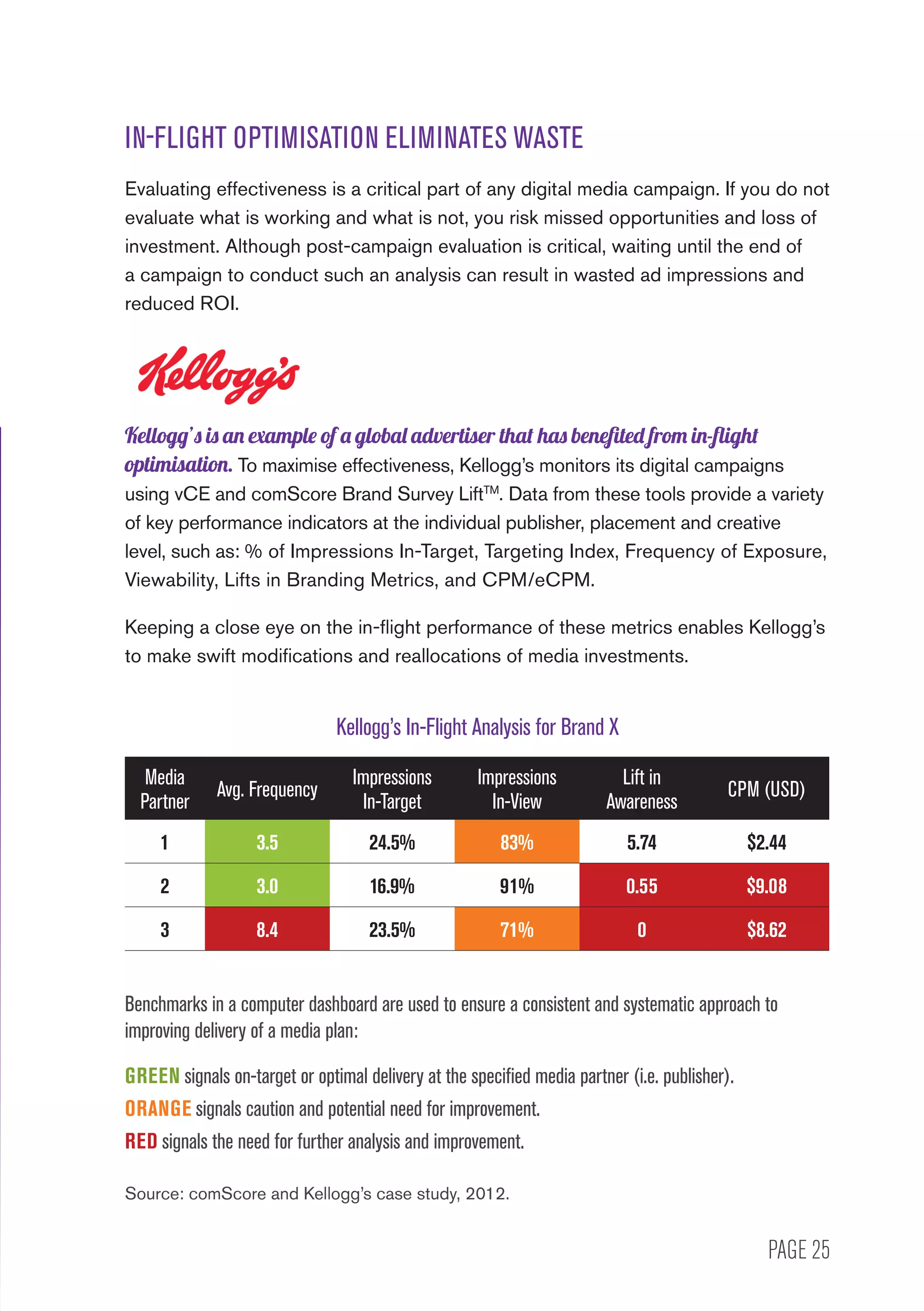
IN-FLIGHT OPTIMISATION ELIMINATES WASTE
Evaluating effectiveness is a critical part of any digital media campaign. If you do not
evaluate what is working and what is not, you risk missed opportunities and loss of
investment. Although post-campaign evaluation is critical, waiting until the end of
a campaign to conduct such an analysis can result in wasted ad impressions and
reduced ROI.
Kellogg’s is an example of a global advertiser that has benefited from in-flight
optimisation. To maximise effectiveness, Kellogg’s monitors its digital campaigns
using vCE and comScore Brand Survey LiftTM
. Data from these tools provide a variety
of key performance indicators at the individual publisher, placement and creative
level, such as: % of Impressions In-Target, Targeting Index, Frequency of Exposure,
Viewability, Lifts in Branding Metrics, and CPM/eCPM.
Keeping a close eye on the in-flight performance of these metrics enables Kellogg’s
to make swift modifications and reallocations of media investments.
Media
Partner
Avg. Frequency
Impressions
In-Target
Impressions
In-View
Lift in
Awareness
CPM (USD)
1 3.5 24.5% 83% 5.74 $2.44
2 3.0 16.9% 91% 0.55 $9.08
3 8.4 23.5% 71% 0 $8.62
Benchmarks in a computer dashboard are used to ensure a consistent and systematic approach to
improving delivery of a media plan:
GREEN signals on-target or optimal delivery at the specified media partner (i.e. publisher).
ORANGE signals caution and potential need for improvement.
RED signals the need for further analysis and improvement.
Kellogg’s In-Flight Analysis for Brand X
Source: comScore and Kellogg’s case study, 2012.
PAGE 26
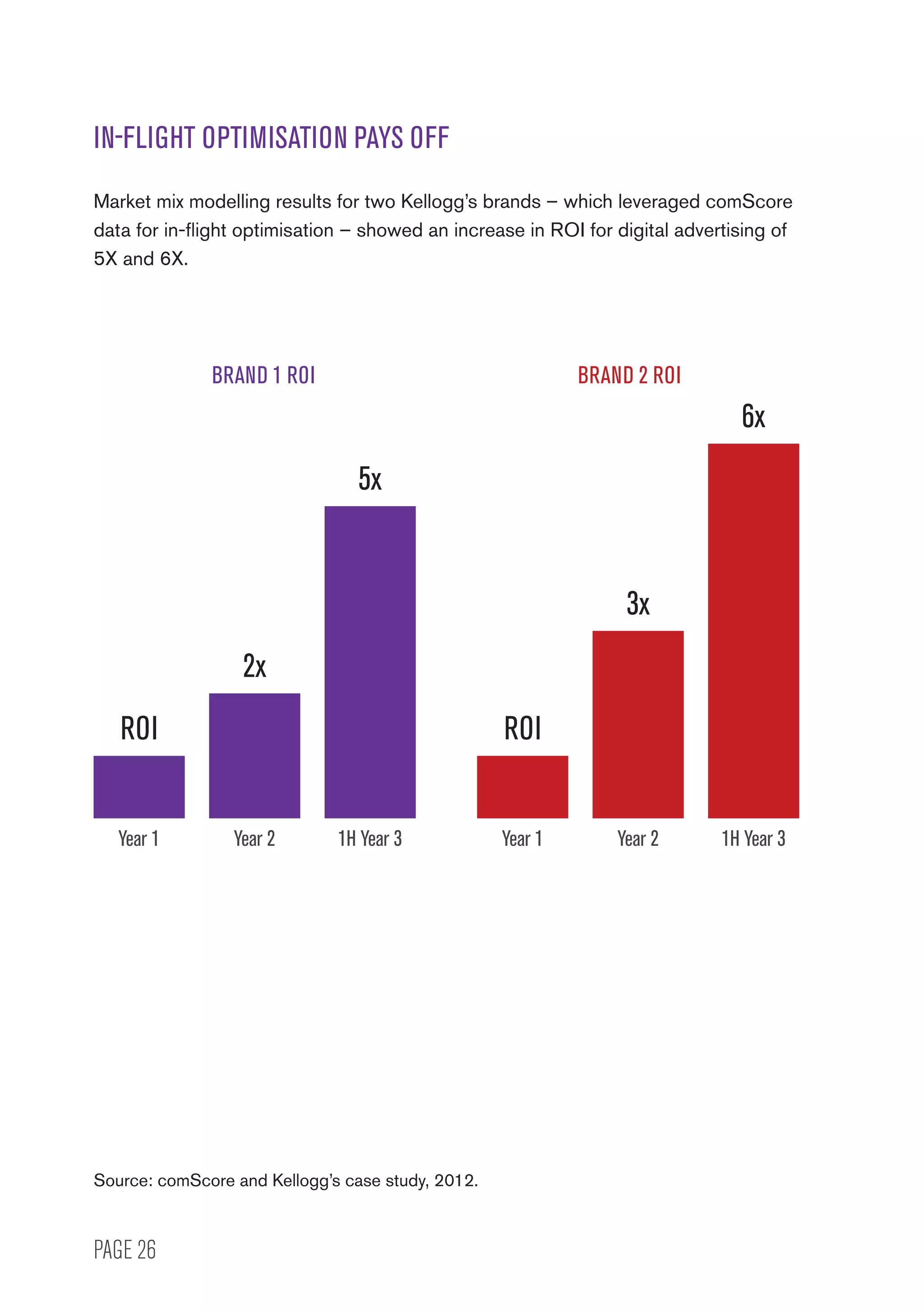
IN-FLIGHT OPTIMISATION PAYS OFF
Market mix modelling results for two Kellogg’s brands – which leveraged comScore
data for in-flight optimisation – showed an increase in ROI for digital advertising of
5X and 6X.
BRAND 1 ROI BRAND 2 ROI
Year 1 Year 1Year 2 Year 21H Year 3 1H Year 3
ROI ROI
2x
3x
5x
6x
Source: comScore and Kellogg’s case study, 2012.
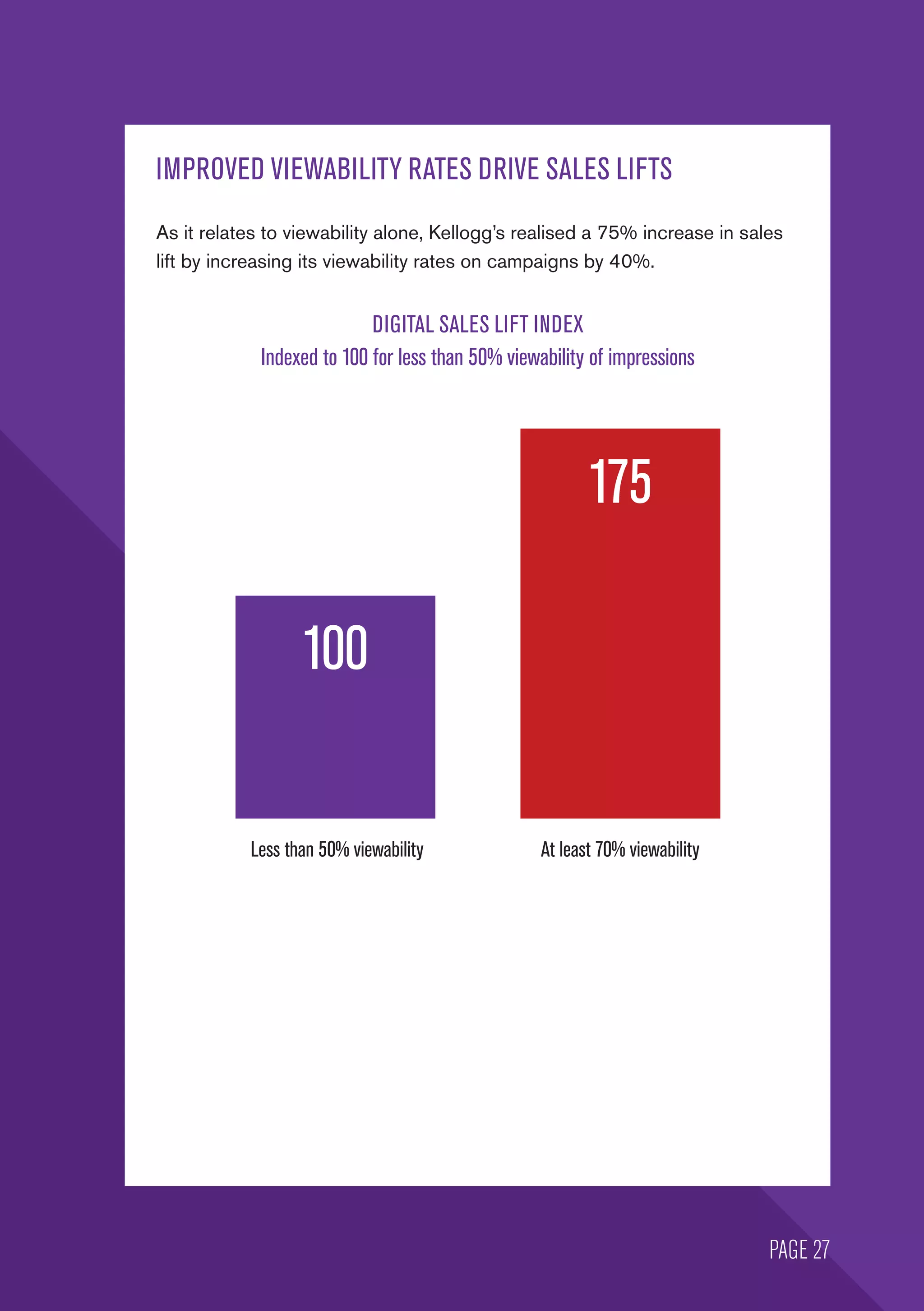
IMPROVED VIEWABILITY RATES DRIVE SALES LIFTS
As it relates to viewability alone, Kellogg’s realised a 75% increase in sales
lift by increasing its viewability rates on campaigns by 40%.
DIGITAL SALES LIFT INDEX
Indexed to 100 for less than 50% viewability of impressions
Less than 50% viewability At least 70% viewability
100
175
PAGE 27
PAGE 28
6.	As the media environment
fragments, campaign and
audience measurement must
adopt a unified, Multi-Platform
view of the consumer.
PAGE 29
MULTI-PLATFORM MAJORITY
Increasingly, audiences are consuming content across a variety of screens,
platforms and devices – and as eyeballs are moving to multi-screens, so are
advertising investments.
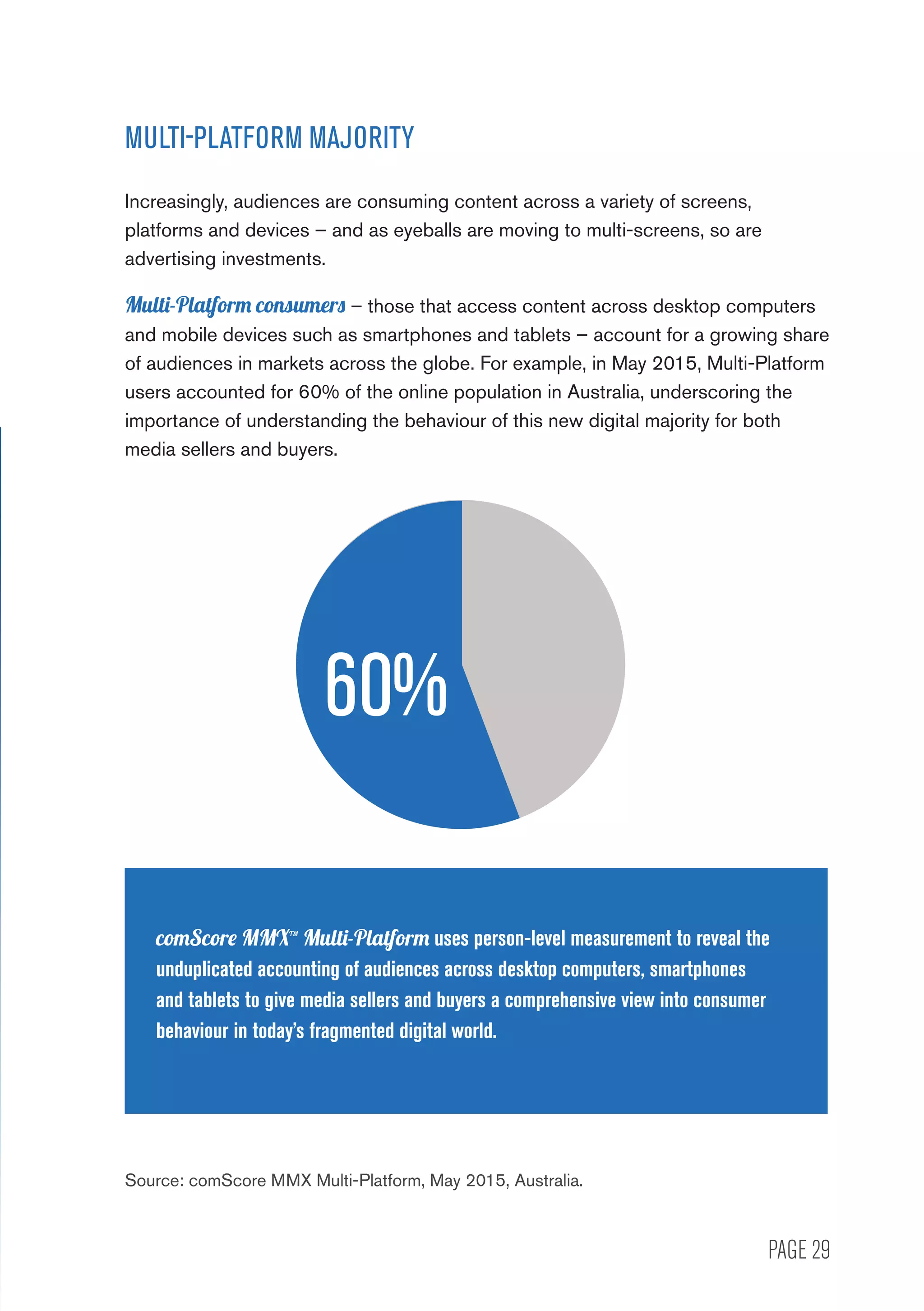
Multi-Platform consumers – those that access content across desktop computers
and mobile devices such as smartphones and tablets – account for a growing share
of audiences in markets across the globe. For example, in May 2015, Multi-Platform
users accounted for 60% of the online population in Australia, underscoring the
importance of understanding the behaviour of this new digital majority for both
media sellers and buyers.
Source: comScore MMX Multi-Platform, May 2015, Australia.
comScore MMX™ Multi-Platform uses person-level measurement to reveal the
unduplicated accounting of audiences across desktop computers, smartphones
and tablets to give media sellers and buyers a comprehensive view into consumer
behaviour in today’s fragmented digital world.
60%
PAGE 30
MEASUREMENT IS CRITICAL
Not only is measurement of consumers and their cross-media habits critical
to realising the potential of the new digital landscape, but media buyers
and sellers also need to understand how their advertising is reaching and
impacting consumers across screens. Indeed, a unified, unduplicated
accounting of media consumption and advertising delivery will facilitate
smarter media buying, selling and evaluation.
In order for online advertising campaigns to achieve optimal impact, provide
the opportunity for real-time optimisation and be fully comparable to TV,
campaign measurement of audience delivery needs to be scalable and
granular. This will enable faster and more reliable in-flight reporting that will
open the door for more efficient evaluation across channels and a better
understanding of the value of digital relative to traditional media, like TV.
PAGE 31
Looking forward
The rapid pace of change in the digital ecosystem over the past
several years has been unprecedented – and it doesn’t seem to be
slowing any time soon. The industry’s continued evolution means
that media buyers and sellers must stay at the forefront of innovative
thinking in order to maintain a competitive edge. Undoubtedly, sound
measurement and research is critical to this process.
The lessons discussed in this booklet provide a framework for how
trusted, independent data and insights can help guide practitioners
down a path toward success. Access to such data can reveal when
a served ad impression has been validated, when a target audience
has been reached, and when online advertising is working.
Ultimately, this transparency and clarity will help digital reach its full
potential as an advertising medium – providing a true win-win for all
members of the ecosystem.
Contact us today to learn more.
www.comscore.com/LessonsLearnedAPAC
COMSCORE SOLUTIONS FOR MEDIA BUYERS  SELLERS
learnmore@comscore.com
www.comscore.com/LessonsLearnedAPAC
comScore validated Campaign Essentials™ (vCE®) is a holistic ad and
audience delivery validation solution that provides deep campaign insights, in-flight
reporting and daily alerting.
•	 	Used by media buyers and sellers
•	 Enables in-flight campaign management and optimisation
•	 Evaluates audience delivery, viewability, brand safety, geographic delivery,
engagement and non-human traffic
•	 Behavioural segment reporting
•	 Reports data by publisher, placement and creative
•	 Enables increased campaign effectiveness and decreased waste
comScore validated Media Essentials™ (vME™) is a comprehensive
measurement solution that evaluates ad inventory across a site or network of sites
for strategic pricing and packaging.
•	 Used exclusively by media sellers
•	 Measures ad inventory across a site or network of sites
•	 Evaluates viewability, engagement, geographic delivery and non-human traffic
•	 Reports data by ad slot, site section and creative size
•	 Enables increased revenue by maximising high-value inventory

Com score - ad analytics-booklet - lessons learned in digital advertising

  • 1.
  • 2.
    INTRODUCTION While advertising hasevolved tremendously with the advent of new digital technologies, its goal today is much the same as it has always been – to elicit feelings, emotions, perceptions and actions that ultimately increase sales and build brand loyalty. Finding ways to do this in the most efficient manner is vital, and being able to quantify a return on a marketing investment is a must. As digital advertising continues to grow in importance and sophistication, so does the need for guiding principles about how to get the most out of this medium. Through comScore’s extensive, global research in the digital advertising space, we’ve identified key Lessons Learned in Digital Advertising that help shed light on the current state of the industry and guide us on a path toward more effective planning, stronger evaluation and overall improved results for media buyers and sellers. © 2015 comScore, Inc. comScore®, MMX™, validated Campaign Essentials™ (vCE®), validated Media Essentials™ (vME™), Action Lift™ and Brand Survey Lift™ (BSL™) are the trademarks of comScore, Inc. All other trademarks are the property of their owners. For information about the proprietary technology used in comScore products, please refer to www.comscore.com/About_comScore/Patents.
  • 3.
    Key Lessons Learned 1. Clicksare at best an incomplete – and at worst a misleading – metric. 2. Cookie-based targeting and measurement can lead to inaccurate campaign planning, execution and evaluation. 3. Viewability, brand safety and non-human traffic measurement can provide much-needed transparency in an increasingly opaque, programmatic world. 4. Industry benchmarks can help media buyers and sellers set campaign delivery expectations. 5. In-flight optimisation of campaign delivery can have powerful brand-building and ROI impact. 6. As the media environment fragments, campaign and audience measurement must adopt a unified, Multi-Platform view of the consumer.
  • 4.
    PAGE 4 1. Clicks areat best an incomplete – and at worst a misleading – metric.
  • 5.
    PAGE 5 WHITHER THECLICK In the early days of digital advertising, many relied on the click-through rate (CTR) as a means of gauging advertising effectiveness. The click gained its popularity for three core reasons: 1. It is a simple, fast and inexpensive metric, making it easy for media buyers to evaluate campaigns and for media sellers to prove their worth – as long as it is a relevant measure of advertising effectiveness. 2. Search advertising’s dominance helped popularise the click-through rate as a direct response measure of success. 3. The novelty of display ads in the early days of online advertising meant that many more people were likely to click on an ad than they are today. Today, in fact, Google DoubleClick reports that CTRs on display ads in a campaign are extremely small, with CTRs in selected Asia Pacific markets ranging from 0.03% in Taiwan to 0.15% in New Zealand. That’s only 0.3 to 1.5 clicks per one thousand impressions! Source: Google DoubleClick, June to August 2014. Click-through rates across static image, flash and rich media formats. While the click on a display ad is still being used by some as a measure of campaign effectiveness, comScore and other industry research have proven time and again there is no significant, positive correlation between clicks and key effectiveness measures of advertising, such as sales lift. 0.03% 0.07% 0.06% 0.12% 0.05% 0.11% 0.04% 0.07% 0.07% 0.15% 0.05% 0.11% Taiwan Japan Hong Kong Thailand China Malaysia Philippines Singapore Australia India Indonesia New Zealand
  • 6.
    PAGE 6 IF NOTTHE CLICK, THEN WHAT? Does the fact that so few people click on ads mean that online advertising does not work? The answer: a resounding “No”! Instead, it points to the simple, yet powerful fact that relying solely on a CTR is incomplete and often misleading. Fortunately, there are a variety of other metrics that can be used to demonstrate the impact of online advertising. comScore conducted a series of seminal studies in 2009 and 2010 titled “Whither the Click?” that proved digital can be a powerful and effective means of brand building. The studies showed that display ads are able to lift key behavioural metrics – such as site visitation, the number of branded search queries, and both online and offline sales – all despite very low CTRs. More recent comScore research has revealed that the relationship between online advertising and brand building continues to hold true today. A recent series of comScore Action LiftTM studies conducted in Western Europe (namely the UK, Ireland, France, Italy and Spain) revealed the following positive campaign results in the face of minimal CTRs: • 52% average lift in visitation to the advertiser’s site among those who were exposed to the campaign compared to matched audiences not exposed to the campaign. • 49% average lift in the number of branded search queries among those who were exposed to the campaign compared to matched audiences not exposed to the campaign. Online Advertising Drives Lift in Brand-Building Measures Lift in Search Term UseLift in Site Visitation 52% 49% These results confirm that even when CTRs are minimal, online advertising has the potential to significantly impact consumer behaviour. Source: comScore Action Lift Normative Data for Europe, 2014. Data are reported, on average, up to 4 weeks post-exposure.
  • 7.
    CONTEXT MATTERS The publisherenvironment in which the ad units are seen also plays a role in impacting consumer behaviour. A comScore study conducted in conjunction with the UK Association of Online Publishers (AOP) found that advertising on original content sites, which includes publishers such as newspapers, magazines and TV/radio broadcasters, can be measurably more effective versus other online environments. In the study, UK consumers exposed to ads on original content sites were most likely to visit the advertiser site and search for the advertiser’s brand when compared to those exposed to the same ad units in either portal or social networking environments: • Original content sites saw the largest lift, 37%, for advertising-exposed consumers over the control group in usage of branded search terms. • Original content sites also saw the largest lift, 43%, for exposed consumers over the control group in visitation to the advertiser’s site. PAGE 7 Advertising on Original Content Sites Outperforms Portals and Social Networks Original Content Site LIFT IN ADVERTISER-BRAND SEARCH TERM USAGE LIFT IN ADVERTISER SITE VISITATION Original Content Site Portals PortalsSocial Networks Social Networks 37% 29% 30% 43% 21% 17% Source: comScore and UK Association of Online Publishers, The Value of Trust, 2012.
  • 8.
    PAGE 8 2. Cookie-based targetingand measurement can lead to inaccurate campaign planning, execution and evaluation.
  • 9.
    PAGE 9 COOKIE DELETION TARGETING One of the greatest promises of the Internet is the ability for advertisers to target with extreme precision and deliver a tailored message to their customers. Cookie- based targeting certainly helps to deliver on this promise and is a core reason why cookie targeting has become such a popular digital strategy. However, solely cookie-based planning and evaluation isn’t always the best approach. WHY SOLELY COOKIE-BASED MEASUREMENT CAN BE SUB-OPTIMAL High Cookie-Deletion Rates Cookie deletion is a reality that has created challenges for accurate measurement of digital audiences and accurate targeting of advertising. • 1ST PARTY COOKIES. 30% of Internet users in Asia Pacific delete their website server cookies, often called first party cookies, per month and they do so an average of 4.29 times during the month. • 3RD PARTY COOKIES. 40% of Internet users in Asia Pacific delete their ad server cookies, often called third party cookies, per month and do so an average of 4.64 times during the month. A server-centric measurement system that uses only cookies to measure the size of a site’s visitor base will typically overstate the true number of monthly unique visitors by a factor of up to 2.74X in Asia Pacific. Source: comScore Custom Analysis, 2014.
  • 10.
    PAGE 10 COOKIE DELETION CAMPAIGN EVALUATION When it comes to campaign evaluation, these high levels of cookie deletion can wreak havoc on results provided by ad or website servers. With reach and frequency reporting, for example, the use of a solely cookie-based ad measurement solution can generate a 2.93X overstatement of reach and understate frequency to the same degree in Asia Pacific. COOKIE A DAY 1 AONE-WEEKSNAPSHOT DAY 7 COOKIE DELETED COOKIE DELETED COOKIE B COOKIE C The site reads 3 distinct cookies, which means this 1 visitor is counted 3 times. How a Solely Cookie-Based Solution Accounts for Reach Frequency
  • 11.
    COOKIES MEASURE COMPUTERS,NOT PEOPLE In addition to challenges with cookie deletion, the fact that cookies are not people can also make it difficult to ensure the correct person is actually being served the ad: • SHARED COMPUTERS IN A HOUSEHOLD. comScore panel data shows that 42% of Asia Pacific Internet consumers use multi-user machines. This means that a cookie cannot accurately identify who is on the computer at any given point in time. As a result, relying on cookies alone to measure demographic delivery of a campaign can result in misattribution of the ad exposure. • COOKIE DATA CAN BE INACCURATE OR BECOME OUTDATED. Demographic data for cookies comes from a variety of sources – such as registration, inference or modelled data. As a result, the quality of the data varies and can have a negative impact on a campaign’s ability to accurately reach its intended audience. comScore validated Campaign Essentials™ (vCE®) and validated Media Essentials™ (vME™) leverage the person-based comScore panel as a core component of their methodology to verify the actual delivery of campaign impressions to a given target audience in addition to measuring the campaign’s reach, frequency and GRPs. This gives media buyers and sellers a more accurate picture of campaign delivery than relying on cookies alone. PAGE 11
  • 12.
    PAGE 12 3. Viewability, brandsafety and non-human traffic measurement can provide much-needed transparency in an increasingly opaque, programmatic world.
  • 13.
    PAGE 13 VERIFYING CAMPAIGNDELIVERY For many in the online advertising space, programmatic audience buying has been heralded as the ideal solution to current ecosystem challenges – with its ability to reduce costs while potentially enabling improved targeting accuracy and ROI. However, with this shift from high-touch, direct buying to low-touch, automated transactions, it can be difficult to discern the quality of campaign delivery as it relates to viewability, brand safety and non-human traffic. Having access to campaign delivery data in real-time can provide much-needed transparency to the market and offer significant benefits to media buyers and sellers. comScore vCE defines viewability in line with the U.S. Media Rating Council’s (MRC’s) definition, which states that 50% of the display ad’s pixels must be viewable in the user’s browser for at least one second. VIEWABILITY BRAND SAFETY NON-HUMAN TRAFFIC (NHT)
  • 14.
    PAGE 14 Source: comScoreCustom Analysis, U.S., Q2 2014. Correlation of In-View Rates CPM Price (USD) $20.00 $16.00 $12.00 $8.00 $4.00 $ - CPMPRICE(USD) AVERAGE IN-VIEW RATE 0% 10% 20% 30% 40% 50% 60% 70% 80% 90% 100% VIEWABILITY If an ad is not seen, then it cannot possibly do its job of eliciting a feeling, emotion or action related to a brand or product. An ad must do more than make an impression on a webpage in order to make an impression on the consumer. This is why quantifying the in-view rate for ad impressions is such an important component of campaign verification. Viewability data can help to bring greater alignment between impression price and impression value. A comScore analysis found that currently there is little correlation between in-view rates and CPMs. This means that some advertisers are paying too much for low-quality impressions with low in-view rates and others are not paying enough for high-quality impressions with high in-view rates. Access to viewability data can help the market correct these inefficiencies over time and bring greater transparency to the digital advertising economy.
  • 15.
    BRAND SAFETY While topicsof viewability and in-target performance often dominate discussions around campaign delivery, brand safety is another important component of quality delivery that cannot be overlooked. Having an ad appear next to questionable content not only detracts from the brand message but can also have a negative impact on brand perceptions. For example, if an ad for a fast food restaurant runs next to a health news story about a study linking fast food to heart disease, the impact of the ad is likely to be more harmful than positive. With vCE, advertisers can set up custom blocking and alerting to manage the delivery of campaign impressions in accordance with the brand’s value. Advertisers can also leverage a pre-defined comScore list, which removes delivery to adult content sites and sites featuring hate speech. In-Flight Data Helps Increase ROI Alerting allows clients to know about issues quickly, preventing waste Blocking prevents issues from occurring in the most sensitive areas When campaigns are actively managed, real ROI increases PAGE 15
  • 16.
    PAGE 16 NON-HUMAN TRAFFIC Invalidweb traffic – often referred to as non-human traffic – can wreak havoc on campaign delivery and diminish the value of digital as a successful advertising medium. Specifically, non-human traffic can decrease viewability rates, dilute site audiences and drive up impression counts. Being able to verify that campaign impressions are delivered to humans – not spiders or bots – is critical to accurately gauging campaign effectiveness. This type of transparency helps to ensure that advertisers get the most out of their digital investments and that quality websites, networks and exchanges realise the full value of the audiences they deliver. vCE uses a triple detection technology to measure non-human traffic across both audiences and campaigns. The comScore panel is a particularly important component because to know what is non-human, you need to know what is human. The comScore 2-million-person panel uniquely distinguishes human behaviour from non-human activity. This helps detect non-human traffic that census-level tools, such as tags, bots and spiders, alone cannot detect. comScore defines non-human traffic as traffic to a website that is generated – either intentionally or unintentionally – by non-human sources.
  • 17.
    comScore Triple DetectionTechnology AD TAGS SITE BEACONS HUMAN PANEL WITHOUT A LARGE GLOBAL PANEL, COMPREHENSIVE NON-HUMAN TRAFFIC MEASUREMENT IS NOT POSSIBLE. PAGE 17
  • 18.
    PAGE 18 4. Industry benchmarkscan help media buyers and sellers set campaign delivery expectations.
  • 19.
    PAGE 19 SETTING CAMPAIGNDELIVERY EXPECTATIONS With digital being heralded as the most measureable and targetable medium, there is a prevailing belief that every ad impression should be able to hit its target audience with precision and every ad should be viewable to the target consumer. In reality, however, that’s not the case. There are some simple – although not necessarily obvious – reasons why: Demographic data becomes outdated Nearly 50% of computers are shared, so cookies can show ads to the wrong person Not all registration data is accurate Some targeting infers demography based on content consumption User’s browser is not on full-screen setting User leaves page before 1 second Non-human traffic drives up impression counts, when a person never actually saw the ad In-View: 100% is not Realistic In-Target: 100% is not Realistic
  • 20.
    PAGE 20 IF 100%ACCURACY IS NOT NORMAL, THEN WHAT IS? Unfortunately, there is not a simple answer to this question, since there is no such thing as a normal campaign. Industry benchmarks, however, can be used to help set delivery expectations and provide a powerful indicator of relative campaign performance. At comScore, we have amassed learnings from measuring billions of campaign impressions around the globe and these learnings can help guide the industry.
  • 21.
    IN-TARGET BENCHMARKS comScore vCE,which provides campaign measurement in 44 markets, gives the unique ability to understand campaign performance on a global scale. In Asia Pacific, comScore vCE Benchmarks revealed an overall average in-target rate of 39%. This means that across all campaigns in the normative data set, 39% of the impressions reached the intended target audience. In comparison, 44% of impressions reached their target in Europe, Middle East and Africa, 43% in North America and 37% in Latin America. Source: comScore vCE Benchmarks, Q1 2015. The global vCE norms database comprises data from more than 200 billion impressions over the course of a 21-month rolling period. % In-Target Overall Europe, Middle East and Africa North America Asia Pacific Latin America 44% 43% 39% 37% PAGE 21 The most important cause of variation with in-target delivery is the composition of the target itself. The more targeting variables used, the harder it is to reach the target. It is also important to note that impressions that land outside of the target audience may also deliver value to the campaign by reaching and influencing other consumers. Thus, not all impressions that fall outside of the target should be viewed as wasted impressions.
  • 22.
    PAGE 22 IN-VIEW BENCHMARKS comScorevCE Benchmarks revealed that the majority of display ads never had the chance to be seen by consumers in nearly all global regions, with only Asia Pacific seeing viewability rates creep slightly above 50%. Source: comScore vCE Benchmarks, Q1 2015. The global vCE norms database comprises data from more than 200 billion impressions over the course of a 21-month rolling period. % In-View Overall Asia Pacific North America Latin America Europe, Middle East and Africa 53% 46% 43% 42%
  • 23.
    IN-VIEW RATES VARYBY PLACEMENT TYPE It is not uncommon to see significant variance in viewability rates across campaigns, publishers and placement types, which is why it is important to evaluate viewability and to set delivery expectations with proper context in mind. As an example, a recent comScore analysis found that premium sites tend to deliver higher viewability rates than non-premium sites, but significant variance exists even among these two groups. The wide viewability ranges suggest that regardless of the publisher type, there are some members of the sell-side market who are delivering very strong in-view rates and others who are falling short. Source: comScore vCE, 2012-2013, Global. Premium is defined by Ad Metrix as having an average CPM above USD5.00 and an average monthly ad revenue of USD100,000. % Ads Viewable by Placement Type Premium Sites Networks Exchanges 53% 31% 60% 50% 40% 30% 20% 10% 0% Overall Viewable 46% PAGE 23
  • 24.
    PAGE 24 5. In-flight optimisationof campaign delivery can have powerful brand-building and ROI impact.
  • 25.
    PAGE 25 IN-FLIGHT OPTIMISATIONELIMINATES WASTE Evaluating effectiveness is a critical part of any digital media campaign. If you do not evaluate what is working and what is not, you risk missed opportunities and loss of investment. Although post-campaign evaluation is critical, waiting until the end of a campaign to conduct such an analysis can result in wasted ad impressions and reduced ROI. Kellogg’s is an example of a global advertiser that has benefited from in-flight optimisation. To maximise effectiveness, Kellogg’s monitors its digital campaigns using vCE and comScore Brand Survey LiftTM . Data from these tools provide a variety of key performance indicators at the individual publisher, placement and creative level, such as: % of Impressions In-Target, Targeting Index, Frequency of Exposure, Viewability, Lifts in Branding Metrics, and CPM/eCPM. Keeping a close eye on the in-flight performance of these metrics enables Kellogg’s to make swift modifications and reallocations of media investments. Media Partner Avg. Frequency Impressions In-Target Impressions In-View Lift in Awareness CPM (USD) 1 3.5 24.5% 83% 5.74 $2.44 2 3.0 16.9% 91% 0.55 $9.08 3 8.4 23.5% 71% 0 $8.62 Benchmarks in a computer dashboard are used to ensure a consistent and systematic approach to improving delivery of a media plan: GREEN signals on-target or optimal delivery at the specified media partner (i.e. publisher). ORANGE signals caution and potential need for improvement. RED signals the need for further analysis and improvement. Kellogg’s In-Flight Analysis for Brand X Source: comScore and Kellogg’s case study, 2012.
  • 26.
    PAGE 26 IN-FLIGHT OPTIMISATIONPAYS OFF Market mix modelling results for two Kellogg’s brands – which leveraged comScore data for in-flight optimisation – showed an increase in ROI for digital advertising of 5X and 6X. BRAND 1 ROI BRAND 2 ROI Year 1 Year 1Year 2 Year 21H Year 3 1H Year 3 ROI ROI 2x 3x 5x 6x Source: comScore and Kellogg’s case study, 2012.
  • 27.
    IMPROVED VIEWABILITY RATESDRIVE SALES LIFTS As it relates to viewability alone, Kellogg’s realised a 75% increase in sales lift by increasing its viewability rates on campaigns by 40%. DIGITAL SALES LIFT INDEX Indexed to 100 for less than 50% viewability of impressions Less than 50% viewability At least 70% viewability 100 175 PAGE 27
  • 28.
    PAGE 28 6. As themedia environment fragments, campaign and audience measurement must adopt a unified, Multi-Platform view of the consumer.
  • 29.
    PAGE 29 MULTI-PLATFORM MAJORITY Increasingly,audiences are consuming content across a variety of screens, platforms and devices – and as eyeballs are moving to multi-screens, so are advertising investments. Multi-Platform consumers – those that access content across desktop computers and mobile devices such as smartphones and tablets – account for a growing share of audiences in markets across the globe. For example, in May 2015, Multi-Platform users accounted for 60% of the online population in Australia, underscoring the importance of understanding the behaviour of this new digital majority for both media sellers and buyers. Source: comScore MMX Multi-Platform, May 2015, Australia. comScore MMX™ Multi-Platform uses person-level measurement to reveal the unduplicated accounting of audiences across desktop computers, smartphones and tablets to give media sellers and buyers a comprehensive view into consumer behaviour in today’s fragmented digital world. 60%
  • 30.
    PAGE 30 MEASUREMENT ISCRITICAL Not only is measurement of consumers and their cross-media habits critical to realising the potential of the new digital landscape, but media buyers and sellers also need to understand how their advertising is reaching and impacting consumers across screens. Indeed, a unified, unduplicated accounting of media consumption and advertising delivery will facilitate smarter media buying, selling and evaluation. In order for online advertising campaigns to achieve optimal impact, provide the opportunity for real-time optimisation and be fully comparable to TV, campaign measurement of audience delivery needs to be scalable and granular. This will enable faster and more reliable in-flight reporting that will open the door for more efficient evaluation across channels and a better understanding of the value of digital relative to traditional media, like TV.
  • 31.
    PAGE 31 Looking forward Therapid pace of change in the digital ecosystem over the past several years has been unprecedented – and it doesn’t seem to be slowing any time soon. The industry’s continued evolution means that media buyers and sellers must stay at the forefront of innovative thinking in order to maintain a competitive edge. Undoubtedly, sound measurement and research is critical to this process. The lessons discussed in this booklet provide a framework for how trusted, independent data and insights can help guide practitioners down a path toward success. Access to such data can reveal when a served ad impression has been validated, when a target audience has been reached, and when online advertising is working. Ultimately, this transparency and clarity will help digital reach its full potential as an advertising medium – providing a true win-win for all members of the ecosystem. Contact us today to learn more. www.comscore.com/LessonsLearnedAPAC
  • 32.
    COMSCORE SOLUTIONS FORMEDIA BUYERS SELLERS learnmore@comscore.com www.comscore.com/LessonsLearnedAPAC comScore validated Campaign Essentials™ (vCE®) is a holistic ad and audience delivery validation solution that provides deep campaign insights, in-flight reporting and daily alerting. • Used by media buyers and sellers • Enables in-flight campaign management and optimisation • Evaluates audience delivery, viewability, brand safety, geographic delivery, engagement and non-human traffic • Behavioural segment reporting • Reports data by publisher, placement and creative • Enables increased campaign effectiveness and decreased waste comScore validated Media Essentials™ (vME™) is a comprehensive measurement solution that evaluates ad inventory across a site or network of sites for strategic pricing and packaging. • Used exclusively by media sellers • Measures ad inventory across a site or network of sites • Evaluates viewability, engagement, geographic delivery and non-human traffic • Reports data by ad slot, site section and creative size • Enables increased revenue by maximising high-value inventory