Reference book: 
Stewart C.bushong 
By Huzaifa Atique 
Sir Syed University of Engineering & Technology
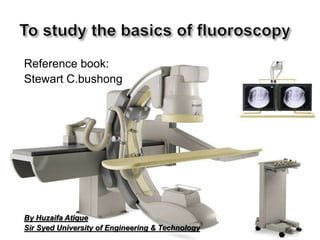
 The primary function of a fluoroscope is to perform 
dynamic studies; that is, the fluoroscope is used to 
visualize the motion of internal structures and fluids. 
 The purpose of this technique is to get real-time and 
moving images of the insides of a person by way of 
the fluoroscope. 
 If something is observed that the radiologist would 
like to preserve for later study, a radiograph can be 
made with little interruption of fluoroscopic 
examination. Such a radiograph is known as spot 
film.
 Visualization of vessels is called 
Angiography. 
 The two main areas of angiography are: 
 Neuroradiology 
Vascular Radiology. 
 And with all this procedure spot films are 
obtained. 
 During fluoroscopy the x-Ray tube is 
operated at less than 5mA. Normally 2 to 
4mA.
Components of 
Fluoroscope 
x-ray generator 
 x-ray tube 
 collimator 
 filters 
 patient table 
 grid 
 image intensifier 
 optical coupling 
television system 
image recording
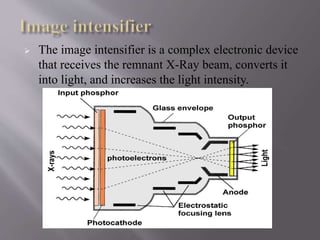
 The image intensifier is a complex electronic device 
that receives the remnant X-Ray beam, converts it 
into light, and increases the light intensity.
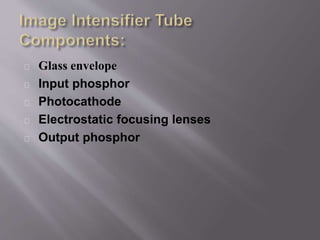
Glass envelope 
Input phosphor 
Photocathode 
Electrostatic focusing lenses 
Output phosphor
Glass envelope: 
Maintains tube vacuum to allow control of e 
flow, has no functional part in image formation. 
Input phosphor: 
X-Rays that exit the patient and are incident on 
the image intensifier tube are transmitted 
through the glass envelope and interact with 
the input phosphor, which is cesium iodide. 
When X-Rays interacts with the input 
phosphor, its energy is converted into a burst of 
visible light photons as occur on the 
intensifying screen.
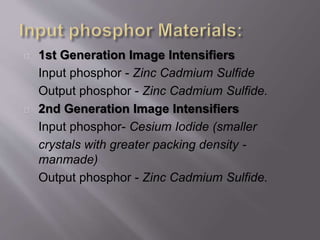
1st Generation Image Intensifiers 
Input phosphor - Zinc Cadmium Sulfide 
Output phosphor - Zinc Cadmium Sulfide. 
2nd Generation Image Intensifiers 
Input phosphor- Cesium Iodide (smaller 
crystals with greater packing density - 
manmade) 
Output phosphor - Zinc Cadmium Sulfide.
Photocathode: 
It is bonded directly to the input phosphor with a 
thin, transparent, adhesive layer. 
The photocathode is a thin metal layer, usually 
composed of cesium and antimony compounds, 
that respond to stimulation by light with the 
emission of electron. This process is known as 
photoemission.
Located along length of the tube, responsible 
for focusing the electrons across the tube from 
input to output phosphor. Image is reversed 
from input to output phosphor (right becomes 
left, superior to inferior). The concave input 
screen reduces distortion by keeping the same 
distance between all points on the input & 
output screens.
Anode is usually charged with 25 kV and is 
used to accelerate e across the tube (not a 
target) to > kinetic energy & > light produced. 
Collects stray e as well. 
The output phosphor is usually made up of zinc 
cadmium sulfide crystals. Each photoelectron that 
arrives at the output phosphor results in 
approximately 50-70times
The principal advantage of image-intensified 
fluoroscopy over earlier types of fluoroscopy is 
increased image brightness. 
Image monitoring: 
Two methods are used to electronically convert 
the visible image on the output phosphor of the 
image intensifier into an electronic signal. 
1. Thermionic television camera tube 
2. The solid state charge-coupled device 
(CCD).
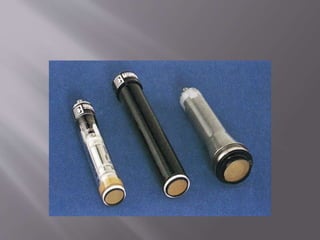
The television camera consists of cylindrical 
housing, approximately 15 mm in diameter by 
25 cm in length, that contains the heart of the 
camera, TV camera tube. 
It also contains electromagnetic coils that are 
used to properly steer the electron beam inside 
the tube. 
A number of such television camera tubes are 
available for television fluoroscopy, but the 
vidicon and its modified version, the 
Plumbicon, are used most often.
Two methods are commonly used to couple the 
television camera tube to the image-intensifier tube. 
Fiber optics. 
Lens system. 
The simplest method is to use a bundle of fiber 
optics. 
One advantage of this type of coupling is its 
compact assembly, which makes it easy to move the 
image-intensifier tower. This coupling is rugged and 
can withstand relatively rough handling. 
The principal disadvantage is that it cannot 
accommodate the additional optics required for 
devices such as cine or photospot cameras.
To accept a cine or photospot camera, lens 
coupling is required. This type of coupling 
results in a much larger assembly that should 
be handled with care. 
The objective lens accepts light from the output 
phosphor and converts it into a parallel beam. 
When an image is recorded on film, this beam 
is interrupted by a beam-splitting mirror so that 
only a portion is transmitted to the television 
camera; the remainder is reflected to a film 
camera. Such a system allows the 
fluoroscopist to view the image while it is being 
recorded.
The video signal is amplified and is transmitted 
by cable to the television monitor, where it is 
transformed back into a visible image.

Fluoroscopy presentation

  • 1.
    Reference book: StewartC.bushong By Huzaifa Atique Sir Syed University of Engineering & Technology
  • 2.
     The primaryfunction of a fluoroscope is to perform dynamic studies; that is, the fluoroscope is used to visualize the motion of internal structures and fluids.  The purpose of this technique is to get real-time and moving images of the insides of a person by way of the fluoroscope.  If something is observed that the radiologist would like to preserve for later study, a radiograph can be made with little interruption of fluoroscopic examination. Such a radiograph is known as spot film.
  • 3.
     Visualization ofvessels is called Angiography.  The two main areas of angiography are:  Neuroradiology Vascular Radiology.  And with all this procedure spot films are obtained.  During fluoroscopy the x-Ray tube is operated at less than 5mA. Normally 2 to 4mA.
  • 4.
    Components of Fluoroscope x-ray generator  x-ray tube  collimator  filters  patient table  grid  image intensifier  optical coupling television system image recording
  • 5.
     The imageintensifier is a complex electronic device that receives the remnant X-Ray beam, converts it into light, and increases the light intensity.
  • 6.
    Glass envelope Inputphosphor Photocathode Electrostatic focusing lenses Output phosphor
  • 7.
    Glass envelope: Maintainstube vacuum to allow control of e flow, has no functional part in image formation. Input phosphor: X-Rays that exit the patient and are incident on the image intensifier tube are transmitted through the glass envelope and interact with the input phosphor, which is cesium iodide. When X-Rays interacts with the input phosphor, its energy is converted into a burst of visible light photons as occur on the intensifying screen.
  • 8.
    1st Generation ImageIntensifiers Input phosphor - Zinc Cadmium Sulfide Output phosphor - Zinc Cadmium Sulfide. 2nd Generation Image Intensifiers Input phosphor- Cesium Iodide (smaller crystals with greater packing density - manmade) Output phosphor - Zinc Cadmium Sulfide.
  • 9.
    Photocathode: It isbonded directly to the input phosphor with a thin, transparent, adhesive layer. The photocathode is a thin metal layer, usually composed of cesium and antimony compounds, that respond to stimulation by light with the emission of electron. This process is known as photoemission.
  • 10.
    Located along lengthof the tube, responsible for focusing the electrons across the tube from input to output phosphor. Image is reversed from input to output phosphor (right becomes left, superior to inferior). The concave input screen reduces distortion by keeping the same distance between all points on the input & output screens.
  • 11.
    Anode is usuallycharged with 25 kV and is used to accelerate e across the tube (not a target) to > kinetic energy & > light produced. Collects stray e as well. The output phosphor is usually made up of zinc cadmium sulfide crystals. Each photoelectron that arrives at the output phosphor results in approximately 50-70times
  • 13.
    The principal advantageof image-intensified fluoroscopy over earlier types of fluoroscopy is increased image brightness. Image monitoring: Two methods are used to electronically convert the visible image on the output phosphor of the image intensifier into an electronic signal. 1. Thermionic television camera tube 2. The solid state charge-coupled device (CCD).
  • 15.
    The television cameraconsists of cylindrical housing, approximately 15 mm in diameter by 25 cm in length, that contains the heart of the camera, TV camera tube. It also contains electromagnetic coils that are used to properly steer the electron beam inside the tube. A number of such television camera tubes are available for television fluoroscopy, but the vidicon and its modified version, the Plumbicon, are used most often.
  • 17.
    Two methods arecommonly used to couple the television camera tube to the image-intensifier tube. Fiber optics. Lens system. The simplest method is to use a bundle of fiber optics. One advantage of this type of coupling is its compact assembly, which makes it easy to move the image-intensifier tower. This coupling is rugged and can withstand relatively rough handling. The principal disadvantage is that it cannot accommodate the additional optics required for devices such as cine or photospot cameras.
  • 18.
    To accept acine or photospot camera, lens coupling is required. This type of coupling results in a much larger assembly that should be handled with care. The objective lens accepts light from the output phosphor and converts it into a parallel beam. When an image is recorded on film, this beam is interrupted by a beam-splitting mirror so that only a portion is transmitted to the television camera; the remainder is reflected to a film camera. Such a system allows the fluoroscopist to view the image while it is being recorded.
  • 20.
    The video signalis amplified and is transmitted by cable to the television monitor, where it is transformed back into a visible image.