PSTN NETWORK
Content over view
 What is PSTN
 Evolution of PSTN
 Band width allocation
 Numbering schemes
 Call set-up, signaling and switching
What is PSTN?
PSTN - short for public switched telephone network,
also knows as the plain old telephone system(POTS) is
basically the inter-connected telephone system over
which telephone calls are made via copper wires.
 PSTN is based on the principles of circuit switching
 Therefore when a call is made a particular
dedicated circuit activates which eventually
deactivates when the call ends
 Telephone calls transmits as analogue signals across
copper wires
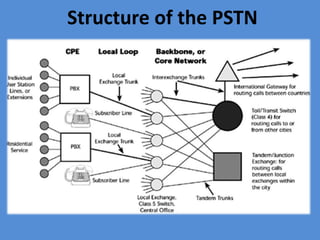
Structure of the PSTN
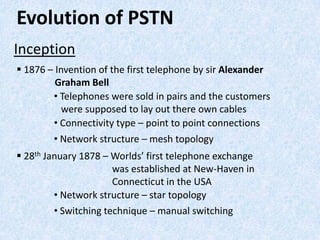
Evolution of PSTN
Inception
 1876 – Invention of the first telephone by sir Alexander
Graham Bell
 28th January 1878 – Worlds’ first telephone exchange
was established at New-Haven in
Connecticut in the USA
• Telephones were sold in pairs and the customers
were supposed to lay out there own cables
• Connectivity type – point to point connections
• Network structure – mesh topology
• Network structure – star topology
• Switching technique – manual switching
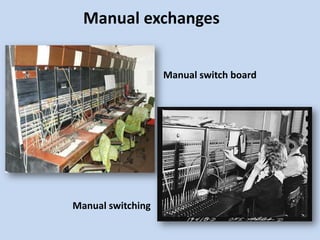
Manual exchanges
Manual switch board
Manual switching
Intermediate
 1887 – Almon Brown Strowger invented the first
electromechanical switch, known as the
Strowger switch or step by step switch
 Switch operated according to the train of pulses
generated by the customer premises telephone
 Pulses were generated by a telegraph key on the
telephone until the dial was introduces
 1920’s – Rotary dial telephones enters service
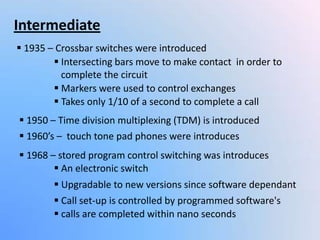
Intermediate
 1935 – Crossbar switches were introduced
 Intersecting bars move to make contact in order to
complete the circuit
 Markers were used to control exchanges
 Takes only 1/10 of a second to complete a call
 1960’s – touch tone pad phones were introduces
 1968 – stored program control switching was introduces
 calls are completed within nano seconds
 An electronic switch
 Upgradable to new versions since software dependant
 Call set-up is controlled by programmed software's
 1950 – Time division multiplexing (TDM) is introduced
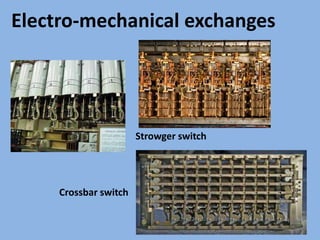
Electro-mechanical exchanges
Strowger switch
Crossbar switch
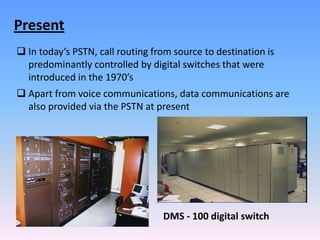
Present
 In today’s PSTN, call routing from source to destination is
predominantly controlled by digital switches that were
introduced in the 1970’s
 Apart from voice communications, data communications are
also provided via the PSTN at present
DMS - 100 digital switch
Evolution of the Telephone
Bandwidth allocation
 voice bandwidth – 300 – 3400Hz
 DSL frequency bands
 Up stream – 25.875kHz – 138kHz
 Down stream – 142kHz – 1104kHz
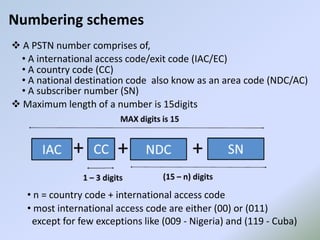
Numbering schemes
 A PSTN number comprises of,
• A international access code/exit code (IAC/EC)
• A national destination code also know as an area code (NDC/AC)
• A subscriber number (SN)
 Maximum length of a number is 15digits
• n = country code + international access code
• most international access code are either (00) or (011)
except for few exceptions like (009 - Nigeria) and (119 - Cuba)
• A country code (CC)
Signaling
 Signaling is the controlling of communications
 Basically anything but voice transmission is signaling
Ex : call setup, call termination, billing , caller ID etc…
 There are types of signaling
 Channel associated signaling (CAS) - signaling information is
transmitted within the same voice channels
 Common channel signaling (CCS) - signaling information is
transmitted via a separate channel
Ex : Dual tone multi frequency signaling (DTMF)
Ex : signaling system #7 (SS7)
 Also know as in-band signaling
 Also know as out-band signaling
Signaling
In-band signaling
out-band signaling
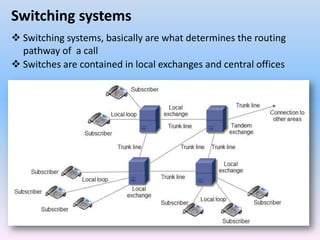
Switching systems
 Switching systems, basically are what determines the routing
pathway of a call
 Switches are contained in local exchanges and central offices
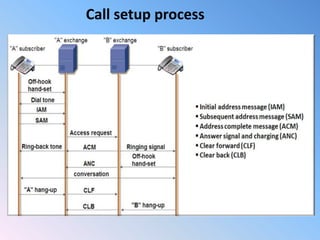
Call setup process
Call setup process
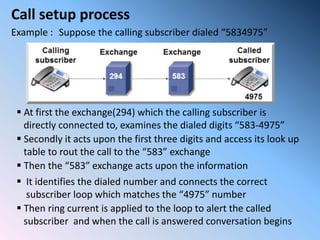
Example : Suppose the calling subscriber dialed “5834975”
 At first the exchange(294) which the calling subscriber is
directly connected to, examines the dialed digits “583-4975”
 Secondly it acts upon the first three digits and access its look up
table to rout the call to the “583” exchange
 Then the “583” exchange acts upon the information
 It identifies the dialed number and connects the correct
subscriber loop which matches the “4975” number
 Then ring current is applied to the loop to alert the called
subscriber and when the call is answered conversation begins
THANK YOU

Public Switched Telephone Network

  • 1.
  • 2.
    Content over view What is PSTN  Evolution of PSTN  Band width allocation  Numbering schemes  Call set-up, signaling and switching
  • 3.
    What is PSTN? PSTN- short for public switched telephone network, also knows as the plain old telephone system(POTS) is basically the inter-connected telephone system over which telephone calls are made via copper wires.  PSTN is based on the principles of circuit switching  Therefore when a call is made a particular dedicated circuit activates which eventually deactivates when the call ends  Telephone calls transmits as analogue signals across copper wires
  • 4.
  • 5.
    Evolution of PSTN Inception 1876 – Invention of the first telephone by sir Alexander Graham Bell  28th January 1878 – Worlds’ first telephone exchange was established at New-Haven in Connecticut in the USA • Telephones were sold in pairs and the customers were supposed to lay out there own cables • Connectivity type – point to point connections • Network structure – mesh topology • Network structure – star topology • Switching technique – manual switching
  • 6.
    Manual exchanges Manual switchboard Manual switching
  • 7.
    Intermediate  1887 –Almon Brown Strowger invented the first electromechanical switch, known as the Strowger switch or step by step switch  Switch operated according to the train of pulses generated by the customer premises telephone  Pulses were generated by a telegraph key on the telephone until the dial was introduces  1920’s – Rotary dial telephones enters service
  • 8.
    Intermediate  1935 –Crossbar switches were introduced  Intersecting bars move to make contact in order to complete the circuit  Markers were used to control exchanges  Takes only 1/10 of a second to complete a call  1960’s – touch tone pad phones were introduces  1968 – stored program control switching was introduces  calls are completed within nano seconds  An electronic switch  Upgradable to new versions since software dependant  Call set-up is controlled by programmed software's  1950 – Time division multiplexing (TDM) is introduced
  • 9.
  • 10.
    Present  In today’sPSTN, call routing from source to destination is predominantly controlled by digital switches that were introduced in the 1970’s  Apart from voice communications, data communications are also provided via the PSTN at present DMS - 100 digital switch
  • 11.
  • 12.
    Bandwidth allocation  voicebandwidth – 300 – 3400Hz  DSL frequency bands  Up stream – 25.875kHz – 138kHz  Down stream – 142kHz – 1104kHz
  • 13.
    Numbering schemes  APSTN number comprises of, • A international access code/exit code (IAC/EC) • A national destination code also know as an area code (NDC/AC) • A subscriber number (SN)  Maximum length of a number is 15digits • n = country code + international access code • most international access code are either (00) or (011) except for few exceptions like (009 - Nigeria) and (119 - Cuba) • A country code (CC)
  • 14.
    Signaling  Signaling isthe controlling of communications  Basically anything but voice transmission is signaling Ex : call setup, call termination, billing , caller ID etc…  There are types of signaling  Channel associated signaling (CAS) - signaling information is transmitted within the same voice channels  Common channel signaling (CCS) - signaling information is transmitted via a separate channel Ex : Dual tone multi frequency signaling (DTMF) Ex : signaling system #7 (SS7)  Also know as in-band signaling  Also know as out-band signaling
  • 15.
  • 16.
    Switching systems  Switchingsystems, basically are what determines the routing pathway of a call  Switches are contained in local exchanges and central offices
  • 17.
  • 18.
    Call setup process Example: Suppose the calling subscriber dialed “5834975”  At first the exchange(294) which the calling subscriber is directly connected to, examines the dialed digits “583-4975”  Secondly it acts upon the first three digits and access its look up table to rout the call to the “583” exchange  Then the “583” exchange acts upon the information  It identifies the dialed number and connects the correct subscriber loop which matches the “4975” number  Then ring current is applied to the loop to alert the called subscriber and when the call is answered conversation begins
  • 19.