Separation Lab Report
University of Engineering and Technology, Lahore-KSK Campus
0
2/20/2018
Submitted To | Sir Ahmed Shakeel
Submitted By | M. Hadeer Khalid
Roll No: 2015-CH-278
SEPARATION
LAB REPORT
GAS ABSORPTION COLUMN EQUIPMENT
Contents
Abstract: ........................................................................................................................................ 1
Gas Absorption Column: ............................................................................................................. 2
Description:...............................................................................................................................................2
Industrial Usage: .......................................................................................................................................2
Experiment No.1:.......................................................................................................................... 3
Objective:..................................................................................................................................................3
Equipment Setup: .....................................................................................................................................3
Procedure:.................................................................................................................................................4
Conclusion:................................................................................................................................................4
Observations and Calculations:.................................................................................................................4
Table:.....................................................................................................................................................5
Results:......................................................................................................................................................5
Experiment No.2:.......................................................................................................................... 6
Objective:..................................................................................................................................................6
Equipment Setup: .................................................................................................................................6
Equipment Required:............................................................................................................................6
Procedure:.................................................................................................................................................7
Observations and Calculations:.................................................................................................................9
Table No.1:............................................................................................................................................9
Table No.2:..........................................................................................................................................11
Results:....................................................................................................................................................11
Conclusion:..............................................................................................................................................11
References:................................................................................................................................... 11
Separation Lab Report
University of Engineering and Technology, Lahore-KSK Campus
1
Abstract:
The Armfield Gas Absorption Column is designed to demonstrate the
principles of gas absorption, and to provide practical training in the operation of a
gas absorption plant. In the process of gas absorption, a mixture of gases is
contacted with a liquid, for dissolving one or more components of the gas and to
provide a solution of them into the liquid. In this lab unit of gas absorption column,
we studied the transfer of phases between two fluids. The absorption of CO2 from
air to water.
Separation Lab Report
University of Engineering and Technology, Lahore-KSK Campus
2
Gas Absorption Column:
Gas absorption is a unit operation in which soluble components of a gas
mixture are dissolved in a liquid.
Most gas absorption aims at separation of acidic impurities from mixed gas
streams. These acidic impurities include carbon dioxide (CO2), hydrogen sulfide
(H2S), sulfur dioxide (SO2), and organic sulfur compounds. The most important of
these are CO2 and H2S, which occur at concentration of five to fifty percent.
(Perry, 1997).
Description:
In the process of gas absorption, a mixture of gases is contacted with a
liquid, for dissolving one or more components of the gas to the liquid solution. In
this process air is introduced into the bottom of the packed column. Flow is
adjusted by the valves. For the liquid phase, water is pumped to the top of the
column where it falls through the packing material. The contact of the two phases
is in counter-current operation and enhances the mixing and diffusion of CO2 in the
liquid phase at the conditions of room temperature and atmospheric pressure.
The outlet gas leaves the system from the top of the column. A sample of the
outlet gas mixture is taken and titrated for concentration of absorbed CO2. The
outlet liquid leaves system from bottom of the column and returns to the tank.
Samples of the liquid phase entering and exiting the system can easily be taken for
further analysis. (Geankoplis, 2003)
Industrial Usage:
Gas absorption at an industrial scale is most commonly practiced in packed
towers. A packed tower is essentially a piece of pipe set on its end and filled with
inert material or “tower packing.” (Perry, 1997)
Liquid poured into the top of the tower trickles down through the packing; gas
pumped into the bottom of the tower flows counter currently upward. The intimate
contact between gas and liquid achieved in this way effects the gas absorption. The
process may be absorption, distillation, solvent extraction or chemical reaction.
Separation Lab Report
University of Engineering and Technology, Lahore-KSK Campus
3
Experiment No.1:
Objective:
To calculate rate of absorption of Carbon Dioxide into water from analysis of
liquid solutions flowing down absorption column.
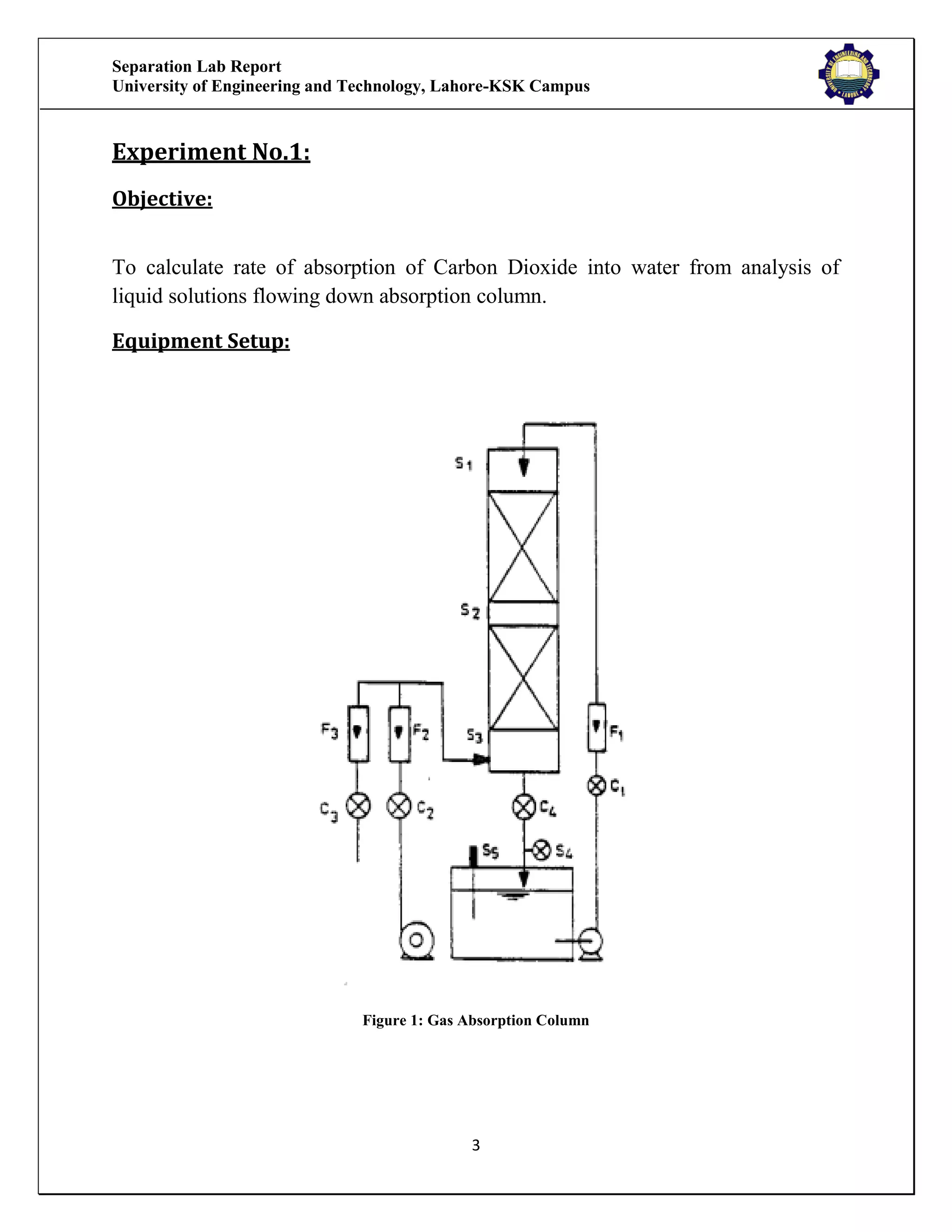
Equipment Setup:
Figure 1: Gas Absorption Column
Separation Lab Report
University of Engineering and Technology, Lahore-KSK Campus
4
Procedure:
 Filled the liquid reservoir tank with deionized water below the column one
third and noted the volume (VT in Liters added).
 We started the liquid pump at flow rate 6 liters/min by valve C1 and closing
gas control values C2 and C3.
 The compressor was started Air flow rate was adjusted 10% (40 L/min) on
scale of F2.
 Pressure valve on the compressor was opened to give flow rate of F3 that was
4 (L/min) one half of the Air flow rate F2.
 Then apparatus was kept running for 10 min so that it achieves steady state.
Then we took samples after regular 10 min intervals to test the gas
absorption in water.
 Phenolphthalein indicator was prepared from CO2 free distilled water.
 We prepared 0.02 M NaOH solution by diluting 27.70ml standard solution
of caustic soda to 1 L distilled water.
 We obtained the samples after 10 min regular intervals approx. 150ml in the
beaker.
 We added 5-10 drops of indicator phenolphthalein it shows colorless means
no CO2.
 Then we titrated it against the NaOH and noted the end point (VB) where its
color changes showing CO2 absorption.
 We calculated for three samples after 10 min intervals. (Armfield, 1993).
Conclusion:
The CO2 concentration in water increases with time showing direct relation
of absorption of gas in water and solubility is also function of temperature. As we
checked from the obtained results.
Observations and Calculations:
The amount of free CO2 (Cd) is calculated as =
F1 =6 L/min = 0.1 litre/second
VT= 15 litres
Sample Volume: 150 ml
Separation Lab Report
University of Engineering and Technology, Lahore-KSK Campus
5
Table:
Time
min
VB
Litre
Cd
gmole/litre
10 10.5 0.0014
20 17 0.00226
30 17 0.00226
Results:
 CO2 absorbed over a time (30 min):
 CO2 absorbed the column at any time:
Separation Lab Report
University of Engineering and Technology, Lahore-KSK Campus
6
Experiment No.2:
Objective:
To measure the absorption of carbon dioxide into water flowing down the tower,
using the gas analysis equipment provided.
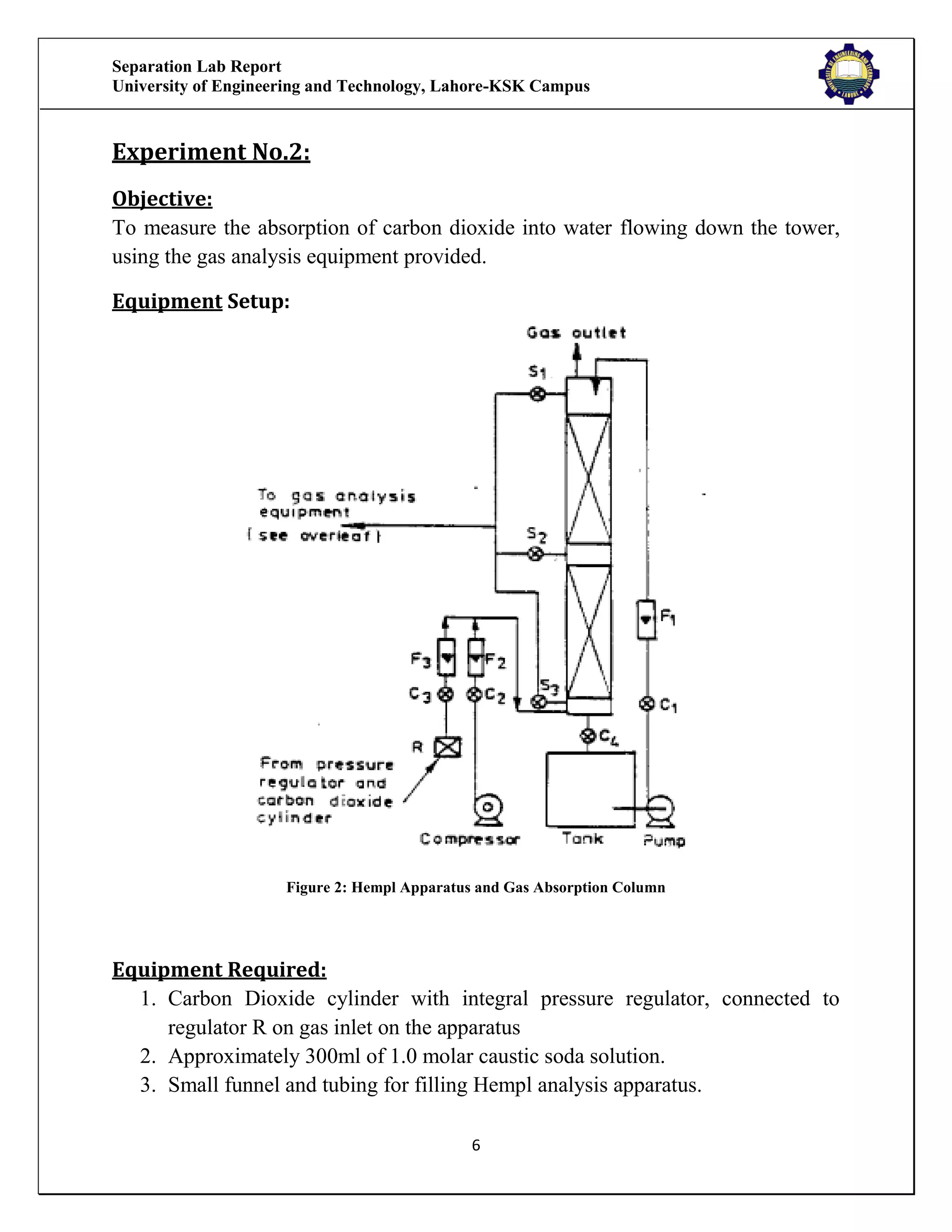
Equipment Setup:
Figure 2: Hempl Apparatus and Gas Absorption Column
Equipment Required:
1. Carbon Dioxide cylinder with integral pressure regulator, connected to
regulator R on gas inlet on the apparatus
2. Approximately 300ml of 1.0 molar caustic soda solution.
3. Small funnel and tubing for filling Hempl analysis apparatus.
Separation Lab Report
University of Engineering and Technology, Lahore-KSK Campus
7
Procedure:
 Liquid reservoir tank was filled to three-quarters with fresh tap water.
 Keeping the gas control valves C2 and C3 were closed, liquid pump was
started and water flow was adjusted to approximately 6litres/min on flow-
meter F1 using control valve C1.
 After starting water pump, the compressor was also turned on and adjusted
control valve C2 to get a flow rate of approximately 30litres/min in flow
meter F2.
 Pressure regulating valve on the carbon dioxide cylinder was opened
carefully, and control valves C3 was adjusted to give a value on the flow
meter F3 approximately one half of the air flow F2.
 Liquid seal at the base of absorption column was ensured to be maintained.
 Operation was allowed to be steady for 15 minutes.
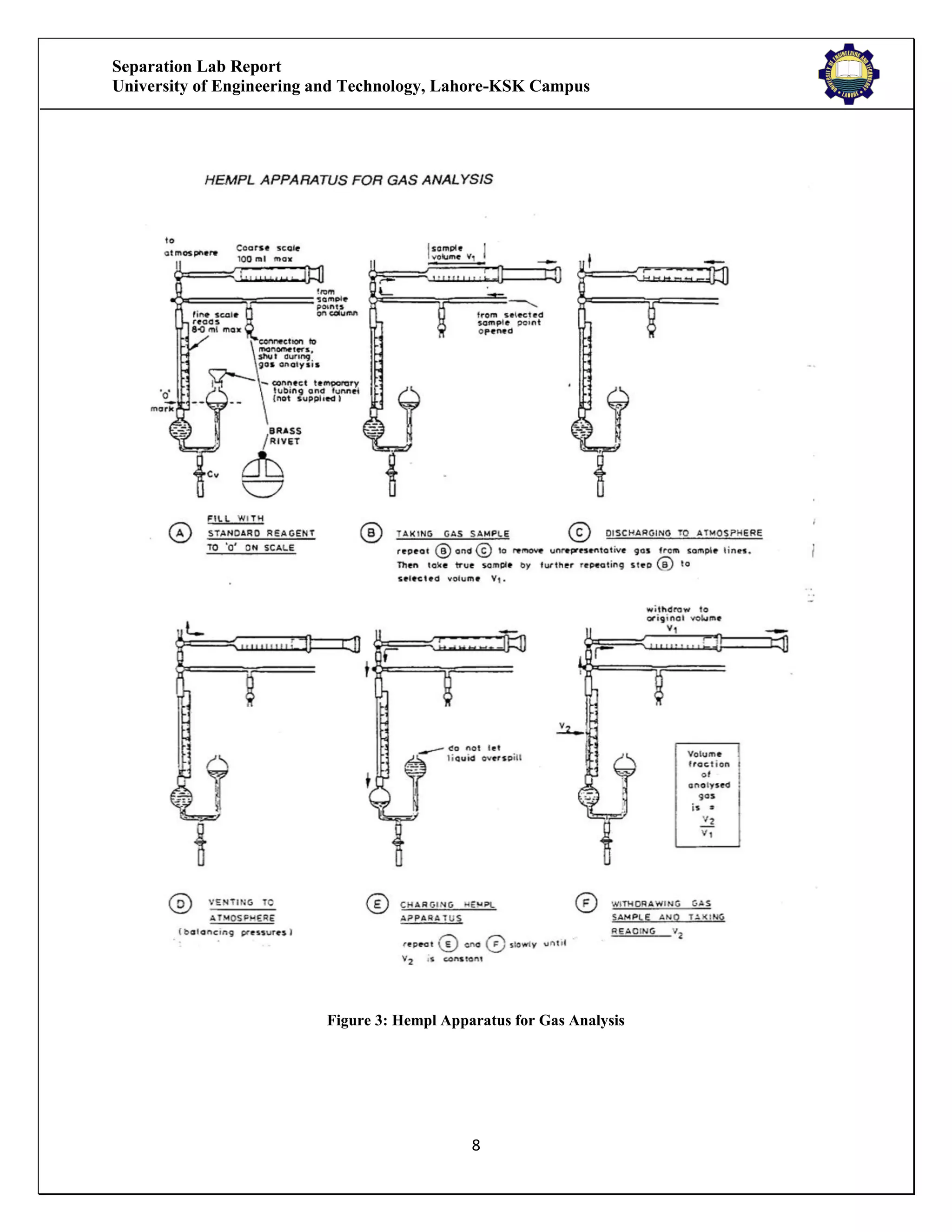
 After steadying the operation, sample was taken from points S1 and S2 and
was analyzed according to following figure (2).
 Sample lines were flushed by repeated sucking from the line, using the gas
piston and releasing the contents of cylinder to atmosphere.
 The volume of suction cylinder is 100cc. We took approximately 20cc
sample of gas in the cylinder.
 Keeping the absorption globe isolated and vent to atmosphere closed, the
cylinder was filled from selected line by drawing the piston out slowly.
 Volume V1 taken into the cylinder was noted, which was approximately
20ml. Two minute time was given to apparatus to allow the gas to come to
the temperature of cylinder.
 Cylinder was isolated from column and the absorption globe and vented the
cylinder to atmospheric pressure. Process was stopped after 10 seconds.
 Cylinder was connected to absorption globe. The liquid level was not meant
to change. If in any case it changes, connect the globe to atmospheric vent.
 We waited until the level in indicator tube was zero which showed that the
pressure in cylinder is atmospheric.
 Piston was closed slowly to empty the cylinder into absorption globe. And
then piston was drawn again slowly.
 Level in indicator tube was noted. (Armfield, 1993)
Separation Lab Report
University of Engineering and Technology, Lahore-KSK Campus
8
Figure 3: Hempl Apparatus for Gas Analysis
Separation Lab Report
University of Engineering and Technology, Lahore-KSK Campus
9
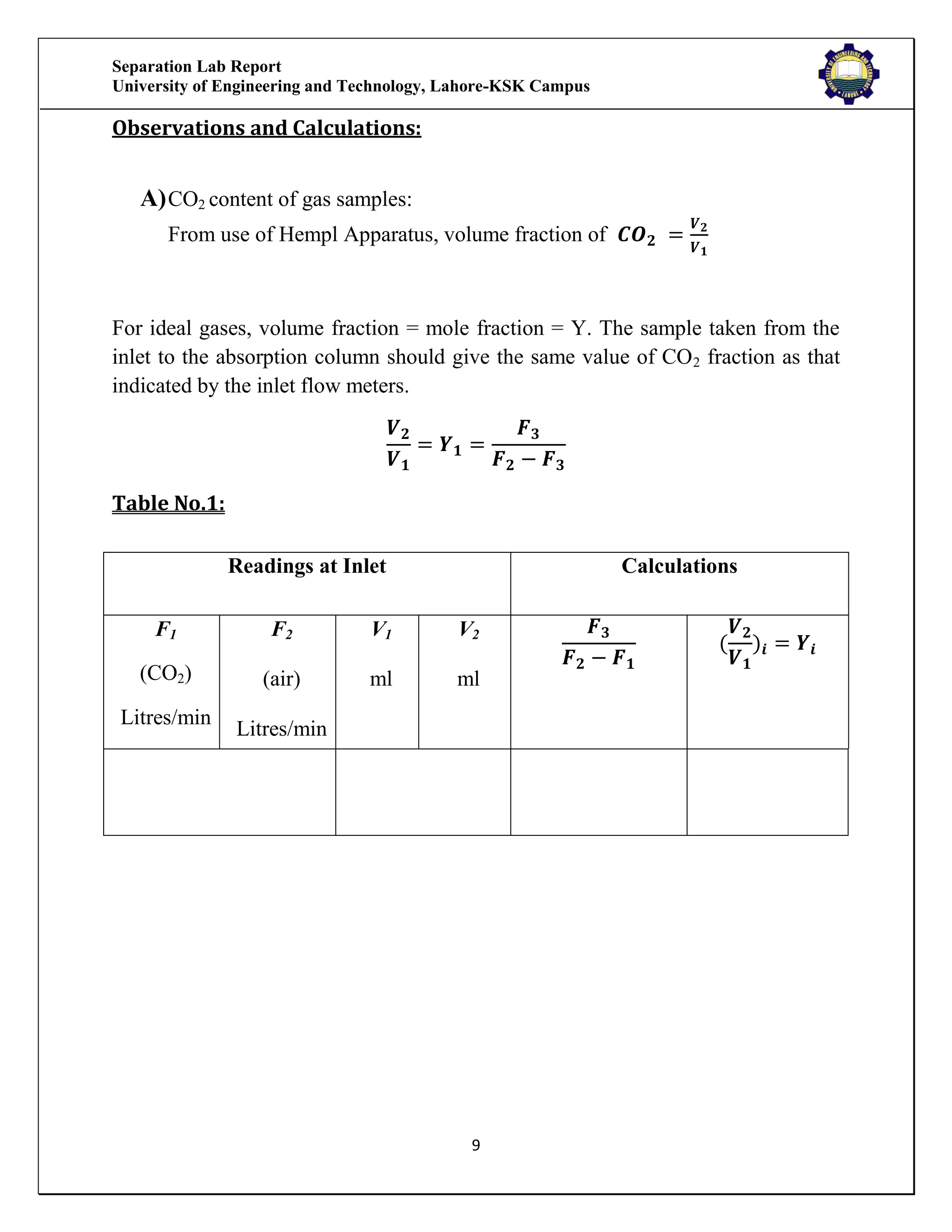
Observations and Calculations:
A)CO2 content of gas samples:
From use of Hempl Apparatus, volume fraction of
For ideal gases, volume fraction = mole fraction = Y. The sample taken from the
inlet to the absorption column should give the same value of CO2 fraction as that
indicated by the inlet flow meters.
Table No.1:
Readings at Inlet Calculations
F1
(CO2)
Litres/min
F2
(air)
Litres/min
V1
ml
V2
ml
Separation Lab Report
University of Engineering and Technology, Lahore-KSK Campus
10
B) Calculations of amount of CO2 absorbed in column from analysis of samples
at inlet and outlet.
From analysis with Hempl apparatus, volume fraction of CO2 in gas stream at inlet:
And at Outlet:
If Fa is litres/second of CO2 absorbed between top and bottom, then:
Where,
CO2 In =
CO2 Out =
CO2 absorbed = Fa
Separation Lab Report
University of Engineering and Technology, Lahore-KSK Campus
11
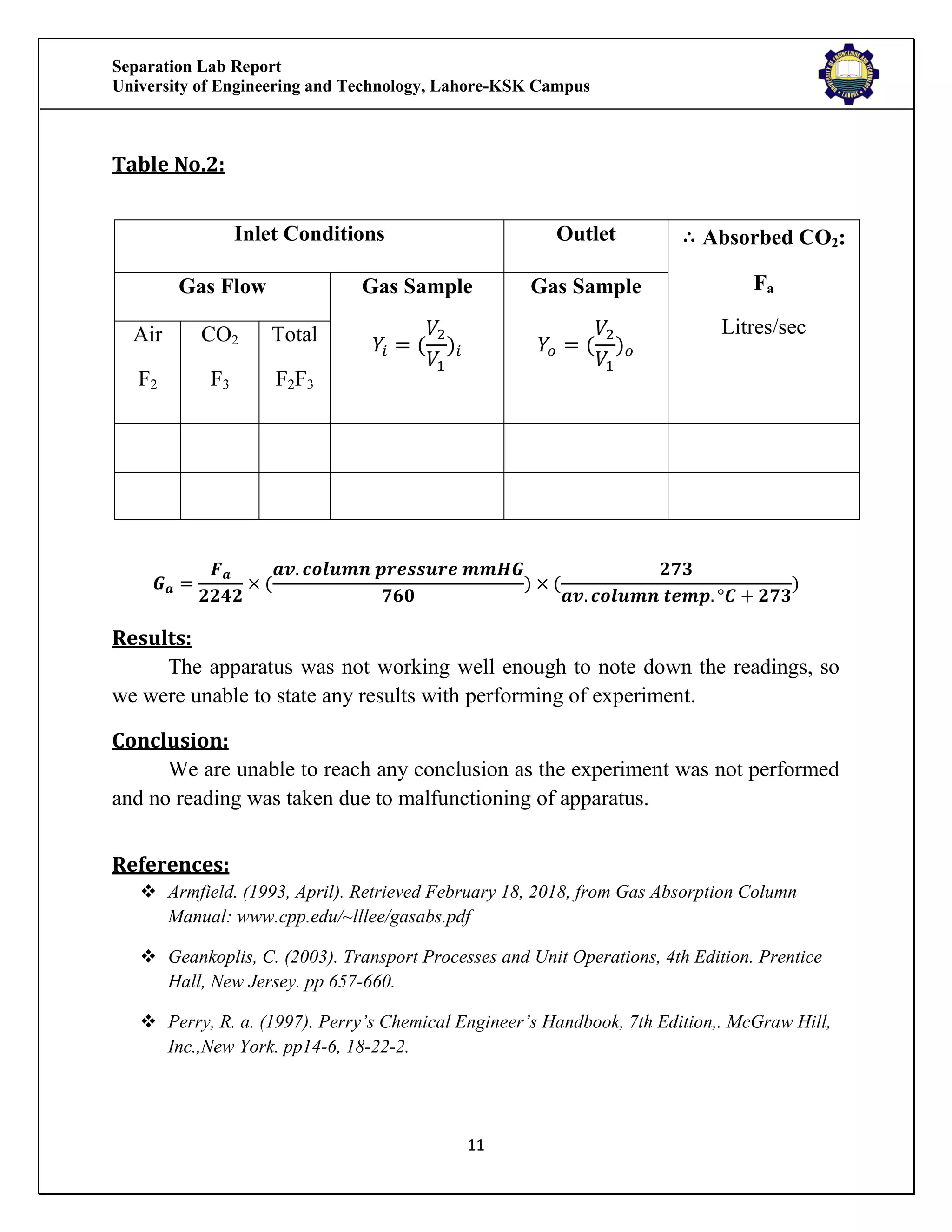
Table No.2:
Inlet Conditions Outlet Absorbed CO2:
Fa
Litres/sec
Gas Flow Gas Sample Gas Sample
Air
F2
CO2
F3
Total
F2F3
Results:
The apparatus was not working well enough to note down the readings, so
we were unable to state any results with performing of experiment.
Conclusion:
We are unable to reach any conclusion as the experiment was not performed
and no reading was taken due to malfunctioning of apparatus.
References:
 Armfield. (1993, April). Retrieved February 18, 2018, from Gas Absorption Column
Manual: www.cpp.edu/~lllee/gasabs.pdf
 Geankoplis, C. (2003). Transport Processes and Unit Operations, 4th Edition. Prentice
Hall, New Jersey. pp 657-660.
 Perry, R. a. (1997). Perry’s Chemical Engineer’s Handbook, 7th Edition,. McGraw Hill,
Inc.,New York. pp14-6, 18-22-2.

Armfield Gas Absorption Column Experiment

  • 1.
    Separation Lab Report Universityof Engineering and Technology, Lahore-KSK Campus 0 2/20/2018 Submitted To | Sir Ahmed Shakeel Submitted By | M. Hadeer Khalid Roll No: 2015-CH-278 SEPARATION LAB REPORT GAS ABSORPTION COLUMN EQUIPMENT
  • 2.
    Contents Abstract: ........................................................................................................................................ 1 GasAbsorption Column: ............................................................................................................. 2 Description:...............................................................................................................................................2 Industrial Usage: .......................................................................................................................................2 Experiment No.1:.......................................................................................................................... 3 Objective:..................................................................................................................................................3 Equipment Setup: .....................................................................................................................................3 Procedure:.................................................................................................................................................4 Conclusion:................................................................................................................................................4 Observations and Calculations:.................................................................................................................4 Table:.....................................................................................................................................................5 Results:......................................................................................................................................................5 Experiment No.2:.......................................................................................................................... 6 Objective:..................................................................................................................................................6 Equipment Setup: .................................................................................................................................6 Equipment Required:............................................................................................................................6 Procedure:.................................................................................................................................................7 Observations and Calculations:.................................................................................................................9 Table No.1:............................................................................................................................................9 Table No.2:..........................................................................................................................................11 Results:....................................................................................................................................................11 Conclusion:..............................................................................................................................................11 References:................................................................................................................................... 11
  • 3.
    Separation Lab Report Universityof Engineering and Technology, Lahore-KSK Campus 1 Abstract: The Armfield Gas Absorption Column is designed to demonstrate the principles of gas absorption, and to provide practical training in the operation of a gas absorption plant. In the process of gas absorption, a mixture of gases is contacted with a liquid, for dissolving one or more components of the gas and to provide a solution of them into the liquid. In this lab unit of gas absorption column, we studied the transfer of phases between two fluids. The absorption of CO2 from air to water.
  • 4.
    Separation Lab Report Universityof Engineering and Technology, Lahore-KSK Campus 2 Gas Absorption Column: Gas absorption is a unit operation in which soluble components of a gas mixture are dissolved in a liquid. Most gas absorption aims at separation of acidic impurities from mixed gas streams. These acidic impurities include carbon dioxide (CO2), hydrogen sulfide (H2S), sulfur dioxide (SO2), and organic sulfur compounds. The most important of these are CO2 and H2S, which occur at concentration of five to fifty percent. (Perry, 1997). Description: In the process of gas absorption, a mixture of gases is contacted with a liquid, for dissolving one or more components of the gas to the liquid solution. In this process air is introduced into the bottom of the packed column. Flow is adjusted by the valves. For the liquid phase, water is pumped to the top of the column where it falls through the packing material. The contact of the two phases is in counter-current operation and enhances the mixing and diffusion of CO2 in the liquid phase at the conditions of room temperature and atmospheric pressure. The outlet gas leaves the system from the top of the column. A sample of the outlet gas mixture is taken and titrated for concentration of absorbed CO2. The outlet liquid leaves system from bottom of the column and returns to the tank. Samples of the liquid phase entering and exiting the system can easily be taken for further analysis. (Geankoplis, 2003) Industrial Usage: Gas absorption at an industrial scale is most commonly practiced in packed towers. A packed tower is essentially a piece of pipe set on its end and filled with inert material or “tower packing.” (Perry, 1997) Liquid poured into the top of the tower trickles down through the packing; gas pumped into the bottom of the tower flows counter currently upward. The intimate contact between gas and liquid achieved in this way effects the gas absorption. The process may be absorption, distillation, solvent extraction or chemical reaction.
  • 5.
    Separation Lab Report Universityof Engineering and Technology, Lahore-KSK Campus 3 Experiment No.1: Objective: To calculate rate of absorption of Carbon Dioxide into water from analysis of liquid solutions flowing down absorption column. Equipment Setup: Figure 1: Gas Absorption Column
  • 6.
    Separation Lab Report Universityof Engineering and Technology, Lahore-KSK Campus 4 Procedure:  Filled the liquid reservoir tank with deionized water below the column one third and noted the volume (VT in Liters added).  We started the liquid pump at flow rate 6 liters/min by valve C1 and closing gas control values C2 and C3.  The compressor was started Air flow rate was adjusted 10% (40 L/min) on scale of F2.  Pressure valve on the compressor was opened to give flow rate of F3 that was 4 (L/min) one half of the Air flow rate F2.  Then apparatus was kept running for 10 min so that it achieves steady state. Then we took samples after regular 10 min intervals to test the gas absorption in water.  Phenolphthalein indicator was prepared from CO2 free distilled water.  We prepared 0.02 M NaOH solution by diluting 27.70ml standard solution of caustic soda to 1 L distilled water.  We obtained the samples after 10 min regular intervals approx. 150ml in the beaker.  We added 5-10 drops of indicator phenolphthalein it shows colorless means no CO2.  Then we titrated it against the NaOH and noted the end point (VB) where its color changes showing CO2 absorption.  We calculated for three samples after 10 min intervals. (Armfield, 1993). Conclusion: The CO2 concentration in water increases with time showing direct relation of absorption of gas in water and solubility is also function of temperature. As we checked from the obtained results. Observations and Calculations: The amount of free CO2 (Cd) is calculated as = F1 =6 L/min = 0.1 litre/second VT= 15 litres Sample Volume: 150 ml
  • 7.
    Separation Lab Report Universityof Engineering and Technology, Lahore-KSK Campus 5 Table: Time min VB Litre Cd gmole/litre 10 10.5 0.0014 20 17 0.00226 30 17 0.00226 Results:  CO2 absorbed over a time (30 min):  CO2 absorbed the column at any time:
  • 8.
    Separation Lab Report Universityof Engineering and Technology, Lahore-KSK Campus 6 Experiment No.2: Objective: To measure the absorption of carbon dioxide into water flowing down the tower, using the gas analysis equipment provided. Equipment Setup: Figure 2: Hempl Apparatus and Gas Absorption Column Equipment Required: 1. Carbon Dioxide cylinder with integral pressure regulator, connected to regulator R on gas inlet on the apparatus 2. Approximately 300ml of 1.0 molar caustic soda solution. 3. Small funnel and tubing for filling Hempl analysis apparatus.
  • 9.
    Separation Lab Report Universityof Engineering and Technology, Lahore-KSK Campus 7 Procedure:  Liquid reservoir tank was filled to three-quarters with fresh tap water.  Keeping the gas control valves C2 and C3 were closed, liquid pump was started and water flow was adjusted to approximately 6litres/min on flow- meter F1 using control valve C1.  After starting water pump, the compressor was also turned on and adjusted control valve C2 to get a flow rate of approximately 30litres/min in flow meter F2.  Pressure regulating valve on the carbon dioxide cylinder was opened carefully, and control valves C3 was adjusted to give a value on the flow meter F3 approximately one half of the air flow F2.  Liquid seal at the base of absorption column was ensured to be maintained.  Operation was allowed to be steady for 15 minutes.  After steadying the operation, sample was taken from points S1 and S2 and was analyzed according to following figure (2).  Sample lines were flushed by repeated sucking from the line, using the gas piston and releasing the contents of cylinder to atmosphere.  The volume of suction cylinder is 100cc. We took approximately 20cc sample of gas in the cylinder.  Keeping the absorption globe isolated and vent to atmosphere closed, the cylinder was filled from selected line by drawing the piston out slowly.  Volume V1 taken into the cylinder was noted, which was approximately 20ml. Two minute time was given to apparatus to allow the gas to come to the temperature of cylinder.  Cylinder was isolated from column and the absorption globe and vented the cylinder to atmospheric pressure. Process was stopped after 10 seconds.  Cylinder was connected to absorption globe. The liquid level was not meant to change. If in any case it changes, connect the globe to atmospheric vent.  We waited until the level in indicator tube was zero which showed that the pressure in cylinder is atmospheric.  Piston was closed slowly to empty the cylinder into absorption globe. And then piston was drawn again slowly.  Level in indicator tube was noted. (Armfield, 1993)
  • 10.
    Separation Lab Report Universityof Engineering and Technology, Lahore-KSK Campus 8 Figure 3: Hempl Apparatus for Gas Analysis
  • 11.
    Separation Lab Report Universityof Engineering and Technology, Lahore-KSK Campus 9 Observations and Calculations: A)CO2 content of gas samples: From use of Hempl Apparatus, volume fraction of For ideal gases, volume fraction = mole fraction = Y. The sample taken from the inlet to the absorption column should give the same value of CO2 fraction as that indicated by the inlet flow meters. Table No.1: Readings at Inlet Calculations F1 (CO2) Litres/min F2 (air) Litres/min V1 ml V2 ml
  • 12.
    Separation Lab Report Universityof Engineering and Technology, Lahore-KSK Campus 10 B) Calculations of amount of CO2 absorbed in column from analysis of samples at inlet and outlet. From analysis with Hempl apparatus, volume fraction of CO2 in gas stream at inlet: And at Outlet: If Fa is litres/second of CO2 absorbed between top and bottom, then: Where, CO2 In = CO2 Out = CO2 absorbed = Fa
  • 13.
    Separation Lab Report Universityof Engineering and Technology, Lahore-KSK Campus 11 Table No.2: Inlet Conditions Outlet Absorbed CO2: Fa Litres/sec Gas Flow Gas Sample Gas Sample Air F2 CO2 F3 Total F2F3 Results: The apparatus was not working well enough to note down the readings, so we were unable to state any results with performing of experiment. Conclusion: We are unable to reach any conclusion as the experiment was not performed and no reading was taken due to malfunctioning of apparatus. References:  Armfield. (1993, April). Retrieved February 18, 2018, from Gas Absorption Column Manual: www.cpp.edu/~lllee/gasabs.pdf  Geankoplis, C. (2003). Transport Processes and Unit Operations, 4th Edition. Prentice Hall, New Jersey. pp 657-660.  Perry, R. a. (1997). Perry’s Chemical Engineer’s Handbook, 7th Edition,. McGraw Hill, Inc.,New York. pp14-6, 18-22-2.