ENGINEERING
POLYMERS
MINI PROJECT
Materials & Metallurgy
INTRODUCTION:
➢Engineering polymers belong to a group of
polymeric materials referred to as technical
thermoplastics which can be used
permanently at temperatures between 100°C
and 150°C.
➢It possesses good mechanical and thermal
characteristics, high dimensional stability,
good chemical resistance, and resistance to
wear.
➢Engineering polymers comprise a special,
high-performance segment of synthetic
plastic materials that offer premium
properties.
INTRODUCTION:
➢When properly formulated, they may be
shaped into mechanically functional, semi-
precision parts or structural components.
➢The term “mechanically functional” implies
that the parts will continue to function even if
they are subjected to factors such as
mechanical stress, impact, flexure,
vibration, sliding friction, temperature
extremes, and hostile environments.
ADVANTAGES OF POLYMERS:
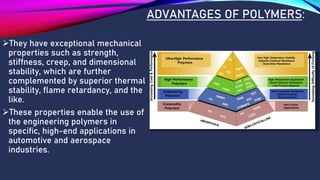
➢They have exceptional mechanical
properties such as strength,
stiffness, creep, and dimensional
stability, which are further
complemented by superior thermal
stability, flame retardancy, and the
like.
➢These properties enable the use of
the engineering polymers in
specific, high-end applications in
automotive and aerospace
industries.
ADVANTAGES OF POLYMERS
OVER METALS:
➢Polymers are more resistant to
chemicals than their metal
counterparts.
➢Polymer parts do not require post-
treatment finishing efforts, unlike
metal.
➢Polymer and composite materials are
up to ten times lighter than typical
metals.
ADVANTAGES OF POLYMERS
OVER METALS:
➢Polymer materials handle far better
than metals in chemically harsh
environments. This increases the
lifespan of the aircraft and avoids
costly repairs brought about by
corroding metal components.
➢Polymers are naturally radar
absorbent as well as thermally and
electrically insulating.
➢In medical Facilities polymer and
composite materials are easier to
clean and sterilize than metal.
DISADVANTAGES OF POLYMERS
OVER METALS :
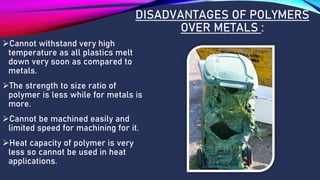
➢Cannot withstand very high
temperature as all plastics melt
down very soon as compared to
metals.
➢The strength to size ratio of
polymer is less while for metals is
more.
➢Cannot be machined easily and
limited speed for machining for it.
➢Heat capacity of polymer is very
less so cannot be used in heat
applications.
DISADVANTAGES OF POLYMERS
OVER METALS :
➢Heavy structure cannot be made by
polymer as the structural rigidity is
very less.
➢The disposal becomes an issue as
some polymer cannot be recycled
but all metals can be recycled.
TYPES OF ENGINEERING
POLYMERS:
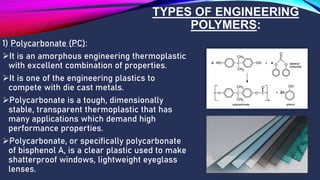
1) Polycarbonate (PC):
➢It is an amorphous engineering thermoplastic
with excellent combination of properties.
➢It is one of the engineering plastics to
compete with die cast metals.
➢Polycarbonate is a tough, dimensionally
stable, transparent thermoplastic that has
many applications which demand high
performance properties.
➢Polycarbonate, or specifically polycarbonate
of bisphenol A, is a clear plastic used to make
shatterproof windows, lightweight eyeglass
lenses.
TYPES OF ENGINEERING
POLYMERS:
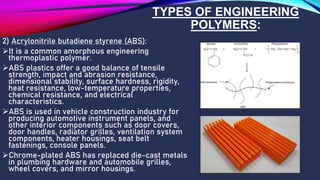
2) Acrylonitrile butadiene styrene (ABS):
➢It is a common amorphous engineering
thermoplastic polymer.
➢ABS plastics offer a good balance of tensile
strength, impact and abrasion resistance,
dimensional stability, surface hardness, rigidity,
heat resistance, low-temperature properties,
chemical resistance, and electrical
characteristics.
➢ABS is used in vehicle construction industry for
producing automotive instrument panels, and
other interior components such as door covers,
door handles, radiator grilles, ventilation system
components, heater housings, seat belt
fastenings, console panels.
➢Chrome-plated ABS has replaced die-cast metals
in plumbing hardware and automobile grilles,
wheel covers, and mirror housings.
TYPES OF ENGINEERING
POLYMERS:
3) Poly(methyl methacrylate) (PMMA):
➢ PMMA is an amorphous engineering
thermoplastic polymer.
➢It is transparent and colourless thermoplastic
that is hard and stiff but brittle and notch-
sensitive.
➢It has good abrasion and UV resistance and
excellent optical clarity but poor low
temperature, fatigue and solvent and scratch
resistances.
➢Its applications include construction of sinks,
baths, displays, signs, glazing (especially
aircraft), lenses and light covers.
TYPES OF ENGINEERING
POLYMERS:
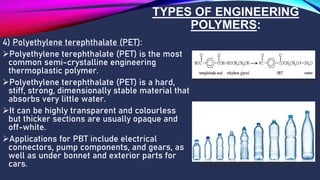
4) Polyethylene terephthalate (PET):
➢Polyethylene terephthalate (PET) is the most
common semi-crystalline engineering
thermoplastic polymer.
➢Polyethylene terephthalate (PET) is a hard,
stiff, strong, dimensionally stable material that
absorbs very little water.
➢It can be highly transparent and colourless
but thicker sections are usually opaque and
off-white.
➢Applications for PBT include electrical
connectors, pump components, and gears, as
well as under bonnet and exterior parts for
cars.
TYPES OF ENGINEERING
POLYMERS:
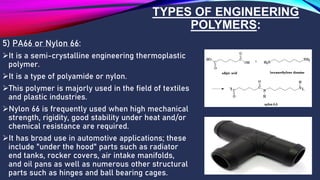
5) PA66 or Nylon 66:
➢It is a semi-crystalline engineering thermoplastic
polymer.
➢It is a type of polyamide or nylon.
➢This polymer is majorly used in the field of textiles
and plastic industries.
➢Nylon 66 is frequently used when high mechanical
strength, rigidity, good stability under heat and/or
chemical resistance are required.
➢It has broad use in automotive applications; these
include "under the hood" parts such as radiator
end tanks, rocker covers, air intake manifolds,
and oil pans as well as numerous other structural
parts such as hinges and ball bearing cages.
THANK YOU

Engineering polymers

  • 1.
  • 2.
    INTRODUCTION: ➢Engineering polymers belongto a group of polymeric materials referred to as technical thermoplastics which can be used permanently at temperatures between 100°C and 150°C. ➢It possesses good mechanical and thermal characteristics, high dimensional stability, good chemical resistance, and resistance to wear. ➢Engineering polymers comprise a special, high-performance segment of synthetic plastic materials that offer premium properties.
  • 3.
    INTRODUCTION: ➢When properly formulated,they may be shaped into mechanically functional, semi- precision parts or structural components. ➢The term “mechanically functional” implies that the parts will continue to function even if they are subjected to factors such as mechanical stress, impact, flexure, vibration, sliding friction, temperature extremes, and hostile environments.
  • 4.
    ADVANTAGES OF POLYMERS: ➢Theyhave exceptional mechanical properties such as strength, stiffness, creep, and dimensional stability, which are further complemented by superior thermal stability, flame retardancy, and the like. ➢These properties enable the use of the engineering polymers in specific, high-end applications in automotive and aerospace industries.
  • 5.
    ADVANTAGES OF POLYMERS OVERMETALS: ➢Polymers are more resistant to chemicals than their metal counterparts. ➢Polymer parts do not require post- treatment finishing efforts, unlike metal. ➢Polymer and composite materials are up to ten times lighter than typical metals.
  • 6.
    ADVANTAGES OF POLYMERS OVERMETALS: ➢Polymer materials handle far better than metals in chemically harsh environments. This increases the lifespan of the aircraft and avoids costly repairs brought about by corroding metal components. ➢Polymers are naturally radar absorbent as well as thermally and electrically insulating. ➢In medical Facilities polymer and composite materials are easier to clean and sterilize than metal.
  • 7.
    DISADVANTAGES OF POLYMERS OVERMETALS : ➢Cannot withstand very high temperature as all plastics melt down very soon as compared to metals. ➢The strength to size ratio of polymer is less while for metals is more. ➢Cannot be machined easily and limited speed for machining for it. ➢Heat capacity of polymer is very less so cannot be used in heat applications.
  • 8.
    DISADVANTAGES OF POLYMERS OVERMETALS : ➢Heavy structure cannot be made by polymer as the structural rigidity is very less. ➢The disposal becomes an issue as some polymer cannot be recycled but all metals can be recycled.
  • 9.
    TYPES OF ENGINEERING POLYMERS: 1)Polycarbonate (PC): ➢It is an amorphous engineering thermoplastic with excellent combination of properties. ➢It is one of the engineering plastics to compete with die cast metals. ➢Polycarbonate is a tough, dimensionally stable, transparent thermoplastic that has many applications which demand high performance properties. ➢Polycarbonate, or specifically polycarbonate of bisphenol A, is a clear plastic used to make shatterproof windows, lightweight eyeglass lenses.
  • 10.
    TYPES OF ENGINEERING POLYMERS: 2)Acrylonitrile butadiene styrene (ABS): ➢It is a common amorphous engineering thermoplastic polymer. ➢ABS plastics offer a good balance of tensile strength, impact and abrasion resistance, dimensional stability, surface hardness, rigidity, heat resistance, low-temperature properties, chemical resistance, and electrical characteristics. ➢ABS is used in vehicle construction industry for producing automotive instrument panels, and other interior components such as door covers, door handles, radiator grilles, ventilation system components, heater housings, seat belt fastenings, console panels. ➢Chrome-plated ABS has replaced die-cast metals in plumbing hardware and automobile grilles, wheel covers, and mirror housings.
  • 11.
    TYPES OF ENGINEERING POLYMERS: 3)Poly(methyl methacrylate) (PMMA): ➢ PMMA is an amorphous engineering thermoplastic polymer. ➢It is transparent and colourless thermoplastic that is hard and stiff but brittle and notch- sensitive. ➢It has good abrasion and UV resistance and excellent optical clarity but poor low temperature, fatigue and solvent and scratch resistances. ➢Its applications include construction of sinks, baths, displays, signs, glazing (especially aircraft), lenses and light covers.
  • 12.
    TYPES OF ENGINEERING POLYMERS: 4)Polyethylene terephthalate (PET): ➢Polyethylene terephthalate (PET) is the most common semi-crystalline engineering thermoplastic polymer. ➢Polyethylene terephthalate (PET) is a hard, stiff, strong, dimensionally stable material that absorbs very little water. ➢It can be highly transparent and colourless but thicker sections are usually opaque and off-white. ➢Applications for PBT include electrical connectors, pump components, and gears, as well as under bonnet and exterior parts for cars.
  • 13.
    TYPES OF ENGINEERING POLYMERS: 5)PA66 or Nylon 66: ➢It is a semi-crystalline engineering thermoplastic polymer. ➢It is a type of polyamide or nylon. ➢This polymer is majorly used in the field of textiles and plastic industries. ➢Nylon 66 is frequently used when high mechanical strength, rigidity, good stability under heat and/or chemical resistance are required. ➢It has broad use in automotive applications; these include "under the hood" parts such as radiator end tanks, rocker covers, air intake manifolds, and oil pans as well as numerous other structural parts such as hinges and ball bearing cages.
  • 14.