By: Farhan Hameed
The periodic table organizes the elements in a
particular way. A great deal of information about
an element can be gathered from its position in
the period table.
 For example, we can predict with reasonably good
accuracy the physical and chemical properties of
the element. We can also predict what other
elements a particular element will react with
chemically.
 Understanding the organization and plan of the
periodic table will help us to obtain basic
information about each of the 118 known
elements.
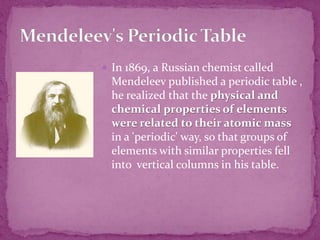
 In 1869, a Russian chemist called
Mendeleev published a periodic table ,
he realized that the physical and
chemical properties of elements
were related to their atomic mass
in a 'periodic' way, so that groups of
elements with similar properties fell
into vertical columns in his table.
 Position of Hydrogen
 The position of hydrogen was not correctly defined. It
was placed in Group I although its properties
resembled both the Group I elements (the alkali
metals) and the group VII elements (the halogens).
 Grouping of Some Elements
 In some cases Mendeleev placed elements according
to their similarities in properties and not in increasing
order of their atomic masses, while some dissimilar
elements were grouped together. Thus, the position
of these elements was not justified. For example,
cobalt (at. mass 58.9) was placed before nickel (at.
mass 58.6); copper and mercury are similar in their
properties but were placed separately. Copper was
placed in group I although it did not resemble the
elements of this group.
 Anomalous Pair
 In certain pairs of elements like, Ar (40) and K (39); Co
(58.9) and Ni (58.6); Te (127.6) and I (126.9) the
arrangement was not justified. For example, argon was
placed before potassium whereas its atomic mass is
more than potassium.
 Isotopes
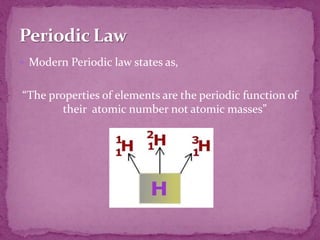
 Isotopes are atoms of the same element having
different atomic mass but same atomic number. For
e.g., there are three isotopes of hydrogen with
atomic mass 1, 2, and 3. According to Mendeleev's
periodic table these should be placed at three
separate places. However isotopes have not been
given separate places in the periodic table.
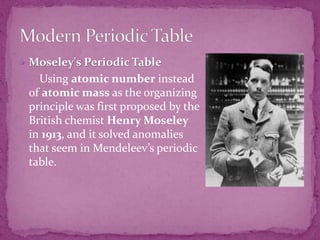
 Moseley's Periodic Table
Using atomic number instead
of atomic mass as the organizing
principle was first proposed by the
British chemist Henry Moseley
in 1913, and it solved anomalies
that seem in Mendeleev’s periodic
table.
 Modern Periodic law states as,
“The properties of elements are the periodic function of
their atomic number not atomic masses”
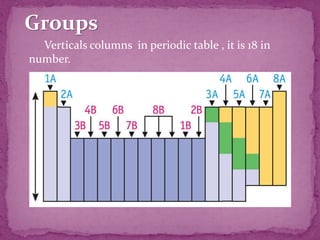
Groups
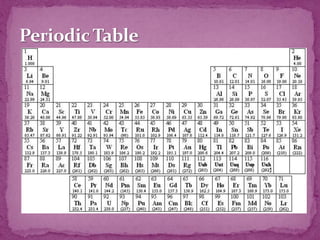
Verticals columns in periodic table , it is 18 in
number.
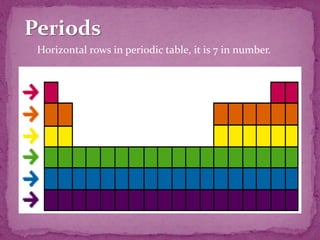
Periods
Horizontal rows in periodic table, it is 7 in number.
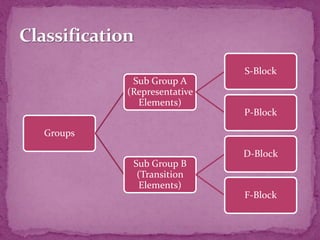
Groups
Sub Group A
(Representative
Elements)
S-Block
P-Block
Sub Group B
(Transition
Elements)
D-Block
F-Block
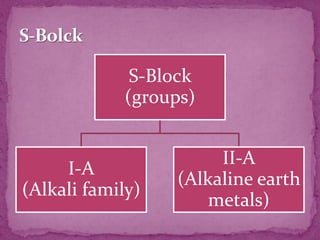
S-Block
(groups)
I-A
(Alkali family)
II-A
(Alkaline earth
metals)
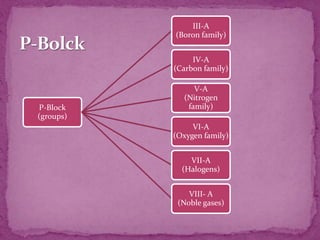
P-Block
(groups)
III-A
(Boron family)
IV-A
(Carbon family)
V-A
(Nitrogen
family)
VI-A
(Oxygen family)
VII-A
(Halogens)
VIII- A
(Noble gases)
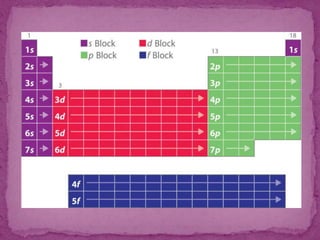
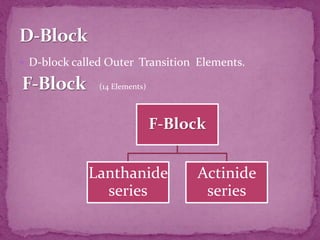
 D-block called Outer Transition Elements.
F-Block
Lanthanide
series
Actinide
series
(14 Elements)
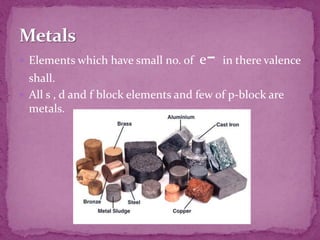
 Elements which have small no. of e- in there valence
shall.
 All s , d and f block elements and few of p-block are
metals.
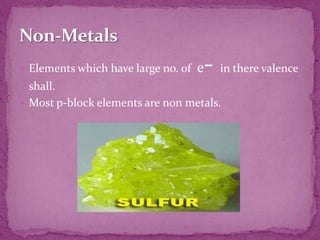
 Elements which have large no. of e- in there valence
shall.
 Most p-block elements are non metals.
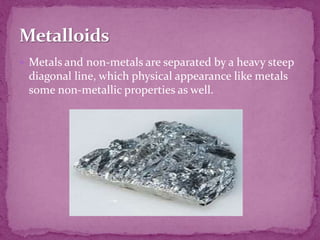
 Metals and non-metals are separated by a heavy steep
diagonal line, which physical appearance like metals
some non-metallic properties as well.
Periodic Table
Periodic Table
Periodic Table
Periodic Table
Periodic Table
Periodic Table

Periodic Table

  • 1.
  • 2.
    The periodic tableorganizes the elements in a particular way. A great deal of information about an element can be gathered from its position in the period table.
  • 3.
     For example,we can predict with reasonably good accuracy the physical and chemical properties of the element. We can also predict what other elements a particular element will react with chemically.
  • 4.
     Understanding theorganization and plan of the periodic table will help us to obtain basic information about each of the 118 known elements.
  • 5.
     In 1869,a Russian chemist called Mendeleev published a periodic table , he realized that the physical and chemical properties of elements were related to their atomic mass in a 'periodic' way, so that groups of elements with similar properties fell into vertical columns in his table.
  • 6.
     Position ofHydrogen  The position of hydrogen was not correctly defined. It was placed in Group I although its properties resembled both the Group I elements (the alkali metals) and the group VII elements (the halogens).
  • 7.
     Grouping ofSome Elements  In some cases Mendeleev placed elements according to their similarities in properties and not in increasing order of their atomic masses, while some dissimilar elements were grouped together. Thus, the position of these elements was not justified. For example, cobalt (at. mass 58.9) was placed before nickel (at. mass 58.6); copper and mercury are similar in their properties but were placed separately. Copper was placed in group I although it did not resemble the elements of this group.
  • 8.
     Anomalous Pair In certain pairs of elements like, Ar (40) and K (39); Co (58.9) and Ni (58.6); Te (127.6) and I (126.9) the arrangement was not justified. For example, argon was placed before potassium whereas its atomic mass is more than potassium.
  • 9.
     Isotopes  Isotopesare atoms of the same element having different atomic mass but same atomic number. For e.g., there are three isotopes of hydrogen with atomic mass 1, 2, and 3. According to Mendeleev's periodic table these should be placed at three separate places. However isotopes have not been given separate places in the periodic table.
  • 10.
     Moseley's PeriodicTable Using atomic number instead of atomic mass as the organizing principle was first proposed by the British chemist Henry Moseley in 1913, and it solved anomalies that seem in Mendeleev’s periodic table.
  • 11.
     Modern Periodiclaw states as, “The properties of elements are the periodic function of their atomic number not atomic masses”
  • 13.
    Groups Verticals columns inperiodic table , it is 18 in number.
  • 14.
    Periods Horizontal rows inperiodic table, it is 7 in number.
  • 15.
    Groups Sub Group A (Representative Elements) S-Block P-Block SubGroup B (Transition Elements) D-Block F-Block
  • 17.
  • 18.
  • 19.
     D-block calledOuter Transition Elements. F-Block Lanthanide series Actinide series (14 Elements)
  • 20.
     Elements whichhave small no. of e- in there valence shall.  All s , d and f block elements and few of p-block are metals.
  • 21.
     Elements whichhave large no. of e- in there valence shall.  Most p-block elements are non metals.
  • 22.
     Metals andnon-metals are separated by a heavy steep diagonal line, which physical appearance like metals some non-metallic properties as well.