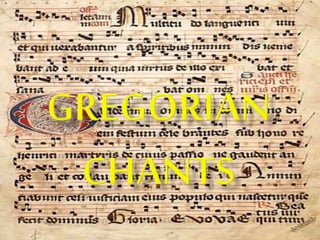
 Gregorian chant is the central tradition of
Western plainchant, a form of monophonic,
unaccompanied sacred song of the
western Roman Catholic Church.It is also
called Sung Bible.
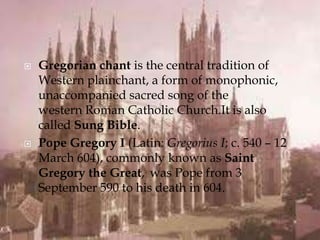
 Pope Gregory I (Latin: Gregorius I; c. 540 – 12
March 604), commonly known as Saint
Gregory the Great, was Pope from 3
September 590 to his death in 604.
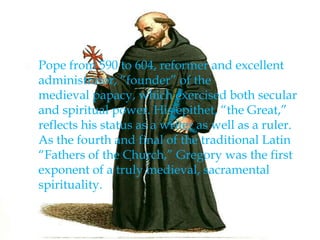
 Pope from 590 to 604, reformer and excellent
administrator, “founder” of the
medieval papacy, which exercised both secular
and spiritual power. His epithet, “the Great,”
reflects his status as a writer as well as a ruler.
As the fourth and final of the traditional Latin
“Fathers of the Church,” Gregory was the first
exponent of a truly medieval, sacramental
spirituality.
 Characteristics of the Gregorian
Chants:
 monophonic
 Free meter
 Modal
 Usually based on Latin liturgy
 Use of Neume notation
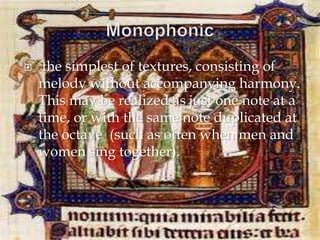
 the simplest of textures, consisting of
melody without accompanying harmony.
This may be realized as just one note at a
time, or with the same note duplicated at
the octave (such as often when men and
women sing together).
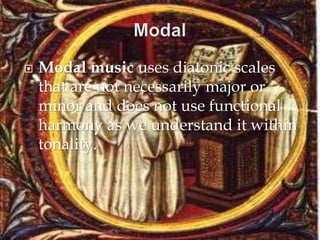
 Modal music uses diatonic scales
that are not necessarily major or
minor and does not use functional
harmony as we understand it within
tonality.
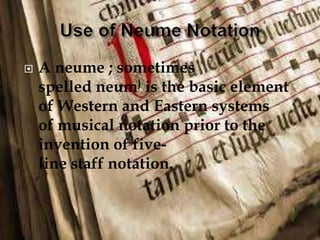
 A neume ; sometimes
spelled neum) is the basic element
of Western and Eastern systems
of musical notation prior to the
invention of five-
line staff notation.
 A troubadour (English , French: ; Occitan:
 trobador,IPA: ) was a composer and performer
of Old Occitan lyric poetry during the High
Middle Ages (1100–1350). Since the
word troubadour is etymologically masculine,
a female troubadour is usually called
a trobairitz.
 The role of the troubadours changed to part
of an elite society of royalty and nobles.
 They are poets that came from Southern
France
 from trobar "to find," earlier "invent a song,
compose in verse," perhaps from Vulgar
Latin *tropare"compose, sing," especially in
the form of tropes, from Latin tropus "a song
 the theme of courtly love.
 Music:
 Usually monophonic
 Sometimes with improvised accompaniment
 Tells of chivalry and courtly love
 Originated in France
 Written in the French language

Gregorian chants

  • 2.
     Gregorian chantis the central tradition of Western plainchant, a form of monophonic, unaccompanied sacred song of the western Roman Catholic Church.It is also called Sung Bible.  Pope Gregory I (Latin: Gregorius I; c. 540 – 12 March 604), commonly known as Saint Gregory the Great, was Pope from 3 September 590 to his death in 604.
  • 4.
     Pope from590 to 604, reformer and excellent administrator, “founder” of the medieval papacy, which exercised both secular and spiritual power. His epithet, “the Great,” reflects his status as a writer as well as a ruler. As the fourth and final of the traditional Latin “Fathers of the Church,” Gregory was the first exponent of a truly medieval, sacramental spirituality.
  • 5.
     Characteristics ofthe Gregorian Chants:  monophonic  Free meter  Modal  Usually based on Latin liturgy  Use of Neume notation
  • 6.
     the simplestof textures, consisting of melody without accompanying harmony. This may be realized as just one note at a time, or with the same note duplicated at the octave (such as often when men and women sing together).
  • 7.
     Modal musicuses diatonic scales that are not necessarily major or minor and does not use functional harmony as we understand it within tonality.
  • 8.
     A neume; sometimes spelled neum) is the basic element of Western and Eastern systems of musical notation prior to the invention of five- line staff notation.
  • 9.
     A troubadour(English , French: ; Occitan:  trobador,IPA: ) was a composer and performer of Old Occitan lyric poetry during the High Middle Ages (1100–1350). Since the word troubadour is etymologically masculine, a female troubadour is usually called a trobairitz.  The role of the troubadours changed to part of an elite society of royalty and nobles.  They are poets that came from Southern France
  • 10.
     from trobar"to find," earlier "invent a song, compose in verse," perhaps from Vulgar Latin *tropare"compose, sing," especially in the form of tropes, from Latin tropus "a song  the theme of courtly love.
  • 11.
     Music:  Usuallymonophonic  Sometimes with improvised accompaniment  Tells of chivalry and courtly love  Originated in France  Written in the French language