ROMANTIC
OPERA
 Opera became increasingly popular during the Romantic period.
 It is a story told by the composers through music while using the words of the
librettist.
 The book that the composer and librettist put together is a called a score.
 During each act, the story unfolds through the music that the singers sing.
 Different roles in the operas are created taking into account different types
of voices.
 Most dialogues are sang or in recitative style.
 Certain aria or solo singing part is what the public will remember best when
leaving the opera house.
Components of an Opera
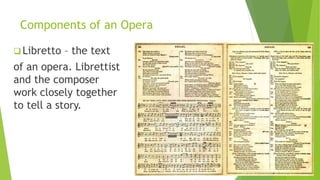
 Libretto – the text
of an opera. Librettist
and the composer
work closely together
to tell a story.
Components of an Opera
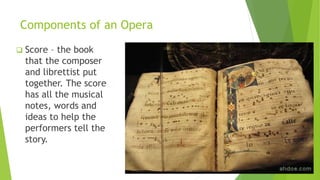
 Score – the book
that the composer
and librettist put
together. The score
has all the musical
notes, words and
ideas to help the
performers tell the
story.
Components of an Opera
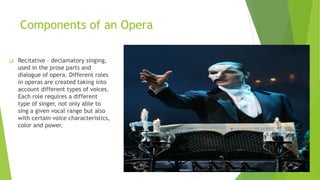
 Recitative – declamatory singing,
used in the prose parts and
dialogue of opera. Different roles
in operas are created taking into
account different types of voices.
Each role requires a different
type of singer, not only able to
sing a given vocal range but also
with certain voice characteristics,
color and power.
Components of an Opera
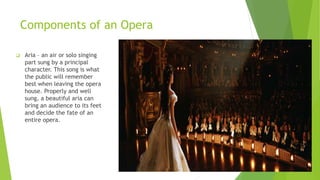
 Aria – an air or solo singing
part sung by a principal
character. This song is what
the public will remember
best when leaving the opera
house. Properly and well
sung, a beautiful aria can
bring an audience to its feet
and decide the fate of an
entire opera.
VOICE CLASSIFICATION
 FOR THE MALE VOICES:
1. Tenor – the highest male voice
2. Baritone – middle male voice, lies between Bass and Tenor voices. It
is the common male voice.
3. Bass – lowest male voice.
VOICE CLASSIFICATION
 FOR THE FEMALE VOICES:
1. Soprano – highest female voice
2. Coloratura – highest soprano voice
3. Lyric – bright and full sound
4. Dramatic – darker full sound
5. Mezzo – Soprano – most common female voice; strong middle voice, tone
is darker or deeper that the soprano
6. Contralto – lowest female voice and most unique among female
 Duet, trio, and other small
ensemble
 Chorus
 Orchestra
 Acts – main divisions of an opera
 Scene – setting or place
Musical Terms:
 A Capella – one or more singers performing without instrumental accompaniment
 Cantabile – in a singing style
 Capo – Head, the beginning
 Coda – closing section appended to a movement or song
 Dolce – sweetly
 Falsetto – a weaker and more airy voice usually in the higher pitch ranges
 Glissando – sliding quickly between 2 notes
 Passagio – parts of a singing voice where register transitions occur.
 Rubato – slight speeding up or slowing down of the tempo of a piece at the
discretion of the soloist.
 Tessitura – the most comfortable singing range of a singer.
 Vibrato – rapidly repeated slight pitch variation during a sustained note, to give a
richer and more varied sound.
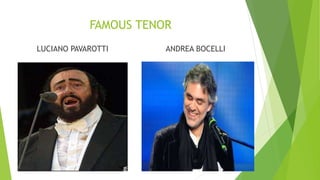
FAMOUS TENOR
LUCIANO PAVAROTTI ANDREA BOCELLI
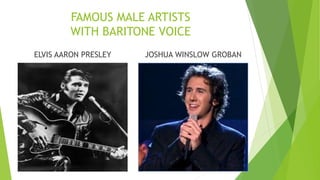
FAMOUS MALE ARTISTS
WITH BARITONE VOICE
ELVIS AARON PRESLEY JOSHUA WINSLOW GROBAN
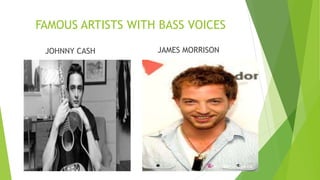
FAMOUS ARTISTS WITH BASS VOICES
JOHNNY CASH JAMES MORRISON
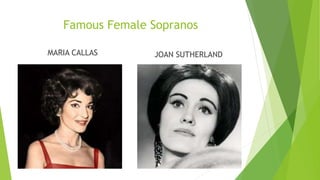
Famous Female Sopranos
MARIA CALLAS JOAN SUTHERLAND
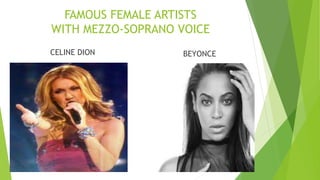
FAMOUS FEMALE ARTISTS
WITH MEZZO-SOPRANO VOICE
CELINE DION BEYONCE
FAMOUS FEMALE ARTISTS
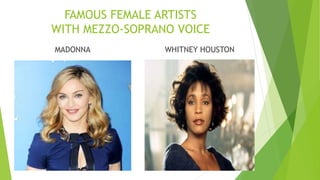
WITH MEZZO-SOPRANO VOICE
MADONNA WHITNEY HOUSTON
FAMOUS ARTISTS
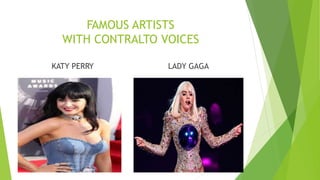
WITH CONTRALTO VOICES
KATY PERRY LADY GAGA
FAMOUS ARTISTS
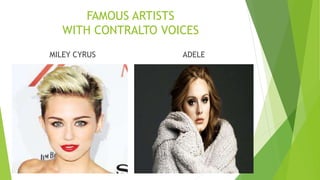
WITH CONTRALTO VOICES
MILEY CYRUS ADELE
For your activity:
 Instructions:
 Class will be grouped into two.
 Read the examples of the story of 2 famous operas of the Romantic Period.
Group 1 La Traviata
Group 2 Madame Butterfly
 Study the characteristics of the assigned opera
 Perform a mini opera regarding on the assigned opera during the Romantic Period.
GOOD LUCK!!!!

Romantic opera

  • 1.
  • 2.
     Opera becameincreasingly popular during the Romantic period.  It is a story told by the composers through music while using the words of the librettist.  The book that the composer and librettist put together is a called a score.  During each act, the story unfolds through the music that the singers sing.  Different roles in the operas are created taking into account different types of voices.  Most dialogues are sang or in recitative style.  Certain aria or solo singing part is what the public will remember best when leaving the opera house.
  • 3.
    Components of anOpera  Libretto – the text of an opera. Librettist and the composer work closely together to tell a story.
  • 4.
    Components of anOpera  Score – the book that the composer and librettist put together. The score has all the musical notes, words and ideas to help the performers tell the story.
  • 5.
    Components of anOpera  Recitative – declamatory singing, used in the prose parts and dialogue of opera. Different roles in operas are created taking into account different types of voices. Each role requires a different type of singer, not only able to sing a given vocal range but also with certain voice characteristics, color and power.
  • 6.
    Components of anOpera  Aria – an air or solo singing part sung by a principal character. This song is what the public will remember best when leaving the opera house. Properly and well sung, a beautiful aria can bring an audience to its feet and decide the fate of an entire opera.
  • 8.
    VOICE CLASSIFICATION  FORTHE MALE VOICES: 1. Tenor – the highest male voice 2. Baritone – middle male voice, lies between Bass and Tenor voices. It is the common male voice. 3. Bass – lowest male voice.
  • 9.
    VOICE CLASSIFICATION  FORTHE FEMALE VOICES: 1. Soprano – highest female voice 2. Coloratura – highest soprano voice 3. Lyric – bright and full sound 4. Dramatic – darker full sound 5. Mezzo – Soprano – most common female voice; strong middle voice, tone is darker or deeper that the soprano 6. Contralto – lowest female voice and most unique among female
  • 10.
     Duet, trio,and other small ensemble  Chorus  Orchestra  Acts – main divisions of an opera  Scene – setting or place
  • 11.
    Musical Terms:  ACapella – one or more singers performing without instrumental accompaniment  Cantabile – in a singing style  Capo – Head, the beginning  Coda – closing section appended to a movement or song  Dolce – sweetly  Falsetto – a weaker and more airy voice usually in the higher pitch ranges  Glissando – sliding quickly between 2 notes  Passagio – parts of a singing voice where register transitions occur.  Rubato – slight speeding up or slowing down of the tempo of a piece at the discretion of the soloist.  Tessitura – the most comfortable singing range of a singer.  Vibrato – rapidly repeated slight pitch variation during a sustained note, to give a richer and more varied sound.
  • 12.
  • 13.
    FAMOUS MALE ARTISTS WITHBARITONE VOICE ELVIS AARON PRESLEY JOSHUA WINSLOW GROBAN
  • 14.
    FAMOUS ARTISTS WITHBASS VOICES JOHNNY CASH JAMES MORRISON
  • 15.
    Famous Female Sopranos MARIACALLAS JOAN SUTHERLAND
  • 16.
    FAMOUS FEMALE ARTISTS WITHMEZZO-SOPRANO VOICE CELINE DION BEYONCE
  • 17.
    FAMOUS FEMALE ARTISTS WITHMEZZO-SOPRANO VOICE MADONNA WHITNEY HOUSTON
  • 18.
    FAMOUS ARTISTS WITH CONTRALTOVOICES KATY PERRY LADY GAGA
  • 19.
    FAMOUS ARTISTS WITH CONTRALTOVOICES MILEY CYRUS ADELE
  • 20.
    For your activity: Instructions:  Class will be grouped into two.  Read the examples of the story of 2 famous operas of the Romantic Period. Group 1 La Traviata Group 2 Madame Butterfly  Study the characteristics of the assigned opera  Perform a mini opera regarding on the assigned opera during the Romantic Period. GOOD LUCK!!!!