Earthquake
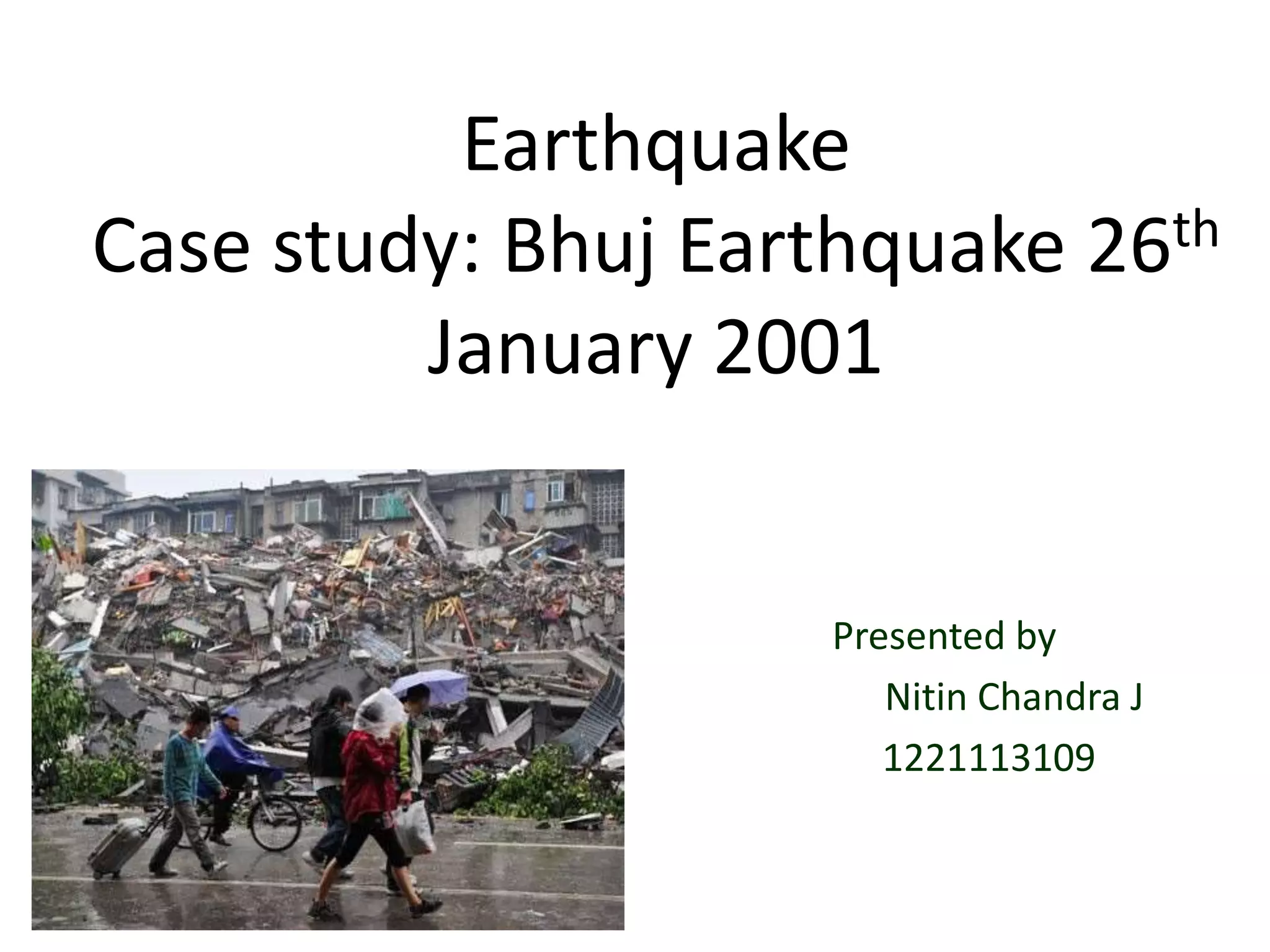
Case study: Bhuj Earthquake 26th
January 2001
Presented by
Nitin Chandra J
1221113109
Disaster
A disaster is a natural or man-made (or
technological) hazard resulting in an event of
substantial extent causing significant physical damage
or destruction, loss of life, or drastic change to
the environment.
Classification of Disaster
Natural disasters
Human made disasters
Human induced disasters
Earthquake?
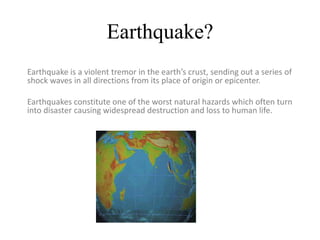
Earthquake is a violent tremor in the earth’s crust, sending out a series of
shock waves in all directions from its place of origin or epicenter.
Earthquakes constitute one of the worst natural hazards which often turn
into disaster causing widespread destruction and loss to human life.
Causes of Earthquake
Earthquakes are caused by sudden release of energy
in rocks.
Plates in the form of rocks are moving very slowly
and earthquake occur when moving plates grind and
scrape against each other.
Terminology : The point at which an earthquake
originates is the focus or hypocenter and the point on
the earth’s surface directly above this is epicenter.
The study of earthquake is called seismology.
Tectonic Plates
There are 7 large and 12 small such plates which are in continuous
motion.
These plates move along three distinctive types of boundaries, that is :
Convergent boundaries : where plates push each other and
one plate slides down the other one
Divergent boundaries: where plates pull away from each
other
Transformed boundaries : where plates slide past each other.
Earthquake occur due to several causes such as volcanic eruption, etc.
but the plate tectonic theory is the most convincing and widely accepted
Strength of earthquake
The intensity and strength of an earthquake is measured on
Richter scale, the scale invented by Charles Richter
California, USA in 1935, which categories earthquake on the
basis of energy released.
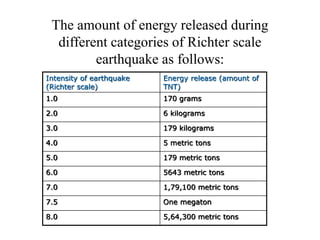
The amount of energy released during
different categories of Richter scale
earthquake as follows:
Intensity of earthquake
(Richter scale)
Energy release (amount of
TNT)
1.0 170 grams
2.0 6 kilograms
3.0 179 kilograms
4.0 5 metric tons
5.0 179 metric tons
6.0 5643 metric tons
7.0 1,79,100 metric tons
7.5 One megaton
8.0 5,64,300 metric tons
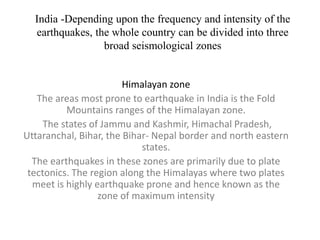
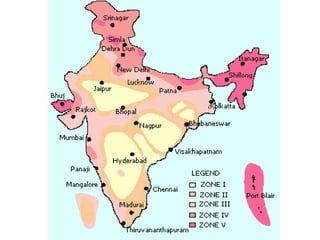
India -Depending upon the frequency and intensity of the
earthquakes, the whole country can be divided into three
broad seismological zones
Himalayan zone
The areas most prone to earthquake in India is the Fold
Mountains ranges of the Himalayan zone.
The states of Jammu and Kashmir, Himachal Pradesh,
Uttaranchal, Bihar, the Bihar- Nepal border and north eastern
states.
The earthquakes in these zones are primarily due to plate
tectonics. The region along the Himalayas where two plates
meet is highly earthquake prone and hence known as the
zone of maximum intensity
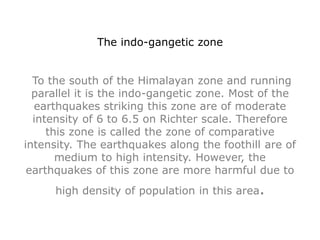
The indo-gangetic zone
To the south of the Himalayan zone and running
parallel it is the indo-gangetic zone. Most of the
earthquakes striking this zone are of moderate
intensity of 6 to 6.5 on Richter scale. Therefore
this zone is called the zone of comparative
intensity. The earthquakes along the foothill are of
medium to high intensity. However, the
earthquakes of this zone are more harmful due to
high density of population in this area.
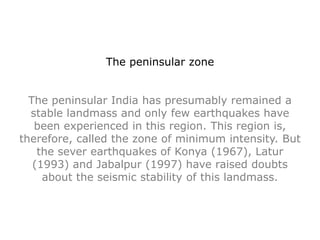
The peninsular zone
The peninsular India has presumably remained a
stable landmass and only few earthquakes have
been experienced in this region. This region is,
therefore, called the zone of minimum intensity. But
the sever earthquakes of Konya (1967), Latur
(1993) and Jabalpur (1997) have raised doubts
about the seismic stability of this landmass.
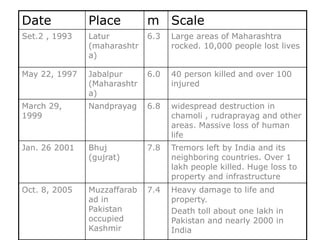
Date Place m Scale
Set.2 , 1993 Latur
(maharashtr
a)
6.3 Large areas of Maharashtra
rocked. 10,000 people lost lives
May 22, 1997 Jabalpur
(Maharashtr
a)
6.0 40 person killed and over 100
injured
March 29,
1999
Nandprayag 6.8 widespread destruction in
chamoli , rudraprayag and other
areas. Massive loss of human
life
Jan. 26 2001 Bhuj
(gujrat)
7.8 Tremors left by India and its
neighboring countries. Over 1
lakh people killed. Huge loss to
property and infrastructure
Oct. 8, 2005 Muzzaffarab
ad in
Pakistan
occupied
Kashmir
7.4 Heavy damage to life and
property.
Death toll about one lakh in
Pakistan and nearly 2000 in
India
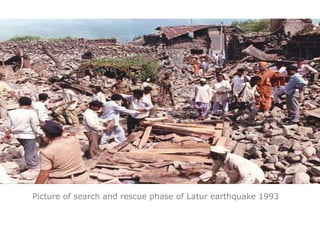
Picture of search and rescue phase of Latur earthquake 1993
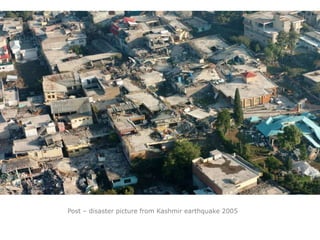
Post – disaster picture from Kashmir earthquake 2005
Hazardous Effects of Earthquake
- Loss of life and property
- Damage to infrastructure
- Topographical changes
- Damage to transport system i.e. roads, railways, highways,
airports, marine.
- Chances of fire short-circuit.
- Chances of Floods – Dams and Embankments can develop cracks
- Chances of outburst of epidemic
- Water pipes, sewers are disrupted
- Communications such as telephone wires are damaged.
- Economic activities like agriculture, industry, trade and transport
are severely affected.
Introduction to Gujarat
Gujarat, state, in western India, bordered on the northeast by Rajasthan
state, on the east by Madhya Pradesh state, on the southeast by
Maharashtra state, on the south and southwest by the Arabian Sea, and on
the northwest by Pakistan
The state covers an area of 196,024 sq km (The capital is Gandhinagar, on
the outskirts of Ahmadabad, the former capital and largest city in the state.
Date:
Origin line:
Epicenter:
Magnitude:
Focal Depth:
26 January 2001
08 hrs.46 min. 42.9 sec. IST
Latitude 23.40° N Longitude 70.28° E
7.7
25 kms.
Bhuj Earthquake 26th January. 2001
On the morning of January 26, 2001, the Nation’s 52nd Republic Day, a
devastating earthquake occurred in the Kutch district of the state
of Gujarat.
The earthquake was felt as far away as Delhi in the north, Kolkata in
the east and Chennai in the south.
Bhuj town and the village Bhachau, 60 km east of Bhuj, were the worst
affected and many other areas of Gujarat including its state
headquarters Ahmedabad, were badly affected
The earthquake devastated the Bhuj and nearby regions
of Gujarat causing extensive loss of life and property.
Damage assessment
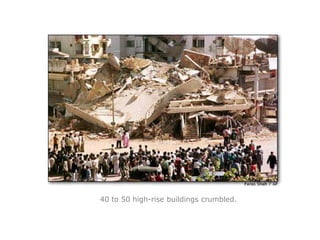
• There were more than 20,000 deaths and 167,000 people injured
• Four districts of Gujarat lay in ruin and altogether, 21 districts were
affected
• Around 300,000 families and at least 3 million children aged 14 and under
were affected.
• Around 600,000 people were left homeless.
• In the city of Bhuj, more than 3,000 inhabitants of the city lost their lives;
the main hospital was crushed and close to 90% of the buildings was
destroyed.
• There was significant damage to infrastructure with facilities such as
hospitals, schools, electric power and water systems, bridges and roads
damaged or destroyed.
40 to 50 high-rise buildings crumbled.
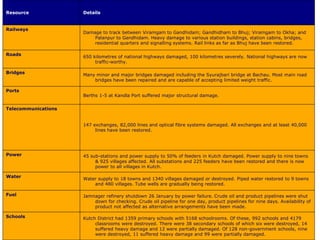
Resource Details
Railways
Damage to track between Viramgam to Gandhidam; Gandhidham to Bhuj; Viramgam to Okha; and
Palanpur to Gandhidam. Heavy damage to various station buildings, station cabins, bridges,
residential quarters and signalling systems. Rail links as far as Bhuj have been restored.
Roads
650 kilometres of national highways damaged, 100 kilometres severely. National highways are now
traffic-worthy.
Bridges
Many minor and major bridges damaged including the Syurajbari bridge at Bachau. Most main road
bridges have been repaired and are capable of accepting limited weight traffic.
Ports
Berths 1-5 at Kandla Port suffered major structural damage.
Telecommunications
147 exchanges, 82,000 lines and optical fibre systems damaged. All exchanges and at least 40,000
lines have been restored.
Power 45 sub-stations and power supply to 50% of feeders in Kutch damaged. Power supply to nine towns
& 925 villages affected. All substations and 225 feeders have been restored and there is now
power to all villages in Kutch.
Water
Water supply to 18 towns and 1340 villages damaged or destroyed. Piped water restored to 9 towns
and 480 villages. Tube wells are gradually being restored.
Fuel Jamnager refinery shutdown 26 January by power failure. Crude oil and product pipelines were shut
down for checking. Crude oil pipeline for one day, product pipelines for nine days. Availability of
product not affected as alternative arrangements have been made.
Schools Kutch District had 1359 primary schools with 5168 schoolrooms. Of these, 992 schools and 4179
classrooms were destroyed. There were 38 secondary schools of which six were destroyed, 14
suffered heavy damage and 12 were partially damaged. Of 128 non-government schools, nine
were destroyed, 11 suffered heavy damage and 99 were partially damaged.
Local response
The response within India was immediate. The national and
state governments quickly provided assistance in many forms
including cash, medical supplies, communications teams,
shelters, food, clothing, transport and relief workers.
There were more than 185 non-government organizations
(NGOs), mostly Indian charities, which undertook earthquake-
related activities
International response
Search and Rescue teams soon arrived from
Switzerland, United Kingdom, Russia and Turkey to find
and rescue survivors buried under debris.
Relief teams and supplies soon followed from 38
countries as well as United Nations agencies and many
international NGOs such as the Red Cross.
Rescue & Relief
The short term rescue and relief operation were being
undertaken, medium term and long term recovery
aspects were analyzed. Rehabilitation schemes
Government of Gujarat tired to, known as packages,
were formulated.
The world bank and Asian development bank sanction
loans in less than three months after the earthquake.
Contd.
Several state governments came forward to participate in, the
reconstruction work in different villages.
The UN system, multilateral and bilateral agencies, NGOs and the
corporate sector participated in the relief and reconstruction
work.
Government of Gujarat provided assistance in the form of
materials and cash to about 218,000 families.
NGOs supplemented the efforts by providing shelter to about
7000 families.
Reconstruction
A public private partnership program was started to help in
reconstruction, which was undertaken by GSDMA.
A number of NGOs like FICCI-CARE venture, manav sadhana, rashtriya
swabhiman, jai prakash industries, etc. came forward to help. About 65
NGOs were active in kutch alone who adopted 211 villages and
constructed 32,297 houses at the cost of Rs. 185.80 crores.
Gujarat earthquake emergency reconstruction project (GEERP) was
started by GSDMA, with financial help from world bank, Asian
development bank, govt of India and other donor agencies.
Contd.
Architects, engineers and masons were trained in
construction of disaster resistant houses
. The technical support was made available to the
owners who were provided loan to reconstruct the
houses. The houses were registered in the joint names
of husband and wife. More than 2 lac houses have been
constructed under this program; all houses being multi
hazard resistant.
Thank you!!!

Earthquake case study

  • 1.
    Earthquake Case study: BhujEarthquake 26th January 2001 Presented by Nitin Chandra J 1221113109
  • 2.
    Disaster A disaster isa natural or man-made (or technological) hazard resulting in an event of substantial extent causing significant physical damage or destruction, loss of life, or drastic change to the environment.
  • 3.
    Classification of Disaster Naturaldisasters Human made disasters Human induced disasters
  • 4.
    Earthquake? Earthquake is aviolent tremor in the earth’s crust, sending out a series of shock waves in all directions from its place of origin or epicenter. Earthquakes constitute one of the worst natural hazards which often turn into disaster causing widespread destruction and loss to human life.
  • 5.
    Causes of Earthquake Earthquakesare caused by sudden release of energy in rocks. Plates in the form of rocks are moving very slowly and earthquake occur when moving plates grind and scrape against each other. Terminology : The point at which an earthquake originates is the focus or hypocenter and the point on the earth’s surface directly above this is epicenter. The study of earthquake is called seismology.
  • 6.
    Tectonic Plates There are7 large and 12 small such plates which are in continuous motion. These plates move along three distinctive types of boundaries, that is : Convergent boundaries : where plates push each other and one plate slides down the other one Divergent boundaries: where plates pull away from each other Transformed boundaries : where plates slide past each other. Earthquake occur due to several causes such as volcanic eruption, etc. but the plate tectonic theory is the most convincing and widely accepted
  • 8.
    Strength of earthquake Theintensity and strength of an earthquake is measured on Richter scale, the scale invented by Charles Richter California, USA in 1935, which categories earthquake on the basis of energy released.
  • 9.
    The amount ofenergy released during different categories of Richter scale earthquake as follows: Intensity of earthquake (Richter scale) Energy release (amount of TNT) 1.0 170 grams 2.0 6 kilograms 3.0 179 kilograms 4.0 5 metric tons 5.0 179 metric tons 6.0 5643 metric tons 7.0 1,79,100 metric tons 7.5 One megaton 8.0 5,64,300 metric tons
  • 10.
    India -Depending uponthe frequency and intensity of the earthquakes, the whole country can be divided into three broad seismological zones Himalayan zone The areas most prone to earthquake in India is the Fold Mountains ranges of the Himalayan zone. The states of Jammu and Kashmir, Himachal Pradesh, Uttaranchal, Bihar, the Bihar- Nepal border and north eastern states. The earthquakes in these zones are primarily due to plate tectonics. The region along the Himalayas where two plates meet is highly earthquake prone and hence known as the zone of maximum intensity
  • 11.
    The indo-gangetic zone Tothe south of the Himalayan zone and running parallel it is the indo-gangetic zone. Most of the earthquakes striking this zone are of moderate intensity of 6 to 6.5 on Richter scale. Therefore this zone is called the zone of comparative intensity. The earthquakes along the foothill are of medium to high intensity. However, the earthquakes of this zone are more harmful due to high density of population in this area.
  • 12.
    The peninsular zone Thepeninsular India has presumably remained a stable landmass and only few earthquakes have been experienced in this region. This region is, therefore, called the zone of minimum intensity. But the sever earthquakes of Konya (1967), Latur (1993) and Jabalpur (1997) have raised doubts about the seismic stability of this landmass.
  • 14.
    Date Place mScale Set.2 , 1993 Latur (maharashtr a) 6.3 Large areas of Maharashtra rocked. 10,000 people lost lives May 22, 1997 Jabalpur (Maharashtr a) 6.0 40 person killed and over 100 injured March 29, 1999 Nandprayag 6.8 widespread destruction in chamoli , rudraprayag and other areas. Massive loss of human life Jan. 26 2001 Bhuj (gujrat) 7.8 Tremors left by India and its neighboring countries. Over 1 lakh people killed. Huge loss to property and infrastructure Oct. 8, 2005 Muzzaffarab ad in Pakistan occupied Kashmir 7.4 Heavy damage to life and property. Death toll about one lakh in Pakistan and nearly 2000 in India
  • 15.
    Picture of searchand rescue phase of Latur earthquake 1993
  • 16.
    Post – disasterpicture from Kashmir earthquake 2005
  • 17.
    Hazardous Effects ofEarthquake - Loss of life and property - Damage to infrastructure - Topographical changes - Damage to transport system i.e. roads, railways, highways, airports, marine. - Chances of fire short-circuit. - Chances of Floods – Dams and Embankments can develop cracks - Chances of outburst of epidemic - Water pipes, sewers are disrupted - Communications such as telephone wires are damaged. - Economic activities like agriculture, industry, trade and transport are severely affected.
  • 18.
    Introduction to Gujarat Gujarat,state, in western India, bordered on the northeast by Rajasthan state, on the east by Madhya Pradesh state, on the southeast by Maharashtra state, on the south and southwest by the Arabian Sea, and on the northwest by Pakistan The state covers an area of 196,024 sq km (The capital is Gandhinagar, on the outskirts of Ahmadabad, the former capital and largest city in the state. Date: Origin line: Epicenter: Magnitude: Focal Depth: 26 January 2001 08 hrs.46 min. 42.9 sec. IST Latitude 23.40° N Longitude 70.28° E 7.7 25 kms.
  • 19.
    Bhuj Earthquake 26thJanuary. 2001 On the morning of January 26, 2001, the Nation’s 52nd Republic Day, a devastating earthquake occurred in the Kutch district of the state of Gujarat. The earthquake was felt as far away as Delhi in the north, Kolkata in the east and Chennai in the south. Bhuj town and the village Bhachau, 60 km east of Bhuj, were the worst affected and many other areas of Gujarat including its state headquarters Ahmedabad, were badly affected The earthquake devastated the Bhuj and nearby regions of Gujarat causing extensive loss of life and property.
  • 20.
    Damage assessment • Therewere more than 20,000 deaths and 167,000 people injured • Four districts of Gujarat lay in ruin and altogether, 21 districts were affected • Around 300,000 families and at least 3 million children aged 14 and under were affected. • Around 600,000 people were left homeless. • In the city of Bhuj, more than 3,000 inhabitants of the city lost their lives; the main hospital was crushed and close to 90% of the buildings was destroyed. • There was significant damage to infrastructure with facilities such as hospitals, schools, electric power and water systems, bridges and roads damaged or destroyed.
  • 21.
    40 to 50high-rise buildings crumbled.
  • 22.
    Resource Details Railways Damage totrack between Viramgam to Gandhidam; Gandhidham to Bhuj; Viramgam to Okha; and Palanpur to Gandhidam. Heavy damage to various station buildings, station cabins, bridges, residential quarters and signalling systems. Rail links as far as Bhuj have been restored. Roads 650 kilometres of national highways damaged, 100 kilometres severely. National highways are now traffic-worthy. Bridges Many minor and major bridges damaged including the Syurajbari bridge at Bachau. Most main road bridges have been repaired and are capable of accepting limited weight traffic. Ports Berths 1-5 at Kandla Port suffered major structural damage. Telecommunications 147 exchanges, 82,000 lines and optical fibre systems damaged. All exchanges and at least 40,000 lines have been restored. Power 45 sub-stations and power supply to 50% of feeders in Kutch damaged. Power supply to nine towns & 925 villages affected. All substations and 225 feeders have been restored and there is now power to all villages in Kutch. Water Water supply to 18 towns and 1340 villages damaged or destroyed. Piped water restored to 9 towns and 480 villages. Tube wells are gradually being restored. Fuel Jamnager refinery shutdown 26 January by power failure. Crude oil and product pipelines were shut down for checking. Crude oil pipeline for one day, product pipelines for nine days. Availability of product not affected as alternative arrangements have been made. Schools Kutch District had 1359 primary schools with 5168 schoolrooms. Of these, 992 schools and 4179 classrooms were destroyed. There were 38 secondary schools of which six were destroyed, 14 suffered heavy damage and 12 were partially damaged. Of 128 non-government schools, nine were destroyed, 11 suffered heavy damage and 99 were partially damaged.
  • 23.
    Local response The responsewithin India was immediate. The national and state governments quickly provided assistance in many forms including cash, medical supplies, communications teams, shelters, food, clothing, transport and relief workers. There were more than 185 non-government organizations (NGOs), mostly Indian charities, which undertook earthquake- related activities
  • 24.
    International response Search andRescue teams soon arrived from Switzerland, United Kingdom, Russia and Turkey to find and rescue survivors buried under debris. Relief teams and supplies soon followed from 38 countries as well as United Nations agencies and many international NGOs such as the Red Cross.
  • 25.
    Rescue & Relief Theshort term rescue and relief operation were being undertaken, medium term and long term recovery aspects were analyzed. Rehabilitation schemes Government of Gujarat tired to, known as packages, were formulated. The world bank and Asian development bank sanction loans in less than three months after the earthquake.
  • 26.
    Contd. Several state governmentscame forward to participate in, the reconstruction work in different villages. The UN system, multilateral and bilateral agencies, NGOs and the corporate sector participated in the relief and reconstruction work. Government of Gujarat provided assistance in the form of materials and cash to about 218,000 families. NGOs supplemented the efforts by providing shelter to about 7000 families.
  • 27.
    Reconstruction A public privatepartnership program was started to help in reconstruction, which was undertaken by GSDMA. A number of NGOs like FICCI-CARE venture, manav sadhana, rashtriya swabhiman, jai prakash industries, etc. came forward to help. About 65 NGOs were active in kutch alone who adopted 211 villages and constructed 32,297 houses at the cost of Rs. 185.80 crores. Gujarat earthquake emergency reconstruction project (GEERP) was started by GSDMA, with financial help from world bank, Asian development bank, govt of India and other donor agencies.
  • 28.
    Contd. Architects, engineers andmasons were trained in construction of disaster resistant houses . The technical support was made available to the owners who were provided loan to reconstruct the houses. The houses were registered in the joint names of husband and wife. More than 2 lac houses have been constructed under this program; all houses being multi hazard resistant.
  • 29.