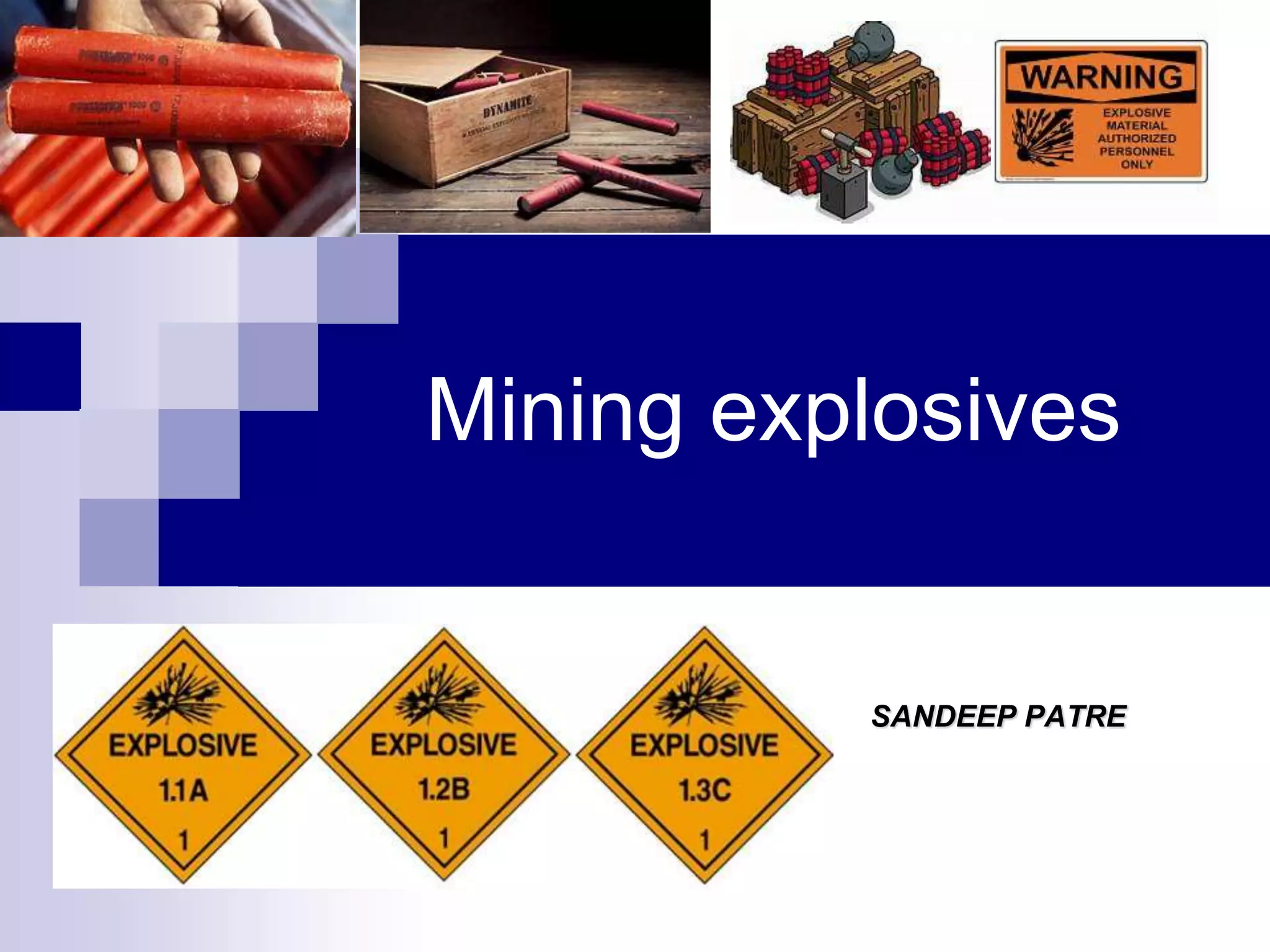

Mining explosives
SANDEEP PATRE
EXPLOSIVES:
An explosive is a substance which has a
high rate of combustions involving an
excessive and instantaneous increase in
volume of resultant gases.
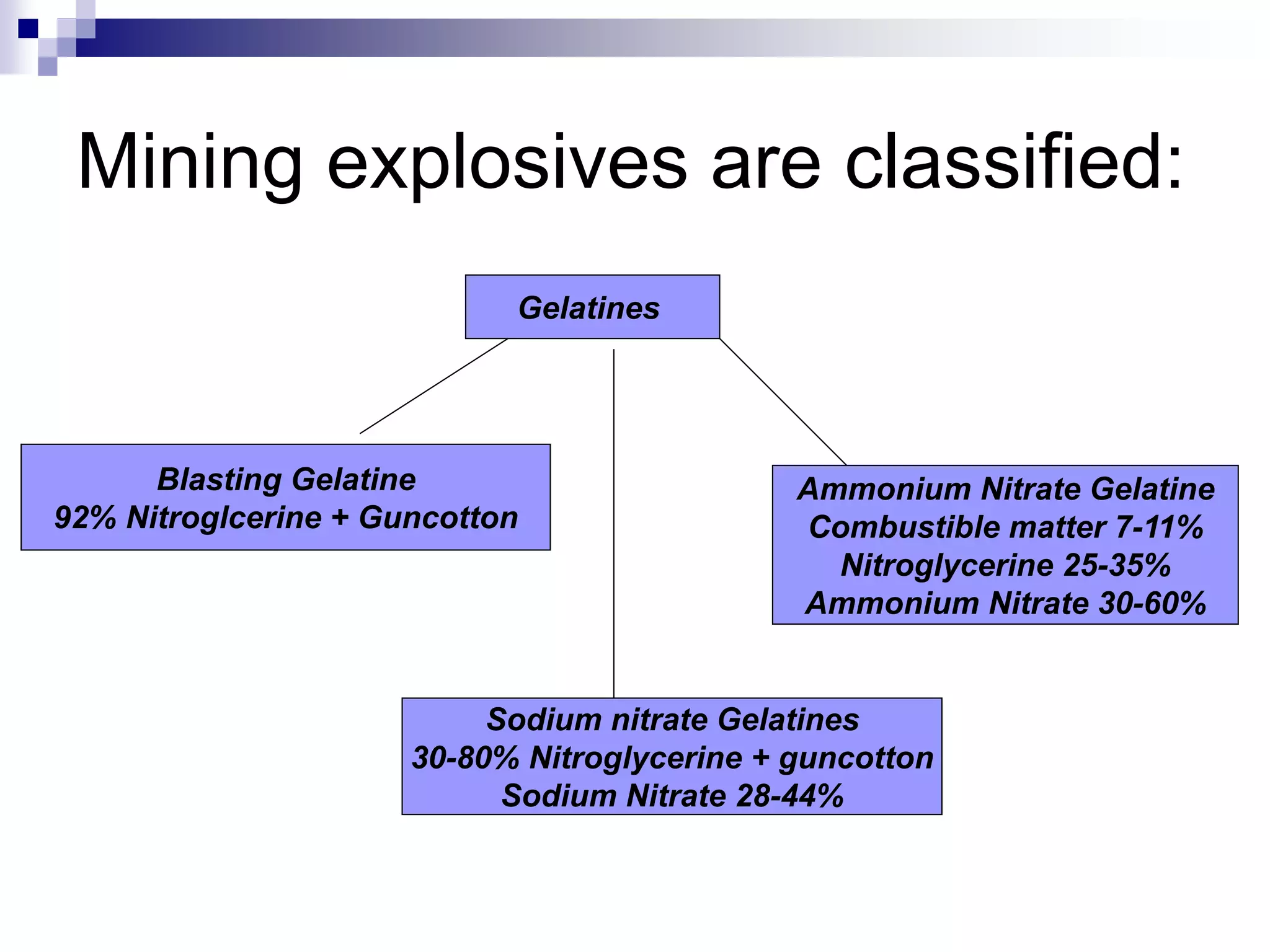
Mining explosives are classified:
Gelatines
Blasting Gelatine
92% Nitroglcerine + Guncotton
Sodium nitrate Gelatines
30-80% Nitroglycerine + guncotton
Sodium Nitrate 28-44%
Ammonium Nitrate Gelatine
Combustible matter 7-11%
Nitroglycerine 25-35%
Ammonium Nitrate 30-60%
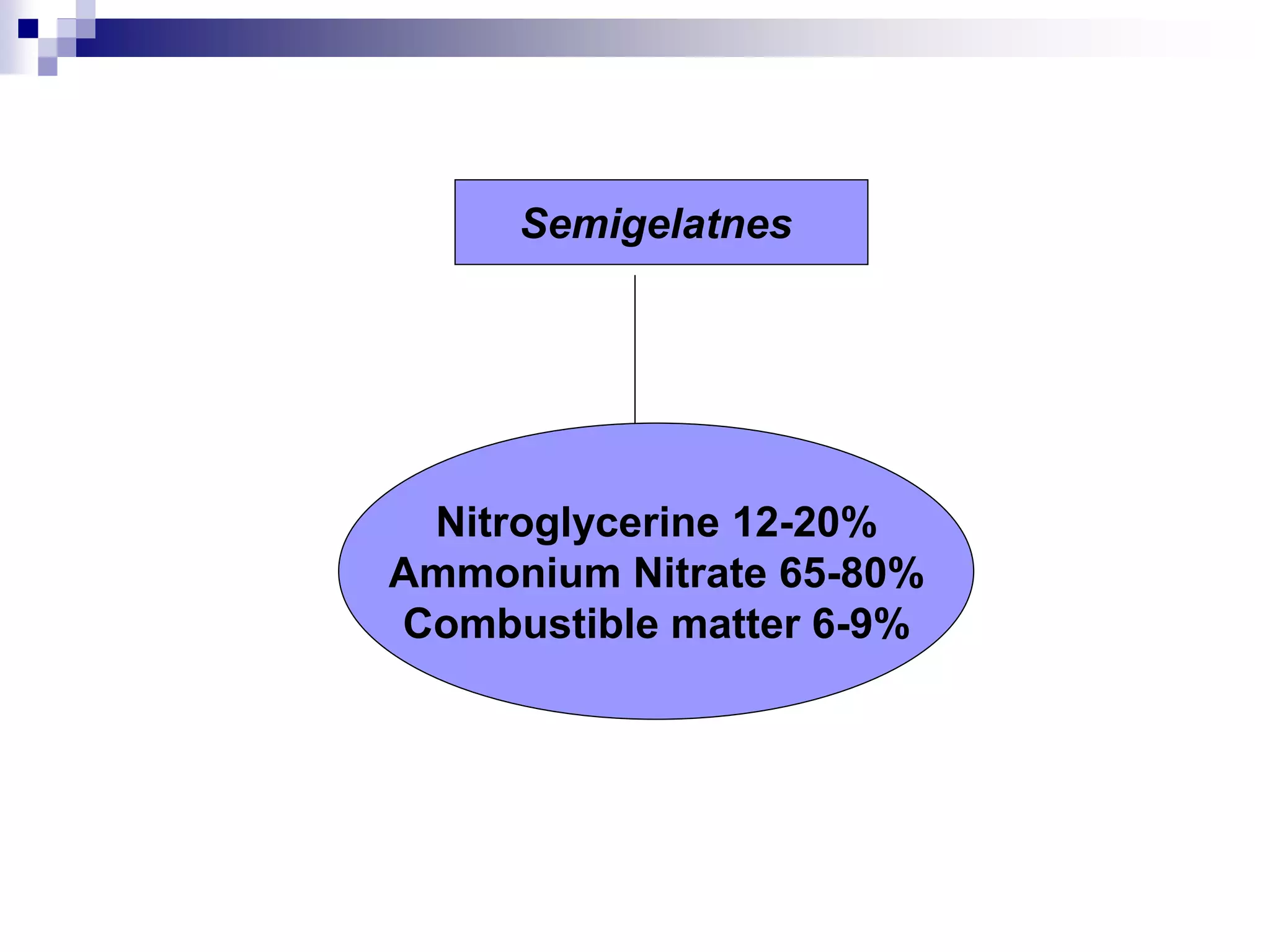
Semigelatnes
Nitroglycerine 12-20%
Ammonium Nitrate 65-80%
Combustible matter 6-9%
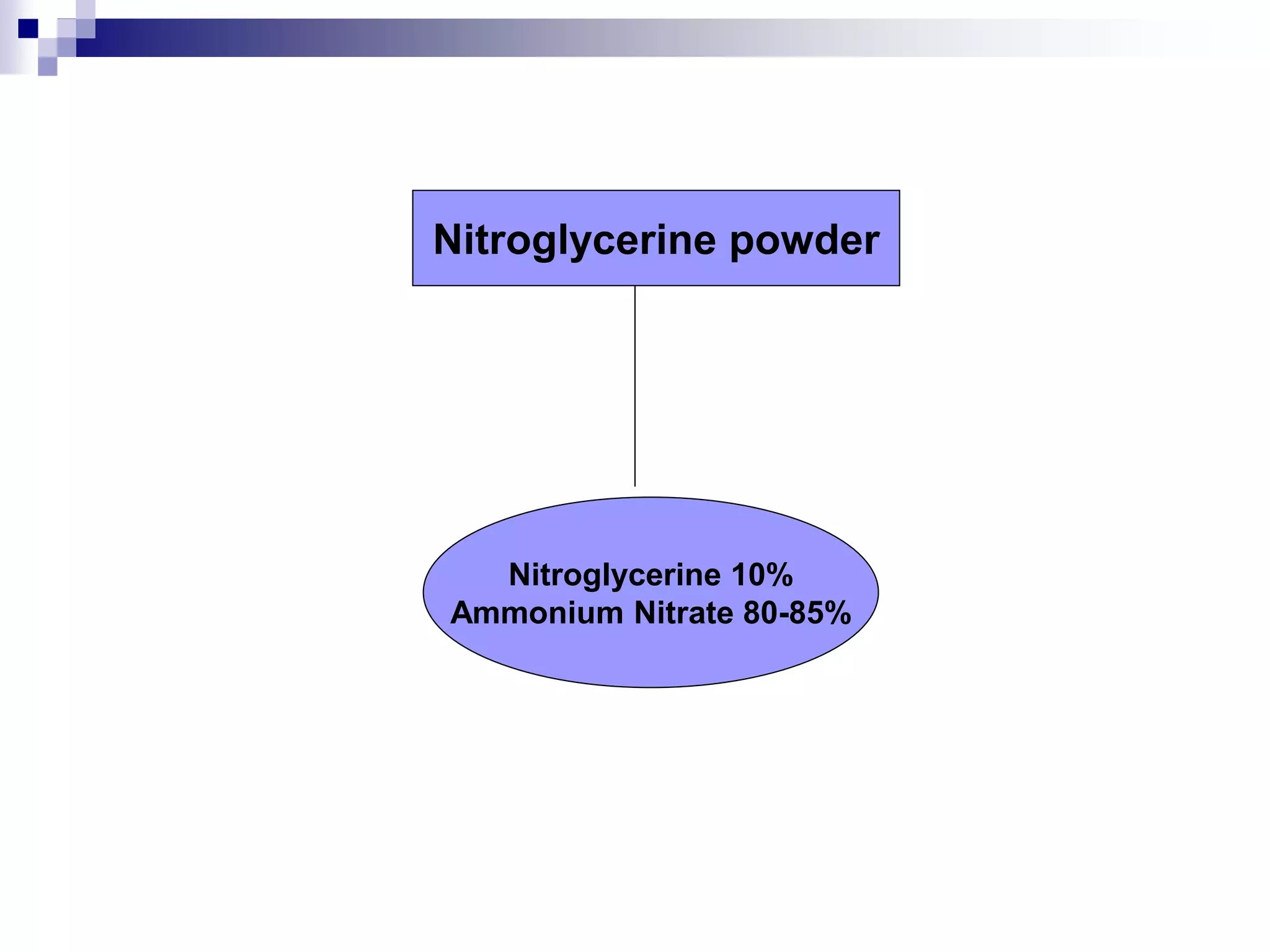
Nitroglycerine powder
Nitroglycerine 10%
Ammonium Nitrate 80-85%
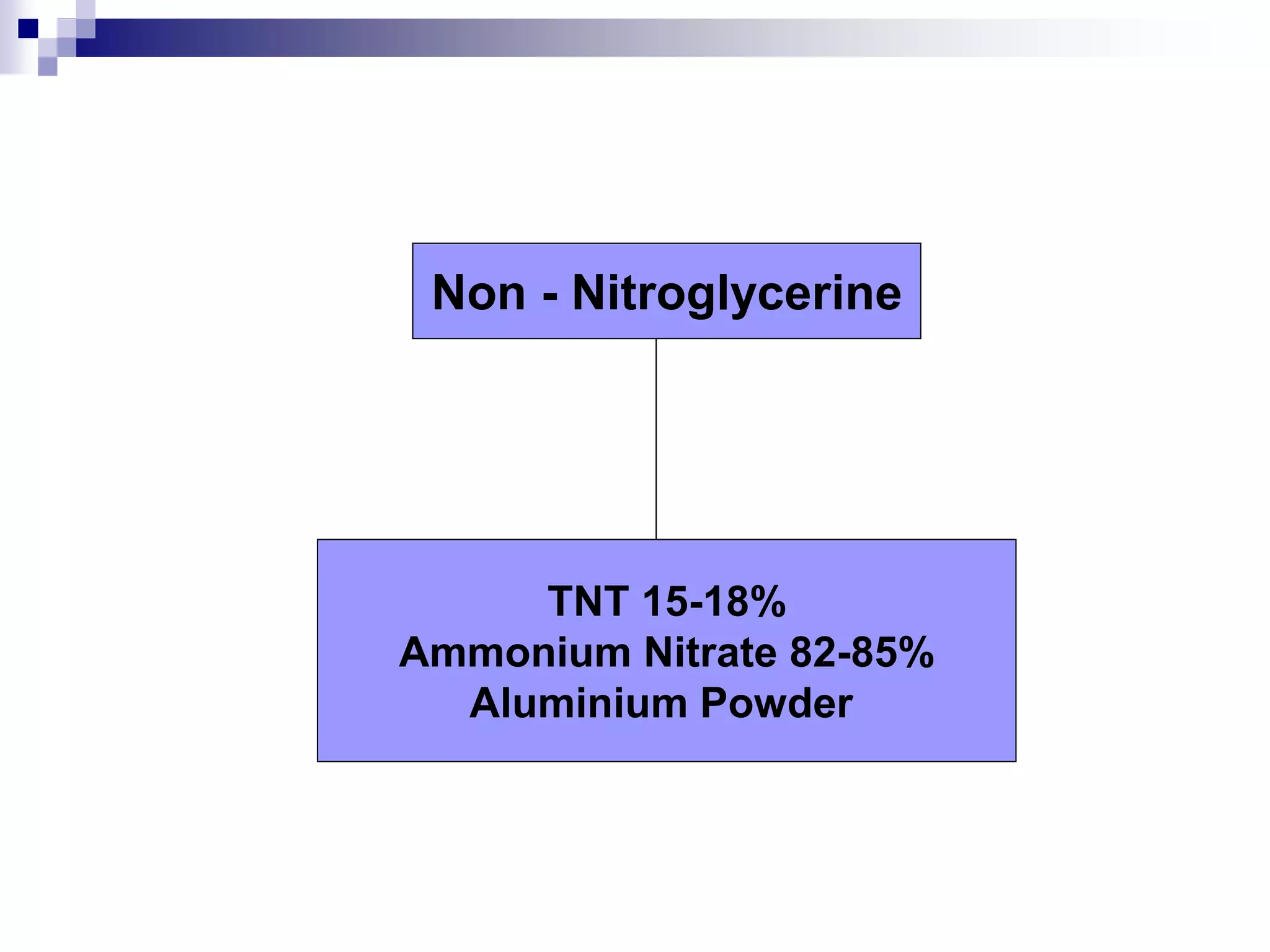
Non - Nitroglycerine
TNT 15-18%
Ammonium Nitrate 82-85%
Aluminium Powder
CLASSIFICATION OF EXPLOSIVES
Low Explosives: Low explosives deflagrate
rather than detonate. Their reaction velocities
are 2000 to less than 3000 feet per second.
Black powder is a good example. These
materials normally have little water resistance,
are highly flammable, sensitive to a No. 6
strength blasting cap, and have a heaving action
during blasting. Low explosives generally do not
fragment rock as well as high explosives.
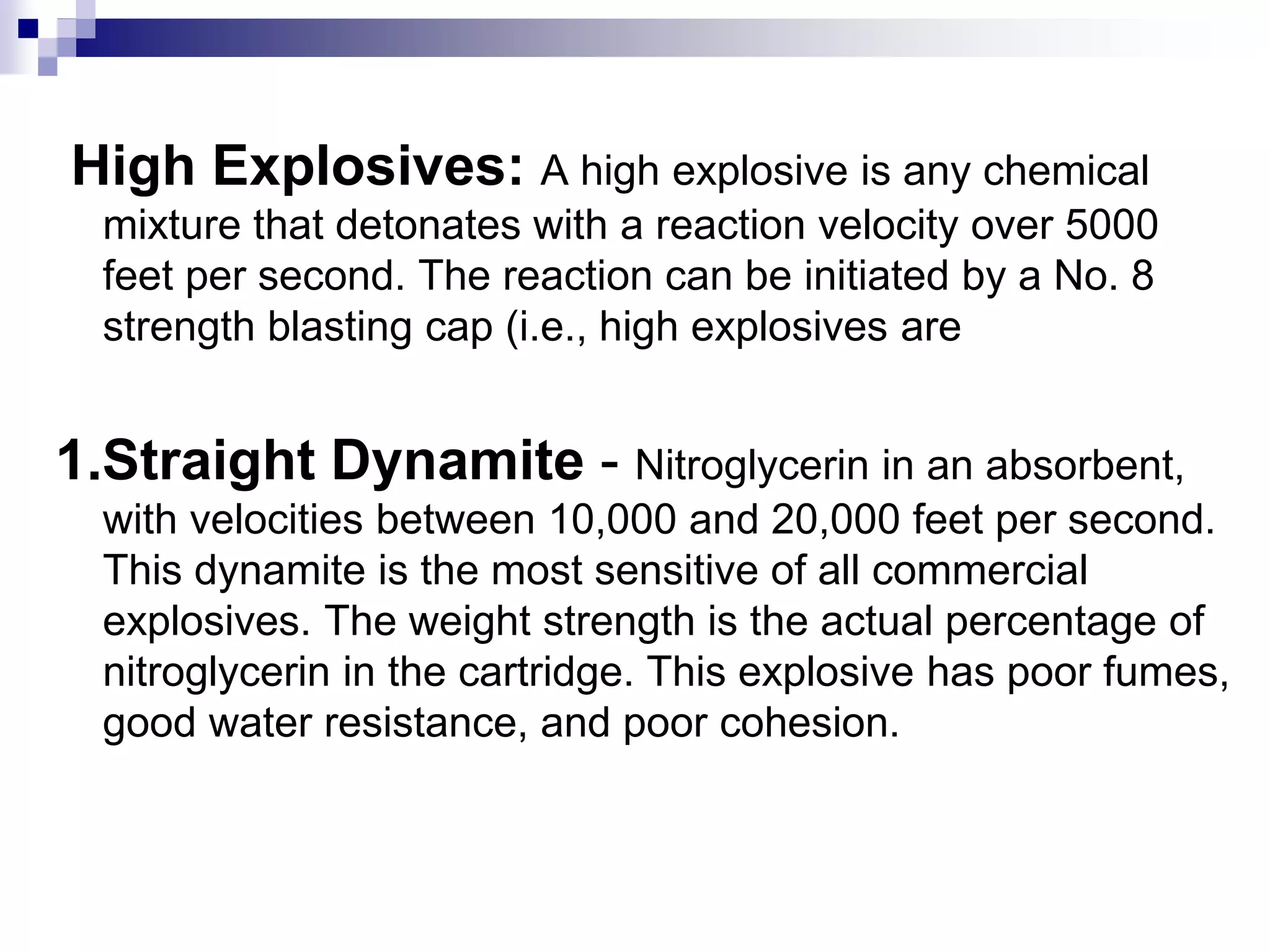
High Explosives: A high explosive is any chemical
mixture that detonates with a reaction velocity over 5000
feet per second. The reaction can be initiated by a No. 8
strength blasting cap (i.e., high explosives are
1.Straight Dynamite - Nitroglycerin in an absorbent,
with velocities between 10,000 and 20,000 feet per second.
This dynamite is the most sensitive of all commercial
explosives. The weight strength is the actual percentage of
nitroglycerin in the cartridge. This explosive has poor fumes,
good water resistance, and poor cohesion.
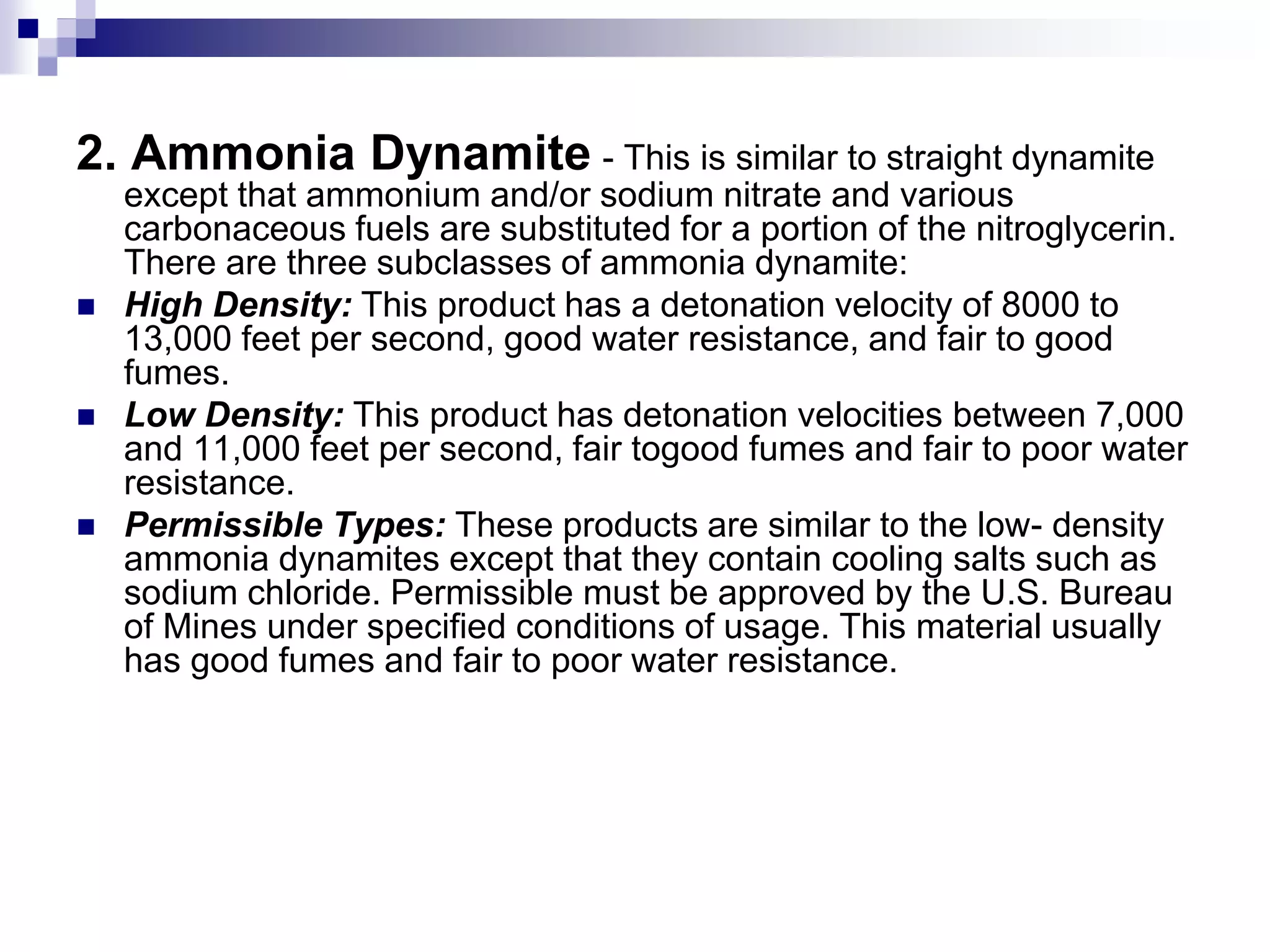
2. Ammonia Dynamite - This is similar to straight dynamite
except that ammonium and/or sodium nitrate and various
carbonaceous fuels are substituted for a portion of the nitroglycerin.
There are three subclasses of ammonia dynamite:
 High Density: This product has a detonation velocity of 8000 to
13,000 feet per second, good water resistance, and fair to good
fumes.
 Low Density: This product has detonation velocities between 7,000
and 11,000 feet per second, fair togood fumes and fair to poor water
resistance.
 Permissible Types: These products are similar to the low- density
ammonia dynamites except that they contain cooling salts such as
sodium chloride. Permissible must be approved by the U.S. Bureau
of Mines under specified conditions of usage. This material usually
has good fumes and fair to poor water resistance.
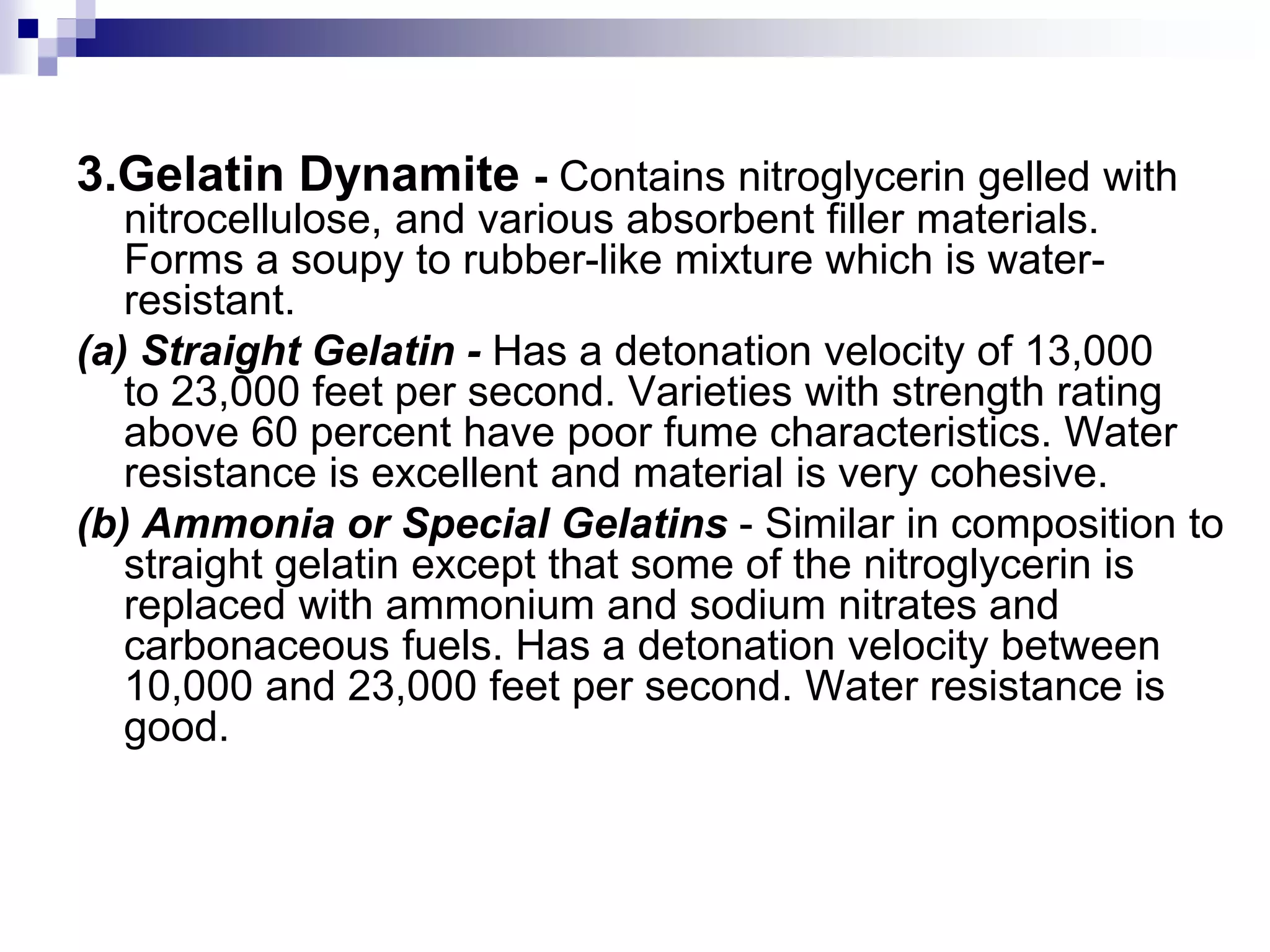
3.Gelatin Dynamite - Contains nitroglycerin gelled with
nitrocellulose, and various absorbent filler materials.
Forms a soupy to rubber-like mixture which is water-
resistant.
(a) Straight Gelatin - Has a detonation velocity of 13,000
to 23,000 feet per second. Varieties with strength rating
above 60 percent have poor fume characteristics. Water
resistance is excellent and material is very cohesive.
(b) Ammonia or Special Gelatins - Similar in composition to
straight gelatin except that some of the nitroglycerin is
replaced with ammonium and sodium nitrates and
carbonaceous fuels. Has a detonation velocity between
10,000 and 23,000 feet per second. Water resistance is
good.
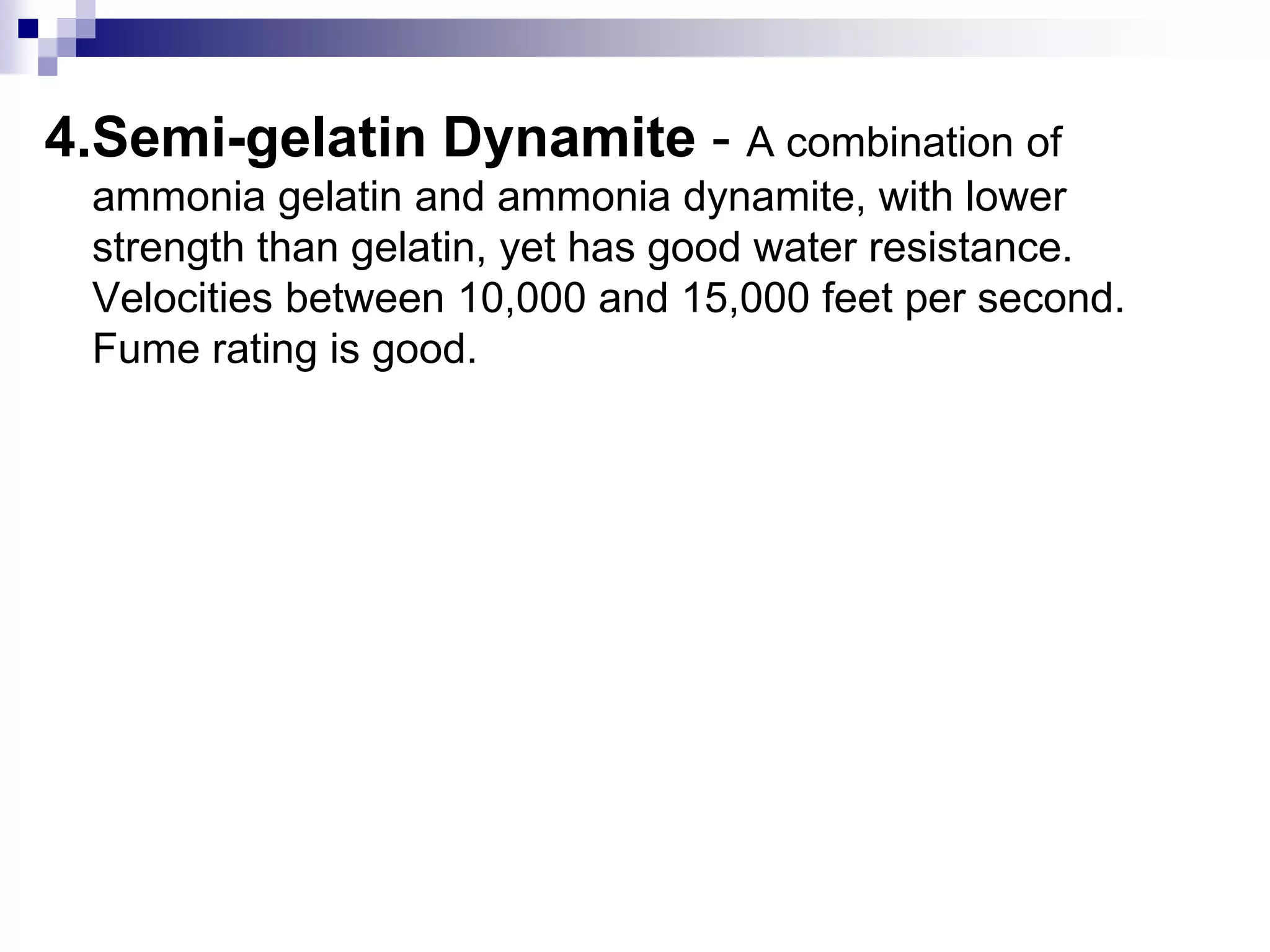
4.Semi-gelatin Dynamite - A combination of
ammonia gelatin and ammonia dynamite, with lower
strength than gelatin, yet has good water resistance.
Velocities between 10,000 and 15,000 feet per second.
Fume rating is good.
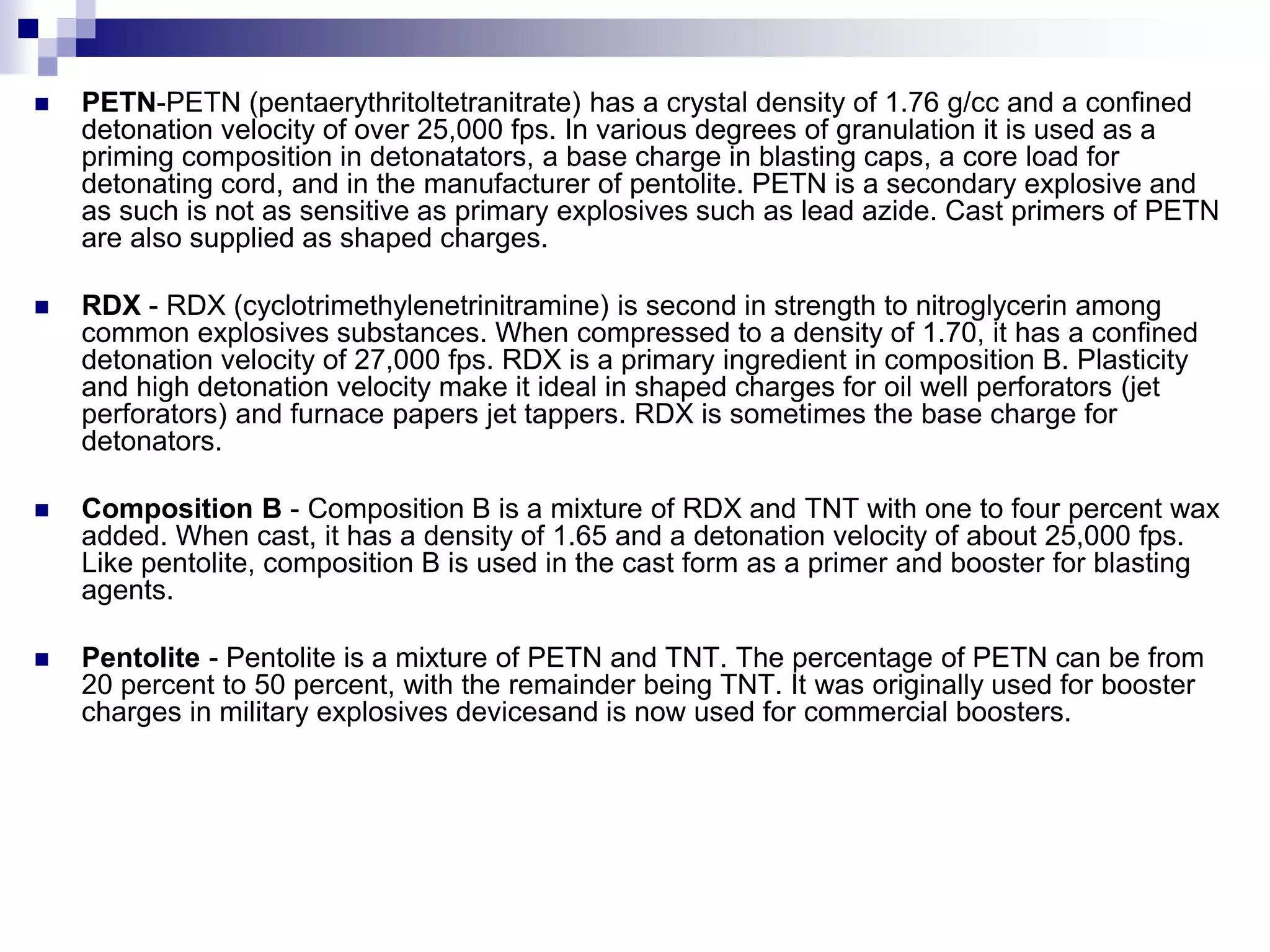
 PETN-PETN (pentaerythritoltetranitrate) has a crystal density of 1.76 g/cc and a confined
detonation velocity of over 25,000 fps. In various degrees of granulation it is used as a
priming composition in detonatators, a base charge in blasting caps, a core load for
detonating cord, and in the manufacturer of pentolite. PETN is a secondary explosive and
as such is not as sensitive as primary explosives such as lead azide. Cast primers of PETN
are also supplied as shaped charges.
 RDX - RDX (cyclotrimethylenetrinitramine) is second in strength to nitroglycerin among
common explosives substances. When compressed to a density of 1.70, it has a confined
detonation velocity of 27,000 fps. RDX is a primary ingredient in composition B. Plasticity
and high detonation velocity make it ideal in shaped charges for oil well perforators (jet
perforators) and furnace papers jet tappers. RDX is sometimes the base charge for
detonators.
 Composition B - Composition B is a mixture of RDX and TNT with one to four percent wax
added. When cast, it has a density of 1.65 and a detonation velocity of about 25,000 fps.
Like pentolite, composition B is used in the cast form as a primer and booster for blasting
agents.
 Pentolite - Pentolite is a mixture of PETN and TNT. The percentage of PETN can be from
20 percent to 50 percent, with the remainder being TNT. It was originally used for booster
charges in military explosives devicesand is now used for commercial boosters.
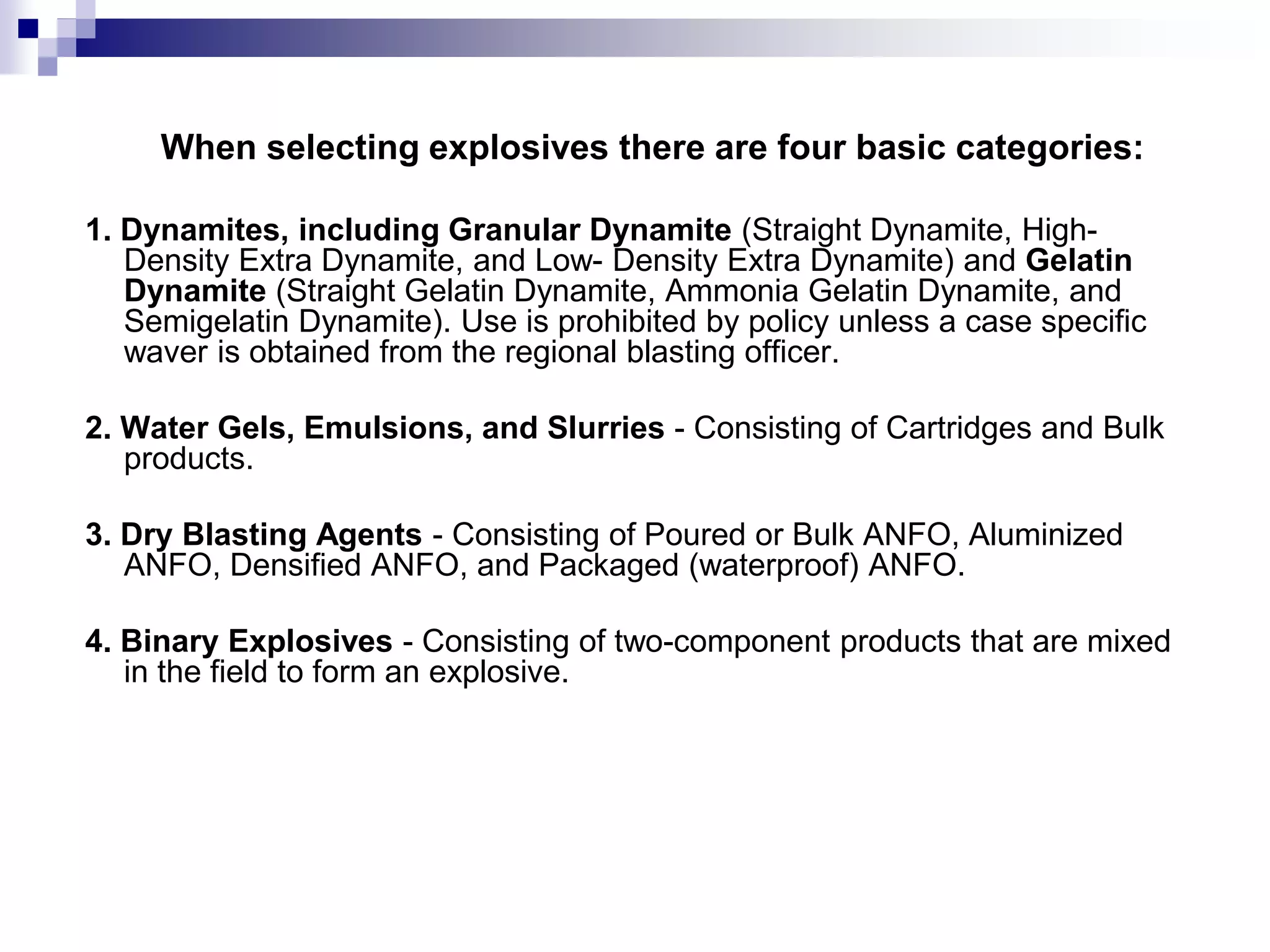
When selecting explosives there are four basic categories:
1. Dynamites, including Granular Dynamite (Straight Dynamite, High-
Density Extra Dynamite, and Low- Density Extra Dynamite) and Gelatin
Dynamite (Straight Gelatin Dynamite, Ammonia Gelatin Dynamite, and
Semigelatin Dynamite). Use is prohibited by policy unless a case specific
waver is obtained from the regional blasting officer.
2. Water Gels, Emulsions, and Slurries - Consisting of Cartridges and Bulk
products.
3. Dry Blasting Agents - Consisting of Poured or Bulk ANFO, Aluminized
ANFO, Densified ANFO, and Packaged (waterproof) ANFO.
4. Binary Explosives - Consisting of two-component products that are mixed
in the field to form an explosive.
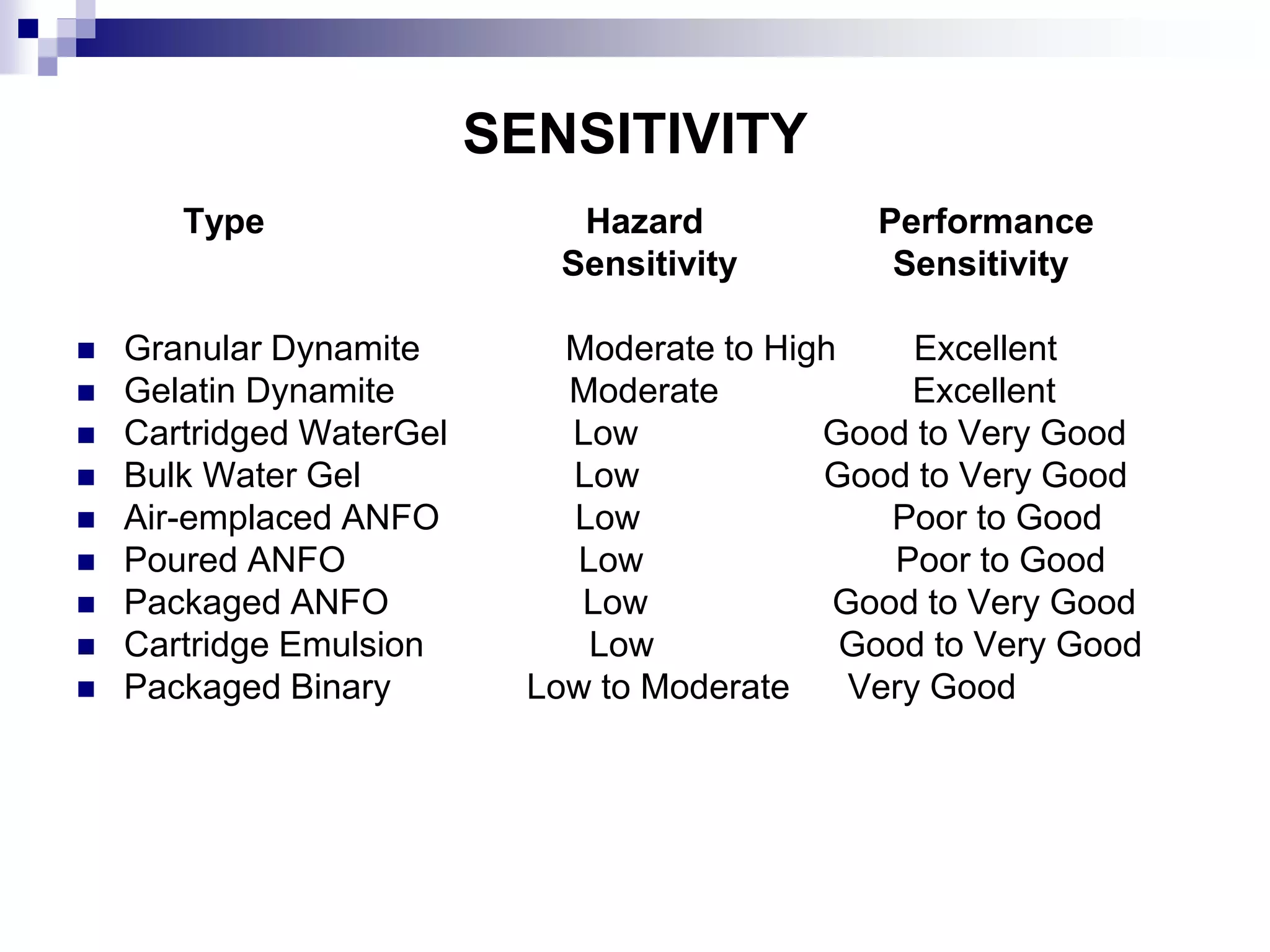
SENSITIVITY
Type Hazard Performance
Sensitivity Sensitivity
 Granular Dynamite Moderate to High Excellent
 Gelatin Dynamite Moderate Excellent
 Cartridged WaterGel Low Good to Very Good
 Bulk Water Gel Low Good to Very Good
 Air-emplaced ANFO Low Poor to Good
 Poured ANFO Low Poor to Good
 Packaged ANFO Low Good to Very Good
 Cartridge Emulsion Low Good to Very Good
 Packaged Binary Low to Moderate Very Good
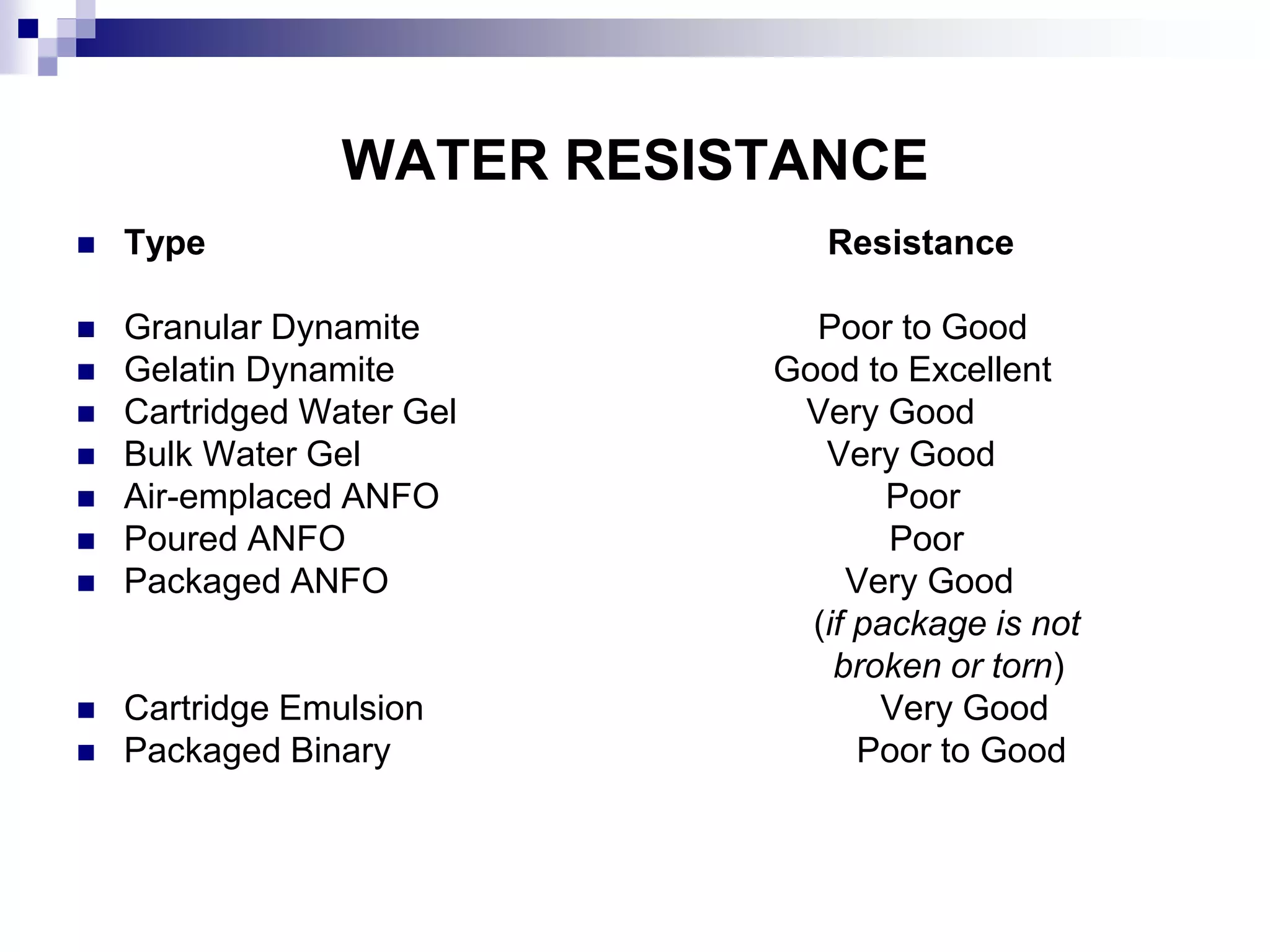
WATER RESISTANCE
 Type Resistance
 Granular Dynamite Poor to Good
 Gelatin Dynamite Good to Excellent
 Cartridged Water Gel Very Good
 Bulk Water Gel Very Good
 Air-emplaced ANFO Poor
 Poured ANFO Poor
 Packaged ANFO Very Good
(if package is not
broken or torn)
 Cartridge Emulsion Very Good
 Packaged Binary Poor to Good
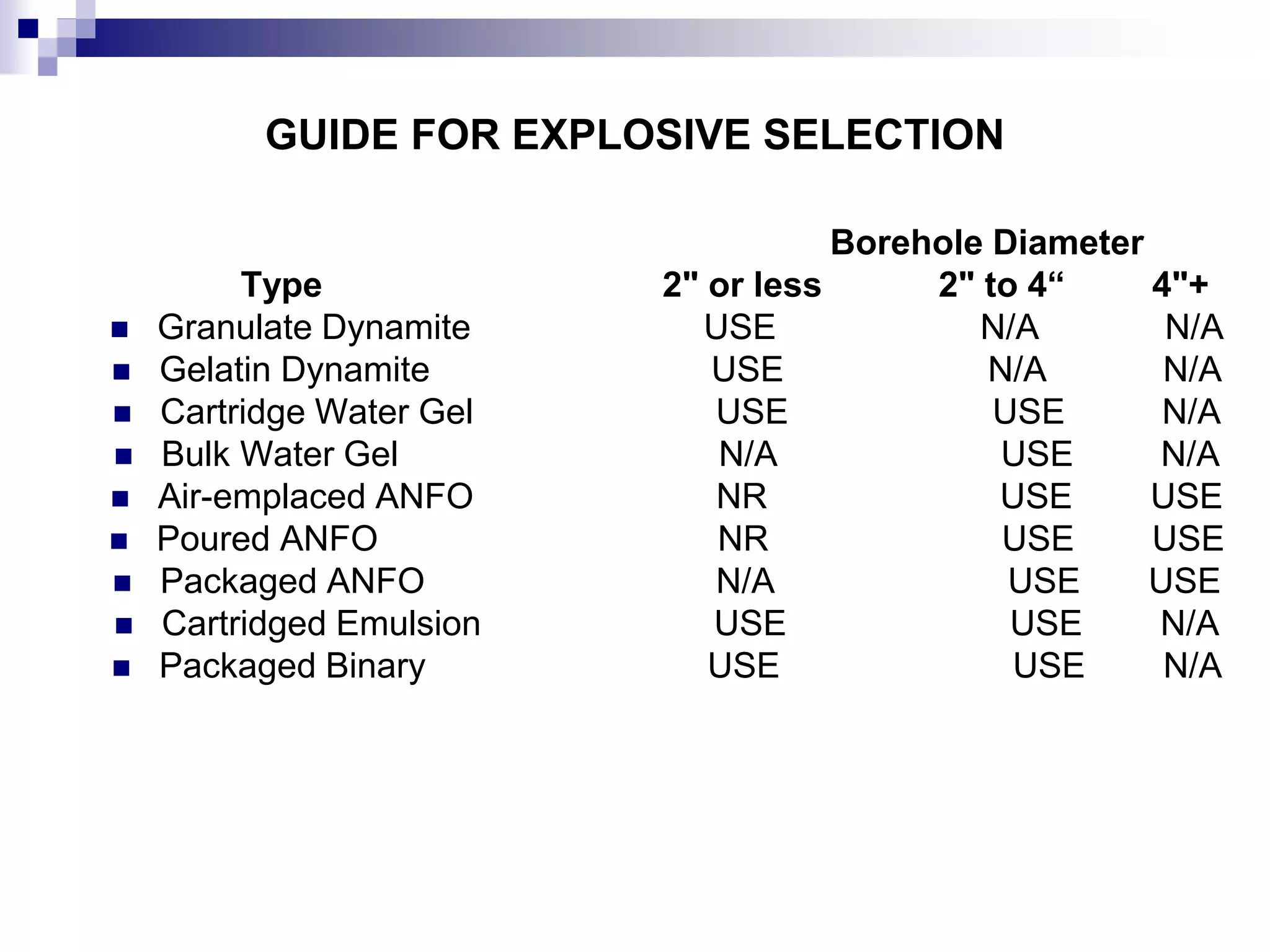
GUIDE FOR EXPLOSIVE SELECTION
Borehole Diameter
Type 2" or less 2" to 4“ 4"+
 Granulate Dynamite USE N/A N/A
 Gelatin Dynamite USE N/A N/A
 Cartridge Water Gel USE USE N/A
 Bulk Water Gel N/A USE N/A
 Air-emplaced ANFO NR USE USE
 Poured ANFO NR USE USE
 Packaged ANFO N/A USE USE
 Cartridged Emulsion USE USE N/A
 Packaged Binary USE USE N/A
THANK YOU

Mining explosives CLASSIFICATION OF EXPLOSIVES

  • 1.
  • 2.
    EXPLOSIVES: An explosive isa substance which has a high rate of combustions involving an excessive and instantaneous increase in volume of resultant gases.
  • 3.
    Mining explosives areclassified: Gelatines Blasting Gelatine 92% Nitroglcerine + Guncotton Sodium nitrate Gelatines 30-80% Nitroglycerine + guncotton Sodium Nitrate 28-44% Ammonium Nitrate Gelatine Combustible matter 7-11% Nitroglycerine 25-35% Ammonium Nitrate 30-60%
  • 4.
  • 5.
  • 6.
    Non - Nitroglycerine TNT15-18% Ammonium Nitrate 82-85% Aluminium Powder
  • 8.
    CLASSIFICATION OF EXPLOSIVES LowExplosives: Low explosives deflagrate rather than detonate. Their reaction velocities are 2000 to less than 3000 feet per second. Black powder is a good example. These materials normally have little water resistance, are highly flammable, sensitive to a No. 6 strength blasting cap, and have a heaving action during blasting. Low explosives generally do not fragment rock as well as high explosives.
  • 9.
    High Explosives: Ahigh explosive is any chemical mixture that detonates with a reaction velocity over 5000 feet per second. The reaction can be initiated by a No. 8 strength blasting cap (i.e., high explosives are 1.Straight Dynamite - Nitroglycerin in an absorbent, with velocities between 10,000 and 20,000 feet per second. This dynamite is the most sensitive of all commercial explosives. The weight strength is the actual percentage of nitroglycerin in the cartridge. This explosive has poor fumes, good water resistance, and poor cohesion.
  • 10.
    2. Ammonia Dynamite- This is similar to straight dynamite except that ammonium and/or sodium nitrate and various carbonaceous fuels are substituted for a portion of the nitroglycerin. There are three subclasses of ammonia dynamite:  High Density: This product has a detonation velocity of 8000 to 13,000 feet per second, good water resistance, and fair to good fumes.  Low Density: This product has detonation velocities between 7,000 and 11,000 feet per second, fair togood fumes and fair to poor water resistance.  Permissible Types: These products are similar to the low- density ammonia dynamites except that they contain cooling salts such as sodium chloride. Permissible must be approved by the U.S. Bureau of Mines under specified conditions of usage. This material usually has good fumes and fair to poor water resistance.
  • 11.
    3.Gelatin Dynamite -Contains nitroglycerin gelled with nitrocellulose, and various absorbent filler materials. Forms a soupy to rubber-like mixture which is water- resistant. (a) Straight Gelatin - Has a detonation velocity of 13,000 to 23,000 feet per second. Varieties with strength rating above 60 percent have poor fume characteristics. Water resistance is excellent and material is very cohesive. (b) Ammonia or Special Gelatins - Similar in composition to straight gelatin except that some of the nitroglycerin is replaced with ammonium and sodium nitrates and carbonaceous fuels. Has a detonation velocity between 10,000 and 23,000 feet per second. Water resistance is good.
  • 12.
    4.Semi-gelatin Dynamite -A combination of ammonia gelatin and ammonia dynamite, with lower strength than gelatin, yet has good water resistance. Velocities between 10,000 and 15,000 feet per second. Fume rating is good.
  • 13.
     PETN-PETN (pentaerythritoltetranitrate)has a crystal density of 1.76 g/cc and a confined detonation velocity of over 25,000 fps. In various degrees of granulation it is used as a priming composition in detonatators, a base charge in blasting caps, a core load for detonating cord, and in the manufacturer of pentolite. PETN is a secondary explosive and as such is not as sensitive as primary explosives such as lead azide. Cast primers of PETN are also supplied as shaped charges.  RDX - RDX (cyclotrimethylenetrinitramine) is second in strength to nitroglycerin among common explosives substances. When compressed to a density of 1.70, it has a confined detonation velocity of 27,000 fps. RDX is a primary ingredient in composition B. Plasticity and high detonation velocity make it ideal in shaped charges for oil well perforators (jet perforators) and furnace papers jet tappers. RDX is sometimes the base charge for detonators.  Composition B - Composition B is a mixture of RDX and TNT with one to four percent wax added. When cast, it has a density of 1.65 and a detonation velocity of about 25,000 fps. Like pentolite, composition B is used in the cast form as a primer and booster for blasting agents.  Pentolite - Pentolite is a mixture of PETN and TNT. The percentage of PETN can be from 20 percent to 50 percent, with the remainder being TNT. It was originally used for booster charges in military explosives devicesand is now used for commercial boosters.
  • 14.
    When selecting explosivesthere are four basic categories: 1. Dynamites, including Granular Dynamite (Straight Dynamite, High- Density Extra Dynamite, and Low- Density Extra Dynamite) and Gelatin Dynamite (Straight Gelatin Dynamite, Ammonia Gelatin Dynamite, and Semigelatin Dynamite). Use is prohibited by policy unless a case specific waver is obtained from the regional blasting officer. 2. Water Gels, Emulsions, and Slurries - Consisting of Cartridges and Bulk products. 3. Dry Blasting Agents - Consisting of Poured or Bulk ANFO, Aluminized ANFO, Densified ANFO, and Packaged (waterproof) ANFO. 4. Binary Explosives - Consisting of two-component products that are mixed in the field to form an explosive.
  • 15.
    SENSITIVITY Type Hazard Performance SensitivitySensitivity  Granular Dynamite Moderate to High Excellent  Gelatin Dynamite Moderate Excellent  Cartridged WaterGel Low Good to Very Good  Bulk Water Gel Low Good to Very Good  Air-emplaced ANFO Low Poor to Good  Poured ANFO Low Poor to Good  Packaged ANFO Low Good to Very Good  Cartridge Emulsion Low Good to Very Good  Packaged Binary Low to Moderate Very Good
  • 16.
    WATER RESISTANCE  TypeResistance  Granular Dynamite Poor to Good  Gelatin Dynamite Good to Excellent  Cartridged Water Gel Very Good  Bulk Water Gel Very Good  Air-emplaced ANFO Poor  Poured ANFO Poor  Packaged ANFO Very Good (if package is not broken or torn)  Cartridge Emulsion Very Good  Packaged Binary Poor to Good
  • 17.
    GUIDE FOR EXPLOSIVESELECTION Borehole Diameter Type 2" or less 2" to 4“ 4"+  Granulate Dynamite USE N/A N/A  Gelatin Dynamite USE N/A N/A  Cartridge Water Gel USE USE N/A  Bulk Water Gel N/A USE N/A  Air-emplaced ANFO NR USE USE  Poured ANFO NR USE USE  Packaged ANFO N/A USE USE  Cartridged Emulsion USE USE N/A  Packaged Binary USE USE N/A
  • 18.