Osteopathic Approach to Drain
the Lymphatic System
David Lintonbon DO PG Cert (clin ed)
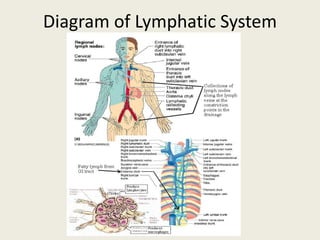
Diagram of Lymphatic System
1
3
7
2
6
5
4
9
8
1
4
1
3
1
2
11
10
1
5
Lymphatic
Drainage
Routine
Lymphatic Drainage Routine 1
• Patient prone, spring
the thorax to encourage
maximum mobility of
ribs and vertebrae prior
to treatment
Lymphatic Drainage Routine 2
• Patient supine, clear the
thoracic ducts. Stand to
the side of the couch,
place the patient’s hand
on your shoulder and
pull up gently and
rhythmically on the
clavicle to clear the
thoracic ducts.
Lymphatic Drainage Routine 3
• Thoracic pump, compress
the manubrium AP at bout
two cycles per second,
following patient’s
expiration. Repeat 6 times.
On the sixth, follow the
expiration all the way
through and just as you feel
the resistance of the
patient’s inspiration,
suddenly release your
hands, this will create a
‘vacuum’ in the thorax
which will encourage lymph
flow.
Lymphatic Drainage Routine 4
• Dome the diaphragm
bilaterally. Knees bent,
thumbs or tips of fingers
under the borders of the
ribs inhibiting the
diaphragm. Follow the
patient’s breath out and
push upwards into the
diaphragm. Take care not to
press too hard, it might be
uncomfortable but it
shouldn’t be painful. Inhibit
the diaphragm as the
patient inhales. Repeat six
times.
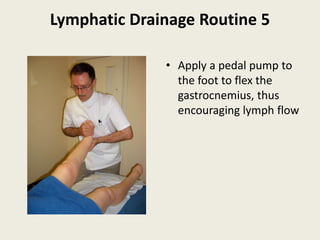
Lymphatic Drainage Routine 5
• Apply a pedal pump to
the foot to flex the
gastrocnemius, thus
encouraging lymph flow
Lymphatic Drainage Routine 6
• Bend the leg (patient
still supine) and stand
at the foot of the couch.
Move your fingers into
the popliteal crease and
rhythmically pump the
popliteal nodes
Lymphatic Drainage Routine 7
• Externally rotate flexed
leg and stretch
saphenous opening
(Hunter’s canal) along
the medial border of
the sartorius
• Gently move the
abdominal contents
towards the umbalicus
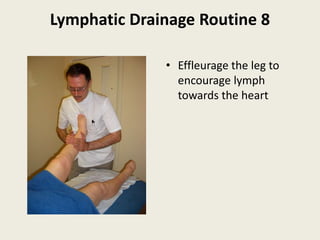
Lymphatic Drainage Routine 8
• Effleurage the leg to
encourage lymph
towards the heart
Lymphatic Drainage Routine 9
• Palpate L3 with the right hand
while simultaneously flexing
the hips.
• As you palpate motion at L3/4
there should be sufficient
compression of the cysterna
chyli.
• Gently pump the cysterna
chyli, which has valves.
• Thereby encouraging lymph
drainage toward the thoracic
duct.
Lymphatic Drainage Routine UEX/LEX
• 1
• Patient prone, spring the thorax to encourage maximum mobility of
ribs and vertebrae prior to treatment
• 2
• Patient supine, clear the thoracic ducts. Stand to the side of the
couch, place the patient’s hand on your shoulder and pull up gently
and rhythmically on the clavicle to clear the thoracic ducts.
• 3
• Thoracic pump, compress the manubrium AP at bout two cycles per
second, following patient’s expiration. Repeat 6 times. On the sixth,
follow the expiration all the way through and just as you feel the
resistance of the patient’s inspiration, suddenly release your hands,
this will create a ‘vacuum’ in the thorax which will encourage lymph
flow.
• 4
• Dome the diaphragm bilaterally. Knees bent, thumbs or tips of fingers
under the borders of the ribs inhibiting the diaphragm. Follow the
patient’s breath out and push upwards into the diaphragm. Take care
not to press too hard, it might be uncomfortable but it shouldn’t be
painful. Inhibit the diaphragm as the patient inhales. Repeat six times.
• 5
• Stand at the head of the couch, locate and palpate the nodes of the
face and neck and apply light stroking movements towards the heart.
• 6
• Place fingertips in the suboccipital groove and traction as the patient
breathes out. Repeat several times
• 7
• Clasp the patient’s wrist to your side and gently grip the
forearm, keeping the elbow bent perform a ‘figure-of-eight
manoeuvre to encourage lymph flow in the axillary and
cubital nodes
• 8
• Included in the above manoeuvre
• 9
• Gently flex and extend the wrist to encourage lymph flow in
this area
• 10
• Effleurage the forearm and upper arm to encourage lymph
flow towards the heart
• 11
• Rhythmically pump the inguinal nodes with the heel of your
hand to encourage lymph flow.
• 12
• Externally rotate flexed leg and stretch saphenous opening
(Hunter’s canal) along the medial border of the sartorius
• 13
• Bend the leg (patient still supine) and sit at the foot of the
couch. Move your fingers into the popliteal crease and
rhythmically pump the popliteal nodes
• 14
• Apply a pedal pump to the foot to flex the gastrocnemius,
thus encouraging lymph flow
• 15
• Effleurage the leg to encourage lymph towards the heart
•
•
Diaphragmatic Breathing Exercise
• To encourage diaphragmatic breathing in the
patient.
• Hold your hand just above the patient’s
diaphragm and ask them to try to touch it
with the abdomen as they breathe in
• repeat several times.

Lymphatic drainage technique

  • 1.
    Osteopathic Approach toDrain the Lymphatic System David Lintonbon DO PG Cert (clin ed)
  • 2.
  • 3.
  • 4.
    Lymphatic Drainage Routine1 • Patient prone, spring the thorax to encourage maximum mobility of ribs and vertebrae prior to treatment
  • 5.
    Lymphatic Drainage Routine2 • Patient supine, clear the thoracic ducts. Stand to the side of the couch, place the patient’s hand on your shoulder and pull up gently and rhythmically on the clavicle to clear the thoracic ducts.
  • 6.
    Lymphatic Drainage Routine3 • Thoracic pump, compress the manubrium AP at bout two cycles per second, following patient’s expiration. Repeat 6 times. On the sixth, follow the expiration all the way through and just as you feel the resistance of the patient’s inspiration, suddenly release your hands, this will create a ‘vacuum’ in the thorax which will encourage lymph flow.
  • 7.
    Lymphatic Drainage Routine4 • Dome the diaphragm bilaterally. Knees bent, thumbs or tips of fingers under the borders of the ribs inhibiting the diaphragm. Follow the patient’s breath out and push upwards into the diaphragm. Take care not to press too hard, it might be uncomfortable but it shouldn’t be painful. Inhibit the diaphragm as the patient inhales. Repeat six times.
  • 8.
    Lymphatic Drainage Routine5 • Apply a pedal pump to the foot to flex the gastrocnemius, thus encouraging lymph flow
  • 9.
    Lymphatic Drainage Routine6 • Bend the leg (patient still supine) and stand at the foot of the couch. Move your fingers into the popliteal crease and rhythmically pump the popliteal nodes
  • 10.
    Lymphatic Drainage Routine7 • Externally rotate flexed leg and stretch saphenous opening (Hunter’s canal) along the medial border of the sartorius • Gently move the abdominal contents towards the umbalicus
  • 11.
    Lymphatic Drainage Routine8 • Effleurage the leg to encourage lymph towards the heart
  • 12.
    Lymphatic Drainage Routine9 • Palpate L3 with the right hand while simultaneously flexing the hips. • As you palpate motion at L3/4 there should be sufficient compression of the cysterna chyli. • Gently pump the cysterna chyli, which has valves. • Thereby encouraging lymph drainage toward the thoracic duct.
  • 13.
    Lymphatic Drainage RoutineUEX/LEX • 1 • Patient prone, spring the thorax to encourage maximum mobility of ribs and vertebrae prior to treatment • 2 • Patient supine, clear the thoracic ducts. Stand to the side of the couch, place the patient’s hand on your shoulder and pull up gently and rhythmically on the clavicle to clear the thoracic ducts. • 3 • Thoracic pump, compress the manubrium AP at bout two cycles per second, following patient’s expiration. Repeat 6 times. On the sixth, follow the expiration all the way through and just as you feel the resistance of the patient’s inspiration, suddenly release your hands, this will create a ‘vacuum’ in the thorax which will encourage lymph flow. • 4 • Dome the diaphragm bilaterally. Knees bent, thumbs or tips of fingers under the borders of the ribs inhibiting the diaphragm. Follow the patient’s breath out and push upwards into the diaphragm. Take care not to press too hard, it might be uncomfortable but it shouldn’t be painful. Inhibit the diaphragm as the patient inhales. Repeat six times. • 5 • Stand at the head of the couch, locate and palpate the nodes of the face and neck and apply light stroking movements towards the heart. • 6 • Place fingertips in the suboccipital groove and traction as the patient breathes out. Repeat several times • 7 • Clasp the patient’s wrist to your side and gently grip the forearm, keeping the elbow bent perform a ‘figure-of-eight manoeuvre to encourage lymph flow in the axillary and cubital nodes • 8 • Included in the above manoeuvre • 9 • Gently flex and extend the wrist to encourage lymph flow in this area • 10 • Effleurage the forearm and upper arm to encourage lymph flow towards the heart • 11 • Rhythmically pump the inguinal nodes with the heel of your hand to encourage lymph flow. • 12 • Externally rotate flexed leg and stretch saphenous opening (Hunter’s canal) along the medial border of the sartorius • 13 • Bend the leg (patient still supine) and sit at the foot of the couch. Move your fingers into the popliteal crease and rhythmically pump the popliteal nodes • 14 • Apply a pedal pump to the foot to flex the gastrocnemius, thus encouraging lymph flow • 15 • Effleurage the leg to encourage lymph towards the heart • •
  • 14.
    Diaphragmatic Breathing Exercise •To encourage diaphragmatic breathing in the patient. • Hold your hand just above the patient’s diaphragm and ask them to try to touch it with the abdomen as they breathe in • repeat several times.