Operating System
Topic
Windows 7 Architecture
Presented By
Daniyal Khan
Haris Mobeen Ahmed
Hammad Jameel Syed
Adeel Awan
Nasir Ali
History
Windows 7 is a personal computer operating
system developed by Microsoft. It is a part of
the Windows NT family of operating
systems. Windows 7 was released on July
22, 2009, and became generally available on
October 22, 2009.
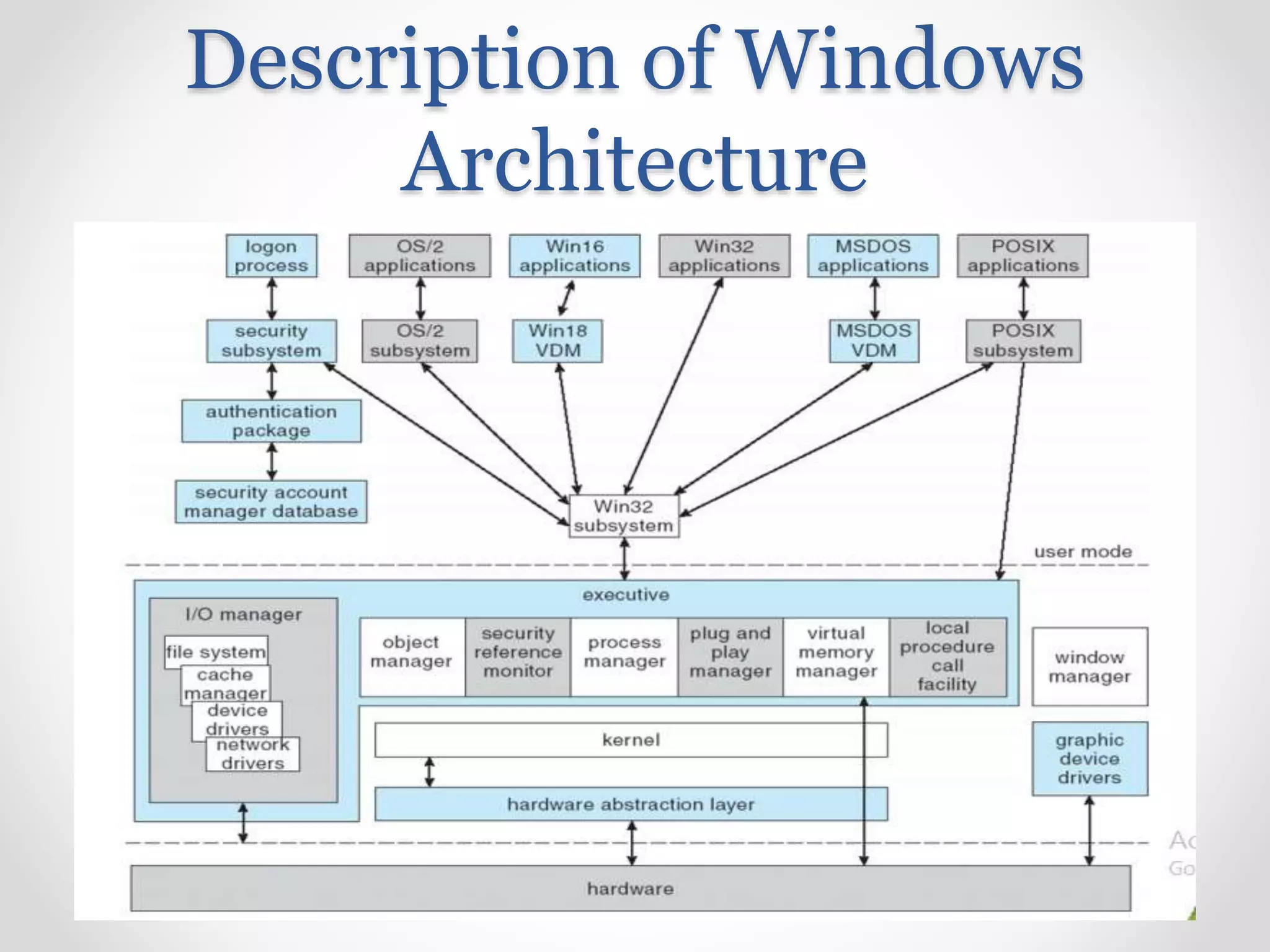
Description of Windows
Architecture
Layered Architecture
• Kernel layer runs in protected mode and
provides access to the CPU by supporting
threads, interrupts, and traps.
• Executive runs in protected mode above the
Kernel layer and, provides the basic system
services.
• On top of the executive, environmental
subsystems operate in user mode providing
different OS APIs
Portability
• Windows 7 can be moved from on
hardware platform to another with
relatively few changes
• Written in C and C++
• Platform-dependent code is isolated in a
dynamic link library (DLL) called the
“hardware abstraction layer” (HAL)
System Components
„Four main responsibilities:
1. Thread scheduling
2. Interrupt and exception handling
3. Low-level processor synchronization
4. Recovery after a power failure
System Components
Kernel is object-oriented, uses two sets of objects
1. Dispatcher objects control dispatching and
synchronization (events, mutants, murexes,
semaphores, threads and timers)
2. Control objects (asynchronous procedure calls,
interrupts, power notify, process and profile
objects)
Processes & Threads
 „The process has a virtual memory address
space, information (such as a base priority), and
an affinity for one or more processors.
 Threads are the unit of execution scheduled by
the kernel’s dispatcher.
 Each thread has its own state, including a
priority, processor affinity, and accounting
information.
 A thread can be one of six states: ready, standby,
running, waiting, transition, and terminated.
Kernel Scheduling
„Characteristics of Windows 7’s priority strategy:
 Gives very good response times to interactive
threads that are using the mouse and windows
 Enables I/O-bound threads to keep the I/O
devices busy
 Compute-bound threads soak up the spare CPU
cycles in the background
Object Manager
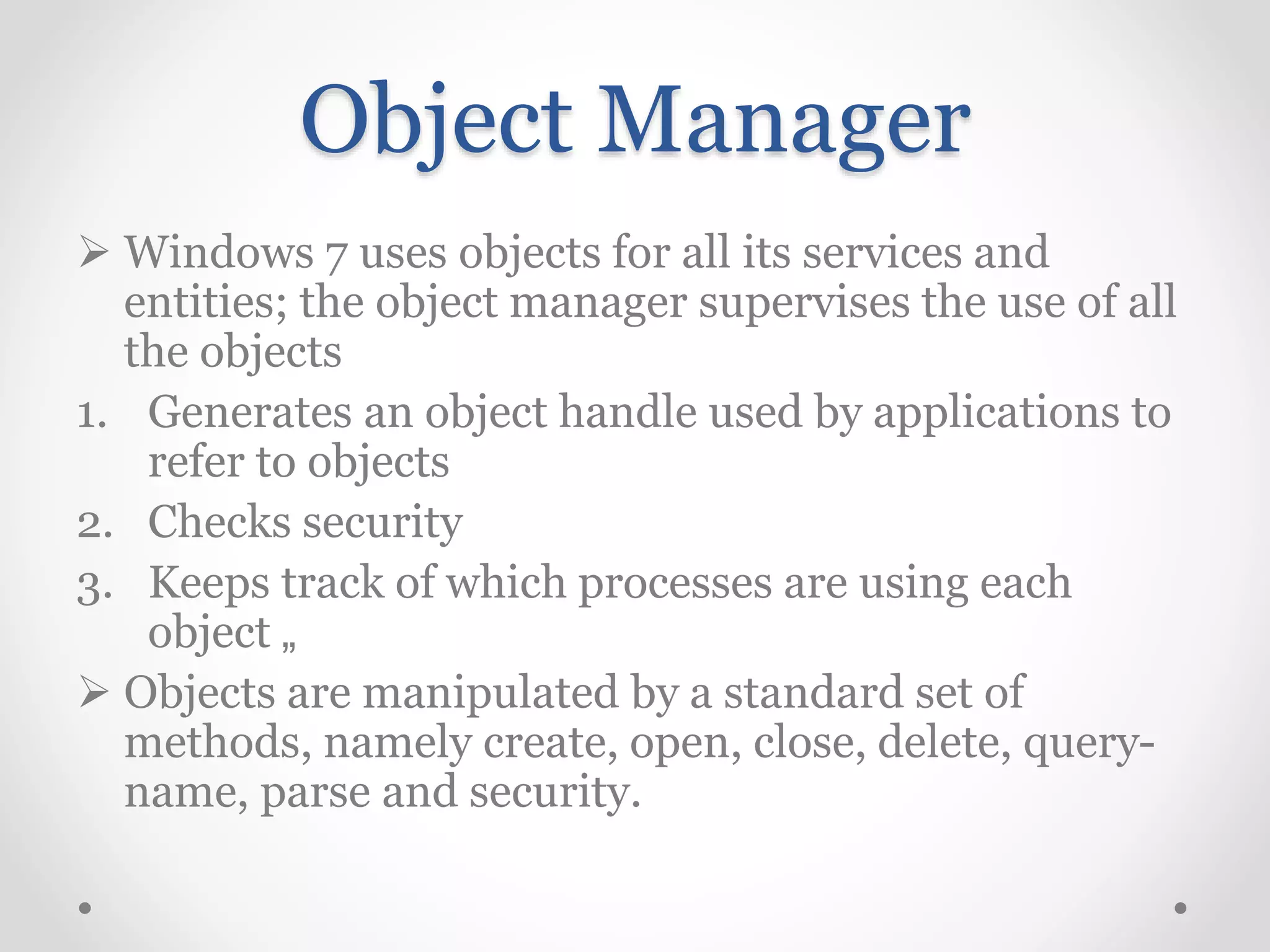
 Windows 7 uses objects for all its services and
entities; the object manager supervises the use of all
the objects
1. Generates an object handle used by applications to
refer to objects
2. Checks security
3. Keeps track of which processes are using each
object „
 Objects are manipulated by a standard set of
methods, namely create, open, close, delete, query-
name, parse and security.
Virtual Memory
Management
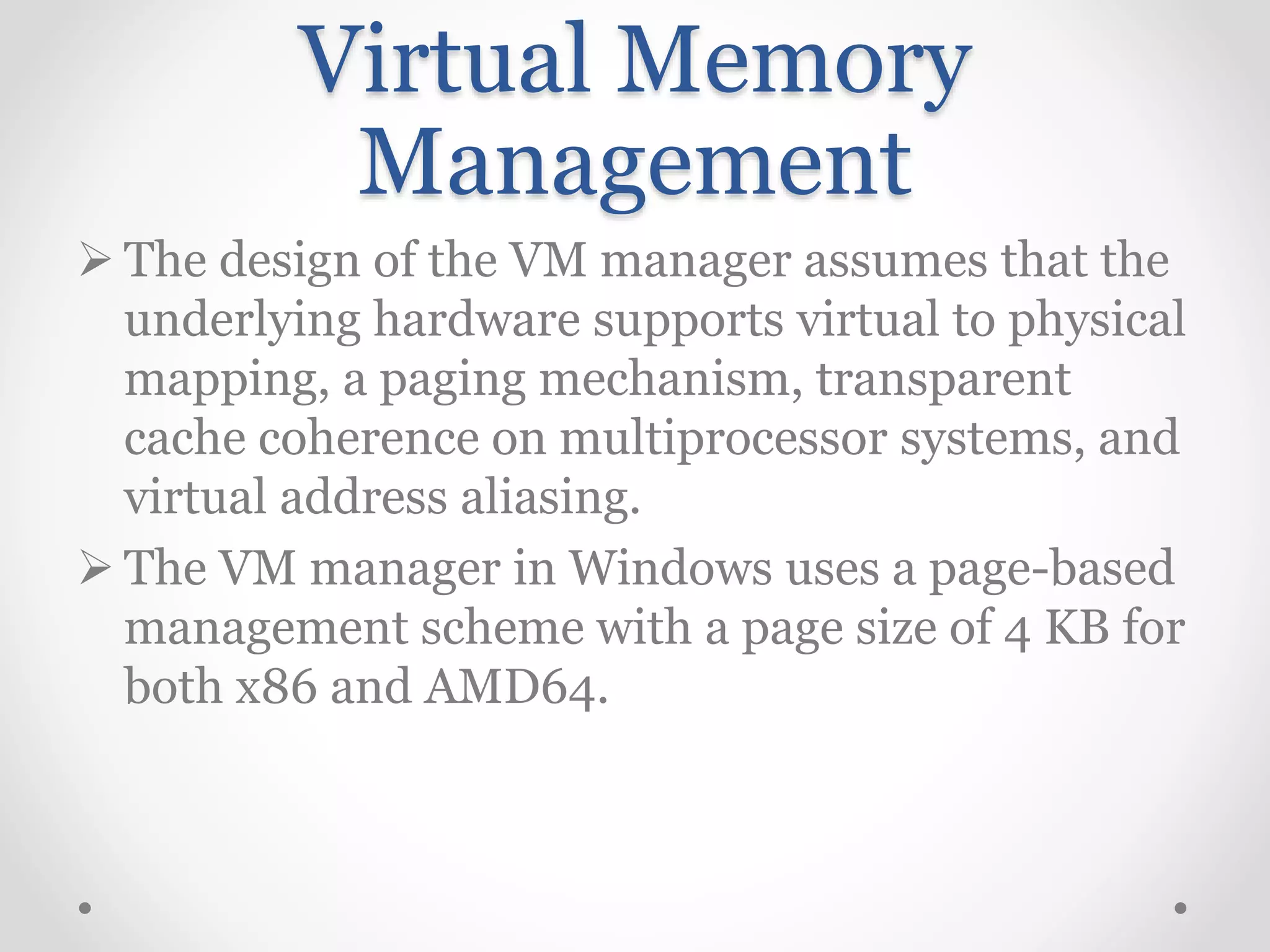
 The design of the VM manager assumes that the
underlying hardware supports virtual to physical
mapping, a paging mechanism, transparent
cache coherence on multiprocessor systems, and
virtual address aliasing.
 The VM manager in Windows uses a page-based
management scheme with a page size of 4 KB for
both x86 and AMD64.
File System
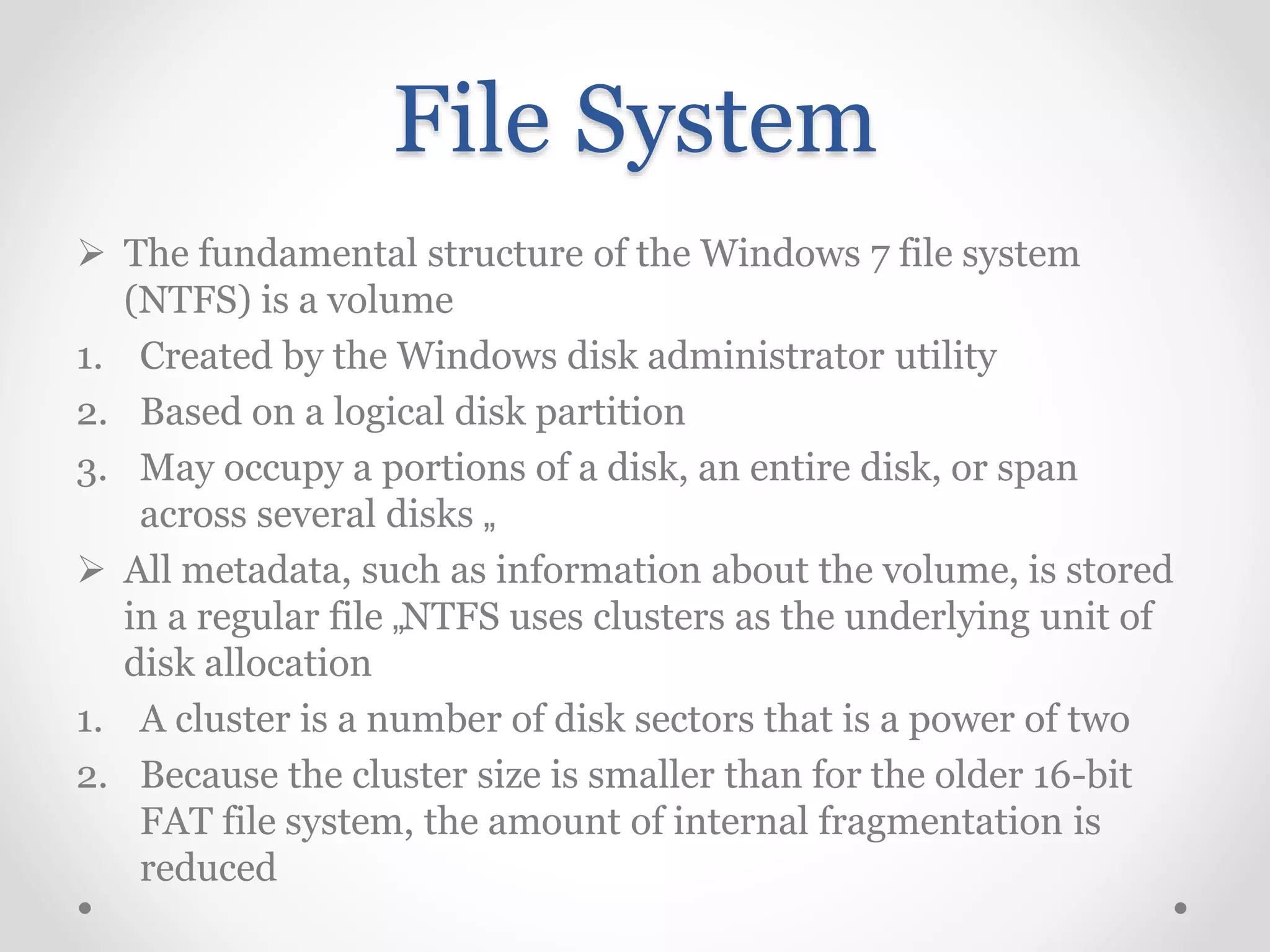
 The fundamental structure of the Windows 7 file system
(NTFS) is a volume
1. Created by the Windows disk administrator utility
2. Based on a logical disk partition
3. May occupy a portions of a disk, an entire disk, or span
across several disks „
 All metadata, such as information about the volume, is stored
in a regular file „NTFS uses clusters as the underlying unit of
disk allocation
1. A cluster is a number of disk sectors that is a power of two
2. Because the cluster size is smaller than for the older 16-bit
FAT file system, the amount of internal fragmentation is
reduced
Memory Management
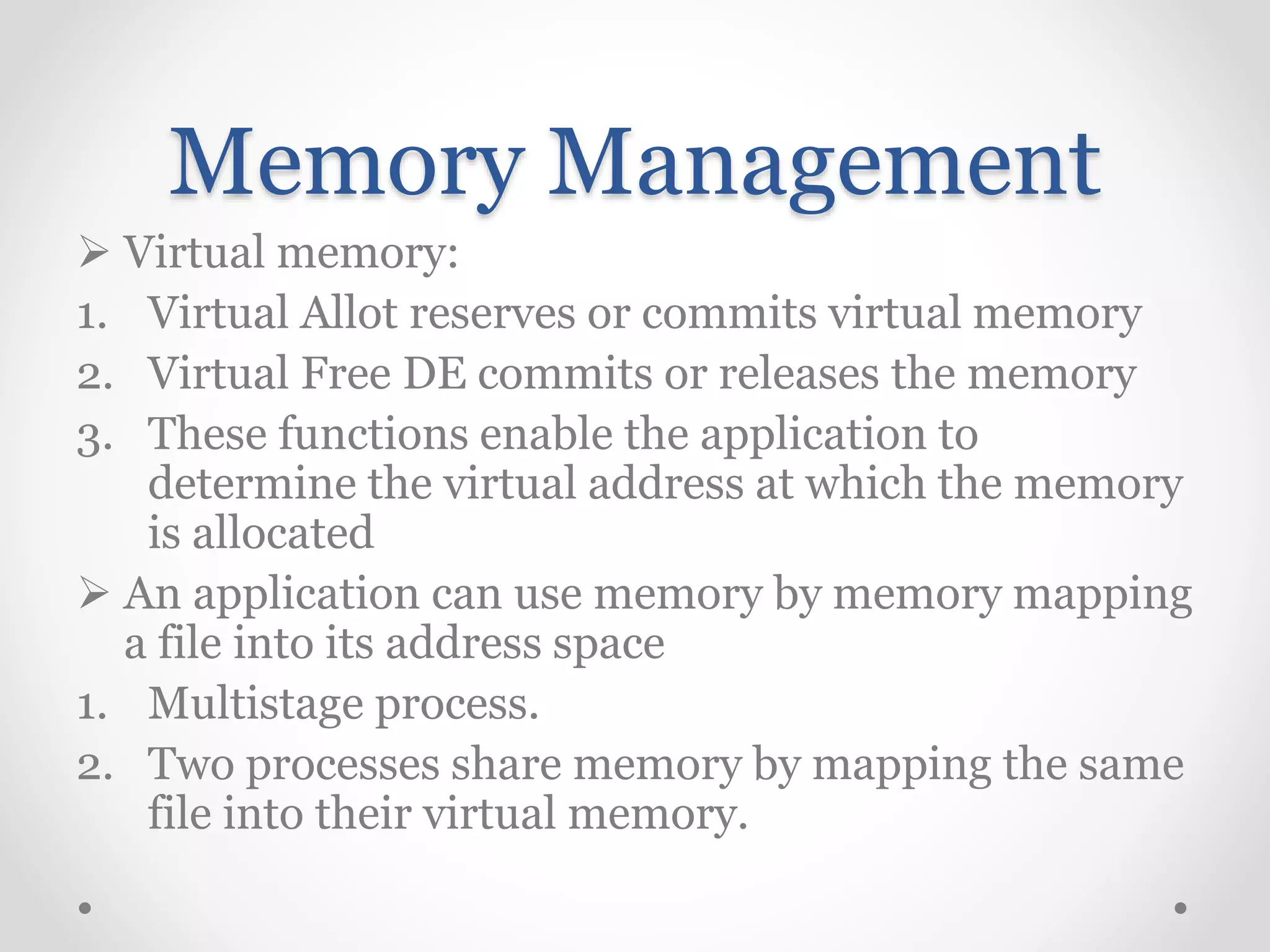
 Virtual memory:
1. Virtual Allot reserves or commits virtual memory
2. Virtual Free DE commits or releases the memory
3. These functions enable the application to
determine the virtual address at which the memory
is allocated
 An application can use memory by memory mapping
a file into its address space
1. Multistage process.
2. Two processes share memory by mapping the same
file into their virtual memory.
Memory Management
 A heap in the Win32 environment is a region of reserved
address space.
1. A Win 32 process is created with a 1 MB default heap.
2. Access is synchronized to protect the heap’s space
allocation data structures from damage by concurrent
updates by multiple threads.
 Because functions that rely on global or static data
typically fail to work properly in a multithreaded
environment, the thread-local storage mechanism
allocates global storage on a per-thread basis.
1. The mechanism provides both dynamic and static
methods of creating thread-local storage
Windows 7 Architecture

Windows 7 Architecture

  • 2.
    Operating System Topic Windows 7Architecture Presented By Daniyal Khan Haris Mobeen Ahmed Hammad Jameel Syed Adeel Awan Nasir Ali
  • 3.
    History Windows 7 isa personal computer operating system developed by Microsoft. It is a part of the Windows NT family of operating systems. Windows 7 was released on July 22, 2009, and became generally available on October 22, 2009.
  • 4.
  • 5.
    Layered Architecture • Kernellayer runs in protected mode and provides access to the CPU by supporting threads, interrupts, and traps. • Executive runs in protected mode above the Kernel layer and, provides the basic system services. • On top of the executive, environmental subsystems operate in user mode providing different OS APIs
  • 6.
    Portability • Windows 7can be moved from on hardware platform to another with relatively few changes • Written in C and C++ • Platform-dependent code is isolated in a dynamic link library (DLL) called the “hardware abstraction layer” (HAL)
  • 7.
    System Components „Four mainresponsibilities: 1. Thread scheduling 2. Interrupt and exception handling 3. Low-level processor synchronization 4. Recovery after a power failure
  • 8.
    System Components Kernel isobject-oriented, uses two sets of objects 1. Dispatcher objects control dispatching and synchronization (events, mutants, murexes, semaphores, threads and timers) 2. Control objects (asynchronous procedure calls, interrupts, power notify, process and profile objects)
  • 9.
    Processes & Threads „The process has a virtual memory address space, information (such as a base priority), and an affinity for one or more processors.  Threads are the unit of execution scheduled by the kernel’s dispatcher.  Each thread has its own state, including a priority, processor affinity, and accounting information.  A thread can be one of six states: ready, standby, running, waiting, transition, and terminated.
  • 10.
    Kernel Scheduling „Characteristics ofWindows 7’s priority strategy:  Gives very good response times to interactive threads that are using the mouse and windows  Enables I/O-bound threads to keep the I/O devices busy  Compute-bound threads soak up the spare CPU cycles in the background
  • 11.
    Object Manager  Windows7 uses objects for all its services and entities; the object manager supervises the use of all the objects 1. Generates an object handle used by applications to refer to objects 2. Checks security 3. Keeps track of which processes are using each object „  Objects are manipulated by a standard set of methods, namely create, open, close, delete, query- name, parse and security.
  • 12.
    Virtual Memory Management  Thedesign of the VM manager assumes that the underlying hardware supports virtual to physical mapping, a paging mechanism, transparent cache coherence on multiprocessor systems, and virtual address aliasing.  The VM manager in Windows uses a page-based management scheme with a page size of 4 KB for both x86 and AMD64.
  • 13.
    File System  Thefundamental structure of the Windows 7 file system (NTFS) is a volume 1. Created by the Windows disk administrator utility 2. Based on a logical disk partition 3. May occupy a portions of a disk, an entire disk, or span across several disks „  All metadata, such as information about the volume, is stored in a regular file „NTFS uses clusters as the underlying unit of disk allocation 1. A cluster is a number of disk sectors that is a power of two 2. Because the cluster size is smaller than for the older 16-bit FAT file system, the amount of internal fragmentation is reduced
  • 14.
    Memory Management  Virtualmemory: 1. Virtual Allot reserves or commits virtual memory 2. Virtual Free DE commits or releases the memory 3. These functions enable the application to determine the virtual address at which the memory is allocated  An application can use memory by memory mapping a file into its address space 1. Multistage process. 2. Two processes share memory by mapping the same file into their virtual memory.
  • 15.
    Memory Management  Aheap in the Win32 environment is a region of reserved address space. 1. A Win 32 process is created with a 1 MB default heap. 2. Access is synchronized to protect the heap’s space allocation data structures from damage by concurrent updates by multiple threads.  Because functions that rely on global or static data typically fail to work properly in a multithreaded environment, the thread-local storage mechanism allocates global storage on a per-thread basis. 1. The mechanism provides both dynamic and static methods of creating thread-local storage