Organic Pedagogical Electronic
Network
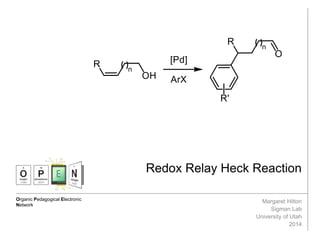
Redox Relay Heck Reaction
Margaret Hilton
Sigman Lab
University of Utah
2014
Heck Reaction
Review: Chem. Rev. 2000, 100, 3009.
Other Examples and Applications: Overman JACS 1993, 115, 11028 , Sarpong JACS 2008, 130, 7222,
Shibasaki JOC 1996, 61, 4876, Sigman JACS 2010, 132, 13981, Sigman JACS 2011, 133, 9692.
2010 Nobel Prize
*Note: this reaction may also proceed through an oxidative mechanism, where
a PdII precatalyst , a transmetallating aryl reagent, and a terminal oxidant are
used, such as with Heck’s conditions shown.
Since Heck’s seminal publication in 1968,
the Heck reaction has been a powerful
synthetic tool for the functionalization of
olefins with aryl groups.
Heck’s Conditions:
Heck, along with Negishi and Suzuki,
won the Chemistry Nobel Prize in
2010 for their work in cross coupling.
General Mechanism*
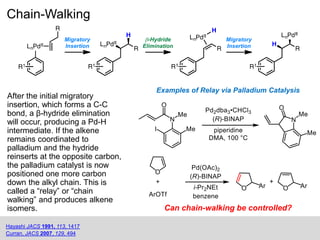
Chain-Walking
Examples of Relay via Palladium Catalysis
Hayashi JACS 1991, 113, 1417
Curran, JACS 2007, 129, 494
After the initial migratory
insertion, which forms a C-C
bond, a β-hydride elimination
will occur, producing a Pd-H
intermediate. If the alkene
remains coordinated to
palladium and the hydride
reinserts at the opposite carbon,
the palladium catalyst is now
positioned one more carbon
down the alkyl chain. This is
called a “relay” or “chain
walking” and produces alkene
isomers. Can chain-walking be controlled?
Redox-Relay Heck Reaction
Sigman Science 2012, 338, 1455
Sigman JACS, 2013, 135, 6830
Classical Variant
Oxidative Variant
Sigman and coworkers have developed a redox-relay Heck reaction, where the relay
by palladium is controlled by a thermodynamic sink (an alcohol) on the substrate. The
unsaturation of the alkene is transferred to the alcohol to form aldehydes or ketones.
Problems
1. Keay, JOC, 2007, 72, 7253
This work is licensed under a
Creative Commons Attribution-
ShareAlike 4.0 International
License.
Contributed by:
Margaret Hilton
Sigman Lab
University of Utah
2014

Heck redox relay

  • 1.
    Organic Pedagogical Electronic Network RedoxRelay Heck Reaction Margaret Hilton Sigman Lab University of Utah 2014
  • 2.
    Heck Reaction Review: Chem.Rev. 2000, 100, 3009. Other Examples and Applications: Overman JACS 1993, 115, 11028 , Sarpong JACS 2008, 130, 7222, Shibasaki JOC 1996, 61, 4876, Sigman JACS 2010, 132, 13981, Sigman JACS 2011, 133, 9692. 2010 Nobel Prize *Note: this reaction may also proceed through an oxidative mechanism, where a PdII precatalyst , a transmetallating aryl reagent, and a terminal oxidant are used, such as with Heck’s conditions shown. Since Heck’s seminal publication in 1968, the Heck reaction has been a powerful synthetic tool for the functionalization of olefins with aryl groups. Heck’s Conditions: Heck, along with Negishi and Suzuki, won the Chemistry Nobel Prize in 2010 for their work in cross coupling. General Mechanism*
  • 3.
    Chain-Walking Examples of Relayvia Palladium Catalysis Hayashi JACS 1991, 113, 1417 Curran, JACS 2007, 129, 494 After the initial migratory insertion, which forms a C-C bond, a β-hydride elimination will occur, producing a Pd-H intermediate. If the alkene remains coordinated to palladium and the hydride reinserts at the opposite carbon, the palladium catalyst is now positioned one more carbon down the alkyl chain. This is called a “relay” or “chain walking” and produces alkene isomers. Can chain-walking be controlled?
  • 4.
    Redox-Relay Heck Reaction SigmanScience 2012, 338, 1455 Sigman JACS, 2013, 135, 6830 Classical Variant Oxidative Variant Sigman and coworkers have developed a redox-relay Heck reaction, where the relay by palladium is controlled by a thermodynamic sink (an alcohol) on the substrate. The unsaturation of the alkene is transferred to the alcohol to form aldehydes or ketones.
  • 5.
    Problems 1. Keay, JOC,2007, 72, 7253
  • 6.
    This work islicensed under a Creative Commons Attribution- ShareAlike 4.0 International License. Contributed by: Margaret Hilton Sigman Lab University of Utah 2014