
Wave-particle dualityDone by: Damien Poh(2a1)22
IntroductionWave–particle duality prostulates that all particles exhibit both particle and wave properties.
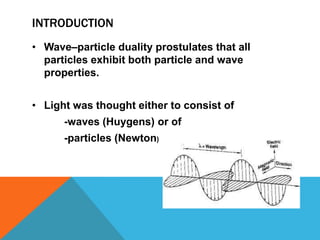
Light was thought either to consist of 	-waves (Huygens) or of 	-particles (Newton)
IntroductionThe first to publicly hypothesize about the nature of light, proposing that light is a disturbance in the element air was Aristotle
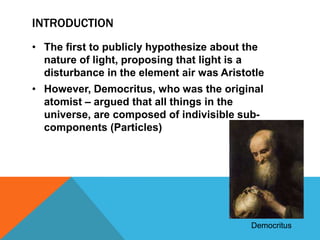
However, Democritus, who was the original atomist – argued that all things in the universe, are composed of indivisible sub-components (Particles)Democritus
History Through the work ofMax Planck, Albert Einstein, Niels Bohr,and many others, current scientific theory holds that all particles also have a wave nature (and vice versa).
This phenomenon has been verified not only for elementary particles, but also for compound particles like atoms and even moleculesSo what is wave-particle duality?The wave particle duality is the principle of quantum physics.
Holds that matter and light exhibit the behaviors of both waves and particles, depending upon the circumstances of the experiment.
It is a complex topic, but among the most intriguing in physics.Wave-particle duality in lightLight is able to function as both a particle and a wave, depending on how the experiment is conducted and when observations are made.
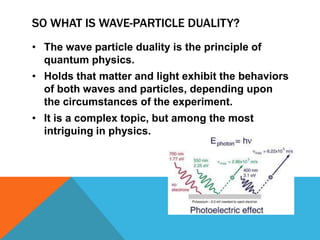
Under certain conditions, such as when we shine it through narrow slits and look at the result, it behaves as only a wave can. Under other conditions, such as when we shine it on a metal and examine the spray of electrons that comes off, light behaves as only particles can.
This multiple personality of light is referred to as "wave-particle duality." Light behaves as a wave, or as particles, depending on what we do with it, and what we try to observe.Wave-particle duality in matterJust like light, matter is also capable of exhibiting properties of both wave-lengths and particles.
Massive objects exhibit very small wavelengths, so small in fact that it's rather pointless to think of them in a wave form.

Wave particle duality

  • 1.
  • 2.
    IntroductionWave–particle duality prostulatesthat all particles exhibit both particle and wave properties.
  • 3.
    Light was thoughteither to consist of -waves (Huygens) or of -particles (Newton)
  • 4.
    IntroductionThe first topublicly hypothesize about the nature of light, proposing that light is a disturbance in the element air was Aristotle
  • 5.
    However, Democritus, whowas the original atomist – argued that all things in the universe, are composed of indivisible sub-components (Particles)Democritus
  • 6.
    History Through thework ofMax Planck, Albert Einstein, Niels Bohr,and many others, current scientific theory holds that all particles also have a wave nature (and vice versa).
  • 7.
    This phenomenon hasbeen verified not only for elementary particles, but also for compound particles like atoms and even moleculesSo what is wave-particle duality?The wave particle duality is the principle of quantum physics.
  • 8.
    Holds that matterand light exhibit the behaviors of both waves and particles, depending upon the circumstances of the experiment.
  • 9.
    It is acomplex topic, but among the most intriguing in physics.Wave-particle duality in lightLight is able to function as both a particle and a wave, depending on how the experiment is conducted and when observations are made.
  • 10.
    Under certain conditions,such as when we shine it through narrow slits and look at the result, it behaves as only a wave can. Under other conditions, such as when we shine it on a metal and examine the spray of electrons that comes off, light behaves as only particles can.
  • 11.
    This multiple personalityof light is referred to as "wave-particle duality." Light behaves as a wave, or as particles, depending on what we do with it, and what we try to observe.Wave-particle duality in matterJust like light, matter is also capable of exhibiting properties of both wave-lengths and particles.
  • 12.
    Massive objects exhibitvery small wavelengths, so small in fact that it's rather pointless to think of them in a wave form.