INCISION AND DRAINAGE
BY Dr.DONY DEVASIA,
ASSISTANT PROFESSOR, DEPARTMENT OF GENERAL SURGERY,
BELIEVERS CHURCH MEDICAL COLLEGE HOSPITAL.
OBJECTIVES:
• To drain pus along with bacterial toxins and other debris
• To relieve pressure effects and pain.
• To irrigate the cavity.
• To obtain fluid or pus for culture and sensitivity testing.
• Staphylococcus is the most common organism except in
perianal and perineal areas where coliforms and anerobes are
mostly responsible
INDICATIONS
• Abscesses more than 5 mms in size and found in
accessible location.
• Abscess has swelling,pain, redness, fluctuance.
• Needle aspiration could help confirm or a bed side
ultrasound could help in confirmation.
PRINCIPLES OF INCISION
PLACEMENT:
• Incision should be placed in most dependant area of
swelling and not on the centre most area.
• Parallel to the langers line. Resting lines within the skin
creases,
• sufficiently large enough to drain completely but
aesthetically acceptable also.
• Some practice cruciate incisions and deroofing of abscess
cavity.
SURGICAL PROCEDURE
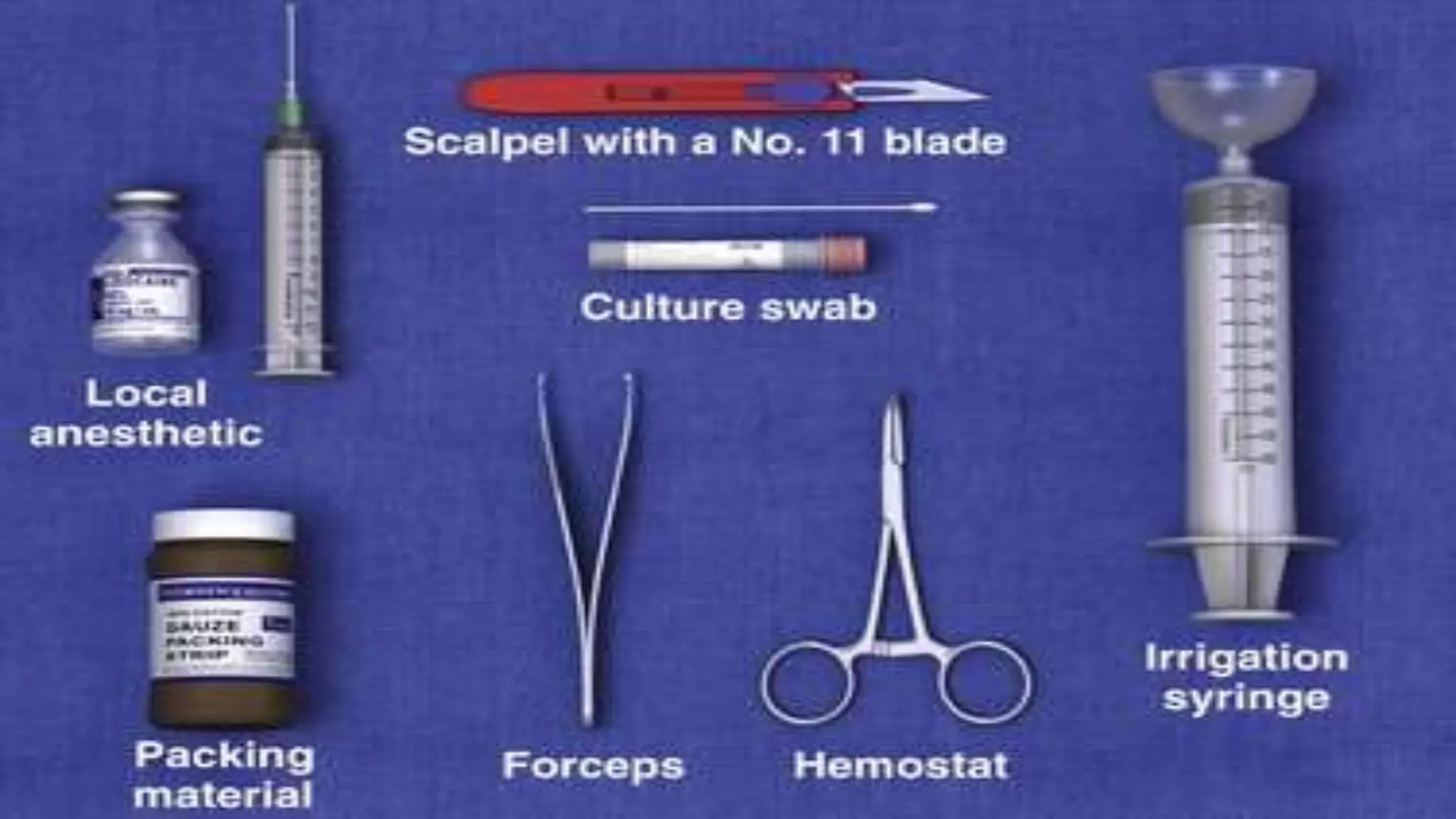
• To attain anesthesia, either block the area or local infiltration in diamond shape.
• Incision placement
• Evacuation of pus , curved artery or listers forceps are used to break the loculi.Sent culture
and sensitivity
• Should be directed in all directions so that all locules are broken.
• Also finger can be inserted to break the locules.
• Irrigate the cavity with peroxide betadine+followed by normal saline to wash out to flush
necrotic debri or bacterial toxins until the flush is clear.
• Can put drain(corrugated rubber drain) or pack cavity with roller gauze so cavity is kept
opened and to keep walls of abcess separated and hemostasis is achieved,
HILTONS METHOD:
• In vital areas one method of incision and drainage near important structures.
• In Hilton method after skin incision through skin and subcutaneous tissue
only listers sinus forceps with closed beaks is inserted into deeper structures .
• Then beaks of listers sinus forceps are opened parallel to vital structues
and break locules.
when removing sinus forceps keep beaks opened so opening becomes larger.
• Supplementary antibiotics are needed if there is associated cellulitis or other
immunocompromised,fever or chills
• Make sure patients tetanus immunisations are up to date
• No benefit for topical antibiotics and are not needed.
• Packing removal to be done in 2 to 3 days.
• Follow up and packing removal earlier if there is any worsening.
• May need repacking.
COMPLICATIONS:
• Pain during procedure, insufficient anesthesia as tissue around an abscess is acidotic
and local anesthetic agents losses effect around acidotic tissue.Do field block
instead.
• Progression to cellulitis.
• Development of fever.
• Signs of clinical worsening.
Incision and drainage

Incision and drainage

  • 1.
    INCISION AND DRAINAGE BYDr.DONY DEVASIA, ASSISTANT PROFESSOR, DEPARTMENT OF GENERAL SURGERY, BELIEVERS CHURCH MEDICAL COLLEGE HOSPITAL.
  • 2.
    OBJECTIVES: • To drainpus along with bacterial toxins and other debris • To relieve pressure effects and pain. • To irrigate the cavity. • To obtain fluid or pus for culture and sensitivity testing. • Staphylococcus is the most common organism except in perianal and perineal areas where coliforms and anerobes are mostly responsible
  • 4.
    INDICATIONS • Abscesses morethan 5 mms in size and found in accessible location. • Abscess has swelling,pain, redness, fluctuance. • Needle aspiration could help confirm or a bed side ultrasound could help in confirmation.
  • 6.
    PRINCIPLES OF INCISION PLACEMENT: •Incision should be placed in most dependant area of swelling and not on the centre most area. • Parallel to the langers line. Resting lines within the skin creases, • sufficiently large enough to drain completely but aesthetically acceptable also. • Some practice cruciate incisions and deroofing of abscess cavity.
  • 8.
    SURGICAL PROCEDURE • Toattain anesthesia, either block the area or local infiltration in diamond shape. • Incision placement • Evacuation of pus , curved artery or listers forceps are used to break the loculi.Sent culture and sensitivity • Should be directed in all directions so that all locules are broken. • Also finger can be inserted to break the locules. • Irrigate the cavity with peroxide betadine+followed by normal saline to wash out to flush necrotic debri or bacterial toxins until the flush is clear. • Can put drain(corrugated rubber drain) or pack cavity with roller gauze so cavity is kept opened and to keep walls of abcess separated and hemostasis is achieved,
  • 10.
    HILTONS METHOD: • Invital areas one method of incision and drainage near important structures. • In Hilton method after skin incision through skin and subcutaneous tissue only listers sinus forceps with closed beaks is inserted into deeper structures . • Then beaks of listers sinus forceps are opened parallel to vital structues and break locules. when removing sinus forceps keep beaks opened so opening becomes larger.
  • 11.
    • Supplementary antibioticsare needed if there is associated cellulitis or other immunocompromised,fever or chills • Make sure patients tetanus immunisations are up to date • No benefit for topical antibiotics and are not needed. • Packing removal to be done in 2 to 3 days. • Follow up and packing removal earlier if there is any worsening. • May need repacking.
  • 12.
    COMPLICATIONS: • Pain duringprocedure, insufficient anesthesia as tissue around an abscess is acidotic and local anesthetic agents losses effect around acidotic tissue.Do field block instead. • Progression to cellulitis. • Development of fever. • Signs of clinical worsening.