THE BASICS OF DIALOGUE
AND DIALOGUE TAGS
BY DM YATES
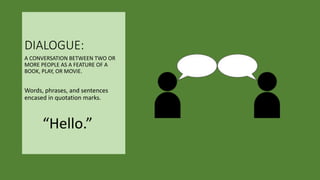
DIALOGUE:
A CONVERSATION BETWEEN TWO OR
MORE PEOPLE AS A FEATURE OF A
BOOK, PLAY, OR MOVIE.
Words, phrases, and sentences
encased in quotation marks.
“Hello.”
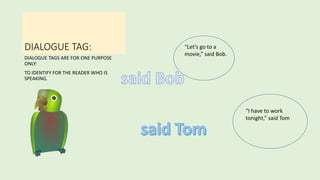
DIALOGUE TAG:
DIALOGUE TAGS ARE FOR ONE PURPOSE
ONLY:
TO IDENTIFY FOR THE READER WHO IS
SPEAKING.
“Let’s go to a
movie,” said Bob.
“I have to work
tonight,” said Tom
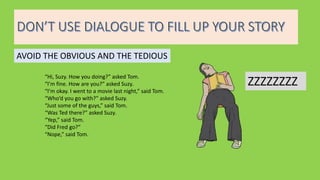
“Hi, Suzy. How you doing?” asked Tom.
“I’m fine. How are you?” asked Suzy.
“I’m okay. I went to a movie last night,” said Tom.
“Who’d you go with?” asked Suzy.
“Just some of the guys,” said Tom.
“Was Ted there?” asked Suzy.
“Yep,” said Tom.
“Did Fred go?”
“Nope,” said Tom.
ZZZZZZZZ
AVOID THE OBVIOUS AND THE TEDIOUS
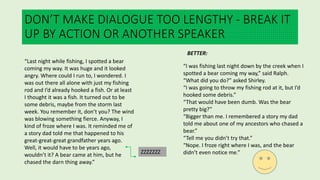
DON’T MAKE DIALOGUE TOO LENGTHY - BREAK IT
UP BY ACTION OR ANOTHER SPEAKER
“Last night while fishing, I spotted a bear
coming my way. It was huge and it looked
angry. Where could I run to, I wondered. I
was out there all alone with just my fishing
rod and I’d already hooked a fish. Or at least
I thought it was a fish. It turned out to be
some debris, maybe from the storm last
week. You remember it, don’t you? The wind
was blowing something fierce. Anyway, I
kind of froze where I was. It reminded me of
a story dad told me that happened to his
great-great-great grandfather years ago.
Well, it would have to be years ago,
wouldn’t it? A bear came at him, but he
chased the darn thing away.”
ZZZZZZZ
“I was fishing last night down by the creek when I
spotted a bear coming my way,” said Ralph.
“What did you do?” asked Shirley.
“I was going to throw my fishing rod at it, but I’d
hooked some debris.”
“That would have been dumb. Was the bear
pretty big?”
“Bigger than me. I remembered a story my dad
told me about one of my ancestors who chased a
bear.”
“Tell me you didn’t try that.”
“Nope. I froze right where I was, and the bear
didn’t even notice me.”
BETTER:
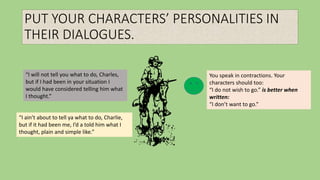
PUT YOUR CHARACTERS’ PERSONALITIES IN
THEIR DIALOGUES.
“I will not tell you what to do, Charles,
but if I had been in your situation I
would have considered telling him what
I thought.”
“I ain’t about to tell ya what to do, Charlie,
but if it had been me, I’d a told him what I
thought, plain and simple like.”
You speak in contractions. Your
characters should too:
“I do not wish to go.” is better when
written:
“I don’t want to go.”
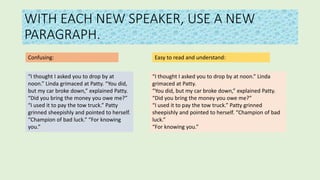
WITH EACH NEW SPEAKER, USE A NEW
PARAGRAPH.
“I thought I asked you to drop by at noon.” Linda
grimaced at Patty.
“You did, but my car broke down,” explained Patty.
“Did you bring the money you owe me?”
“I used it to pay the tow truck.” Patty grinned
sheepishly and pointed to herself. “Champion of bad
luck.”
“For knowing you.”
“I thought I asked you to drop by at
noon.” Linda grimaced at Patty. “You did,
but my car broke down,” explained Patty.
“Did you bring the money you owe me?”
“I used it to pay the tow truck.” Patty
grinned sheepishly and pointed to herself.
“Champion of bad luck.” “For knowing
you.”
Confusing: Easy to read and understand:
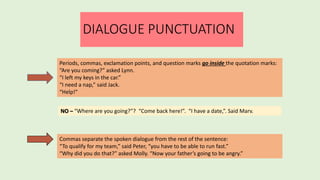
DIALOGUE PUNCTUATION
Periods, commas, exclamation points, and question marks go inside the quotation marks:
“Are you coming?” asked Lynn.
“I left my keys in the car.”
“I need a nap,” said Jack.
“Help!”
Commas separate the spoken dialogue from the rest of the sentence:
“To qualify for my team,” said Peter, “you have to be able to run fast.”
“Why did you do that?” asked Molly. “Now your father’s going to be angry.”
NO – “Where are you going?”? “Come back here!”. “I have a date,”. Said Marv.
DIALOGUE PUNCTUATION
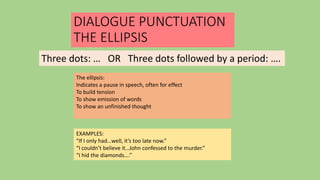
THE ELLIPSIS
The ellipsis:
Indicates a pause in speech, often for effect
To build tension
To show emission of words
To show an unfinished thought
Three dots: … OR Three dots followed by a period: ….
EXAMPLES:
“If I only had…well, it’s too late now.”
“I couldn’t believe it…John confessed to the murder.”
“I hid the diamonds….”
DIALOGUE PUNCTION
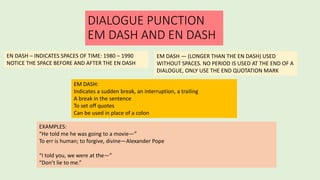
EM DASH AND EN DASH
EM DASH — (LONGER THAN THE EN DASH) USED
WITHOUT SPACES. NO PERIOD IS USED AT THE END OF A
DIALOGUE, ONLY USE THE END QUOTATION MARK
EN DASH – INDICATES SPACES OF TIME: 1980 – 1990
NOTICE THE SPACE BEFORE AND AFTER THE EN DASH
EM DASH:
Indicates a sudden break, an interruption, a trailing
A break in the sentence
To set off quotes
Can be used in place of a colon
EXAMPLES:
“He told me he was going to a movie—”
To err is human; to forgive, divine—Alexander Pope
“I told you, we were at the—”
“Don’t lie to me.”
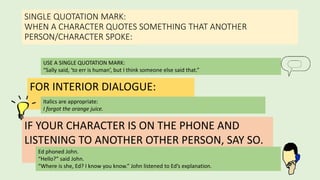
SINGLE QUOTATION MARK:
WHEN A CHARACTER QUOTES SOMETHING THAT ANOTHER
PERSON/CHARACTER SPOKE:
USE A SINGLE QUOTATION MARK:
“Sally said, ‘to err is human’, but I think someone else said that.”
FOR INTERIOR DIALOGUE:
Italics are appropriate:
I forgot the orange juice.
IF YOUR CHARACTER IS ON THE PHONE AND
LISTENING TO ANOTHER OTHER PERSON, SAY SO.
Ed phoned John.
“Hello?” said John.
“Where is she, Ed? I know you know.” John listened to Ed’s explanation.
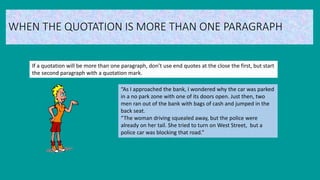
WHEN THE QUOTATION IS MORE THAN ONE PARAGRAPH
If a quotation will be more than one paragraph, don’t use end quotes at the close the first, but start
the second paragraph with a quotation mark.
“As I approached the bank, I wondered why the car was parked
in a no park zone with one of its doors open. Just then, two
men ran out of the bank with bags of cash and jumped in the
back seat.
“The woman driving squealed away, but the police were
already on her tail. She tried to turn on West Street, but a
police car was blocking that road.”
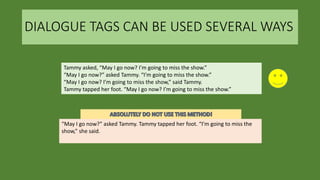
DIALOGUE TAGS CAN BE USED SEVERAL WAYS
Tammy asked, “May I go now? I’m going to miss the show.”
“May I go now?” asked Tammy. “I’m going to miss the show.”
“May I go now? I’m going to miss the show,” said Tammy.
Tammy tapped her foot. “May I go now? I’m going to miss the show.”
“May I go now?” asked Tammy. Tammy tapped her foot. “I’m going to miss the
show,” she said.
CAREFUL ON USING DIALOGUE TAGS
If only two people are speaking, you don’t have to use dialogue tags for each dialogue.
That’s too much repetition.
“Did you go to the dance last night?” asked Angie.
“I had to study,” said Pam.
“Too bad. It was lots of fun.”
Sometimes, showing the action is enough of a tag.
Craig kicked the wall. “You make me so mad.”
“Contributions for the poor.” Alex rattled the can.
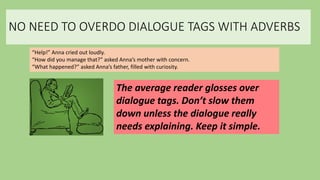
NO NEED TO OVERDO DIALOGUE TAGS WITH ADVERBS
“Help!” Anna cried out loudly.
“How did you manage that?” asked Anna’s mother with concern.
“What happened?” asked Anna’s father, filled with curiosity.
The average reader glosses over
dialogue tags. Don’t slow them
down unless the dialogue really
needs explaining. Keep it simple.
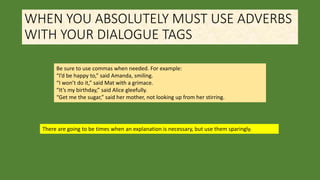
WHEN YOU ABSOLUTELY MUST USE ADVERBS
WITH YOUR DIALOGUE TAGS
Be sure to use commas when needed. For example:
“I’d be happy to,” said Amanda, smiling.
“I won’t do it,” said Mat with a grimace.
“It’s my birthday,” said Alice gleefully.
“Get me the sugar,” said her mother, not looking up from her stirring.
There are going to be times when an explanation is necessary, but use them sparingly.
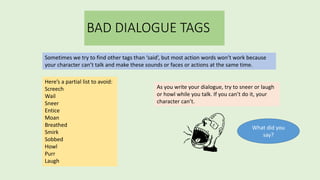
BAD DIALOGUE TAGS
Sometimes we try to find other tags than ‘said’, but most action words won’t work because
your character can’t talk and make these sounds or faces or actions at the same time.
Here’s a partial list to avoid:
Screech
Wail
Sneer
Entice
Moan
Breathed
Smirk
Sobbed
Howl
Purr
Laugh
As you write your dialogue, try to sneer or laugh
or howl while you talk. If you can’t do it, your
character can’t.
What did you
say?
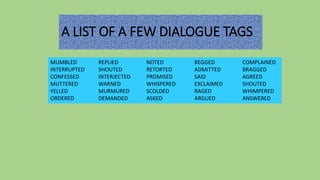
A LIST OF A FEW DIALOGUE TAGS
MUMBLED REPLIED NOTED BEGGED COMPLAINED
INTERRUPTED SHOUTED RETORTED ADMITTED BRAGGED
CONFESSED INTERJECTED PROMISED SAID AGREED
MUTTERED WARNED WHISPERED EXCLAIMED SHOUTED
YELLED MURMURED SCOLDED RAGED WHIMPERED
ORDERED DEMANDED ASKED ARGUED ANSWERED
THANK YOU FOR TAKING YOUR TIME TO LOOK AT THESE SLIDES.
A HUGE THANK YOU TO OCAL CLKER.COM AND ITS
CONTRIBUTORS FOR THE FREE CLIPART, INCLUDING
KELLY FOR THE BLONDE GIRL, AND JESSICA FOR THE BLUE
QUOTATION MARKS.

Understanding dialogue and dialogue tags

  • 1.
    THE BASICS OFDIALOGUE AND DIALOGUE TAGS BY DM YATES
  • 2.
    DIALOGUE: A CONVERSATION BETWEENTWO OR MORE PEOPLE AS A FEATURE OF A BOOK, PLAY, OR MOVIE. Words, phrases, and sentences encased in quotation marks. “Hello.”
  • 3.
    DIALOGUE TAG: DIALOGUE TAGSARE FOR ONE PURPOSE ONLY: TO IDENTIFY FOR THE READER WHO IS SPEAKING. “Let’s go to a movie,” said Bob. “I have to work tonight,” said Tom
  • 4.
    “Hi, Suzy. Howyou doing?” asked Tom. “I’m fine. How are you?” asked Suzy. “I’m okay. I went to a movie last night,” said Tom. “Who’d you go with?” asked Suzy. “Just some of the guys,” said Tom. “Was Ted there?” asked Suzy. “Yep,” said Tom. “Did Fred go?” “Nope,” said Tom. ZZZZZZZZ AVOID THE OBVIOUS AND THE TEDIOUS
  • 5.
    DON’T MAKE DIALOGUETOO LENGTHY - BREAK IT UP BY ACTION OR ANOTHER SPEAKER “Last night while fishing, I spotted a bear coming my way. It was huge and it looked angry. Where could I run to, I wondered. I was out there all alone with just my fishing rod and I’d already hooked a fish. Or at least I thought it was a fish. It turned out to be some debris, maybe from the storm last week. You remember it, don’t you? The wind was blowing something fierce. Anyway, I kind of froze where I was. It reminded me of a story dad told me that happened to his great-great-great grandfather years ago. Well, it would have to be years ago, wouldn’t it? A bear came at him, but he chased the darn thing away.” ZZZZZZZ “I was fishing last night down by the creek when I spotted a bear coming my way,” said Ralph. “What did you do?” asked Shirley. “I was going to throw my fishing rod at it, but I’d hooked some debris.” “That would have been dumb. Was the bear pretty big?” “Bigger than me. I remembered a story my dad told me about one of my ancestors who chased a bear.” “Tell me you didn’t try that.” “Nope. I froze right where I was, and the bear didn’t even notice me.” BETTER:
  • 6.
    PUT YOUR CHARACTERS’PERSONALITIES IN THEIR DIALOGUES. “I will not tell you what to do, Charles, but if I had been in your situation I would have considered telling him what I thought.” “I ain’t about to tell ya what to do, Charlie, but if it had been me, I’d a told him what I thought, plain and simple like.” You speak in contractions. Your characters should too: “I do not wish to go.” is better when written: “I don’t want to go.”
  • 7.
    WITH EACH NEWSPEAKER, USE A NEW PARAGRAPH. “I thought I asked you to drop by at noon.” Linda grimaced at Patty. “You did, but my car broke down,” explained Patty. “Did you bring the money you owe me?” “I used it to pay the tow truck.” Patty grinned sheepishly and pointed to herself. “Champion of bad luck.” “For knowing you.” “I thought I asked you to drop by at noon.” Linda grimaced at Patty. “You did, but my car broke down,” explained Patty. “Did you bring the money you owe me?” “I used it to pay the tow truck.” Patty grinned sheepishly and pointed to herself. “Champion of bad luck.” “For knowing you.” Confusing: Easy to read and understand:
  • 8.
    DIALOGUE PUNCTUATION Periods, commas,exclamation points, and question marks go inside the quotation marks: “Are you coming?” asked Lynn. “I left my keys in the car.” “I need a nap,” said Jack. “Help!” Commas separate the spoken dialogue from the rest of the sentence: “To qualify for my team,” said Peter, “you have to be able to run fast.” “Why did you do that?” asked Molly. “Now your father’s going to be angry.” NO – “Where are you going?”? “Come back here!”. “I have a date,”. Said Marv.
  • 9.
    DIALOGUE PUNCTUATION THE ELLIPSIS Theellipsis: Indicates a pause in speech, often for effect To build tension To show emission of words To show an unfinished thought Three dots: … OR Three dots followed by a period: …. EXAMPLES: “If I only had…well, it’s too late now.” “I couldn’t believe it…John confessed to the murder.” “I hid the diamonds….”
  • 10.
    DIALOGUE PUNCTION EM DASHAND EN DASH EM DASH — (LONGER THAN THE EN DASH) USED WITHOUT SPACES. NO PERIOD IS USED AT THE END OF A DIALOGUE, ONLY USE THE END QUOTATION MARK EN DASH – INDICATES SPACES OF TIME: 1980 – 1990 NOTICE THE SPACE BEFORE AND AFTER THE EN DASH EM DASH: Indicates a sudden break, an interruption, a trailing A break in the sentence To set off quotes Can be used in place of a colon EXAMPLES: “He told me he was going to a movie—” To err is human; to forgive, divine—Alexander Pope “I told you, we were at the—” “Don’t lie to me.”
  • 11.
    SINGLE QUOTATION MARK: WHENA CHARACTER QUOTES SOMETHING THAT ANOTHER PERSON/CHARACTER SPOKE: USE A SINGLE QUOTATION MARK: “Sally said, ‘to err is human’, but I think someone else said that.” FOR INTERIOR DIALOGUE: Italics are appropriate: I forgot the orange juice. IF YOUR CHARACTER IS ON THE PHONE AND LISTENING TO ANOTHER OTHER PERSON, SAY SO. Ed phoned John. “Hello?” said John. “Where is she, Ed? I know you know.” John listened to Ed’s explanation.
  • 12.
    WHEN THE QUOTATIONIS MORE THAN ONE PARAGRAPH If a quotation will be more than one paragraph, don’t use end quotes at the close the first, but start the second paragraph with a quotation mark. “As I approached the bank, I wondered why the car was parked in a no park zone with one of its doors open. Just then, two men ran out of the bank with bags of cash and jumped in the back seat. “The woman driving squealed away, but the police were already on her tail. She tried to turn on West Street, but a police car was blocking that road.”
  • 13.
    DIALOGUE TAGS CANBE USED SEVERAL WAYS Tammy asked, “May I go now? I’m going to miss the show.” “May I go now?” asked Tammy. “I’m going to miss the show.” “May I go now? I’m going to miss the show,” said Tammy. Tammy tapped her foot. “May I go now? I’m going to miss the show.” “May I go now?” asked Tammy. Tammy tapped her foot. “I’m going to miss the show,” she said.
  • 14.
    CAREFUL ON USINGDIALOGUE TAGS If only two people are speaking, you don’t have to use dialogue tags for each dialogue. That’s too much repetition. “Did you go to the dance last night?” asked Angie. “I had to study,” said Pam. “Too bad. It was lots of fun.” Sometimes, showing the action is enough of a tag. Craig kicked the wall. “You make me so mad.” “Contributions for the poor.” Alex rattled the can.
  • 15.
    NO NEED TOOVERDO DIALOGUE TAGS WITH ADVERBS “Help!” Anna cried out loudly. “How did you manage that?” asked Anna’s mother with concern. “What happened?” asked Anna’s father, filled with curiosity. The average reader glosses over dialogue tags. Don’t slow them down unless the dialogue really needs explaining. Keep it simple.
  • 16.
    WHEN YOU ABSOLUTELYMUST USE ADVERBS WITH YOUR DIALOGUE TAGS Be sure to use commas when needed. For example: “I’d be happy to,” said Amanda, smiling. “I won’t do it,” said Mat with a grimace. “It’s my birthday,” said Alice gleefully. “Get me the sugar,” said her mother, not looking up from her stirring. There are going to be times when an explanation is necessary, but use them sparingly.
  • 17.
    BAD DIALOGUE TAGS Sometimeswe try to find other tags than ‘said’, but most action words won’t work because your character can’t talk and make these sounds or faces or actions at the same time. Here’s a partial list to avoid: Screech Wail Sneer Entice Moan Breathed Smirk Sobbed Howl Purr Laugh As you write your dialogue, try to sneer or laugh or howl while you talk. If you can’t do it, your character can’t. What did you say?
  • 18.
    A LIST OFA FEW DIALOGUE TAGS MUMBLED REPLIED NOTED BEGGED COMPLAINED INTERRUPTED SHOUTED RETORTED ADMITTED BRAGGED CONFESSED INTERJECTED PROMISED SAID AGREED MUTTERED WARNED WHISPERED EXCLAIMED SHOUTED YELLED MURMURED SCOLDED RAGED WHIMPERED ORDERED DEMANDED ASKED ARGUED ANSWERED
  • 19.
    THANK YOU FORTAKING YOUR TIME TO LOOK AT THESE SLIDES. A HUGE THANK YOU TO OCAL CLKER.COM AND ITS CONTRIBUTORS FOR THE FREE CLIPART, INCLUDING KELLY FOR THE BLONDE GIRL, AND JESSICA FOR THE BLUE QUOTATION MARKS.