Mini-lesson: Dialogue
Read along as I go over each rule
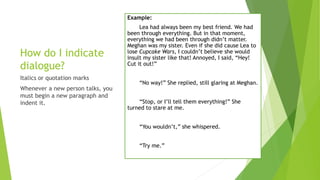
How do I indicate
dialogue?
Example:
Lea had always been my best friend. We had
been through everything. But in that moment,
everything we had been through didn’t matter.
Meghan was my sister. Even if she did cause Lea to
lose Cupcake Wars, I couldn’t believe she would
insult my sister like that! Annoyed, I said, “Hey!
Cut it out!”
“No way!” She replied, still glaring at Meghan.
“Stop, or I’ll tell them everything!” She
turned to stare at me.
“You wouldn’t,” she whispered.
“Try me.”
Italics or quotation marks
Whenever a new person talks, you
must begin a new paragraph and
indent it.
What do I do about
punctuation and
capitalization?
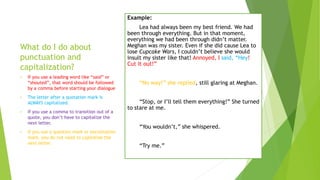
• If you use a leading word like “said” or
“shouted”, that word should be followed
by a comma before starting your dialogue
• The letter after a quotation mark is
ALWAYS capitalized.
• If you use a comma to transition out of a
quote, you don’t have to capitalize the
next letter.
• If you use a question mark or exclamation
mark, you do not need to capitalize the
next letter.
Example:
Lea had always been my best friend. We had
been through everything. But in that moment,
everything we had been through didn’t matter.
Meghan was my sister. Even if she did cause Lea to
lose Cupcake Wars, I couldn’t believe she would
insult my sister like that! Annoyed, I said, “Hey!
Cut it out!”
“No way!” she replied, still glaring at Meghan.
“Stop, or I’ll tell them everything!” She turned
to stare at me.
“You wouldn’t,” she whispered.
“Try me.”
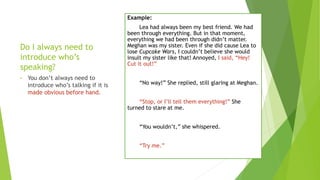
Do I always need to
introduce who’s
speaking?
• You don’t always need to
introduce who’s talking if it is
made obvious before hand.
Example:
Lea had always been my best friend. We had
been through everything. But in that moment,
everything we had been through didn’t matter.
Meghan was my sister. Even if she did cause Lea to
lose Cupcake Wars, I couldn’t believe she would
insult my sister like that! Annoyed, I said, “Hey!
Cut it out!”
“No way!” She replied, still glaring at Meghan.
“Stop, or I’ll tell them everything!” She
turned to stare at me.
“You wouldn’t,” she whispered.
“Try me.”
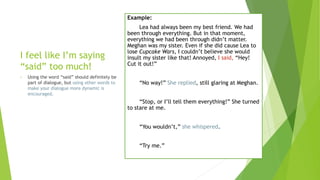
I feel like I’m saying
“said” too much!
• Using the word “said” should definitely be
part of dialogue, but using other words to
make your dialogue more dynamic is
encouraged.
Example:
Lea had always been my best friend. We had
been through everything. But in that moment,
everything we had been through didn’t matter.
Meghan was my sister. Even if she did cause Lea to
lose Cupcake Wars, I couldn’t believe she would
insult my sister like that! Annoyed, I said, “Hey!
Cut it out!”
“No way!” She replied, still glaring at Meghan.
“Stop, or I’ll tell them everything!” She turned
to stare at me.
“You wouldn’t,” she whispered.
“Try me.”
Questions about Dialogue?
If it’s a general question, please ask now! If it’s a question that’s really
just specific to your writing, please ask me as everyone is writing.

dialogue mini lesson for English communication

  • 1.
    Mini-lesson: Dialogue Read alongas I go over each rule
  • 2.
    How do Iindicate dialogue? Example: Lea had always been my best friend. We had been through everything. But in that moment, everything we had been through didn’t matter. Meghan was my sister. Even if she did cause Lea to lose Cupcake Wars, I couldn’t believe she would insult my sister like that! Annoyed, I said, “Hey! Cut it out!” “No way!” She replied, still glaring at Meghan. “Stop, or I’ll tell them everything!” She turned to stare at me. “You wouldn’t,” she whispered. “Try me.” Italics or quotation marks Whenever a new person talks, you must begin a new paragraph and indent it.
  • 3.
    What do Ido about punctuation and capitalization? • If you use a leading word like “said” or “shouted”, that word should be followed by a comma before starting your dialogue • The letter after a quotation mark is ALWAYS capitalized. • If you use a comma to transition out of a quote, you don’t have to capitalize the next letter. • If you use a question mark or exclamation mark, you do not need to capitalize the next letter. Example: Lea had always been my best friend. We had been through everything. But in that moment, everything we had been through didn’t matter. Meghan was my sister. Even if she did cause Lea to lose Cupcake Wars, I couldn’t believe she would insult my sister like that! Annoyed, I said, “Hey! Cut it out!” “No way!” she replied, still glaring at Meghan. “Stop, or I’ll tell them everything!” She turned to stare at me. “You wouldn’t,” she whispered. “Try me.”
  • 4.
    Do I alwaysneed to introduce who’s speaking? • You don’t always need to introduce who’s talking if it is made obvious before hand. Example: Lea had always been my best friend. We had been through everything. But in that moment, everything we had been through didn’t matter. Meghan was my sister. Even if she did cause Lea to lose Cupcake Wars, I couldn’t believe she would insult my sister like that! Annoyed, I said, “Hey! Cut it out!” “No way!” She replied, still glaring at Meghan. “Stop, or I’ll tell them everything!” She turned to stare at me. “You wouldn’t,” she whispered. “Try me.”
  • 5.
    I feel likeI’m saying “said” too much! • Using the word “said” should definitely be part of dialogue, but using other words to make your dialogue more dynamic is encouraged. Example: Lea had always been my best friend. We had been through everything. But in that moment, everything we had been through didn’t matter. Meghan was my sister. Even if she did cause Lea to lose Cupcake Wars, I couldn’t believe she would insult my sister like that! Annoyed, I said, “Hey! Cut it out!” “No way!” She replied, still glaring at Meghan. “Stop, or I’ll tell them everything!” She turned to stare at me. “You wouldn’t,” she whispered. “Try me.”
  • 6.
    Questions about Dialogue? Ifit’s a general question, please ask now! If it’s a question that’s really just specific to your writing, please ask me as everyone is writing.