Flow Injection Analysis and ApplicationsFlow Injection Analysis and Applications
Western Kentucky UniversityWestern Kentucky University
Chemistry DepartmentChemistry Department
Fall Graduate SeminarFall Graduate Seminar
Presented by: Dheyaa AlkarawiPresented by: Dheyaa Alkarawi
1
OutlineOutline
• IntroductionIntroduction
• Theory and applicationTheory and application
• ConclusionConclusion
• ReferencesReferences
• AcknowledgeAcknowledge
• QuestionsQuestions
2
IntroductionIntroduction
• Flow injection analysis (FIA): a high throughput sampling technique used in
combination with other instruments.
• In FIA, analytes are detected after sequential insertion of a discrete sample
solution into an unsegmented continuously flowing stream. Even this
definition, however, is frequently made obsolete by new developments.
3
The main advantage of Flow Injection is the ability to automate a wide range of
wet chemical assays expediently.
applicationsapplications
• Flow injection analysis designed as tool of for automation of
laboratory assays, also FIA is a tool of research in a variety of fields:
 Industrial, clinical, environmental, agricultural, metallurgical,
geological, food mixture, pharmaceutical, and biotechnological
applications.
 FIA methods of analysis could be very useful for water analysis
 FIA was exploited to analyze the pollutants in water samples from a stream, river,
lake.
 Due to its flexibility, FIA can be combined and integrated with other
instruments (HPLC, AA, GC, CE…) to provide a robust research tool.
4
Theory and applicationTheory and application
 Flow Injection Analysis (FIA) is group of a flow-based
techniques;
 Presently FIA techniques fall into four categories:
5
1.Flow Injection Analysis (FIA)
2. Sequential Injection analysis (SI)
3. Bead Injection (BI)
4. Sequential Injection Chromatography (SIC)
Absorbance
Time (s)
0
2
5
8
Sample injected into a continuously moving stream
Reagent merged with sample, generating a colored product
Color intensity measured in detector
Flow Injection Analysis (FIA)Flow Injection Analysis (FIA)
6
Flow injection analysis to determine chloride IonFlow injection analysis to determine chloride Ion
 Sampling rate was approximately 120 sample/h can be analyzed
 Each sample was injected 4 times. At 480nm
J. Ruzicka & E.H. Hansen, “Flow Injection Analysis” 2nd ed. J. Wiley, N.Y. 1988
7
480nm
Sequential Injection Analysis (SIA)Sequential Injection Analysis (SIA)
 Sample (A red) and reagent (B blue) are injected sequentially, by means of a multiposition
valve (MPV), into a carrier stream, driven by a single syringe pump, placed upstream of the
valve.
8
 As the reaction product (C yellow) starts to form at the interface of stacked zones the flow stopped to
allow product to form
 The flow is then reversed (D) to further promote mixing and to transport the reaction mixture into the
detector for monitoring.
ADV:
Robustness and reliability.
Stability of flow.
Low reagent consumption even lower than FlA teq.
Low waste generation
Speed of response: the readout is available within 30
seconds after sample injection
Features:
Both sample and reagent injected as finite
segments
Discontinuous operation the flow can be
stopped, slowed, accelerated, reversed at
will
Sequential Injection Analysis (FIA)Sequential Injection Analysis (FIA)
Multiposition valve (MPV),
9
Configuration of SI-LOV system for the determination of ethanol in beverages was
successfully analyzed, including red and white wine, beers and various spirits.
Fig. 2.2 ADH, alcohol dehydrogenase; NAD+ Nicotinamide adenine
dinucleotide; Buffer, phosphate buffer pH 9.5; W, waste; SP, syringe
pump HC, holding coil; FC, flow cell; P, peristaltic pump; Detector.
Fig 2.3Variation of the absorbance with the increase of the concentration of ethanol by (A)
initial rate measurements and (B) “A linear dynamic application “ peak height measurement.
at 340 nm.
Susana S.M.P. Vidigal, Ildiko V. T ´ oth, Ant ´ onio O.S.S. Rangel ´2011
 Variant of ethanol Conc In the range of 0.00–
0.040% (v/v) was monitored.
 The objective of this work was to study the potential of the
sequential injection-lab-on-valve (SI-LOV) format for the
miniaturization of enzymatic assays, by using different
measurement modes (peak height and initial-rate-based
measurement).
Table 1. Comparison of the results obtained for the analysis of different beverages according
to the reference and the developed procedures
10
BEAD INJECTIONBEAD INJECTION
 Bead Injection (BI): volume of suspension of microbeads are injected into a carrier stream, where the
beads with a suitable bioligand ion exchange group or C-18 group are trapped within a selected location
(flow cell).
Step 1
Step 2
Step 3
Step 4
On-column Off-column
11
The sample is injected and transported downstream and when the sample reaches the bead layer, its
components react with functional groups on the bead surfaces.
The main advantage of BI is accumulation of target analyte on bead surfaces, while the non retained matrix
is being removed.
A) carrier solution and bead suspension were aspirated
respectively.
12
Y.-L. Yu; Jiang, Y; R.-H. He. Development of a miniature analytical system in a lab-on-valve for determination of trace copper by bead injection spectroscopy,
Talanta, 88 (2012) 352– 357
LOV-BIS system incorporating a multipurpose flow cell for copper measurement by beadLOV-BIS system incorporating a multipurpose flow cell for copper measurement by bead
injection spectroscopyinjection spectroscopy
B) variants of copper conc. were analyzed. The absorbance
in the flow cell was real-time monitored and recorded by
spectrophotometer. Samples Certified (micg g−1
) Found (micg g−1
)
rice 4.9 ± 0.3 4.5 ± 0.5
Human hair 23 ± 1.4 22 ± 1
Water 51 ± 2 ng g−1
49 ± 2 ng g−1
Table 1.Determination of copper contents in various
samples by LOV-BIS platformLOV-BIS platform
Sequential Injection Chromatography (SIC)Sequential Injection Chromatography (SIC)
Sequential Injection Chromatography (SIC) is a
combination of two technologies:
A)Liquid Chromatography (LC).
B) Sequential Injection Analysis (SIA).
13
Sequential Injection Chromatography (SIC)Sequential Injection Chromatography (SIC)
A) Firstly, the system is filled with an eluent solution, A precise volume of sample (red) is aspirated via multi-
position valve (MPV) by flow reversal.
14
B) The MPV is then switched from sample port to the column port, and the sample passes through the column
while analytes are retained.
C) eluent is aspirated via MPV by flow reversal.
D) Flow is reversed and a gradient of eluent is passed via MPV into the column and the separated
analytes are measured as they flow through the detector.
15
Basic combinations of on-line coupling of flow-processing devices and different separation
techniques
16
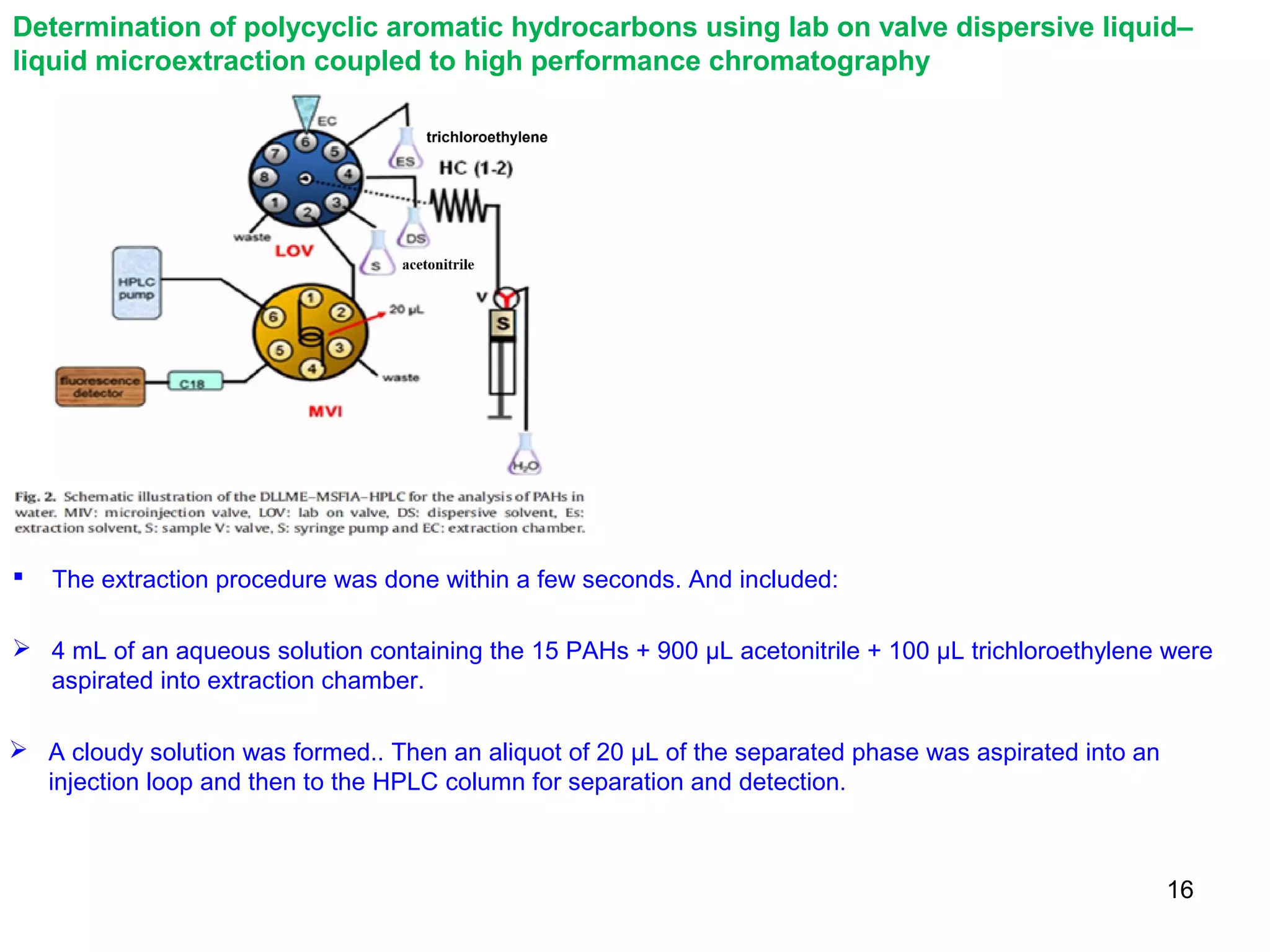
Determination of polycyclic aromatic hydrocarbons using lab on valve dispersive liquid–
liquid microextraction coupled to high performance chromatography
 The extraction procedure was done within a few seconds. And included:
 4 mL of an aqueous solution containing the 15 PAHs + 900 µL acetonitrile + 100 µL trichloroethylene were
aspirated into extraction chamber.
 A cloudy solution was formed.. Then an aliquot of 20 µL of the separated phase was aspirated into an
injection loop and then to the HPLC column for separation and detection.
Compound Abbreviati
on
Peak Order
Naphthalene Nap 1
Acenaphthene Acp 2
fluorene Flu 3
phenanthrene PA 4
anthracene Ant 5
fluoranthene FL 6
pyrene Pyr 7
benz[a]anthrace
ne
BaA 8
chrysene Chr 9
benzo[b]fluorant
hene
BbFl 10
benzo[a]pyrene BkFl 11
benzo[a]pyrene BaP 12
indeno[1,2,3-
cd]pyrene
IP 13
dibenzo[a,h]ant
hracene
DBA 14
benzo[g,h,i]pery
lene
BghiP 15
Table 4: The elution order and retention time of 15 PAHs
On-line DLLME–HPLC chromatograms of water spiked with 0.02
mg/L of each PAH. PAHs were preconcentrated from 4 ml of sample
17
 No PAHs were found in tap water.
 In rain or stream water samples only PAHs of 2 or 3 rings were detected.
 Those PAHs consist of five or six rings only found in highly contaminated sites.
 Application to real Samples:
ConclusionConclusion
 Four FIA techniques were described. However, the goal of any approach to automation of a
reagent based assay is to design a method that will:
19
 Finally, The automated MSFIA–DLLME proposed procedure offers significant saving of reagents and
time compared to other techniques.
1. Provide reproducible and accurate data. 2. Achieve a high sampling frequency
3. Minimize reagent consumption and waste
generation.
4. Simplify the assay protocol, while making the
system transparent to the user.
5- Be versatile, and can be combined to various instruments to provide a power
and solid instrumentation can be used in different ways for qualitative purposes.
 In addition, An analytical methodology for the determination of PAHs in aqueous sample was developed.
The results showed good performance of the analytical protocol.
AcknowledgeAcknowledge
 My research adviser: Dr. Eric Conte
 The department chair and research adviser: Dr . Stuart Burris
 Dr. Kevin Williams
 Evaluation committee
 The audience
20
ReferencesReferences
• Clavijo, S.; Avivar, J.;Suarez, R.; Cerda, V. Analytical strategies for coupling separation and flow-injection
techniques, Trends in Analytical Chemistry. 67 (2015) 26–33
• Zacharis, C.-K.; Theodoridis, G.-A.; Voulgaropoulos, A.-N. Coupling of sequential injection with liquid
chromatography for the automated derivatization and on-line determination of amino acids, Talanta. 69 (2006)
841–847
• Fernández, M.; Clavijo, S.; Forteza, R.; Cerdà, V. Determination of polycyclic aromatic hydrocarbons using lab on
valve dispersive liquid–liquid microextraction coupled to high performance chromatography, Talanta. 138 (2015)
190–195
• Ayyildiz, H.- F.; Kara, H. A Highly Efficient Automated Flow Injection Method for Rapid Determination of Free
Fatty Acid Content in Corn Oils, J Am Oil Chem Soc. (2014) 91:549–558
• Ružicka, J., & Hansen, E. H. (1988). Flow injection analysis (Vol. 62). John Wiley & Sons.
• Clavijo, S.; Fern´andez, M.; Forteza, R.; Brunetto, M.-R.; Cerdà, V. Online coupling lab on valve-dispersive liquid–
liquid microextraction multisyringe flow injection with gas chromatography-mass spectrometry for the
determination of sixteen priority PAHs in water, Anal. Methods. 2014, 6, 3335
• Boonjob, W.; Sklenářová, H.; Barron, L.; Solich, P.; Smith, N. Renewable sorbent material for solid phase
extraction with direct coupling of sequential injection analysis-bead injection to liquid chromatography-electrospray
ionization tandem mass spectrometry, Anal Bioanal Chem. (2015) 407:5719–5728
• Danchana, K.; Maya, F’; Wilairat, P.; Uraisin, K..; Cerdà, V. Spectrophotometric determination of bromide in water
using the multisyringe flow injection analysis technique coupled to a gas-diffusion unit, Anal. Methods. 2015,7,
4202-4208
21
22

Flow Injection Analysis-Dheyaa

  • 1.
    Flow Injection Analysisand ApplicationsFlow Injection Analysis and Applications Western Kentucky UniversityWestern Kentucky University Chemistry DepartmentChemistry Department Fall Graduate SeminarFall Graduate Seminar Presented by: Dheyaa AlkarawiPresented by: Dheyaa Alkarawi 1
  • 2.
    OutlineOutline • IntroductionIntroduction • Theoryand applicationTheory and application • ConclusionConclusion • ReferencesReferences • AcknowledgeAcknowledge • QuestionsQuestions 2
  • 3.
    IntroductionIntroduction • Flow injectionanalysis (FIA): a high throughput sampling technique used in combination with other instruments. • In FIA, analytes are detected after sequential insertion of a discrete sample solution into an unsegmented continuously flowing stream. Even this definition, however, is frequently made obsolete by new developments. 3 The main advantage of Flow Injection is the ability to automate a wide range of wet chemical assays expediently.
  • 4.
    applicationsapplications • Flow injectionanalysis designed as tool of for automation of laboratory assays, also FIA is a tool of research in a variety of fields:  Industrial, clinical, environmental, agricultural, metallurgical, geological, food mixture, pharmaceutical, and biotechnological applications.  FIA methods of analysis could be very useful for water analysis  FIA was exploited to analyze the pollutants in water samples from a stream, river, lake.  Due to its flexibility, FIA can be combined and integrated with other instruments (HPLC, AA, GC, CE…) to provide a robust research tool. 4
  • 5.
    Theory and applicationTheoryand application  Flow Injection Analysis (FIA) is group of a flow-based techniques;  Presently FIA techniques fall into four categories: 5 1.Flow Injection Analysis (FIA) 2. Sequential Injection analysis (SI) 3. Bead Injection (BI) 4. Sequential Injection Chromatography (SIC)
  • 6.
    Absorbance Time (s) 0 2 5 8 Sample injectedinto a continuously moving stream Reagent merged with sample, generating a colored product Color intensity measured in detector Flow Injection Analysis (FIA)Flow Injection Analysis (FIA) 6
  • 7.
    Flow injection analysisto determine chloride IonFlow injection analysis to determine chloride Ion  Sampling rate was approximately 120 sample/h can be analyzed  Each sample was injected 4 times. At 480nm J. Ruzicka & E.H. Hansen, “Flow Injection Analysis” 2nd ed. J. Wiley, N.Y. 1988 7 480nm
  • 8.
    Sequential Injection Analysis(SIA)Sequential Injection Analysis (SIA)  Sample (A red) and reagent (B blue) are injected sequentially, by means of a multiposition valve (MPV), into a carrier stream, driven by a single syringe pump, placed upstream of the valve. 8  As the reaction product (C yellow) starts to form at the interface of stacked zones the flow stopped to allow product to form  The flow is then reversed (D) to further promote mixing and to transport the reaction mixture into the detector for monitoring.
  • 9.
    ADV: Robustness and reliability. Stabilityof flow. Low reagent consumption even lower than FlA teq. Low waste generation Speed of response: the readout is available within 30 seconds after sample injection Features: Both sample and reagent injected as finite segments Discontinuous operation the flow can be stopped, slowed, accelerated, reversed at will Sequential Injection Analysis (FIA)Sequential Injection Analysis (FIA) Multiposition valve (MPV), 9
  • 10.
    Configuration of SI-LOVsystem for the determination of ethanol in beverages was successfully analyzed, including red and white wine, beers and various spirits. Fig. 2.2 ADH, alcohol dehydrogenase; NAD+ Nicotinamide adenine dinucleotide; Buffer, phosphate buffer pH 9.5; W, waste; SP, syringe pump HC, holding coil; FC, flow cell; P, peristaltic pump; Detector. Fig 2.3Variation of the absorbance with the increase of the concentration of ethanol by (A) initial rate measurements and (B) “A linear dynamic application “ peak height measurement. at 340 nm. Susana S.M.P. Vidigal, Ildiko V. T ´ oth, Ant ´ onio O.S.S. Rangel ´2011  Variant of ethanol Conc In the range of 0.00– 0.040% (v/v) was monitored.  The objective of this work was to study the potential of the sequential injection-lab-on-valve (SI-LOV) format for the miniaturization of enzymatic assays, by using different measurement modes (peak height and initial-rate-based measurement). Table 1. Comparison of the results obtained for the analysis of different beverages according to the reference and the developed procedures 10
  • 11.
    BEAD INJECTIONBEAD INJECTION Bead Injection (BI): volume of suspension of microbeads are injected into a carrier stream, where the beads with a suitable bioligand ion exchange group or C-18 group are trapped within a selected location (flow cell). Step 1 Step 2 Step 3 Step 4 On-column Off-column 11 The sample is injected and transported downstream and when the sample reaches the bead layer, its components react with functional groups on the bead surfaces. The main advantage of BI is accumulation of target analyte on bead surfaces, while the non retained matrix is being removed.
  • 12.
    A) carrier solutionand bead suspension were aspirated respectively. 12 Y.-L. Yu; Jiang, Y; R.-H. He. Development of a miniature analytical system in a lab-on-valve for determination of trace copper by bead injection spectroscopy, Talanta, 88 (2012) 352– 357 LOV-BIS system incorporating a multipurpose flow cell for copper measurement by beadLOV-BIS system incorporating a multipurpose flow cell for copper measurement by bead injection spectroscopyinjection spectroscopy B) variants of copper conc. were analyzed. The absorbance in the flow cell was real-time monitored and recorded by spectrophotometer. Samples Certified (micg g−1 ) Found (micg g−1 ) rice 4.9 ± 0.3 4.5 ± 0.5 Human hair 23 ± 1.4 22 ± 1 Water 51 ± 2 ng g−1 49 ± 2 ng g−1 Table 1.Determination of copper contents in various samples by LOV-BIS platformLOV-BIS platform
  • 13.
    Sequential Injection Chromatography(SIC)Sequential Injection Chromatography (SIC) Sequential Injection Chromatography (SIC) is a combination of two technologies: A)Liquid Chromatography (LC). B) Sequential Injection Analysis (SIA). 13
  • 14.
    Sequential Injection Chromatography(SIC)Sequential Injection Chromatography (SIC) A) Firstly, the system is filled with an eluent solution, A precise volume of sample (red) is aspirated via multi- position valve (MPV) by flow reversal. 14 B) The MPV is then switched from sample port to the column port, and the sample passes through the column while analytes are retained. C) eluent is aspirated via MPV by flow reversal. D) Flow is reversed and a gradient of eluent is passed via MPV into the column and the separated analytes are measured as they flow through the detector.
  • 15.
    15 Basic combinations ofon-line coupling of flow-processing devices and different separation techniques
  • 16.
    16 Determination of polycyclicaromatic hydrocarbons using lab on valve dispersive liquid– liquid microextraction coupled to high performance chromatography  The extraction procedure was done within a few seconds. And included:  4 mL of an aqueous solution containing the 15 PAHs + 900 µL acetonitrile + 100 µL trichloroethylene were aspirated into extraction chamber.  A cloudy solution was formed.. Then an aliquot of 20 µL of the separated phase was aspirated into an injection loop and then to the HPLC column for separation and detection.
  • 17.
    Compound Abbreviati on Peak Order NaphthaleneNap 1 Acenaphthene Acp 2 fluorene Flu 3 phenanthrene PA 4 anthracene Ant 5 fluoranthene FL 6 pyrene Pyr 7 benz[a]anthrace ne BaA 8 chrysene Chr 9 benzo[b]fluorant hene BbFl 10 benzo[a]pyrene BkFl 11 benzo[a]pyrene BaP 12 indeno[1,2,3- cd]pyrene IP 13 dibenzo[a,h]ant hracene DBA 14 benzo[g,h,i]pery lene BghiP 15 Table 4: The elution order and retention time of 15 PAHs On-line DLLME–HPLC chromatograms of water spiked with 0.02 mg/L of each PAH. PAHs were preconcentrated from 4 ml of sample 17
  • 18.
     No PAHswere found in tap water.  In rain or stream water samples only PAHs of 2 or 3 rings were detected.  Those PAHs consist of five or six rings only found in highly contaminated sites.  Application to real Samples:
  • 19.
    ConclusionConclusion  Four FIAtechniques were described. However, the goal of any approach to automation of a reagent based assay is to design a method that will: 19  Finally, The automated MSFIA–DLLME proposed procedure offers significant saving of reagents and time compared to other techniques. 1. Provide reproducible and accurate data. 2. Achieve a high sampling frequency 3. Minimize reagent consumption and waste generation. 4. Simplify the assay protocol, while making the system transparent to the user. 5- Be versatile, and can be combined to various instruments to provide a power and solid instrumentation can be used in different ways for qualitative purposes.  In addition, An analytical methodology for the determination of PAHs in aqueous sample was developed. The results showed good performance of the analytical protocol.
  • 20.
    AcknowledgeAcknowledge  My researchadviser: Dr. Eric Conte  The department chair and research adviser: Dr . Stuart Burris  Dr. Kevin Williams  Evaluation committee  The audience 20
  • 21.
    ReferencesReferences • Clavijo, S.;Avivar, J.;Suarez, R.; Cerda, V. Analytical strategies for coupling separation and flow-injection techniques, Trends in Analytical Chemistry. 67 (2015) 26–33 • Zacharis, C.-K.; Theodoridis, G.-A.; Voulgaropoulos, A.-N. Coupling of sequential injection with liquid chromatography for the automated derivatization and on-line determination of amino acids, Talanta. 69 (2006) 841–847 • Fernández, M.; Clavijo, S.; Forteza, R.; Cerdà, V. Determination of polycyclic aromatic hydrocarbons using lab on valve dispersive liquid–liquid microextraction coupled to high performance chromatography, Talanta. 138 (2015) 190–195 • Ayyildiz, H.- F.; Kara, H. A Highly Efficient Automated Flow Injection Method for Rapid Determination of Free Fatty Acid Content in Corn Oils, J Am Oil Chem Soc. (2014) 91:549–558 • Ružicka, J., & Hansen, E. H. (1988). Flow injection analysis (Vol. 62). John Wiley & Sons. • Clavijo, S.; Fern´andez, M.; Forteza, R.; Brunetto, M.-R.; Cerdà, V. Online coupling lab on valve-dispersive liquid– liquid microextraction multisyringe flow injection with gas chromatography-mass spectrometry for the determination of sixteen priority PAHs in water, Anal. Methods. 2014, 6, 3335 • Boonjob, W.; Sklenářová, H.; Barron, L.; Solich, P.; Smith, N. Renewable sorbent material for solid phase extraction with direct coupling of sequential injection analysis-bead injection to liquid chromatography-electrospray ionization tandem mass spectrometry, Anal Bioanal Chem. (2015) 407:5719–5728 • Danchana, K.; Maya, F’; Wilairat, P.; Uraisin, K..; Cerdà, V. Spectrophotometric determination of bromide in water using the multisyringe flow injection analysis technique coupled to a gas-diffusion unit, Anal. Methods. 2015,7, 4202-4208 21
  • 22.