MEANMEANDDERSERS
KEY TERMS:
UNDERCUT – as the river bank is eroded lower down, an overhang will form and eventually fall in
EROSION – the wearing away of the river bank and river bed
DEPOSITION – process that sees particles and rocks deposited on the slow flowing side of meander bends
SLIP OFF SLOPE – the slow flowing side of the river creates this as deposits; aka POINT BAR.
MEANDER MIGRATION – over time the bend digs further inland. Both banks are moving so the meander
migrates sideways and downstream.
FAST/SLOW FLOW – the build-up of deposition on one side causes friction and makes the river shallower, so the
flow is slowed. On the other side, where the main erosion occurs, the river bed is deeper and with more water the flow
rate speeds up (more water needs to travel a greater distance than the lesser volume on the slow side). With this greater
flow rate (therefore greater energy) the hydraulic action is enhanced.
VIDEO NOTES
As the river approaches the end of its journey towards the , it usually travels over land. It
develops increasingly bends called meanders. Meanders constantly change their shape & ,
sometimes creating , often over periods of 1000s of years. The water the banks & the
river bottom. The it flows, the more material it carries, which in turn causes greater erosion of the
river bank and bed. The of the river bank is the key factor in the gradual creation of a meander.
The flowing part of the river is on the inside of the bend, where the is highest, & this is
where it deposits its load of mud and (small rounded pebbles), forming a . On the of
the bend, the water cuts into the bank, causing the river to bend more and more, across the land.
WRITING TASK
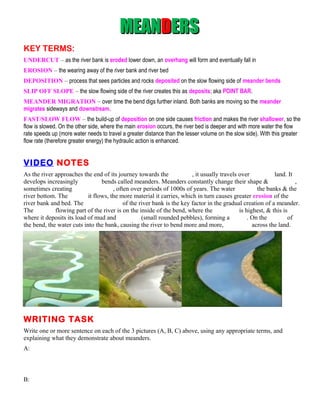
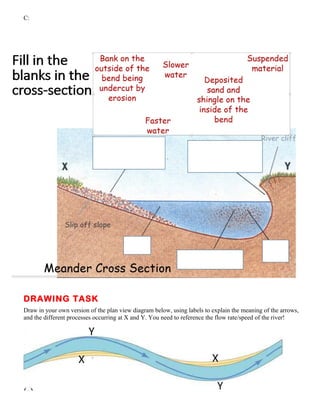
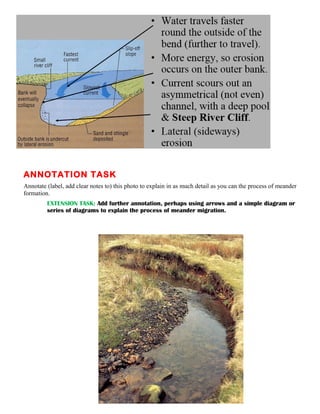
Write one or more sentence on each of the 3 pictures (A, B, C) above, using any appropriate terms, and
explaining what they demonstrate about meanders.
A:
B:
C:
DRAWING TASK
Draw in your own version of the plan view diagram below, using labels to explain the meaning of the arrows,
and the different processes occurring at X and Y. You need to reference the flow rate/speed of the river!
ANNOTATION TASK
Annotate (label, add clear notes to) this photo to explain in as much detail as you can the process of meander
formation.
EXTENSION TASK: Add further annotation, perhaps using arrows and a simple diagram or
series of diagrams to explain the process of meander migration.

Meanders db worksheet

  • 1.
    MEANMEANDDERSERS KEY TERMS: UNDERCUT –as the river bank is eroded lower down, an overhang will form and eventually fall in EROSION – the wearing away of the river bank and river bed DEPOSITION – process that sees particles and rocks deposited on the slow flowing side of meander bends SLIP OFF SLOPE – the slow flowing side of the river creates this as deposits; aka POINT BAR. MEANDER MIGRATION – over time the bend digs further inland. Both banks are moving so the meander migrates sideways and downstream. FAST/SLOW FLOW – the build-up of deposition on one side causes friction and makes the river shallower, so the flow is slowed. On the other side, where the main erosion occurs, the river bed is deeper and with more water the flow rate speeds up (more water needs to travel a greater distance than the lesser volume on the slow side). With this greater flow rate (therefore greater energy) the hydraulic action is enhanced. VIDEO NOTES As the river approaches the end of its journey towards the , it usually travels over land. It develops increasingly bends called meanders. Meanders constantly change their shape & , sometimes creating , often over periods of 1000s of years. The water the banks & the river bottom. The it flows, the more material it carries, which in turn causes greater erosion of the river bank and bed. The of the river bank is the key factor in the gradual creation of a meander. The flowing part of the river is on the inside of the bend, where the is highest, & this is where it deposits its load of mud and (small rounded pebbles), forming a . On the of the bend, the water cuts into the bank, causing the river to bend more and more, across the land. WRITING TASK Write one or more sentence on each of the 3 pictures (A, B, C) above, using any appropriate terms, and explaining what they demonstrate about meanders. A: B:
  • 2.
    C: DRAWING TASK Draw inyour own version of the plan view diagram below, using labels to explain the meaning of the arrows, and the different processes occurring at X and Y. You need to reference the flow rate/speed of the river!
  • 3.
    ANNOTATION TASK Annotate (label,add clear notes to) this photo to explain in as much detail as you can the process of meander formation. EXTENSION TASK: Add further annotation, perhaps using arrows and a simple diagram or series of diagrams to explain the process of meander migration.