How to reduce patient anxiety before
a urodynamics test?
By Brighter Health Network (BHN)
www.BHNCo.com
1
About Brighter Health Network (BHN)
• BHN is a leading provider of mobile medical diagnostics
including Urodynamics, Anorectal Manometry, UroCuff
Testing, and more
• Over 300 clinics across the country trust BHN to provide
them with urodynamics testing services
• BHN services urology, UroGyn, and ObGyn practices of all
sizes and interacts with them daily, which served as the
basis for this presentation.
• Visit www.BHNCo.com for more info.
• For one (1) minute corporate overview, see this video:
https://vimeo.com/184366711
• If you are interested in urodynamics outsourcing visit this
link and sign up to get a brochure and pricing:
http://www.bhnco.com/Urodynamics/Urodynamics-
Testing-Services-slideshare.html
2
Overview
• Urodynamic Testing
• Urodynamic testing and anxiety
• Why Anxiety?
• How well do patients tolerate urodynamic tests?
• Studies on interventions to decrease pain & anxiety
before a urodynamics test
• Resulting Suggestions
3
Urodynamic Testing
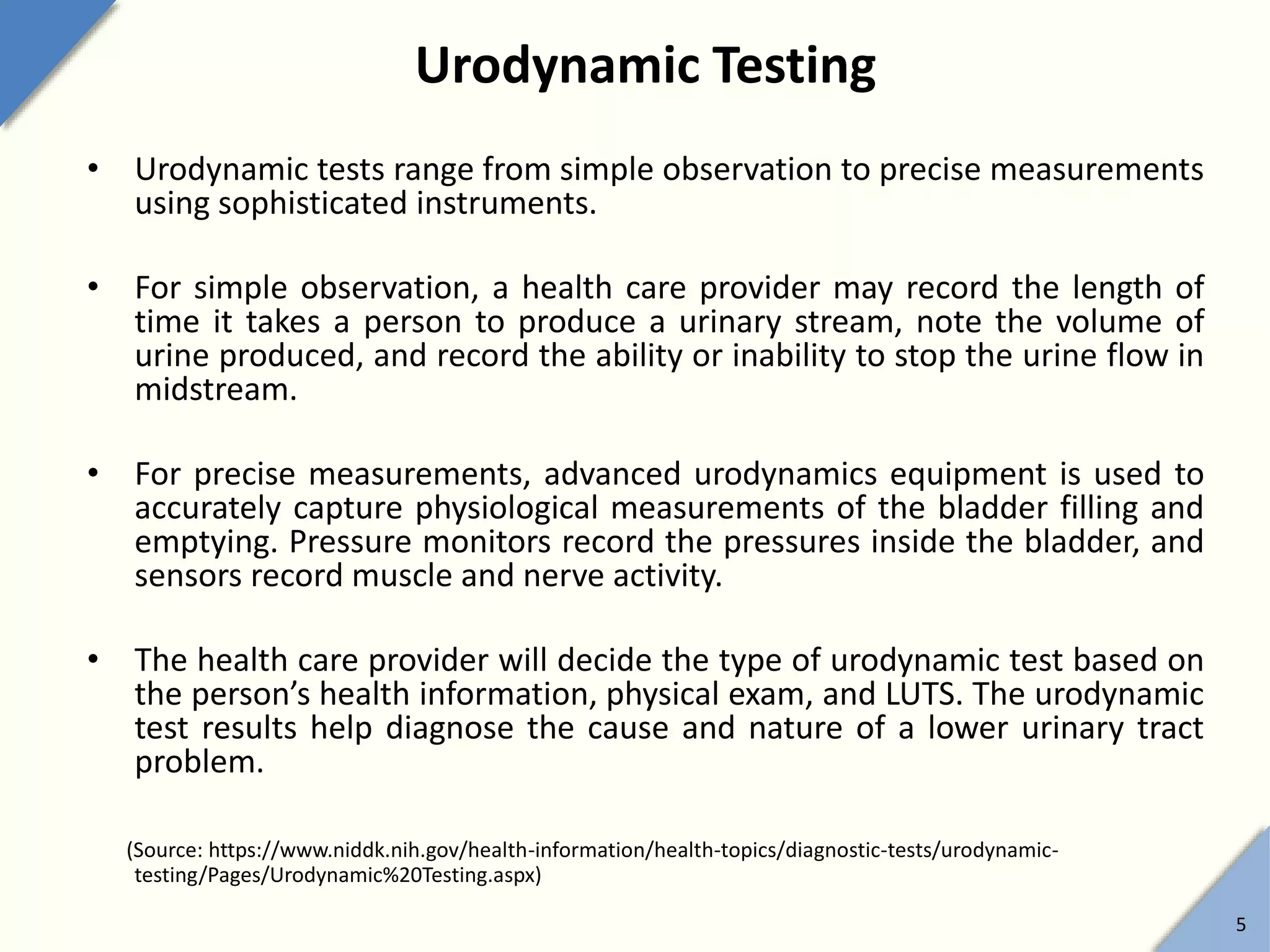
• A group of procedures that evaluation how well the
bladder, sphincters, and urethra are storing and
releasing urine. Most urodynamic tests focus on the
bladder’s ability to hold urine and empty steadily and
completely. Urodynamic tests can also show whether
the bladder is having involuntary contractions that
cause urine leakage.
• Urodynamic tests may be recommended if symptoms
suggest problems with the lower urinary tract. Lower
urinary tract symptoms (LUTS) include
– urine leakage
– frequent urination
– painful urination
– sudden, strong urges to urinate
– problems starting a urine stream
– problems emptying the bladder completely
– recurrent urinary tract infections
(Source: https://www.niddk.nih.gov/health-information/health-
topics/diagnostic-tests/urodynamic-
testing/Pages/Urodynamic%20Testing.aspx)
4
Urodynamic Testing
• Urodynamic tests range from simple observation to precise measurements
using sophisticated instruments.
• For simple observation, a health care provider may record the length of
time it takes a person to produce a urinary stream, note the volume of
urine produced, and record the ability or inability to stop the urine flow in
midstream.
• For precise measurements, advanced urodynamics equipment is used to
accurately capture physiological measurements of the bladder filling and
emptying. Pressure monitors record the pressures inside the bladder, and
sensors record muscle and nerve activity.
• The health care provider will decide the type of urodynamic test based on
the person’s health information, physical exam, and LUTS. The urodynamic
test results help diagnose the cause and nature of a lower urinary tract
problem.
(Source: https://www.niddk.nih.gov/health-information/health-topics/diagnostic-tests/urodynamic-
testing/Pages/Urodynamic%20Testing.aspx)
5
Urodynamics testing and anxiety
• While urodynamics testing is perceived by clinicians
as minimally invasive, patients may experience
anxiety related to urodynamics testing associated
with uncertainty about catheterization, the need to
urinate in a test situation, and potential
embarrassment or discomfort associated with other
aspects of testing.
• Adult patients tend to report that urodynamics
testing causes modest psychosocial anxiety and
physical discomfort
(Source: Urol Nurs. 2011;31(2):71-77.)
6
Why Anxiety ?
• Anxiety was due to fear of the unknown and
embarrassment at the intimate nature of the procedure
and lack of privacy.
• The interpersonal and communication skills of the health
care professional are central in alleviating these negative
feelings.
• The establishment of a friendly relationship based on
equality and mutual respect and trust was important in
preventing anxiety and embarrassment.
(Source: JAN ; 32 (6) December 2000 ; 1356–1363)
7
How well do patients tolerate urodynamic tests?
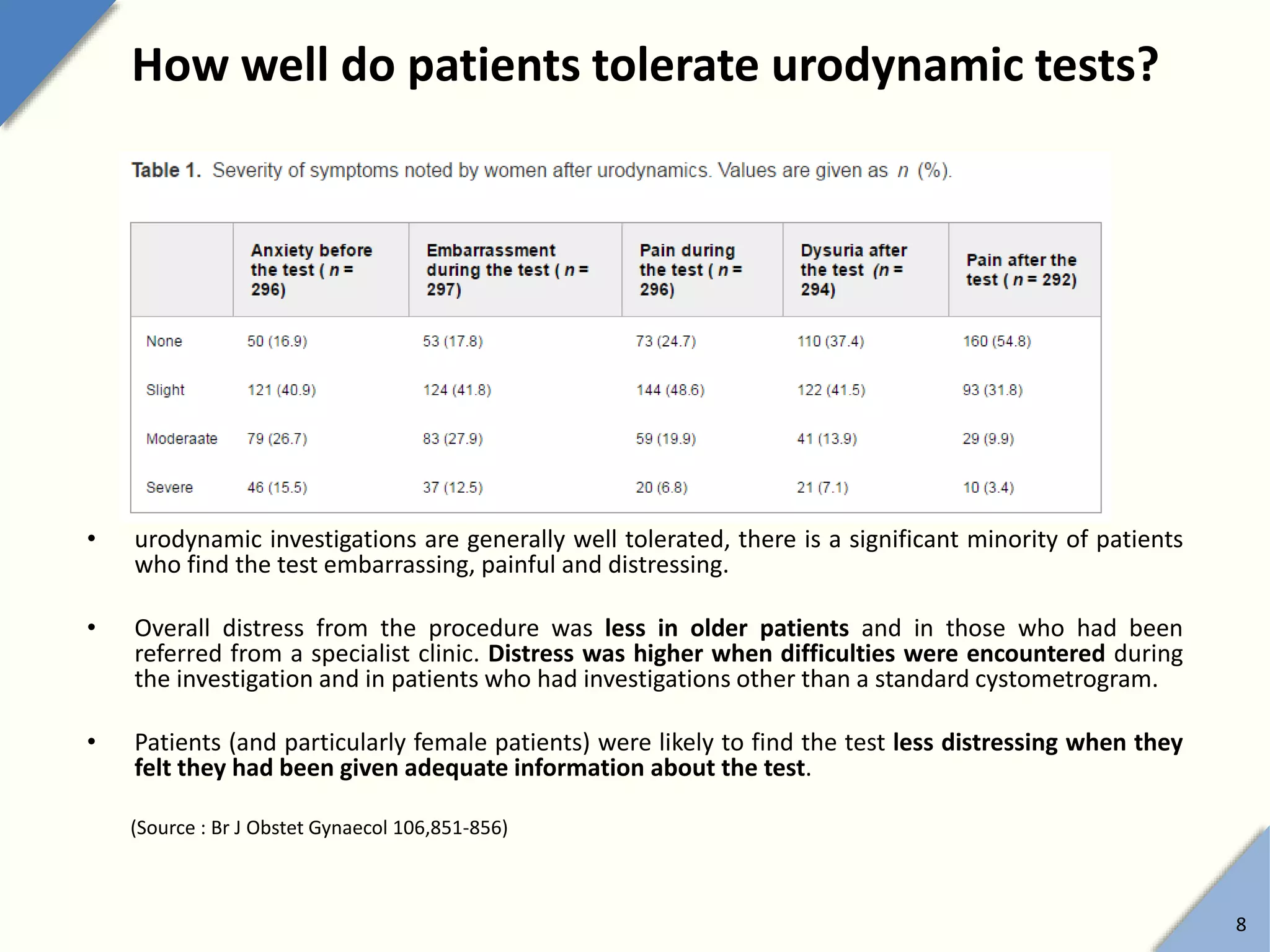
• urodynamic investigations are generally well tolerated, there is a significant minority of patients
who find the test embarrassing, painful and distressing.
• Overall distress from the procedure was less in older patients and in those who had been
referred from a specialist clinic. Distress was higher when difficulties were encountered during
the investigation and in patients who had investigations other than a standard cystometrogram.
• Patients (and particularly female patients) were likely to find the test less distressing when they
felt they had been given adequate information about the test.
(Source : Br J Obstet Gynaecol 106,851-856)
8
Study I - Interventions to decrease pain & anxiety
before a urodynamics test
(Neurourol. Urodynam. 35:805–808, 2016)
• Aims
To find out if information leaflets reduce anxiety levels before urodynamic studies
(UDS).
• Methods
One hundred and four patients (age 60 ± 15 years) who were referred for
multichannel UDS were prospectively recruited and randomized into 2 groups:
(1) received a leaflet containing detailed information regarding the examination;
(2) did not receive a leaflet.
• Results
Demographics and clinical and psychological co-morbidities were similar between
the groups. The “psychological distress“ score was significantly lower in group 1
(13.1 ± 2.9 vs. 24.8 ± 5.8, P < 0.001), whereas there was no difference in the
“positive well being“ score.
• Conclusions
We recommend providing patients with an information leaflet on UDS since it
significantly reduces anxiety levels.
Study II - Interventions to decrease pain & anxiety
before a urodynamics test
(Pioneer Med Sci 2015; 5(4):113-116)
• Aims
To examine the influence of pre-examination intimation and counseling of patient with urinary
incontinence on physical and psychological discomforts during urodynamic assessment.
• Methods
One hundred fifty-two patients with urinary incontinence, who underwent urodynamic
assessment, were studied prospectively. A questionnaire survey was used to study their awareness
about the nature of the assessment, extent of physical discomfort, mental stress, and the pain level
during the assessments and to determine if pre-examination counseling had any effect on the level
of pain or distress.
• Results
Most patients felt that the urodynamic examination was important, but noted lack of detailed
information. Although the patients were anxious, most were not in distress. There was no
correlation between prior information and the extent of pain or distress. However, older patients
reported less pain during the procedure compared to the younger patients. The results also
indicated that the patients were comfortable with familiar doctors, and that most preferred a
female doctor.
• Conclusion
Our findings confirm the importance of pre-examination counseling in patients before undergoing
urodynamic examination to minimize the symptoms of anxiety and shame, which may indirectly
result in fewer artifacts and better interpretation of the results.
Study III - Interventions to decrease pain & anxiety
before a urodynamics test
(Neurourol Urodyn 2015 Jul 30)
• Aims
To determine if music (at 60 beats/min) or watching a pre-procedure educational video decreases
pain and anxiety in patients undergoing multichannel urodynamic testing compared to usual care.
• Methods
Patients undergoing multichannel urodynamic testing at a health care center were randomized to
one of three groups: usual care (UC), music (M), in which music was played throughout the
urodynamic test, or video (V), in which subjects watched an informational video on the procedure
prior to undergoing the test.
• Results
98 subjects were included in this analysis. In the overall group, mean perceived pain on the pre-test
VAS was significantly higher than the post-test VAS with pre-test mean (SD) 47(±30) and post-test
mean (SD) 26(±23), P = 0.0001. Overall the anxiety pre-test VAS was significantly greater than post-
test VAS with pre-test mean (SD) 46.9(±29) and post-test mean 17.9(±18), P = 0.0001. There were
no differences in pain and anxiety scores between the two intervention groups and usual care.
Patients who were randomized to usual care or the video arm felt more prepared for the test
compared to patients who were randomized to the music arm, with (mean ± SD): usual care
(42 ± 8), video (43 ± 9), music (37 ± 11), P = 0.002.
• Conclusions
Music and an educational video do not decrease pain or anxiety in subjects undergoing
multichannel urodynamics compared to usual care.
Resulting Suggestions
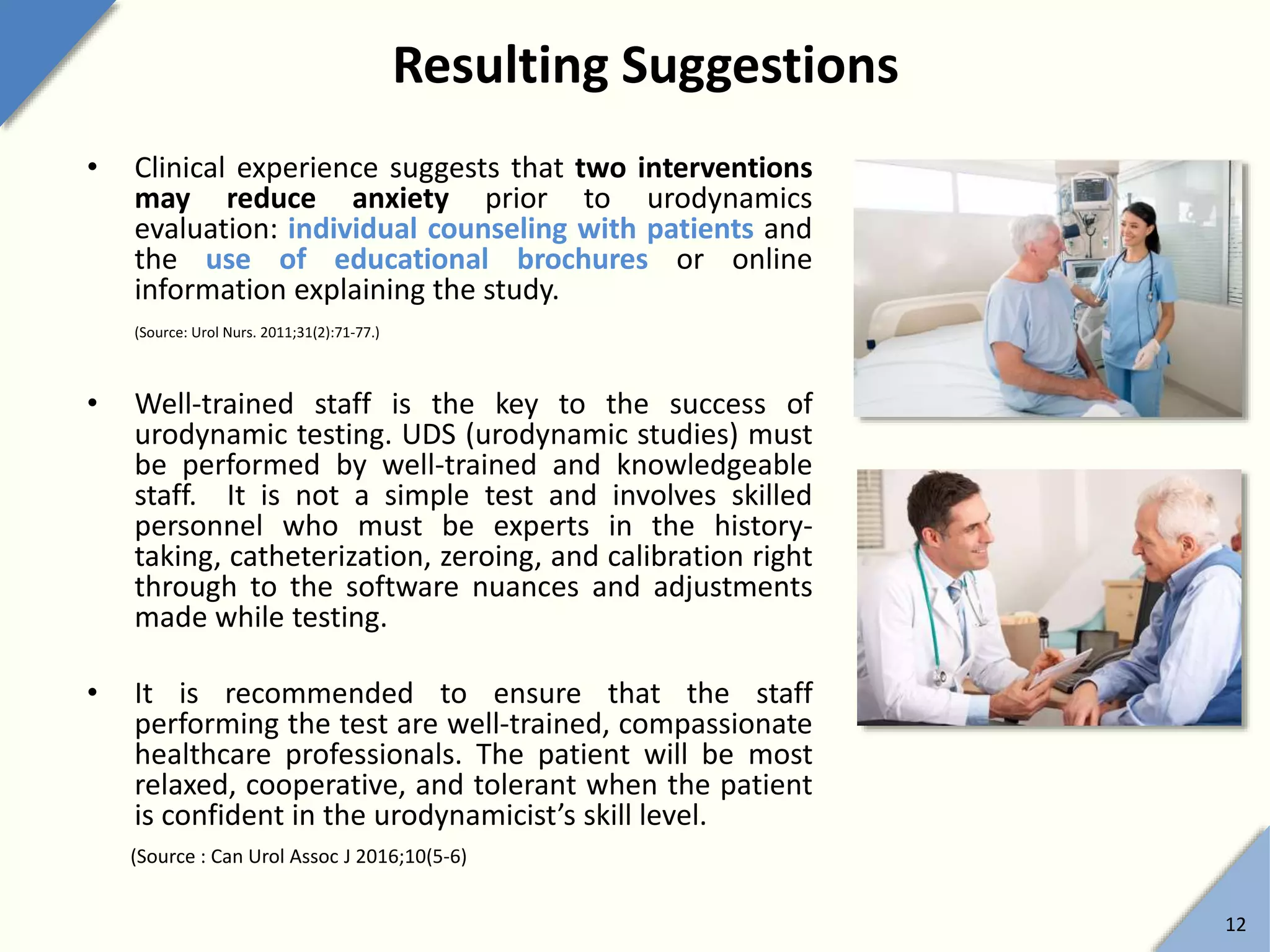
• Clinical experience suggests that two interventions
may reduce anxiety prior to urodynamics
evaluation: individual counseling with patients and
the use of educational brochures or online
information explaining the study.
(Source: Urol Nurs. 2011;31(2):71-77.)
• Well-trained staff is the key to the success of
urodynamic testing. UDS (urodynamic studies) must
be performed by well-trained and knowledgeable
staff. It is not a simple test and involves skilled
personnel who must be experts in the history-
taking, catheterization, zeroing, and calibration right
through to the software nuances and adjustments
made while testing.
• It is recommended to ensure that the staff
performing the test are well-trained, compassionate
healthcare professionals. The patient will be most
relaxed, cooperative, and tolerant when the patient
is confident in the urodynamicist’s skill level.
(Source : Can Urol Assoc J 2016;10(5-6)
12
13
Thank you !

How to reduce patient anxiety before a urodynamics test?

  • 1.
    How to reducepatient anxiety before a urodynamics test? By Brighter Health Network (BHN) www.BHNCo.com 1
  • 2.
    About Brighter HealthNetwork (BHN) • BHN is a leading provider of mobile medical diagnostics including Urodynamics, Anorectal Manometry, UroCuff Testing, and more • Over 300 clinics across the country trust BHN to provide them with urodynamics testing services • BHN services urology, UroGyn, and ObGyn practices of all sizes and interacts with them daily, which served as the basis for this presentation. • Visit www.BHNCo.com for more info. • For one (1) minute corporate overview, see this video: https://vimeo.com/184366711 • If you are interested in urodynamics outsourcing visit this link and sign up to get a brochure and pricing: http://www.bhnco.com/Urodynamics/Urodynamics- Testing-Services-slideshare.html 2
  • 3.
    Overview • Urodynamic Testing •Urodynamic testing and anxiety • Why Anxiety? • How well do patients tolerate urodynamic tests? • Studies on interventions to decrease pain & anxiety before a urodynamics test • Resulting Suggestions 3
  • 4.
    Urodynamic Testing • Agroup of procedures that evaluation how well the bladder, sphincters, and urethra are storing and releasing urine. Most urodynamic tests focus on the bladder’s ability to hold urine and empty steadily and completely. Urodynamic tests can also show whether the bladder is having involuntary contractions that cause urine leakage. • Urodynamic tests may be recommended if symptoms suggest problems with the lower urinary tract. Lower urinary tract symptoms (LUTS) include – urine leakage – frequent urination – painful urination – sudden, strong urges to urinate – problems starting a urine stream – problems emptying the bladder completely – recurrent urinary tract infections (Source: https://www.niddk.nih.gov/health-information/health- topics/diagnostic-tests/urodynamic- testing/Pages/Urodynamic%20Testing.aspx) 4
  • 5.
    Urodynamic Testing • Urodynamictests range from simple observation to precise measurements using sophisticated instruments. • For simple observation, a health care provider may record the length of time it takes a person to produce a urinary stream, note the volume of urine produced, and record the ability or inability to stop the urine flow in midstream. • For precise measurements, advanced urodynamics equipment is used to accurately capture physiological measurements of the bladder filling and emptying. Pressure monitors record the pressures inside the bladder, and sensors record muscle and nerve activity. • The health care provider will decide the type of urodynamic test based on the person’s health information, physical exam, and LUTS. The urodynamic test results help diagnose the cause and nature of a lower urinary tract problem. (Source: https://www.niddk.nih.gov/health-information/health-topics/diagnostic-tests/urodynamic- testing/Pages/Urodynamic%20Testing.aspx) 5
  • 6.
    Urodynamics testing andanxiety • While urodynamics testing is perceived by clinicians as minimally invasive, patients may experience anxiety related to urodynamics testing associated with uncertainty about catheterization, the need to urinate in a test situation, and potential embarrassment or discomfort associated with other aspects of testing. • Adult patients tend to report that urodynamics testing causes modest psychosocial anxiety and physical discomfort (Source: Urol Nurs. 2011;31(2):71-77.) 6
  • 7.
    Why Anxiety ? •Anxiety was due to fear of the unknown and embarrassment at the intimate nature of the procedure and lack of privacy. • The interpersonal and communication skills of the health care professional are central in alleviating these negative feelings. • The establishment of a friendly relationship based on equality and mutual respect and trust was important in preventing anxiety and embarrassment. (Source: JAN ; 32 (6) December 2000 ; 1356–1363) 7
  • 8.
    How well dopatients tolerate urodynamic tests? • urodynamic investigations are generally well tolerated, there is a significant minority of patients who find the test embarrassing, painful and distressing. • Overall distress from the procedure was less in older patients and in those who had been referred from a specialist clinic. Distress was higher when difficulties were encountered during the investigation and in patients who had investigations other than a standard cystometrogram. • Patients (and particularly female patients) were likely to find the test less distressing when they felt they had been given adequate information about the test. (Source : Br J Obstet Gynaecol 106,851-856) 8
  • 9.
    Study I -Interventions to decrease pain & anxiety before a urodynamics test (Neurourol. Urodynam. 35:805–808, 2016) • Aims To find out if information leaflets reduce anxiety levels before urodynamic studies (UDS). • Methods One hundred and four patients (age 60 ± 15 years) who were referred for multichannel UDS were prospectively recruited and randomized into 2 groups: (1) received a leaflet containing detailed information regarding the examination; (2) did not receive a leaflet. • Results Demographics and clinical and psychological co-morbidities were similar between the groups. The “psychological distress“ score was significantly lower in group 1 (13.1 ± 2.9 vs. 24.8 ± 5.8, P < 0.001), whereas there was no difference in the “positive well being“ score. • Conclusions We recommend providing patients with an information leaflet on UDS since it significantly reduces anxiety levels.
  • 10.
    Study II -Interventions to decrease pain & anxiety before a urodynamics test (Pioneer Med Sci 2015; 5(4):113-116) • Aims To examine the influence of pre-examination intimation and counseling of patient with urinary incontinence on physical and psychological discomforts during urodynamic assessment. • Methods One hundred fifty-two patients with urinary incontinence, who underwent urodynamic assessment, were studied prospectively. A questionnaire survey was used to study their awareness about the nature of the assessment, extent of physical discomfort, mental stress, and the pain level during the assessments and to determine if pre-examination counseling had any effect on the level of pain or distress. • Results Most patients felt that the urodynamic examination was important, but noted lack of detailed information. Although the patients were anxious, most were not in distress. There was no correlation between prior information and the extent of pain or distress. However, older patients reported less pain during the procedure compared to the younger patients. The results also indicated that the patients were comfortable with familiar doctors, and that most preferred a female doctor. • Conclusion Our findings confirm the importance of pre-examination counseling in patients before undergoing urodynamic examination to minimize the symptoms of anxiety and shame, which may indirectly result in fewer artifacts and better interpretation of the results.
  • 11.
    Study III -Interventions to decrease pain & anxiety before a urodynamics test (Neurourol Urodyn 2015 Jul 30) • Aims To determine if music (at 60 beats/min) or watching a pre-procedure educational video decreases pain and anxiety in patients undergoing multichannel urodynamic testing compared to usual care. • Methods Patients undergoing multichannel urodynamic testing at a health care center were randomized to one of three groups: usual care (UC), music (M), in which music was played throughout the urodynamic test, or video (V), in which subjects watched an informational video on the procedure prior to undergoing the test. • Results 98 subjects were included in this analysis. In the overall group, mean perceived pain on the pre-test VAS was significantly higher than the post-test VAS with pre-test mean (SD) 47(±30) and post-test mean (SD) 26(±23), P = 0.0001. Overall the anxiety pre-test VAS was significantly greater than post- test VAS with pre-test mean (SD) 46.9(±29) and post-test mean 17.9(±18), P = 0.0001. There were no differences in pain and anxiety scores between the two intervention groups and usual care. Patients who were randomized to usual care or the video arm felt more prepared for the test compared to patients who were randomized to the music arm, with (mean ± SD): usual care (42 ± 8), video (43 ± 9), music (37 ± 11), P = 0.002. • Conclusions Music and an educational video do not decrease pain or anxiety in subjects undergoing multichannel urodynamics compared to usual care.
  • 12.
    Resulting Suggestions • Clinicalexperience suggests that two interventions may reduce anxiety prior to urodynamics evaluation: individual counseling with patients and the use of educational brochures or online information explaining the study. (Source: Urol Nurs. 2011;31(2):71-77.) • Well-trained staff is the key to the success of urodynamic testing. UDS (urodynamic studies) must be performed by well-trained and knowledgeable staff. It is not a simple test and involves skilled personnel who must be experts in the history- taking, catheterization, zeroing, and calibration right through to the software nuances and adjustments made while testing. • It is recommended to ensure that the staff performing the test are well-trained, compassionate healthcare professionals. The patient will be most relaxed, cooperative, and tolerant when the patient is confident in the urodynamicist’s skill level. (Source : Can Urol Assoc J 2016;10(5-6) 12
  • 13.

Editor's Notes

  • #11 http://onlinelibrary.wiley.com/doi/10.1002/nau.22799/full or https://www.ncbi.nlm.nih.gov/pubmed/26227401