RDM Recap
Claire Sewell
Research Support Skills Coordinator,
Office of Scholarly Communication
Agenda
Introduction to data
Organising data
Storing data
Archiving data
Data sharing
Data management plans
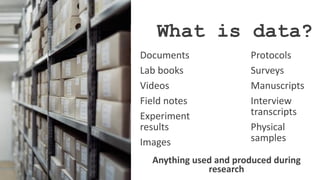
What is data?
Documents
Lab books
Videos
Field notes
Experiment
results
Images
Protocols
Surveys
Manuscripts
Interview
transcripts
Physical
samples
Anything used and produced during
research
F.A.I.R.
Data should be F.A.I.R.
Findable
Accessible
Interoperable
Reusable
Helps data to be
discovered and
analysed by both
humans and machines
Research lifecycle
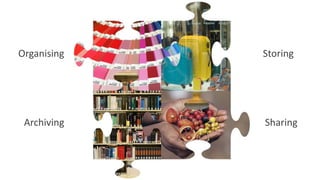
Organising
Archiving
Storing
Sharing
Part 1:
Organising
data
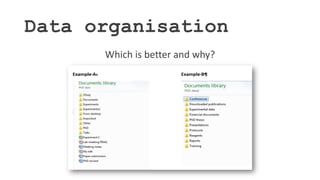
Data organisation
Which is better and why?
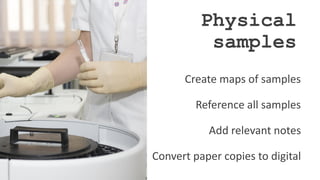
Physical
samples
Create maps of samples
Reference all samples
Add relevant notes
Convert paper copies to digital
Data organisation should…
Allow you to find your files easily
Be meaningful to you and your colleagues
Be consistent
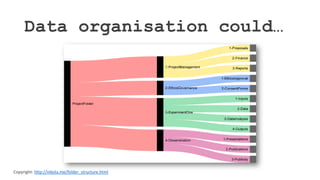
Data organisation could…
Copyright: http://nikola.me/folder_structure.html
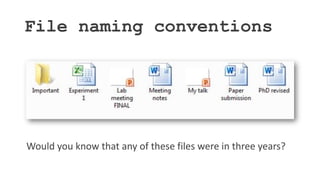
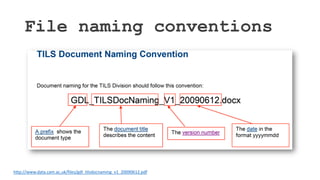
File naming conventions
Would you know that any of these files were in three years?
File naming conventions
http://www.data.cam.ac.uk/files/gdl_tilsdocnaming_v1_20090612.pdf
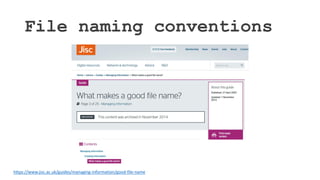
File naming conventions
https://www.jisc.ac.uk/guides/managing-information/good-file-name
Part 2:
Storing
data
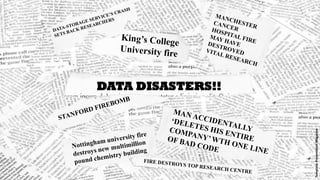
DATA DISASTERS!!
Template:PresentationMagazine
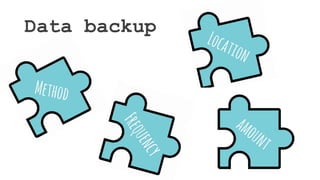
Data backup
Always back up data
In at least two locations
Keep these apart from each
other
Data backup
Cloud services
Always read the small print
Investigate university cloud services
Be careful which data you store on these
services
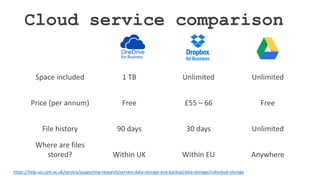
Cloud service comparison
Space included 1 TB Unlimited Unlimited
Price (per annum) Free £55 – 66 Free
File history 90 days 30 days Unlimited
Where are files
stored? Within UK Within EU Anywhere
https://help.uis.cam.ac.uk/service/supporting-research/servers-data-storage-and-backup/data-storage/individual-storage
Part 3:
Archiving
data
Personal
data
“records or other information,
on their own, or linked with
other data or information in
the possession of the data
controller, can reveal the
identity of an actual living
person”
Data Protection Act (1998)
Personal
data
“‘personal data’ means any information relating
to an identified or identifiable natural person
(‘data subject’); an identifiable natural person is
one who can be identified, directly or indirectly, in
particular by reference to an identifier such as a
name, an identification number, location data,
an online identifier or to one or more factors
specific to the physical, physiological, genetic,
mental, economic, cultural or social identity of
that natural person”
Art. 4 EU GDPR Definitions
GDPR
Consent forms will change
Data breach notification is required
Right to be forgotten
Organisation has responsibility
Think of privacy when storing data
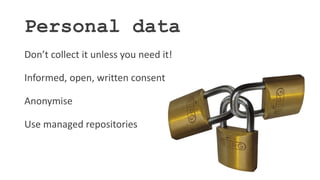
Personal data
Don’t collect it unless you need it!
Informed, open, written consent
Anonymise
Use managed repositories
Part 4:
Sharing
data
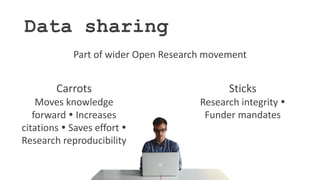
Data sharing
Part of wider Open Research movement
Carrots
Moves knowledge
forward  Increases
citations  Saves effort 
Research reproducibility
Sticks
Research integrity 
Funder mandates
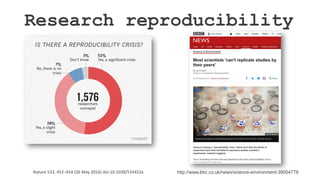
Research reproducibility
Nature 533, 452–454 (26 May 2016) doi:10.1038/533452a http://www.bbc.co.uk/news/science-environment-39054778
At the time of publication (or
earlier)
Choose a suitable repository
Describe and licence your data
Investigate potential costs
How to share
data
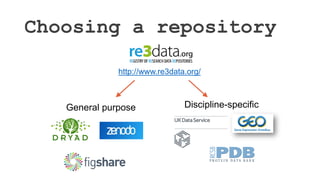
Choosing a repository
http://www.re3data.org/
General purpose Discipline-specific
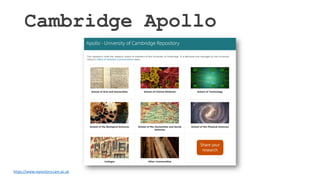
Cambridge Apollo
https://www.repository.cam.ac.uk
Licensing
data
Think about how people can:
Use your data
Share your data
Publish their own data
Make money from your data
Part 5:
Data
management
plans
Data management plans
Outline of how data will be managed and shared
Mandated by funders a part of a grant application
Covers:
Data type  Storage 
Data backup  Metadata
 Sensitive information 
Sharing data
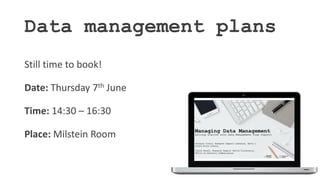
Data management plans
Still time to book!
Date: Thursday 7th June
Time: 14:30 – 16:30
Place: Milstein Room
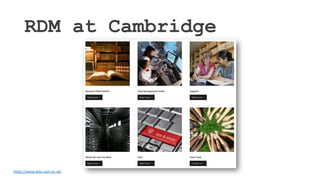
RDM at Cambridge
https://www.data.cam.ac.uk/
Take home message
www.data.cam.ac.uk
info@data.cam.ac.uk
Questions?
THANKS FOR
LISTENING
Contact details:
Claire Sewell
Research Support Skills
Coordinator
Office of Scholarly
Communication
ces43@cam.ac.uk

RDM Recap