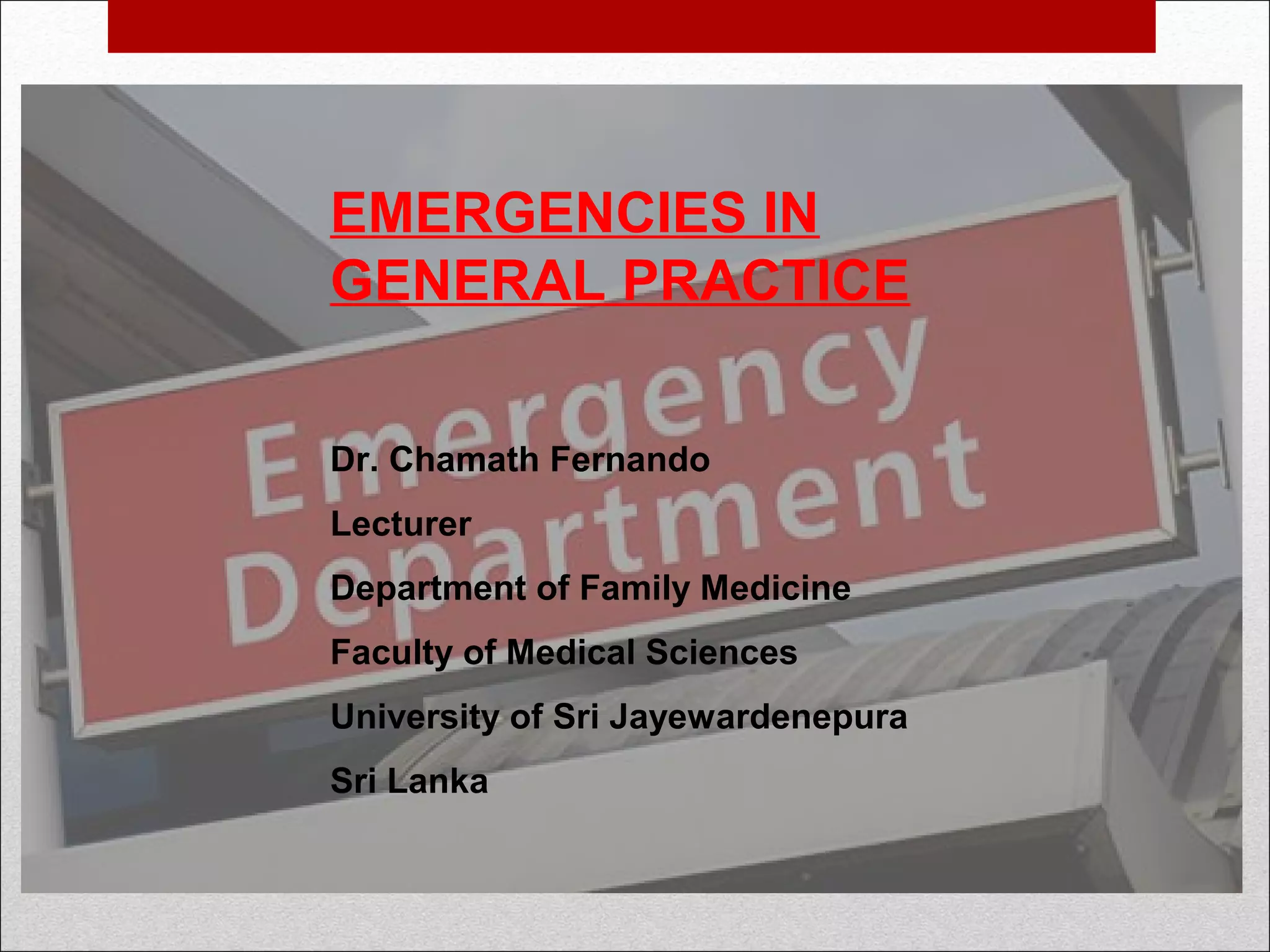
EMERGENCIES IN
GENERAL PRACTICE
Dr. Chamath Fernando
Lecturer
Department of Family Medicine
Faculty of Medical Sciences
University of Sri Jayewardenepura
Sri Lanka
What is an emergency?
A highly volatile, dangerous situation requiring immediate remedial
action.
“A physician can sometimes parry the scythe of death, but has no power
over the sand in the hourglass”.
Hester Piozzi, Mrs. Thrale (1741-1821). English writer.
 
Nature of GP emergencies
Who decides it is an emergency?
patient / relatives / neighbours / health professionals
How does it differ from A & E work?
• time pressures
• social / psychological / physical problems
• the primary care physician may be able
to provide complete solution
Home visit emergencies - should all requests for visits - even daytime - be
screened by a doctor?
 
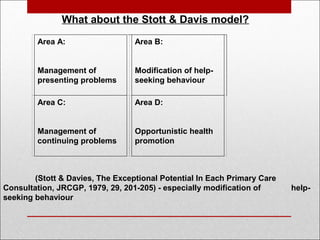
Area B:
Modification of help-
seeking behaviour
Area A:
Management of
presenting problems
 
Area C:
Management of
continuing problems
 
Area D:
Opportunistic health
promotion
 
(Stott & Davies, The Exceptional Potential In Each Primary Care
Consultation, JRCGP, 1979, 29, 201-205) - especially modification of help-
seeking behaviour
What about the Stott & Davis model?
Cardiovascular emergencies
“Collapse“ - often vasovagal attack
Chest pain
LVF
Stroke
Haemorrhage
Anaphylaxis
Diagnosis - should you carry an ECG machine?
Treatment
Time of response
Thrombolytic therapy
(Should GPs give thrombolytic therapy)
CPR training
Why not just dial for Emergency care?
- referral without assessment can lead to breach of terms of
service if there is subsequently a problem
Respiratory emergencies
SOB - Asthma/COPD
Airway obstruction
- epiglottitis
- FB
Surgical emergencies
Abdominal pain - common
- acute abdomen is rare
Torsion
Strangulation of hernia
Bleeding - also haematemesis / malaena
Injury etc
 
Orthopaedic emergencies
What is the correct assessment of bony injuries in practice?
Gynaecological emergencies
Pelvic pain – PID
Bleeding
Ectopic pregnancy
Obstetric emergencies
Unexpected delivery at home
- ergometrine?
- equipment for iv infusion?
PPH
What if you undertake GP deliveries?
What is your responsibility if you do not?
Contraception emergencies
Requests for emergency contraception
Dermatological emergencies/ Trauma
Rashes ? Urticarial rashes
Injury / lacerations
Burns, scalds, sunburn
Neurological emergencies
Convulsions
Stroke/ TIA – Hemipareisis, LOC, Loss of vision
Eyes / ENT
Otalgia
Insect in Ear
Visual loss
Glaucoma
Social / psychiatric emergencies
Somatisers / neurotic symptoms - somatic symptoms creating demand
- abdominal pain
- those who cannot cope with viral illnesses - Distressed
Overdose / Deliberate Self Harm
True psychiatric emergencies - Mental Health Act
- possible harm to themselves or others
- Agitated depression/ psychosis
Endocrine Emergencies
Hypoglycaemia
DKA
Addisonian Crisis
Myxoedema coma, Thyrotoxic crisis
Urinary tract emergencies
UTI / pyelonephritis - do you administer antibiotics?
analgesia?
referral?
Ureteric colic - analgesia?
referral?
what about starting investigations in the middle of the
night?
 
Paediatric emergencies
Earache - what about middle of the night call?
Asthma
Upper airways obstruction / epiglottitis
Meningism
Abdominal pain
Ingestion of poisons
Intussussception
NAI
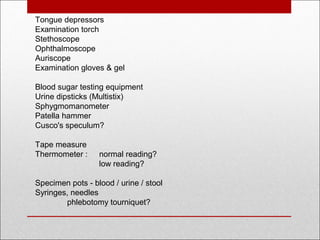
What equipment should GPs have?
Tongue depressors
Examination torch
Stethoscope
Ophthalmoscope
Auriscope
Examination gloves & gel
Blood sugar testing equipment 
Urine dipsticks (Multistix)
Sphygmomanometer
Patella hammer
Cusco's speculum?
Tape measure
Thermometer : normal reading?
low reading?
Specimen pots - blood / urine / stool
Syringes, needles
phlebotomy tourniquet?
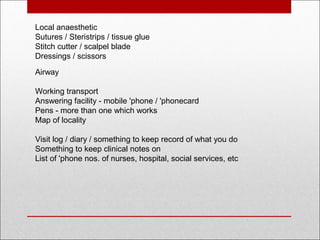
Local anaesthetic
Sutures / Steristrips / tissue glue
Stitch cutter / scalpel blade
Dressings / scissors
Airway
Working transport
Answering facility - mobile 'phone / 'phonecard 
Pens - more than one which works
Map of locality
 
Visit log / diary / something to keep record of what you do
Something to keep clinical notes on
List of 'phone nos. of nurses, hospital, social services, etc
 
 
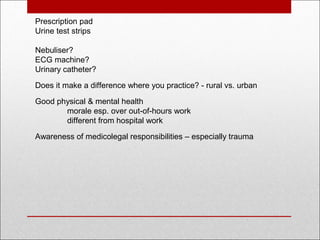
Prescription pad
Urine test strips
Nebuliser?
ECG machine?
Urinary catheter?
 
Does it make a difference where you practice? - rural vs. urban
Good physical & mental health
morale esp. over out-of-hours work
different from hospital work
 
Awareness of medicolegal responsibilities – especially trauma
What drugs should GPs have?
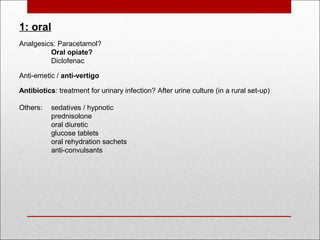
1: oral
Analgesics: Paracetamol?
Oral opiate?
Diclofenac 
 
Anti-emetic / anti-vertigo
 
Antibiotics: treatment for urinary infection? After urine culture (in a rural set-up)
 
Others: sedatives / hypnotic
prednisolone
oral diuretic
glucose tablets
oral rehydration sachets
anti-convulsants
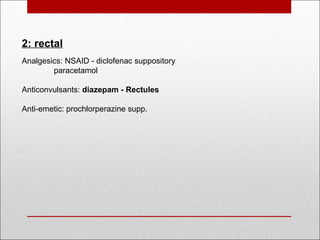
2: rectal
Analgesics: NSAID - diclofenac suppository
paracetamol
Anticonvulsants: diazepam - Rectules
 
Anti-emetic: prochlorperazine supp.
 
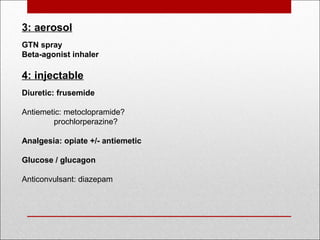
3: aerosol 
GTN spray
Beta-agonist inhaler
4: injectable
Diuretic: frusemide
Antiemetic: metoclopramide?
prochlorperazine?
 
Analgesia: opiate +/- antiemetic
Glucose / glucagon
Anticonvulsant: diazepam 
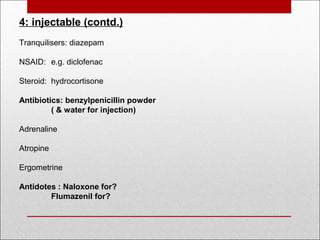
4: injectable (contd.)
Tranquilisers: diazepam 
 
NSAID: e.g. diclofenac 
 
Steroid: hydrocortisone
Antibiotics: benzylpenicillin powder
( & water for injection)
Adrenaline
 
Atropine
 
Ergometrine
 
Antidotes : Naloxone for?
Flumazenil for?
 
Telephones / message taking
Who does it? - receptionist?
Primary Care Centre?
What do messages need to convey? - patient's details
problem
urgency
telephone number
Medico-legal issues
Records - what to write and where?
Responsibilities if drugs are given
A high proportion of complaints come after "emergencies" - have to be sure that "all
necessary treatment of the type usually provided by GPs" has been provided. The
Family Doctor should do the initial management of the patient and stabilize
before referral to the tertiary care unit is done.
Confidentiality when relatives are around – chaperones?
Some Scenarios
TASK 3
When managing any kind of emergency….
A.
B.
C.
D.
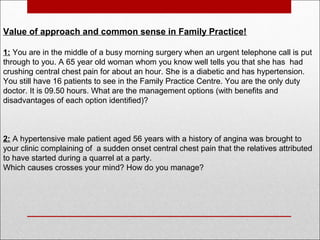
Value of approach and common sense in Family Practice!
1: You are in the middle of a busy morning surgery when an urgent telephone call is put
through to you. A 65 year old woman whom you know well tells you that she has had
crushing central chest pain for about an hour. She is a diabetic and has hypertension.
You still have 16 patients to see in the Family Practice Centre. You are the only duty
doctor. It is 09.50 hours. What are the management options (with benefits and
disadvantages of each option identified)?
2: A hypertensive male patient aged 56 years with a history of angina was brought to
your clinic complaining of a sudden onset central chest pain that the relatives attributed
to have started during a quarrel at a party.
Which causes crosses your mind? How do you manage?
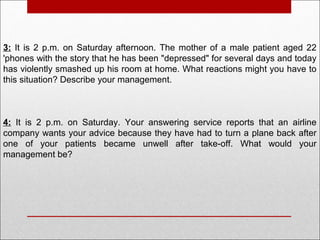
3: It is 2 p.m. on Saturday afternoon. The mother of a male patient aged 22
'phones with the story that he has been "depressed" for several days and today
has violently smashed up his room at home. What reactions might you have to
this situation? Describe your management.
4: It is 2 p.m. on Saturday. Your answering service reports that an airline
company wants your advice because they have had to turn a plane back after
one of your patients became unwell after take-off. What would your
management be?
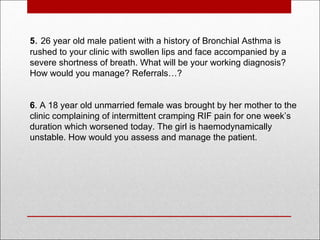
5. 26 year old male patient with a history of Bronchial Asthma is
rushed to your clinic with swollen lips and face accompanied by a
severe shortness of breath. What will be your working diagnosis?
How would you manage? Referrals…?
6. A 18 year old unmarried female was brought by her mother to the
clinic complaining of intermittent cramping RIF pain for one week’s
duration which worsened today. The girl is haemodynamically
unstable. How would you assess and manage the patient.
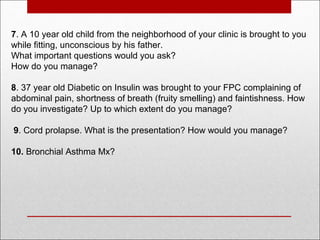
7. A 10 year old child from the neighborhood of your clinic is brought to you
while fitting, unconscious by his father.
What important questions would you ask?
How do you manage?
8. 37 year old Diabetic on Insulin was brought to your FPC complaining of
abdominal pain, shortness of breath (fruity smelling) and faintishness. How
do you investigate? Up to which extent do you manage?
9. Cord prolapse. What is the presentation? How would you manage?
10. Bronchial Asthma Mx?
1. Options include home visit, ask to rush the patient either to you or to the
nearest hospital. The factors determine the decision….
2. Reassure
Short history
Examination- Evaluation of the haemodynamic status.
Features of cardiac failure
Investigations? ECG
Patient positioning – Comfortable position assumed by the patient
O2 - ?
Basic Monitoring?
Stat doses – Aspirin, Clopidogrel
GTN – Repeat every five minutes
Atenolol – C/I?
Atorvastatin – Why?
Captopril – Why?
IV/IM Opioids 5-10mg of Morphine with?
Transfer to Emergency department of a tertiary care unit with a referral
letter.
3. Most likely diagnosis? Agitated depression
DD: Illicit drugs, Delirium tremens, Thyrotoxicosis,
Phaeochromocytoma, Hypoglycaemia, Electrolyte imbalance,
Temporal Lobe Epilepsy)
Consider your own safety – (Backup from Police, Try to calm the
patient down, Ultimate resort is to obtain Help from staff/ relatives
to restrain the patient)
Talk calmly
Try to ascertain the cause
Mx: Tranquilize the patient
If corporative – Propranolol 20-40mg stat
Diazepam 5-10mg stat or Lorazepam 1mg orally with
Chlorpromazine 25mg
If not IM Lorazepam 1.5mg/ Chlorpromazine 25mg / Haloperidol 1-
3mg
Referral
• What sinister complications can be expected from
Phenothiazines (Chlorpromazine) and Buteophenones
(Haloperidol)?
Acute Dystonic Reaction (Trismus, Ophisthotonus, Tongue
protrusion, Grimacing)
Antidote?
IM Procyclidine 5-10mg (repeated up to 20mg total in 20 min)
Anticholinergic drug used for Parkinsonism
4. Considerations
Can you reach the airport/ healthcare facility which is closest
to the patient in a short time?
Can you provide the health staff attending the patient
currently with patient’s health information?
The efficiency of having a computer data base of patients’
clinical details that could be immediately shared among healthcare
personnel.
5. Concerns:
Airway and Breathing – Airway adjunct?
Circulation
Disability (Confusion, Coma)
Exposure (For features of anaphylaxis)
Mx: Reassure and prompt history
Quick examination of vitals, Secure airway
Positioning? Head low, Raise the legs
High flow oxygen
Life saving drug? IM Adrenalin >12yrs = 0.5mg
6-12yrs = 0.3mg
<6yrs = 0.15mg
Attach to monitors – SpO2, ECG, BP
IV Access Blood for FBC, SE
IV Fluids – 500-1000ml in adult 20ml/kg bolus for children
IV Chlorpheniramine 10mg (6-12yrs 5mg….)
IV Hydrocortisone 200mg (6-12yrs 100mg…)
Serum tryptase… Allergist….
6. DD: Appendicitis, Ectopic pregnancy, Twisted/ruptured ovarian cyst,
caecal pathology e.g. amoeboma
What investigation is must?
Mx:
Short history – LMP
Examination
HD stabilization
Immediate admission with referral letter
7. Important aspects in the history? Age 10yrs, Previous episodes,
Duration, Involvement eg Bilateral, Fever
What is Status Epilepticus? >1 seizure without regaining of
consciousness in between or single episode that lasts more than 5
minutes
Mx: Ensure airway patency
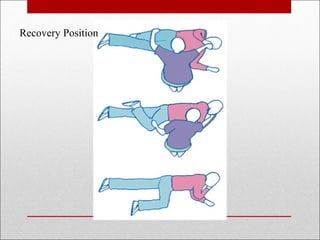
Put the child in ?recovery position
Prevent non-health staff from non-acceptable remedies
Observe for 5 minutes
If continues
Call ambulance
Rectal Diazepam 10mg (Lower for younger children)
Alternatively - Gain IV access IV Lorazepam 100micg/kg Max 4mg)
IV fluids
Monitoring
?CBS stat
Admission necessary if
Possibility of serious pathology e.g. Meningitis
Incomplete recovery or Status
Followup necessary if
Adult with first fit
Child with first fit not related to fever or atypical features
Recovery Position
8. ABCD approach
Diagnosis: Clinical
Biochemical: You may have ABG, Urine for KB, CBS
Mx: 4 Limbs. Can you manage all of them?
1. IV fluids – NS followed by 5% Dextrose when Blood sugar is
stable below 300mg/dl
2. IV/IM Soluble Insulin infusion (Sliding scale)
3. Correct K+ if <3.5 (20mmol of KCl to each
4. Correct pH – If Base excess is >-12  IV 8.4% NaHCO3 50-
100ml
Keep monitoring – Vitals, UOP (important), and biochemical
paramaters
Correct the cause – usually an infection
9. Presentation: The umbilical cord is presenting through the
os of the cervix before the presenting part
Mx:
Explain
Minimal Handling of the cord
Put the mother on knee-chest position
Head down if possible
Wear sterile glove
Place the cord within the warmth of the vagina with moist
warm gauze packed
Push the head (presenting part of the baby) above to release
the squashing of the cord
Fill the bladder with 500ml of saline
Transfer immediately to a tertiary care obstetric unit
10. Bronchial asthma?
Thank you!

Emergencies in gp

  • 1.
    EMERGENCIES IN GENERAL PRACTICE Dr.Chamath Fernando Lecturer Department of Family Medicine Faculty of Medical Sciences University of Sri Jayewardenepura Sri Lanka
  • 2.
    What is anemergency? A highly volatile, dangerous situation requiring immediate remedial action. “A physician can sometimes parry the scythe of death, but has no power over the sand in the hourglass”. Hester Piozzi, Mrs. Thrale (1741-1821). English writer.
  • 3.
      Nature of GPemergencies Who decides it is an emergency? patient / relatives / neighbours / health professionals How does it differ from A & E work? • time pressures • social / psychological / physical problems • the primary care physician may be able to provide complete solution Home visit emergencies - should all requests for visits - even daytime - be screened by a doctor?
  • 4.
      Area B: Modification ofhelp- seeking behaviour Area A: Management of presenting problems   Area C: Management of continuing problems   Area D: Opportunistic health promotion   (Stott & Davies, The Exceptional Potential In Each Primary Care Consultation, JRCGP, 1979, 29, 201-205) - especially modification of help- seeking behaviour What about the Stott & Davis model?
  • 5.
    Cardiovascular emergencies “Collapse“ -often vasovagal attack Chest pain LVF Stroke Haemorrhage Anaphylaxis Diagnosis - should you carry an ECG machine? Treatment Time of response Thrombolytic therapy (Should GPs give thrombolytic therapy) CPR training Why not just dial for Emergency care? - referral without assessment can lead to breach of terms of service if there is subsequently a problem
  • 6.
    Respiratory emergencies SOB -Asthma/COPD Airway obstruction - epiglottitis - FB Surgical emergencies Abdominal pain - common - acute abdomen is rare Torsion Strangulation of hernia Bleeding - also haematemesis / malaena Injury etc
  • 7.
      Orthopaedic emergencies What isthe correct assessment of bony injuries in practice? Gynaecological emergencies Pelvic pain – PID Bleeding Ectopic pregnancy
  • 8.
    Obstetric emergencies Unexpected deliveryat home - ergometrine? - equipment for iv infusion? PPH What if you undertake GP deliveries? What is your responsibility if you do not? Contraception emergencies Requests for emergency contraception
  • 9.
    Dermatological emergencies/ Trauma Rashes? Urticarial rashes Injury / lacerations Burns, scalds, sunburn Neurological emergencies Convulsions Stroke/ TIA – Hemipareisis, LOC, Loss of vision Eyes / ENT Otalgia Insect in Ear Visual loss Glaucoma
  • 10.
    Social / psychiatricemergencies Somatisers / neurotic symptoms - somatic symptoms creating demand - abdominal pain - those who cannot cope with viral illnesses - Distressed Overdose / Deliberate Self Harm True psychiatric emergencies - Mental Health Act - possible harm to themselves or others - Agitated depression/ psychosis Endocrine Emergencies Hypoglycaemia DKA Addisonian Crisis Myxoedema coma, Thyrotoxic crisis
  • 11.
    Urinary tract emergencies UTI/ pyelonephritis - do you administer antibiotics? analgesia? referral? Ureteric colic - analgesia? referral? what about starting investigations in the middle of the night?   Paediatric emergencies Earache - what about middle of the night call? Asthma Upper airways obstruction / epiglottitis Meningism Abdominal pain Ingestion of poisons Intussussception NAI
  • 12.
  • 13.
  • 14.
  • 15.
  • 16.
  • 17.
  • 18.
  • 19.
    3: aerosol  GTN spray Beta-agonistinhaler 4: injectable Diuretic: frusemide Antiemetic: metoclopramide? prochlorperazine?   Analgesia: opiate +/- antiemetic Glucose / glucagon Anticonvulsant: diazepam 
  • 20.
    4: injectable (contd.) Tranquilisers: diazepam    NSAID:e.g. diclofenac    Steroid: hydrocortisone Antibiotics: benzylpenicillin powder ( & water for injection) Adrenaline   Atropine   Ergometrine   Antidotes : Naloxone for? Flumazenil for?  
  • 21.
    Telephones / messagetaking Who does it? - receptionist? Primary Care Centre? What do messages need to convey? - patient's details problem urgency telephone number
  • 22.
    Medico-legal issues Records -what to write and where? Responsibilities if drugs are given A high proportion of complaints come after "emergencies" - have to be sure that "all necessary treatment of the type usually provided by GPs" has been provided. The Family Doctor should do the initial management of the patient and stabilize before referral to the tertiary care unit is done. Confidentiality when relatives are around – chaperones?
  • 23.
  • 24.
    When managing anykind of emergency…. A. B. C. D.
  • 25.
    Value of approachand common sense in Family Practice! 1: You are in the middle of a busy morning surgery when an urgent telephone call is put through to you. A 65 year old woman whom you know well tells you that she has had crushing central chest pain for about an hour. She is a diabetic and has hypertension. You still have 16 patients to see in the Family Practice Centre. You are the only duty doctor. It is 09.50 hours. What are the management options (with benefits and disadvantages of each option identified)? 2: A hypertensive male patient aged 56 years with a history of angina was brought to your clinic complaining of a sudden onset central chest pain that the relatives attributed to have started during a quarrel at a party. Which causes crosses your mind? How do you manage?
  • 26.
    3: It is2 p.m. on Saturday afternoon. The mother of a male patient aged 22 'phones with the story that he has been "depressed" for several days and today has violently smashed up his room at home. What reactions might you have to this situation? Describe your management. 4: It is 2 p.m. on Saturday. Your answering service reports that an airline company wants your advice because they have had to turn a plane back after one of your patients became unwell after take-off. What would your management be?
  • 27.
    5. 26 yearold male patient with a history of Bronchial Asthma is rushed to your clinic with swollen lips and face accompanied by a severe shortness of breath. What will be your working diagnosis? How would you manage? Referrals…? 6. A 18 year old unmarried female was brought by her mother to the clinic complaining of intermittent cramping RIF pain for one week’s duration which worsened today. The girl is haemodynamically unstable. How would you assess and manage the patient.
  • 28.
    7. A 10year old child from the neighborhood of your clinic is brought to you while fitting, unconscious by his father. What important questions would you ask? How do you manage? 8. 37 year old Diabetic on Insulin was brought to your FPC complaining of abdominal pain, shortness of breath (fruity smelling) and faintishness. How do you investigate? Up to which extent do you manage? 9. Cord prolapse. What is the presentation? How would you manage? 10. Bronchial Asthma Mx?
  • 29.
    1. Options includehome visit, ask to rush the patient either to you or to the nearest hospital. The factors determine the decision…. 2. Reassure Short history Examination- Evaluation of the haemodynamic status. Features of cardiac failure Investigations? ECG Patient positioning – Comfortable position assumed by the patient O2 - ? Basic Monitoring? Stat doses – Aspirin, Clopidogrel GTN – Repeat every five minutes Atenolol – C/I? Atorvastatin – Why? Captopril – Why? IV/IM Opioids 5-10mg of Morphine with? Transfer to Emergency department of a tertiary care unit with a referral letter.
  • 30.
    3. Most likelydiagnosis? Agitated depression DD: Illicit drugs, Delirium tremens, Thyrotoxicosis, Phaeochromocytoma, Hypoglycaemia, Electrolyte imbalance, Temporal Lobe Epilepsy) Consider your own safety – (Backup from Police, Try to calm the patient down, Ultimate resort is to obtain Help from staff/ relatives to restrain the patient) Talk calmly Try to ascertain the cause Mx: Tranquilize the patient If corporative – Propranolol 20-40mg stat Diazepam 5-10mg stat or Lorazepam 1mg orally with Chlorpromazine 25mg If not IM Lorazepam 1.5mg/ Chlorpromazine 25mg / Haloperidol 1- 3mg Referral
  • 31.
    • What sinistercomplications can be expected from Phenothiazines (Chlorpromazine) and Buteophenones (Haloperidol)? Acute Dystonic Reaction (Trismus, Ophisthotonus, Tongue protrusion, Grimacing) Antidote? IM Procyclidine 5-10mg (repeated up to 20mg total in 20 min) Anticholinergic drug used for Parkinsonism
  • 32.
    4. Considerations Can youreach the airport/ healthcare facility which is closest to the patient in a short time? Can you provide the health staff attending the patient currently with patient’s health information? The efficiency of having a computer data base of patients’ clinical details that could be immediately shared among healthcare personnel.
  • 33.
    5. Concerns: Airway andBreathing – Airway adjunct? Circulation Disability (Confusion, Coma) Exposure (For features of anaphylaxis) Mx: Reassure and prompt history Quick examination of vitals, Secure airway Positioning? Head low, Raise the legs High flow oxygen Life saving drug? IM Adrenalin >12yrs = 0.5mg 6-12yrs = 0.3mg <6yrs = 0.15mg Attach to monitors – SpO2, ECG, BP IV Access Blood for FBC, SE IV Fluids – 500-1000ml in adult 20ml/kg bolus for children IV Chlorpheniramine 10mg (6-12yrs 5mg….) IV Hydrocortisone 200mg (6-12yrs 100mg…) Serum tryptase… Allergist….
  • 34.
    6. DD: Appendicitis,Ectopic pregnancy, Twisted/ruptured ovarian cyst, caecal pathology e.g. amoeboma What investigation is must? Mx: Short history – LMP Examination HD stabilization Immediate admission with referral letter 7. Important aspects in the history? Age 10yrs, Previous episodes, Duration, Involvement eg Bilateral, Fever What is Status Epilepticus? >1 seizure without regaining of consciousness in between or single episode that lasts more than 5 minutes
  • 35.
    Mx: Ensure airwaypatency Put the child in ?recovery position Prevent non-health staff from non-acceptable remedies Observe for 5 minutes If continues Call ambulance Rectal Diazepam 10mg (Lower for younger children) Alternatively - Gain IV access IV Lorazepam 100micg/kg Max 4mg) IV fluids Monitoring ?CBS stat Admission necessary if Possibility of serious pathology e.g. Meningitis Incomplete recovery or Status Followup necessary if Adult with first fit Child with first fit not related to fever or atypical features
  • 36.
  • 37.
    8. ABCD approach Diagnosis:Clinical Biochemical: You may have ABG, Urine for KB, CBS Mx: 4 Limbs. Can you manage all of them? 1. IV fluids – NS followed by 5% Dextrose when Blood sugar is stable below 300mg/dl 2. IV/IM Soluble Insulin infusion (Sliding scale) 3. Correct K+ if <3.5 (20mmol of KCl to each 4. Correct pH – If Base excess is >-12  IV 8.4% NaHCO3 50- 100ml Keep monitoring – Vitals, UOP (important), and biochemical paramaters Correct the cause – usually an infection
  • 38.
    9. Presentation: Theumbilical cord is presenting through the os of the cervix before the presenting part Mx: Explain Minimal Handling of the cord Put the mother on knee-chest position Head down if possible Wear sterile glove Place the cord within the warmth of the vagina with moist warm gauze packed Push the head (presenting part of the baby) above to release the squashing of the cord Fill the bladder with 500ml of saline Transfer immediately to a tertiary care obstetric unit
  • 39.
  • 40.